
In the early 1970s, Hollywood was in a period of transformation. The old studio system was fading, replaced by a new generation of renegade filmmakers and stars whose raw talent, charisma, and personal lives often became inseparable from their work on screen.
Few pairings captured that era’s glamour and complexity more than Ali MacGraw and Steve McQueen — two actors whose short but intense relationship became the stuff of legend.
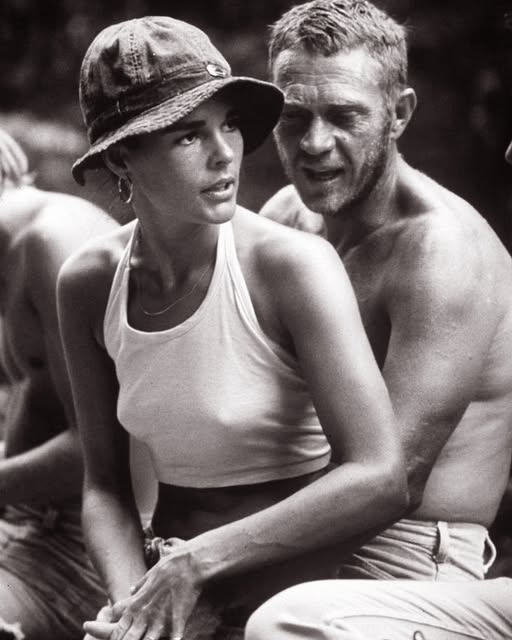
Though a single photograph from the set of Papillon in Jamaica seems at first like just another glamorous snapshot of Hollywood royalty, a deeper look at their story reveals an emotional and cultural moment that went far beyond superficial charm.
Ali MacGraw: From Love Story Sensation to Hollywood Heartthrob
Born Elizabeth Alice MacGraw in 1939, Ali MacGraw rose to international fame with her breakthrough performance in Love Story (1970), a romantic drama that became one of the most successful films of the era.
Her portrayal of Jennifer Cavilleri earned her an Academy Award nomination for Best Actress and made her one of the most recognizable actresses in the world almost overnight.
At the time, MacGraw was married to film producer Robert Evans, then a powerful executive at Paramount Pictures.
The couple had a son, Josh Evans, born in 1971. As her fame soared, so did public interest in her personal life — especially when she met Steve McQueen.
Steve McQueen: The “King of Cool”
By the early 1970s, Steve McQueen was already a Hollywood legend. Known as the “King of Cool,” McQueen was an actor whose onscreen persona blended rugged toughness with understated charm.
He had earned critical acclaim and box office success in films such as The Great Escape and The Sand Pebbles, and by the time he began working on The Getaway (1972), he was one of the most bankable stars in the industry.
McQueen’s charisma wasn’t just a screen presence — it was a cultural phenomenon. From his leather jackets to his intense blue eyes, McQueen embodied the anti‑establishment energy of 1970s America, appealing to audiences who wanted their leading men to be just as raw and unpredictable offscreen as on.
The Getaway: Where Romance and Film Collide
It was during the making of The Getaway that MacGraw and McQueen’s paths crossed in a way that would change both their lives.
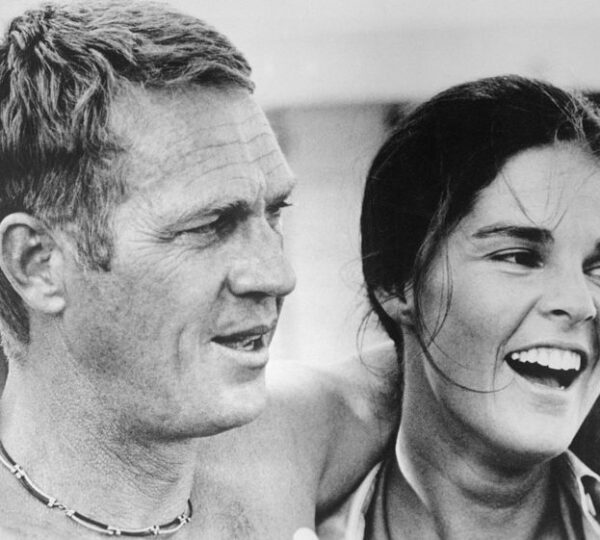
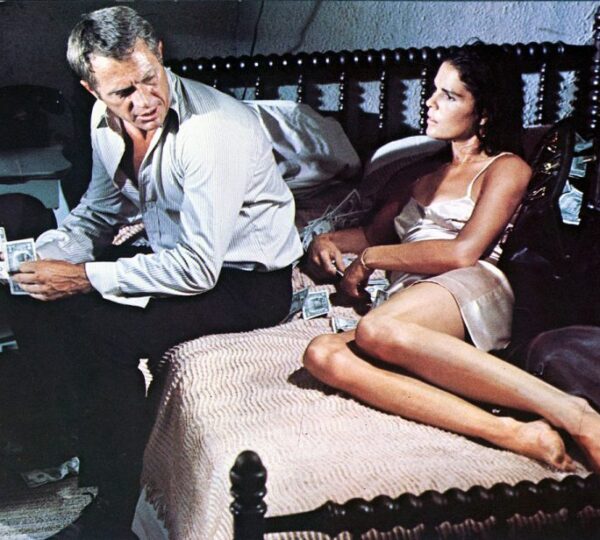
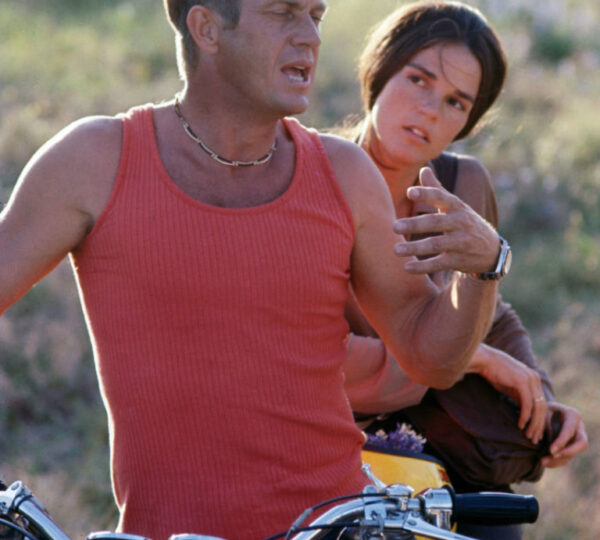
MacGraw was cast opposite McQueen as Carol McCoy, and the chemistry between them was unmistakable. On set, their connection was immediate and powerful — so much so that it quickly became the subject of tabloid gossip.
At the time, MacGraw was still married to Robert Evans — and their marriage was very much in the public eye. When MacGraw and McQueen began a romantic relationship during filming, it quickly became headline news.
Their affair was a major scandal in Hollywood, partly because of Evans’ influence as a studio executive and partly because Hollywood in the early 1970s was still relatively conservative compared to later decades.
MacGraw and Evans separated later in 1972, and their divorce was finalized in June 1973.
Just weeks later, on July 12, 1973, MacGraw and McQueen tied the knot in a ceremony that was emblematic of their unconventional style — married beneath a cottonwood tree in Cheyenne, Wyoming, by a judge who had been fishing at a nearby golf course minutes earlier.
Life as a Power Couple
For a time, MacGraw and McQueen were Hollywood’s ultimate power couple. Their marriage combined two distinct types of celebrity:
MacGraw’s elegant, almost ethereal beauty with McQueen’s rugged machismo. Paparazzi, fans, and media outlets followed their every move, eager for the next image that captured their glamour and magnetism.
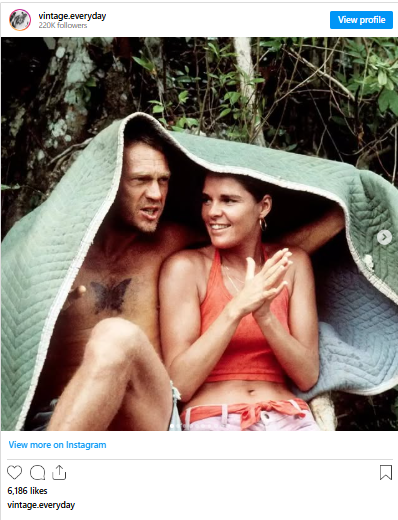
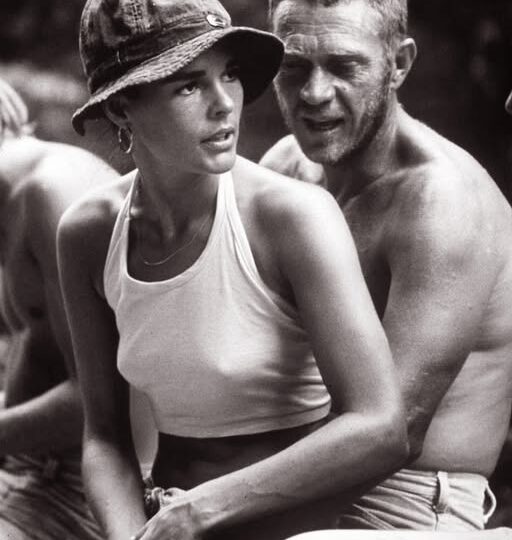
Although MacGraw briefly appeared with McQueen at public events, one of the most famous images associated with their time together comes from the set of Papillon (1973) — even though MacGraw did not appear in the film and was not part of the official cast.
Instead, the photograph that circulates widely shows them together during a break in filming, capturing a moment of relaxed intimacy between two of Hollywood’s biggest stars.
This image — two beautiful people in a paradise setting — seemed to symbolize the very essence of 1970s Hollywood.
But as many fans and biographers have noted, there was much more beneath the surface: a complicated emotional dynamic that would ultimately unravel.
Marriage, Tension, and Career Sacrifice
While their marriage lasted only five years, it was marked by intense emotional ups and downs. According to interviews and biographical accounts, McQueen’s personality — charismatic and strong on the surface — also carried depths of insecurity, possessiveness, and sometimes volatile emotion.
Biographers have described McQueen as a man who struggled with trust and was frequently jealous, traits that he and those close to him grappled with throughout their relationship.
One of the most significant aspects of their marriage was the impact it had on MacGraw’s career. At the height of her fame, MacGraw stepped back from acting to focus on their life together.
Some accounts suggest that McQueen preferred his wife to stay at home, and MacGraw’s output in film slowed during those years. While she would return to work later, the period of her marriage to McQueen represented a major shift in her career trajectory.
The dynamics of their relationship echoed themes familiar to many Hollywood romances: intense attraction, emotional dependency, and the struggle to balance personal ambition with partnership.
In her own words, MacGraw has described the relationship as “chemical” — a connection so powerful it consumed her, even as it conflicted with her own sense of identity.
The Divorce and Aftermath
By the late 1970s, the cracks in their relationship had grown too significant to ignore. In 1978, MacGraw and McQueen separated and eventually divorced.
Their marriage lasted five years — a short period by some standards, but one that left a lasting imprint on both their lives.
After their separation, MacGraw spoke candidly about the experience. She acknowledged the intensity of their connection but also the difficulty of navigating a relationship marked by powerful emotions and conflicting personal goals.
Despite the pain and emotional complexity, she has said she does not see herself as a victim, recognizing both the wonderful and difficult moments of their time together.
McQueen, for his part, moved on and later married again. He died in 1980 at the age of 50 from complications related to cancer, leaving behind a legacy as one of Hollywood’s most fascinating and influential actors.
The Papillon Photo: Style Meets Subtext
When fans look at that iconic photo of MacGraw and McQueen on the Papillon set in Jamaica, it’s worth remembering what it does and does not represent.
-
It is not a film still — MacGraw was not in Papillon, and the image was taken during a break or visit, not as part of the production.
-
It is a genuine glimpse into the era’s Hollywood glamour: two stars whose combination of style and charisma seemed effortless.
-
Yet the subtext — the way their poses convey both connection and distance — reflects the emotional tension that biographers and MacGraw herself have acknowledged from their marriage.
This photo has come to symbolize not just a moment in time, but the emotional duality of their relationship: magnetic attraction on one hand, and underlying strain on the other.
Did Papillon Cost McQueen an Oscar?
One of the more persistent myths around Steve McQueen’s career involves his performance in Papillon and the fact that he did not receive an Academy Award nomination for Best Actor for that role.
According to trivia and film history sources, there are several theories about why McQueen was overlooked by the Academy:
-
Some said that the intense rumors and scandal surrounding his personal life — particularly his high‑profile relationships — may have influenced voters.
-
Others noted his own reputation for being outspoken and unwilling to play Hollywood politics, which may have worked against him among Academy members.
-
There were also debates about whether he was the right age for the role, as the real Henri Charrière was much younger than McQueen’s portrayal.
Whatever the reason, McQueen did receive a Golden Globe nomination for the role, even though he did not earn an Oscar nod — a decision that remains one of the more talked‑about “snubs” in Academy history.
A Legacy of Glamour and Complexity
Today, Ali MacGraw is remembered not only for her early film work but also for her enduring presence as one of the defining beauties of the 1970s.
Though she stepped back from acting in later years, she has expressed gratitude for the opportunities she had and the experiences that shaped her life.
Steve McQueen’s legacy as one of cinema’s most charismatic stars remains solid, his influence seen in generations of actors who followed him.
The story of MacGraw and McQueen is not just a Hollywood romance — it is a narrative about ambition, identity, love, and the price sometimes paid for both.
The photograph from Jamaica, then, becomes more than a pretty image; it is a reminder of a time when Hollywood magic was visible not just on screen, but in the fleeting, fragile connections between those who lived its story.
