...

How a British Airways Pilot Survived Hanging Outside a Flying Plane for 20 Minutes

In the early summer of 1990, a seemingly ordinary British Airways flight turned into one of the most extraordinary survival stories in commercial aviation history.

On the morning of June 10, 1990, British Airways Flight 5390—a BAC One‑Eleven jetliner—departed Birmingham Airport bound for Málaga Airport in Spain with 81 passengers and six crew members aboard.

It was a routine international flight that should have been unremarkable, yet within minutes of takeoff, an event of astonishing danger unfolded that would test the courage, skill, and quick thinking of everyone on board.

A Routine Departure Turns Into Disaster

At 08:20 AM, Flight 5390 lifted off the runway and began its climb toward cruising altitude. Captain Timothy Lancaster, then 42 years old and a seasoned pilot with more than 11,000 flight hours including extensive experience on the BAC 1‑11, was at the controls.
Alongside him sat co‑pilot Alastair Atchison, 39, who also had thousands of hours of flying experience.

The crew prepared for what should have been a normal flight, while passengers relaxed into their seats, unaware of the near catastrophe that awaited them.

After about 13 minutes in the air, as the aircraft climbed through approximately 17,300 feet above Didcot, Oxfordshire, thunder struck.

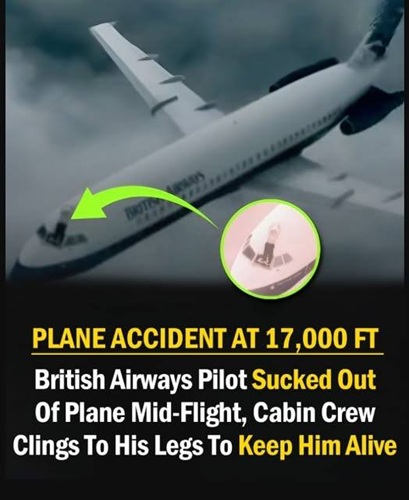
Without warning, a cockpit windshield panel on the left side violently separated from the aircraft, resulting in sudden and catastrophic explosive decompression.

Cabin pressure dropped in a split second, and a deafening roar filled the cockpit as air surged outward at high speed.

The Moment That Changed Everything

In an instant, Captain Lancaster was violently pulled forward by the rushing air.

The decompression was so forceful that he was partially sucked out of the cockpit window, his upper body propelled outside the aircraft, while his legs became trapped on the flight controls and the seat.

Despite the unimaginable force, Lancaster’s legs—and the fact they snagged on the control column—prevented him from being fully ejected into the sky.
The sudden decompression also caused the cockpit door to blow inward, knocking it onto the control console and complicating the situation inside the flight deck.

Loose papers, documents, and other debris were flung around the cockpit and began to get pulled toward the open window.

The entire plane shuddered from the violent disruption, and a condensation fog quickly filled parts of the cabin.

Frontline Heroics: Nigel Ogden’s Instant Reaction

As the chaos unfolded, flight attendant Nigel Ogden—who had just been offering the pilots a cup of tea—turned at the sound of the explosion and confronted a scene that might well have been lifted from an action movie.

He saw the captain’s legs dangling out of the aircraft, moments away from being lost to the raging wind and altitude.

Acting with exceptional courage and presence of mind, Ogden launched himself across the cockpit to grab hold of Lancaster’s waist, pulling with remarkable strength to prevent him from being completely blown out of the plane.

Ogden’s position was perilous: the aircraft was moving at hundreds of miles per hour, and outside temperatures at that altitude plummeted to well below freezing.

The wind blasting into the cockpit was like a force of nature—equivalent to a hurricane multiplied many times over. Yet Ogden refused to let go.

Holding onto Lancaster’s body, he anchored himself and fought an exhausting battle against the gale force winds and the overwhelming suction trying to rip the captain away.
A Team Effort Under Extreme Stress

While Ogden was locked in his desperate struggle, other members of the cabin crew responded with equal urgency.

Purser John Heward rushed to assist, helping secure Lancaster’s legs and keeping him from slipping further out.

At one point, Ogden’s arms began weakening from fatigue, exposure to the cold, and the sheer difficulty of the task.

Recognizing this, flight attendant Simon Rogers entered the cockpit to take over support, enabling Ogden to rest briefly and recover.

Their teamwork ensured that Lancaster’s body remained tethered to the aircraft, even as the extreme wind howled around them.

Meanwhile, co‑pilot Alastair Atchison wrestled with the unfolding crisis behind the controls.

The explosive decompression had caused the autopilot to disengage and the plane to descend suddenly.

Atchison remained calm under extraordinary pressure. He donned his oxygen mask, stabilized the aircraft and initiated an emergency descent to a safer altitude where lower air pressure and available oxygen made conditions more survivable for everyone on board.

Despite howling winds and plummeting temperatures, he was able to communicate with air traffic controllers, declare an emergency, and navigate through heavily trafficked British airspace to reach Southampton Airport for an emergency landing.
Minutes That Felt Like Hours

For an estimated 20 to 22 minutes, Lancaster’s body remained partly outside the aircraft, supported by the heroic flight crew inside.

During this time, conditions were brutal: hurricane‑force winds, sub‑zero temperatures, and relentless outward pull threatened to undo their efforts at every second.

Passengers in the cabin were deeply shaken, some assuming that the aircraft was doomed.

Oxygen masks deployed automatically, and cabin attendants worked to calm and reassure them as Atchison expertly navigated the situation.

Eventually, the jetliner touched down safely at Southampton Airport. Emergency crews, alerted to the attempt, were waiting on the tarmac to assist. Against all odds, the captain was still alive.

Injuries, Recovery, and Aftermath

Once on solid ground, paramedics and medical teams rushed Captain Tim Lancaster to Southampton General Hospital.

Though he had endured an ordeal that many would never survive, his injuries were serious but not fatal.

Lancaster sustained frostbite, shock, bruising, and fractures to his right elbow, wrist, and left thumb—a remarkable outcome considering the extreme forces he had been subjected to outside the aircraft.

Nigel Ogden also suffered injuries including cuts, bruises, and minor frostbite, and later reported enduring emotional aftereffects from the traumatic event, including symptoms consistent with post‑traumatic stress.

Other crew members and a few passengers were treated for shock but were otherwise unharmed. Remarkably, no lives were lost, and all 87 souls aboard the flight survived the incident.

Captain Lancaster’s survival did not mark the end of his flying career. In an astonishing show of resilience and dedication, he returned to commercial flying just five months after the accident, resuming duties as a British Airways pilot.

He continued flying until his retirement in 2008—an extraordinary testament to his fortitude and passion for aviation.
What Caused the Windshield Failure?

Investigators later determined the root cause of the incident to be a maintenance error. Just 27 hours before the flight, the left cockpit windscreen had been replaced during routine maintenance at Birmingham Airport.

However, the bolts used to secure the windshield were improperly sized—many were slightly too small and installed incorrectly.

Under normal circumstances, this might not have immediately caused concern, but once the aircraft pressurized during ascent, the weakened installation could not withstand the forces involved, leading to the panel’s dramatic separation from the fuselage.

The findings from this incident significantly influenced how airlines and maintenance crews approach quality control and adherence to technical manuals, reinforcing the critical importance of strict procedural compliance in aircraft maintenance.

Recognition and Legacy

The bravery shown by the crew of Flight 5390 was widely acknowledged.

Several crew members, including Ogden, Atchison, and Rogers, received the Queen’s Commendation for Valuable Service in the Air, a distinguished honor recognizing their heroic actions and exemplary service.

The story of Flight 5390 has been featured in numerous documentaries and aviation programs, including episodes of Mayday:

Air Disaster, bringing international attention to one of the most dramatic non‑fatal aviation emergencies ever recorded.

A Testament to Human Courage

British Airways Flight 5390 remains one of the most compelling examples of how training, teamwork, and human courage can intersect to overcome near‑impossible odds.

From the catastrophic sudden decompression to the determined hands that kept the captain aboard the aircraft, the event demonstrated the extraordinary power of preparedness and calm under pressure—essential qualities that have helped make modern aviation one of the safest modes of travel in history.

Today, the story of Captain Tim Lancaster, Nigel Ogden, Alastair Atchison, Simon Rogers, and the rest of the Flight 5390 crew stands as an enduring reminder that even in the face of catastrophic failure, extraordinary things can happen when people act decisively, selflessly, and with unwavering resolve.

In the early summer of 1990, a seemingly ordinary British Airways flight turned into one of the most extraordinary survival stories in commercial aviation history.

On the morning of June 10, 1990, British Airways Flight 5390—a BAC One‑Eleven jetliner—departed Birmingham Airport bound for Málaga Airport in Spain with 81 passengers and six crew members aboard.

It was a routine international flight that should have been unremarkable, yet within minutes of takeoff, an event of astonishing danger unfolded that would test the courage, skill, and quick thinking of everyone on board.

A Routine Departure Turns Into Disaster

At 08:20 AM, Flight 5390 lifted off the runway and began its climb toward cruising altitude. Captain Timothy Lancaster, then 42 years old and a seasoned pilot with more than 11,000 flight hours including extensive experience on the BAC 1‑11, was at the controls.

Alongside him sat co‑pilot Alastair Atchison, 39, who also had thousands of hours of flying experience.

The crew prepared for what should have been a normal flight, while passengers relaxed into their seats, unaware of the near catastrophe that awaited them.

After about 13 minutes in the air, as the aircraft climbed through approximately 17,300 feet above Didcot, Oxfordshire, thunder struck.

Without warning, a cockpit windshield panel on the left side violently separated from the aircraft, resulting in sudden and catastrophic explosive decompression.

Cabin pressure dropped in a split second, and a deafening roar filled the cockpit as air surged outward at high speed.

The Moment That Changed Everything

In an instant, Captain Lancaster was violently pulled forward by the rushing air.

The decompression was so forceful that he was partially sucked out of the cockpit window, his upper body propelled outside the aircraft, while his legs became trapped on the flight controls and the seat.

Despite the unimaginable force, Lancaster’s legs—and the fact they snagged on the control column—prevented him from being fully ejected into the sky.

The sudden decompression also caused the cockpit door to blow inward, knocking it onto the control console and complicating the situation inside the flight deck.

Loose papers, documents, and other debris were flung around the cockpit and began to get pulled toward the open window.

The entire plane shuddered from the violent disruption, and a condensation fog quickly filled parts of the cabin.

Frontline Heroics: Nigel Ogden’s Instant Reaction

As the chaos unfolded, flight attendant Nigel Ogden—who had just been offering the pilots a cup of tea—turned at the sound of the explosion and confronted a scene that might well have been lifted from an action movie.

He saw the captain’s legs dangling out of the aircraft, moments away from being lost to the raging wind and altitude.

Acting with exceptional courage and presence of mind, Ogden launched himself across the cockpit to grab hold of Lancaster’s waist, pulling with remarkable strength to prevent him from being completely blown out of the plane.

Ogden’s position was perilous: the aircraft was moving at hundreds of miles per hour, and outside temperatures at that altitude plummeted to well below freezing.

The wind blasting into the cockpit was like a force of nature—equivalent to a hurricane multiplied many times over. Yet Ogden refused to let go.

Holding onto Lancaster’s body, he anchored himself and fought an exhausting battle against the gale force winds and the overwhelming suction trying to rip the captain away.

A Team Effort Under Extreme Stress

While Ogden was locked in his desperate struggle, other members of the cabin crew responded with equal urgency.

Purser John Heward rushed to assist, helping secure Lancaster’s legs and keeping him from slipping further out.

At one point, Ogden’s arms began weakening from fatigue, exposure to the cold, and the sheer difficulty of the task.

Recognizing this, flight attendant Simon Rogers entered the cockpit to take over support, enabling Ogden to rest briefly and recover.

Their teamwork ensured that Lancaster’s body remained tethered to the aircraft, even as the extreme wind howled around them.

Meanwhile, co‑pilot Alastair Atchison wrestled with the unfolding crisis behind the controls.

The explosive decompression had caused the autopilot to disengage and the plane to descend suddenly.

Atchison remained calm under extraordinary pressure. He donned his oxygen mask, stabilized the aircraft and initiated an emergency descent to a safer altitude where lower air pressure and available oxygen made conditions more survivable for everyone on board.

Despite howling winds and plummeting temperatures, he was able to communicate with air traffic controllers, declare an emergency, and navigate through heavily trafficked British airspace to reach Southampton Airport for an emergency landing.

Minutes That Felt Like Hours

For an estimated 20 to 22 minutes, Lancaster’s body remained partly outside the aircraft, supported by the heroic flight crew inside.

During this time, conditions were brutal: hurricane‑force winds, sub‑zero temperatures, and relentless outward pull threatened to undo their efforts at every second.

Passengers in the cabin were deeply shaken, some assuming that the aircraft was doomed.

Oxygen masks deployed automatically, and cabin attendants worked to calm and reassure them as Atchison expertly navigated the situation.

Eventually, the jetliner touched down safely at Southampton Airport. Emergency crews, alerted to the attempt, were waiting on the tarmac to assist. Against all odds, the captain was still alive.

Injuries, Recovery, and Aftermath

Once on solid ground, paramedics and medical teams rushed Captain Tim Lancaster to Southampton General Hospital.

Though he had endured an ordeal that many would never survive, his injuries were serious but not fatal.

Lancaster sustained frostbite, shock, bruising, and fractures to his right elbow, wrist, and left thumb—a remarkable outcome considering the extreme forces he had been subjected to outside the aircraft.

Nigel Ogden also suffered injuries including cuts, bruises, and minor frostbite, and later reported enduring emotional aftereffects from the traumatic event, including symptoms consistent with post‑traumatic stress.

Other crew members and a few passengers were treated for shock but were otherwise unharmed. Remarkably, no lives were lost, and all 87 souls aboard the flight survived the incident.

Captain Lancaster’s survival did not mark the end of his flying career. In an astonishing show of resilience and dedication, he returned to commercial flying just five months after the accident, resuming duties as a British Airways pilot.

He continued flying until his retirement in 2008—an extraordinary testament to his fortitude and passion for aviation.

What Caused the Windshield Failure?

Investigators later determined the root cause of the incident to be a maintenance error. Just 27 hours before the flight, the left cockpit windscreen had been replaced during routine maintenance at Birmingham Airport.

However, the bolts used to secure the windshield were improperly sized—many were slightly too small and installed incorrectly.

Under normal circumstances, this might not have immediately caused concern, but once the aircraft pressurized during ascent, the weakened installation could not withstand the forces involved, leading to the panel’s dramatic separation from the fuselage.

The findings from this incident significantly influenced how airlines and maintenance crews approach quality control and adherence to technical manuals, reinforcing the critical importance of strict procedural compliance in aircraft maintenance.

Recognition and Legacy

The bravery shown by the crew of Flight 5390 was widely acknowledged.

Several crew members, including Ogden, Atchison, and Rogers, received the Queen’s Commendation for Valuable Service in the Air, a distinguished honor recognizing their heroic actions and exemplary service.

The story of Flight 5390 has been featured in numerous documentaries and aviation programs, including episodes of Mayday:

Air Disaster, bringing international attention to one of the most dramatic non‑fatal aviation emergencies ever recorded.

A Testament to Human Courage

British Airways Flight 5390 remains one of the most compelling examples of how training, teamwork, and human courage can intersect to overcome near‑impossible odds.

From the catastrophic sudden decompression to the determined hands that kept the captain aboard the aircraft, the event demonstrated the extraordinary power of preparedness and calm under pressure—essential qualities that have helped make modern aviation one of the safest modes of travel in history.

Today, the story of Captain Tim Lancaster, Nigel Ogden, Alastair Atchison, Simon Rogers, and the rest of the Flight 5390 crew stands as an enduring reminder that even in the face of catastrophic failure, extraordinary things can happen when people act decisively, selflessly, and with unwavering resolve.