
Moving into a new home is a unique experience, a mixture of exhilaration, anticipation, and a touch of uncertainty.
There is something magical about walking through empty rooms for the first time, imagining how each space will be used, and envisioning your furniture, belongings, and family life taking shape.
Every new house carries the promise of new memories, routines, and adventures. But sometimes, amid the thrill of a fresh start, homeowners encounter unexpected items left behind by the previous occupants—objects that provoke curiosity, wonder, and even a little confusion.
Such was the case for one couple who recently moved into a charming mid-century house in a quiet suburban neighborhood.
The property itself was a dream: sunlit living rooms with large windows, a backyard perfect for weekend barbecues, and a kitchen that, while somewhat dated, possessed a warmth and character that immediately appealed to them.
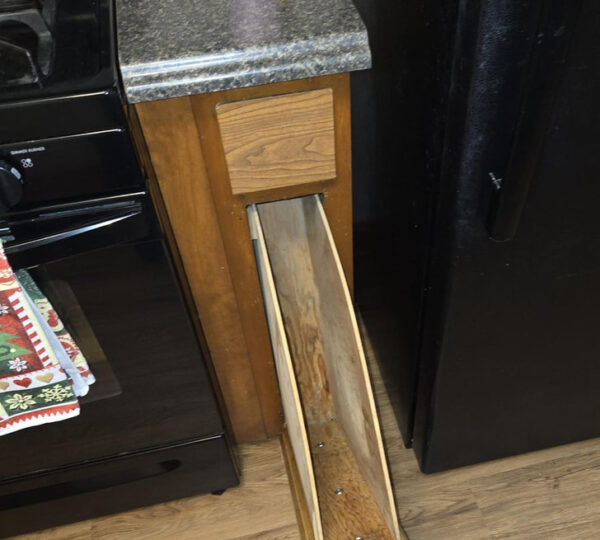
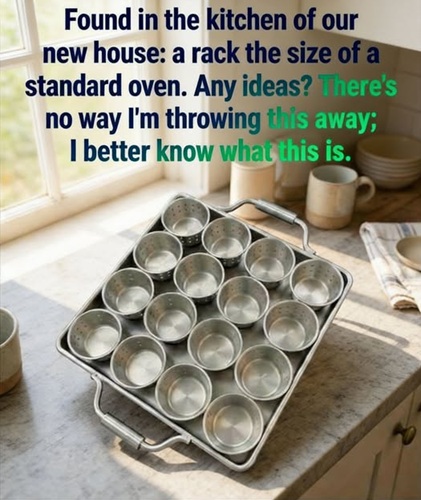
During the first few days of unpacking, however, they discovered something that caught their attention in a way that no appliance or decoration ever could: a peculiar metal rack, roughly the size of an oven rack, tucked behind one of the lower kitchen cabinets.
At first glance, the item seemed ordinary, a flat rectangular piece of metal with evenly spaced ridges running across its surface. But there was something about it that didn’t quite fit the modern kitchen aesthetic.
It was not a cooling rack, nor did it resemble a broiler insert or any standard appliance part they had ever seen. Its edges were slightly worn, suggesting frequent use, and a faint patina had developed on the surface, hinting at age.
The new homeowners picked it up, examining it carefully, turning it over in their hands, and running their fingers along the ridges. What was its purpose? Why had it been left behind? Was it important or merely forgotten?
The couple’s curiosity grew as they inspected the rack. The evenly spaced ridges suggested it was designed to hold items, perhaps for heating or drying. Its metal construction hinted at durability, meant to endure repeated use or exposure to heat.
Yet it didn’t match the style or materials of contemporary kitchen tools. Unlike modern racks, it lacked silicone coatings, nonstick surfaces, or the standardized dimensions of appliance inserts.
Instead, it carried a charm of bygone craftsmanship, a hint that it may have once been part of a larger system, perhaps an older appliance no longer in use or even a specialized baking or cooking tool from decades past.
Unable to resist, the homeowners began to research. They scoured online forums for vintage kitchen equipment, posting photos and descriptions, hoping that someone, somewhere, might recognize the item.
Within hours, responses began to appear, each offering a theory: one user suggested it was an antique broiler rack from an old gas oven, designed to hold meat or vegetables close to the flame.
Another thought it could have been used for candy making, the ridges allowing caramel or chocolate to cool evenly. Yet another suggested it might have been part of a commercial food dehydrator, intended to maximize airflow while preserving fruits, herbs, or meats.
Each suggestion was plausible, yet none could be confirmed without further context, leaving the mystery tantalizingly unresolved.
The item soon became a topic of conversation among friends and neighbors. During a housewarming gathering, one guest picked it up and examined it closely, marveling at the simplicity and ingenuity of its design.
“It almost looks like it was custom-made,” the guest remarked. Others speculated that it might have been used in a workshop or even as part of an old laboratory setup.
The discussions were animated, blending humor, nostalgia, and genuine curiosity. Even without a definitive answer, the metal rack sparked connection and conversation, turning a simple object into a shared experience.
Meanwhile, the homeowners experimented cautiously with the rack, trying to see if it could serve a modern purpose. They placed it in the oven at low heat, noting that it could withstand temperatures without warping.
They used it as a drying rack for dishes, herbs, or small baked goods, discovering that its sturdy design made it surprisingly versatile. What had initially been an object of puzzlement gradually became integrated into daily routines.
The homeowners developed a quiet appreciation for its craftsmanship, imagining the many hands that had once used it, the meals it had helped prepare, and the countless small acts of domestic life it had witnessed over the years.
The mystery deepened when they contacted the previous owners. The former residents, now living across town, remembered leaving behind the rack but could offer only vague details.
“It’s just something old we never used,” they said, laughing. “It may have belonged to the house before us. I think it’s from the previous owners, or maybe it was custom-made by a handyman decades ago. Honestly, we never even knew what it was for.”
While the answer was incomplete, it added another layer to the story, emphasizing the way objects outlive people’s immediate use for them, carrying traces of history and memory.
The homeowners soon realized that the metal rack was more than a mere kitchen oddity. It was a symbol of continuity, a link between past occupants and present life.
It reminded them that homes are living spaces shaped not only by the people who currently inhabit them but also by those who came before. Each scratch, dent, or patina on the rack told a story, hinting at meals prepared, celebrations held, and daily routines performed over years, perhaps even decades.
The presence of such an object encouraged reflection on the impermanence of human activity and the way ordinary tools can acquire extraordinary significance over time.
As weeks passed, the homeowners shared their discovery online, posting photographs on social media and community forums. The post went viral within the local neighborhood group, drawing hundreds of comments and theories.
People shared their own experiences of finding mysterious objects in new homes: old keys without locks, peculiar tools with unknown functions, jars of mysterious contents, and even entire appliances whose purpose had long been forgotten.
The discussions fostered a sense of collective curiosity and historical investigation. The metal rack, initially a mundane curiosity, became a catalyst for community engagement and storytelling, sparking conversations about domestic history, craftsmanship, and the ways in which objects carry memory.
In the meantime, the homeowners decided to preserve the rack as part of their kitchen decor. They placed it prominently on a shelf, cleaned and polished, as a conversation piece and a reminder of the home’s history.
Children and guests would stop to examine it, often asking questions that prompted storytelling and reflection. Its presence turned into a teaching moment: an opportunity to discuss the evolution of kitchen tools, the ingenuity of older generations, and the value of curiosity in uncovering hidden histories.
Interestingly, the mystery also prompted the homeowners to explore other forgotten or overlooked items in the house.
Behind cabinets, in closets, and even in the attic, they found other relics of previous lives: a collection of vintage utensils, old recipe books with handwritten notes, and small pieces of handmade kitchenware.
Each discovery was layered with history and the quiet ingenuity of people who had lived and worked in the space before them. The metal rack had opened the door to a deeper appreciation for the continuity of life and the stories embedded in everyday objects.
Over time, the homeowners became part of a larger narrative. The rack, once mysterious, now held a permanent place in the story of the house.
It symbolized the intersection of past and present, the way ordinary items can acquire extraordinary meaning, and how curiosity and patience can transform confusion into understanding and even appreciation.
Guests visiting the house learned to value the unexpected discoveries hidden within familiar spaces, and children grew to see ordinary tools as vessels of history and imagination.
In the months that followed, the homeowners also began experimenting with the rack’s potential uses in modern contexts.
They used it for cooling freshly baked bread and pastries, for holding jars during a canning session, and even as a surface for air-drying delicate herbs or flowers.
The rack’s sturdy metal construction proved invaluable, and it became a reliable part of the kitchen routine. What had once been an object of uncertainty evolved into a beloved tool with practical and sentimental value.
Eventually, the story of the mysterious metal rack became a defining element of the home itself. Friends and family would recount the tale of its discovery and the ensuing curiosity, turning the object into a symbol of exploration and the joy of discovery in everyday life.
The rack served as a reminder that even in modern homes, objects from the past can continue to serve purposes, inspire imagination, and connect people to history in tangible ways.
Through this experience, the homeowners learned an important lesson about patience, observation, and respect for the stories embedded in objects.
Not every discovery needs an immediate answer, and not every mystery must be solved to be appreciated. Some things—like the metal rack in the kitchen—are best valued for the questions they provoke, the memories they carry, and the connections they inspire.
In leaving it in place and honoring its history, the couple not only preserved a piece of the home’s past but also enriched their present, adding a layer of depth and meaning to daily life.
In the end, the metal rack, once an enigma, became a treasured part of the home. It reminded everyone who saw it that homes are living museums, filled with stories, ingenuity, and traces of the lives that came before.
The mystery of the object, far from being a source of frustration, became a source of joy, learning, and community engagement.
So, while the origin and original purpose of the rack may never be known with certainty, it found its rightful place as both a practical kitchen tool and a conversation starter.
The discovery reinforced a universal truth: every home carries the echoes of past lives, and sometimes, the smallest, most unassuming items have the power to connect us to history, spark curiosity, and remind us that discovery is one of life’s greatest joys.
In this new home, the metal rack was no longer just an object left behind—it was a treasured story, a testament to curiosity, and a symbol of the home’s evolving life, from past to present, and into the future.
