
When rescuers at the Heart of the Forest animal center first received a call about a tiny, unidentified creature, they had no idea that the situation would soon capture the attention of thousands of people and become a powerful story of compassion, mystery, and survival.
What they encountered was something entirely unexpected: a newborn animal so small and unusual in appearance that even experienced wildlife and domestic animal rescuers struggled to identify it at first glance.
The animal was barely larger than the palm of a hand and covered in short, dark black fur. Its features were underdeveloped, its eyes tightly closed, and its movements weak and uncertain.
At first sight, it did not clearly resemble any familiar species. Its size suggested one animal, its fur another, and its overall shape added to the confusion.
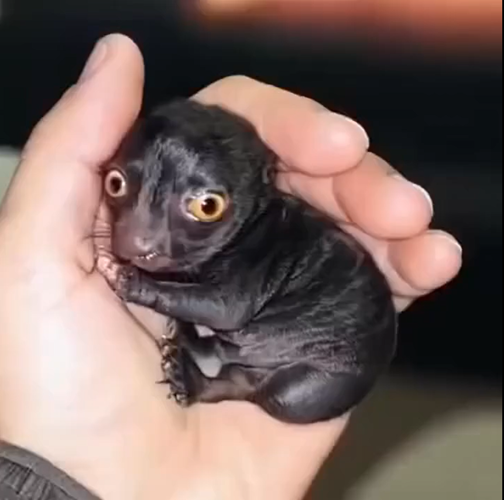
The rescue team was both puzzled and intrigued, knowing that identifying the species correctly would be crucial to providing the right care.
Photos of the tiny animal were taken and shared online in hopes that the wider community might offer insights. Almost immediately, social media users began speculating.
Some believed it might be a newborn kitten abandoned in the woods. Others guessed it could be a baby squirrel, while a few compared it to a miniature teddy bear because of its soft fur and delicate appearance.
The mystery surrounding the animal’s identity quickly sparked curiosity and emotional investment from people around the world.
Even among the rescue staff, opinions initially differed. Many of them had worked with injured wildlife, orphaned domestic animals, and newborn mammals before, yet this tiny creature did not clearly fit into any familiar category.
Its ambiguous appearance made it difficult to determine how it should be fed, housed, and monitored during its first critical hours at the center.
Despite the uncertainty, one thing was clear: the animal was extremely young and fragile, and immediate care was essential.
The rescuers provided warmth, gentle handling, and careful observation while they worked to identify what species it belonged to.
During this time, the story continued to spread online, with many people anxiously awaiting updates about the animal’s condition and identity.
After careful examination, including close observation of physical characteristics and developmental markers, the rescue team made a surprising discovery.
The mysterious creature was not a wild animal at all, but a domestic rabbit, estimated to be only three to four days old.
This revelation explained much of the initial confusion, as newborn domestic rabbits look dramatically different from their wild counterparts.
When she arrived at the rescue center, the baby rabbit had a few light scratches on her body, likely from the environment she had been found in.
However, considering her age and vulnerability, she was in relatively stable condition. This alone was remarkable, as domestic rabbits are entirely dependent on their mothers during the first weeks of life and cannot survive on their own without warmth, protection, and specialized feeding.
What made this rescue even more extraordinary was how the rabbit arrived at the center. Unlike most cases, she was not brought in by a concerned human passerby. Instead, she was carried to safety by a dog.
According to the rescue team, the dog had found the tiny rabbit and, rather than harming her, gently picked her up and brought her to humans for help.
This act of apparent animal compassion deeply astonished the rescue workers. Dogs are predators by nature, and a creature as small and defenseless as a newborn rabbit would normally be at great risk.
Instead, this dog displayed protective behavior, likely saving the rabbit’s life during a critical window of time. The story quickly resonated with animal lovers, becoming a touching example of empathy that transcends species boundaries.
The mystery of how such a young domestic rabbit ended up alone in a forested area remains unresolved. Domestic rabbits are not native to wild environments in the same way wild rabbits are.
They are bred for companionship and lack the survival instincts needed to live independently in nature. Unlike wild baby rabbits, domestic newborns are born blind, hairless or sparsely furred, and completely helpless.
They rely entirely on their mother for warmth and nourishment, making abandonment particularly dangerous.
Wild rabbits, by contrast, are born with fur and open eyes, and they develop mobility much more quickly. This difference often leads to confusion among well-meaning people who encounter baby rabbits in nature.
In many cases, wild rabbit mothers leave their young hidden for long periods while they forage, which can make the babies appear abandoned when they are not.
To address this common misunderstanding, the Heart of the Forest rescue team took an educational approach. They shared comparison photos showing the clear differences between wild baby rabbits and domestic ones.
These images highlighted variations in fur, eye development, and overall body structure, helping people learn how to recognize when an animal truly needs rescue and when it is best to leave it undisturbed.
The goal of this educational effort was not only to explain the situation surrounding this particular rabbit but also to raise broader awareness about responsible intervention.
Removing a wild animal from its natural environment unnecessarily can cause harm, while failing to help a truly vulnerable domestic animal can be fatal.
By providing accurate information, the rescue team hoped to empower the public to make informed decisions in future encounters.
Meanwhile, the baby rabbit began receiving round-the-clock care. The rescuers provided appropriate nutrition, monitored her weight and hydration, and ensured she remained warm and stress-free.
Each small improvement marked a victory, as the first days of life are the most dangerous for orphaned animals.
As updates were shared, thousands of people followed her progress. What began as confusion and uncertainty gradually transformed into a story of hope and resilience.
Many people expressed admiration not only for the rescue team’s dedication but also for the dog whose instincts likely saved the rabbit’s life.
The story also prompted reflection about human responsibility toward domestic animals. While the circumstances of the rabbit’s abandonment are unknown, her situation underscores the importance of proper care, secure environments, and responsible ownership.
Domestic animals depend on humans for their safety, and even a brief lapse can place them in serious danger.
Beyond the individual rescue, this incident highlights the complex relationship between humans, animals, and nature. It serves as a reminder that compassion is not limited to one species and that acts of kindness can come from unexpected sources.
The dog’s behavior challenged assumptions and reminded people that empathy can exist instinctively, even in the animal world.
The rescue center’s experience also emphasizes the importance of education in animal welfare. Well-intentioned actions can sometimes have unintended consequences if people lack the right information.
By sharing accurate details and visual comparisons, the rescuers turned a single rescue into a learning opportunity that could potentially save many animals in the future.
As the rabbit continues to grow stronger under professional care, her journey has become a symbol of what can happen when vigilance, knowledge, and compassion come together.
She survived because someone—both human and animal—noticed her, cared enough to act, and knew where to seek help.
In a broader sense, the story encourages people to pay closer attention to the animals around them. Whether encountering wildlife or domestic animals, thoughtful observation and expert guidance are essential.
Acting too quickly or not at all can both have serious consequences, which is why education and awareness are so important.
What began as a puzzling discovery of a tiny, unidentified creature has evolved into a meaningful reminder of life’s fragility and resilience.
The rabbit’s journey from danger and uncertainty to safety and care illustrates how even the smallest lives can have a powerful impact.
Ultimately, this rescue story is not just about a baby rabbit. It is about empathy, responsibility, and the unexpected connections that exist between living beings.
It reminds us that kindness—whether shown by a trained rescuer, a concerned community, or a loyal dog—has the power to change outcomes.
The little rabbit’s survival stands as a testament to the strength of life and the importance of paying attention to those who cannot help themselves.
Her story continues to inspire people to open their hearts, act thoughtfully, and support rescue and conservation efforts wherever possible.
In the end, what seemed like a simple rescue became a profound lesson in compassion, awareness, and hope—proof that even in the most uncertain moments, goodness can emerge and make a lasting difference.
