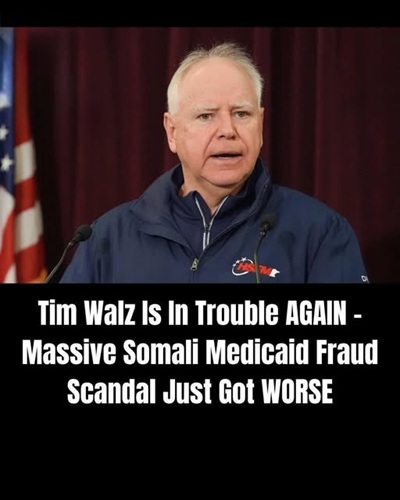
A noticeable strain has emerged in Minnesota between the state’s top leadership and a broad group of local officials. Nearly 100 mayors — representing rural towns.
Mid‑sized cities, and urban communities across the state — have come together to voice a growing concern over how the state is managing large‑scale fraud in public programs and its broader fiscal trajectory.
Their message, though urgent, is rooted less in dramatic political theater and more in pragmatic concern over concrete financial consequences for local governments and residents.
At the center of this dispute is Governor Tim Walz and his administration, which now faces mounting political and civic pressure to demonstrate that Minnesota’s public funds are being managed responsibly and that oversight systems are functioning as intended.
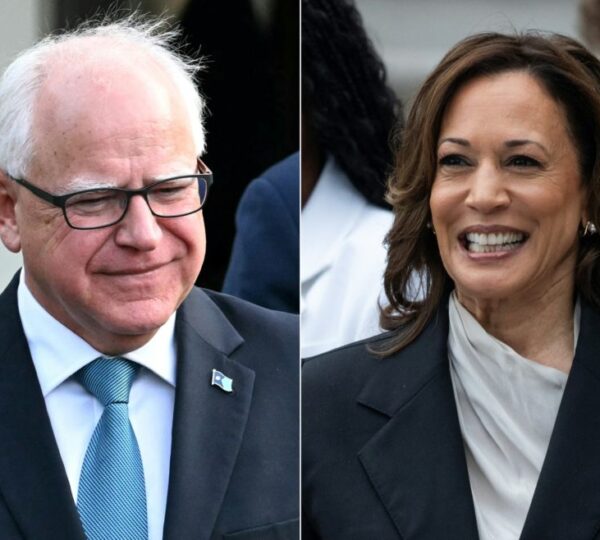
Critics assert that lax oversight and unresolved fraud tied to state‑administered programs — particularly in **Medicaid and other human services — have strained local budgets, pushed costs onto cities, and risked eroding public trust in governance.
What the Mayors Are Saying: A Letter from the Front Lines of Local Government
On December 22, 2025, a group of 98 mayors from towns large and small sent a joint letter to Governor Walz and state legislators outlining their concerns.
The letter lays out a stark picture of how decisions made at the state capitol are cascading down to local communities, affecting budgets, public safety, and services that residents depend on.
In their message, the mayors said that recent fiscal decisions — particularly in the wake of alleged fraud and rising costs — have “trickled down” to cities and towns, reducing their capacity to plan responsibly, maintain infrastructure, hire and retain employees, and sustain core services without placing additional burdens on local taxpayers.
They cited the disappearance of an $18 billion budget surplus and a projected $2.9 billion to $3 billion deficit in the 2028‑29 biennium as evidence of inconsistent fiscal management at the state level.
The letter goes beyond abstract policy critique, pointing directly to the everyday challenges mayors face when city budgets are squeezed.
Rising property taxes, delayed infrastructure work, limits on public safety staffing, and reductions in services are not, in their view, “state problems” alone — they are local realities that community leaders must explain to their constituents.
The Core Issues: Fraud, Mandates, and Budget Shortfalls
Concerns Over Fraud and Overspending
One of the central issues named in the letter is fraud and unchecked spending within certain state programs.

While the exact scope and scale of the fraud continue to be evaluated — and fiercely debated — many mayors see a direct link between these failures and the tightening of local budgets.
Fraud in Medicaid and other social services programs has become a major political and administrative flashpoint in Minnesota.
Federal prosecutors and some watchdog reports suggest that fraudulent billing, inflated claims, and deceptive practices in state‑administered benefits may total in the billions of dollars, with some estimates approaching the nine‑figure or even multi‑billion dollar range.
This alleged fraud — which investigators say involves programs ranging from autism‑related services to housing stabilization initiatives — has drawn attention from federal officials, lawmakers, and civic leaders.
Some have gone so far as to argue that the state’s regulatory systems were too lax, allowing bad actors to exploit vulnerabilities in public programs for years.
Governor Walz’s response has been to acknowledge the seriousness of fraud concerns while disputing some of the most extreme estimates.
State officials have noted that, according to Department of Human Services data, fraud totaling “tens of millions” has been identified so far, with further auditing and investigation underway to determine the true scope.
Walz and his team have pushed back against figures suggesting $9 billion or more without current evidence being disclosed to state auditors.
Economic and Fiscal Pressures on Local Governments
Beyond fraud, mayors’ concerns extend to unfunded mandates, rising operational costs, and an overall fiscal environment that they contend is making it harder for cities to function effectively without cutting services or raising local taxes.
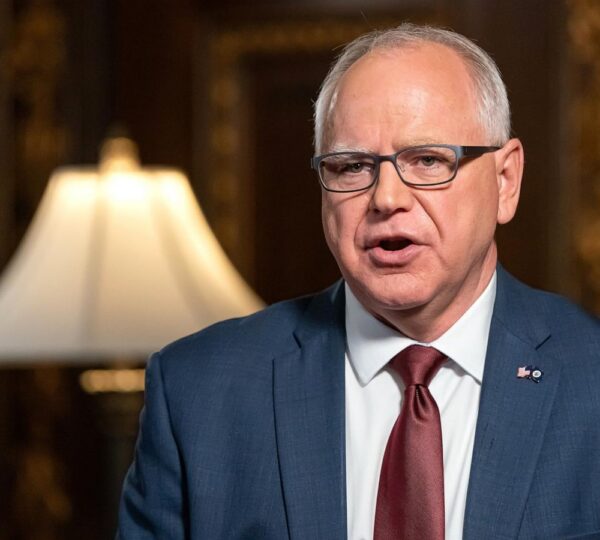
In the letter, mayors point out that rising property tax levies are creeping upward in many communities, partly because state aid has not kept pace with inflation or the cost of fulfilling state‑imposed obligations.
Preliminary projections have shown property tax increases of nearly 6.9 percent statewide for the next fiscal cycle, putting further pressure on families and local budgets.
For many small towns and municipalities outside metropolitan centers, the effects are tangible.
One mayor described having to delay replacing aging water infrastructure because state funds were not forthcoming — even as neighborhoods watched potholes grow and pipes leak.
Another noted that his city of roughly 7,000 people faced far more stringent local auditing requirements than the systems in place at the state level.
Political Dimensions and Broad Coalitions
Interestingly, the coalition of mayors spans party lines and ideological differences. While some signatories are affiliated with Republican politics, others are independents or have previously supported Democratic leadership — including Governor Walz himself.
Their collective letter underscores that this concern is not purely partisan, but rooted in governing responsibilities and civic stewardship.
One mayor who chose not to sign — the mayor of Rochester — explained that she saw fraud and fiscal mismanagement as serious issues but felt the letter veered too far into political messaging.
She emphasized that strong economic performance in her own community made her hesitant to join a broader rebuke she viewed as potentially divisive.
However, even she condemned fraud and urged state leaders to stay mindful of local taxpayers’ burdens.
These divisions, alongside common themes, highlight how complicated the issue has become: mayors are united in practical concern, even as they diverge on strategy, tone, and political framing.
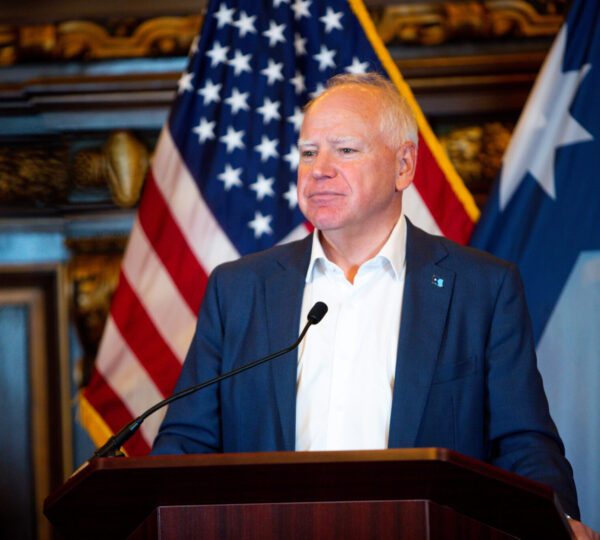
Calls for Reform: What the Mayors Want
The mayors’ letter does not simply complain; it also proposes specific changes they believe could help restore confidence and stabilize Minnesota’s fiscal trajectory:
Stronger Oversight and Transparency: Local leaders are asking for clearer audits, improved reporting, and transparent financial mechanisms to track where public funds are going and how they are spent.
Fiscal Accountability: They want state leadership to demonstrate responsible stewardship of taxpayer dollars, particularly in light of lost surpluses and emerging deficits that put pressure on local services.
Reform of Public Programs: Mayors call for an evaluation of how state‑administered programs are monitored, how fraud is detected and prosecuted, and how oversight can be strengthened to protect both taxpayers and those genuinely in need.
Partnership Between State & Local Governments: Rather than tension and blame, many mayors advocate for collaborative solutions that respect both the state’s authority and local governments’ need for reliable revenue streams and assistance.
Their overarching message is not one of partisan rancor, but of practical necessity: local leaders are literally on the front lines of service delivery, and when state funds falter, the tangible impacts are felt in city council chambers, police departments, parks, and streets where families live and work.
Governor Walz’s Position and State Response
Governor Walz and his administration have acknowledged the scrutiny and taken steps that they say are aimed at addressing fraud and strengthening safeguards.
In recent months, Walz announced pauses on certain Medicaid payments and initiated third‑party audits of high‑risk programs to identify irregular billing and suspicious activity.
The Minnesota Department of Human Services has engaged external firms to scrutinize claims and flag anomalies for further review.
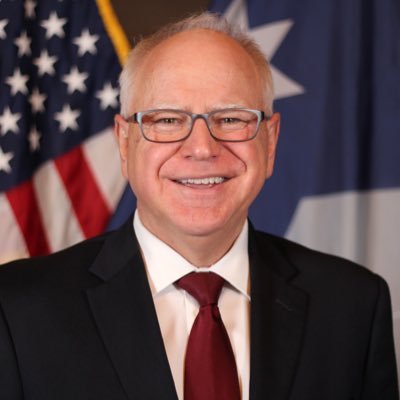
Walz’s office disputes the most dramatic fraud estimates, characterizing some public figures as “sensationalized” and urging that only validated evidence be used to guide policy responses.
State officials have called for cooperation with federal investigators and reaffirmed that any proven fraudsters should face prosecution under the law.
In a broader statement, the governor’s team has also highlighted record state support for local governments — including increased aid for public safety, infrastructure, and property tax relief — as evidence of their commitment to partnering with cities and towns.
Despite these assurances, the core issue remains unresolved for many mayors: confidence in oversight and accountability mechanisms has been eroded, and until that trust is restored through visible reform, communities may continue to feel financially and politically squeezed.
The Broader Implications for Public Governance
The dispute unfolding in Minnesota reflects larger challenges facing state and local governments nationwide.
As public programs grow more complex and interconnected, oversight systems must evolve in tandem to ensure that resources are used effectively and equitably.
Where fraud or waste occurs, it raises questions not just about fiscal management, but about the integrity of governance itself.
The mayors’ letter signals that when local leaders’ hands are tied by budgeting realities, constituents look to them for answers — and when the state’s actions appear to undermine local capacity, frustration deepens.
This is not merely a disagreement over numbers on a spreadsheet; it is a test of trust between levels of government entrusted with public well‑being.
What Comes Next? A Defining Moment for Minnesota
For Governor Walz, the mayors’ warning represents a defining moment: decisive action that strengthens oversight, improves transparency, and rebuilds trust could restore confidence and stabilize local‑state relationships.
Delays or perceived defensiveness risk allowing frustration to harden into a more pervasive distrust of public institutions — a dynamic that threatens not only fiscal health but civic cohesion.
For the mayors and their communities, the message is clear: they are not asking for political retribution, but for accountability, partnership, and a shared commitment to fiscal responsibility and service continuity.
In doing so, they remind Minnesotans that the strength of public governance lies not in rhetoric or blame, but in transparent management, responsive oversight, and a willingness to listen to local voices most directly impacted by state decisions.
A noticeable strain has emerged in Minnesota between the state’s top leadership and a broad group of local officials. Nearly 100 mayors — representing rural towns.
Mid‑sized cities, and urban communities across the state — have come together to voice a growing concern over how the state is managing large‑scale fraud in public programs and its broader fiscal trajectory.
Their message, though urgent, is rooted less in dramatic political theater and more in pragmatic concern over concrete financial consequences for local governments and residents.
At the center of this dispute is Governor Tim Walz and his administration, which now faces mounting political and civic pressure to demonstrate that Minnesota’s public funds are being managed responsibly and that oversight systems are functioning as intended.
Critics assert that lax oversight and unresolved fraud tied to state‑administered programs — particularly in **Medicaid and other human services — have strained local budgets, pushed costs onto cities, and risked eroding public trust in governance.
What the Mayors Are Saying: A Letter from the Front Lines of Local Government
On December 22, 2025, a group of 98 mayors from towns large and small sent a joint letter to Governor Walz and state legislators outlining their concerns.
The letter lays out a stark picture of how decisions made at the state capitol are cascading down to local communities, affecting budgets, public safety, and services that residents depend on.
In their message, the mayors said that recent fiscal decisions — particularly in the wake of alleged fraud and rising costs — have “trickled down” to cities and towns, reducing their capacity to plan responsibly, maintain infrastructure, hire and retain employees, and sustain core services without placing additional burdens on local taxpayers.
They cited the disappearance of an $18 billion budget surplus and a projected $2.9 billion to $3 billion deficit in the 2028‑29 biennium as evidence of inconsistent fiscal management at the state level.
The letter goes beyond abstract policy critique, pointing directly to the everyday challenges mayors face when city budgets are squeezed.
Rising property taxes, delayed infrastructure work, limits on public safety staffing, and reductions in services are not, in their view, “state problems” alone — they are local realities that community leaders must explain to their constituents.
The Core Issues: Fraud, Mandates, and Budget Shortfalls
Concerns Over Fraud and Overspending
One of the central issues named in the letter is fraud and unchecked spending within certain state programs.
While the exact scope and scale of the fraud continue to be evaluated — and fiercely debated — many mayors see a direct link between these failures and the tightening of local budgets.
Fraud in Medicaid and other social services programs has become a major political and administrative flashpoint in Minnesota.
Federal prosecutors and some watchdog reports suggest that fraudulent billing, inflated claims, and deceptive practices in state‑administered benefits may total in the billions of dollars, with some estimates approaching the nine‑figure or even multi‑billion dollar range.
This alleged fraud — which investigators say involves programs ranging from autism‑related services to housing stabilization initiatives — has drawn attention from federal officials, lawmakers, and civic leaders.
Some have gone so far as to argue that the state’s regulatory systems were too lax, allowing bad actors to exploit vulnerabilities in public programs for years.
Governor Walz’s response has been to acknowledge the seriousness of fraud concerns while disputing some of the most extreme estimates.
State officials have noted that, according to Department of Human Services data, fraud totaling “tens of millions” has been identified so far, with further auditing and investigation underway to determine the true scope.
Walz and his team have pushed back against figures suggesting $9 billion or more without current evidence being disclosed to state auditors.
Economic and Fiscal Pressures on Local Governments
Beyond fraud, mayors’ concerns extend to unfunded mandates, rising operational costs, and an overall fiscal environment that they contend is making it harder for cities to function effectively without cutting services or raising local taxes.
In the letter, mayors point out that rising property tax levies are creeping upward in many communities, partly because state aid has not kept pace with inflation or the cost of fulfilling state‑imposed obligations.
Preliminary projections have shown property tax increases of nearly 6.9 percent statewide for the next fiscal cycle, putting further pressure on families and local budgets.
For many small towns and municipalities outside metropolitan centers, the effects are tangible.
One mayor described having to delay replacing aging water infrastructure because state funds were not forthcoming — even as neighborhoods watched potholes grow and pipes leak.
Another noted that his city of roughly 7,000 people faced far more stringent local auditing requirements than the systems in place at the state level.
Political Dimensions and Broad Coalitions
Interestingly, the coalition of mayors spans party lines and ideological differences. While some signatories are affiliated with Republican politics, others are independents or have previously supported Democratic leadership — including Governor Walz himself.
Their collective letter underscores that this concern is not purely partisan, but rooted in governing responsibilities and civic stewardship.
One mayor who chose not to sign — the mayor of Rochester — explained that she saw fraud and fiscal mismanagement as serious issues but felt the letter veered too far into political messaging.
She emphasized that strong economic performance in her own community made her hesitant to join a broader rebuke she viewed as potentially divisive.
However, even she condemned fraud and urged state leaders to stay mindful of local taxpayers’ burdens.
These divisions, alongside common themes, highlight how complicated the issue has become: mayors are united in practical concern, even as they diverge on strategy, tone, and political framing.
Calls for Reform: What the Mayors Want
The mayors’ letter does not simply complain; it also proposes specific changes they believe could help restore confidence and stabilize Minnesota’s fiscal trajectory:
Stronger Oversight and Transparency: Local leaders are asking for clearer audits, improved reporting, and transparent financial mechanisms to track where public funds are going and how they are spent.
Fiscal Accountability: They want state leadership to demonstrate responsible stewardship of taxpayer dollars, particularly in light of lost surpluses and emerging deficits that put pressure on local services.
Reform of Public Programs: Mayors call for an evaluation of how state‑administered programs are monitored, how fraud is detected and prosecuted, and how oversight can be strengthened to protect both taxpayers and those genuinely in need.
Partnership Between State & Local Governments: Rather than tension and blame, many mayors advocate for collaborative solutions that respect both the state’s authority and local governments’ need for reliable revenue streams and assistance.
Their overarching message is not one of partisan rancor, but of practical necessity: local leaders are literally on the front lines of service delivery, and when state funds falter, the tangible impacts are felt in city council chambers, police departments, parks, and streets where families live and work.
Governor Walz’s Position and State Response
Governor Walz and his administration have acknowledged the scrutiny and taken steps that they say are aimed at addressing fraud and strengthening safeguards.
In recent months, Walz announced pauses on certain Medicaid payments and initiated third‑party audits of high‑risk programs to identify irregular billing and suspicious activity.
The Minnesota Department of Human Services has engaged external firms to scrutinize claims and flag anomalies for further review.
Walz’s office disputes the most dramatic fraud estimates, characterizing some public figures as “sensationalized” and urging that only validated evidence be used to guide policy responses.
State officials have called for cooperation with federal investigators and reaffirmed that any proven fraudsters should face prosecution under the law.
In a broader statement, the governor’s team has also highlighted record state support for local governments — including increased aid for public safety, infrastructure, and property tax relief — as evidence of their commitment to partnering with cities and towns.
Despite these assurances, the core issue remains unresolved for many mayors: confidence in oversight and accountability mechanisms has been eroded, and until that trust is restored through visible reform, communities may continue to feel financially and politically squeezed.
The Broader Implications for Public Governance
The dispute unfolding in Minnesota reflects larger challenges facing state and local governments nationwide.
As public programs grow more complex and interconnected, oversight systems must evolve in tandem to ensure that resources are used effectively and equitably.
Where fraud or waste occurs, it raises questions not just about fiscal management, but about the integrity of governance itself.
The mayors’ letter signals that when local leaders’ hands are tied by budgeting realities, constituents look to them for answers — and when the state’s actions appear to undermine local capacity, frustration deepens.
This is not merely a disagreement over numbers on a spreadsheet; it is a test of trust between levels of government entrusted with public well‑being.
What Comes Next? A Defining Moment for Minnesota
For Governor Walz, the mayors’ warning represents a defining moment: decisive action that strengthens oversight, improves transparency, and rebuilds trust could restore confidence and stabilize local‑state relationships.
Delays or perceived defensiveness risk allowing frustration to harden into a more pervasive distrust of public institutions — a dynamic that threatens not only fiscal health but civic cohesion.
For the mayors and their communities, the message is clear: they are not asking for political retribution, but for accountability, partnership, and a shared commitment to fiscal responsibility and service continuity.
In doing so, they remind Minnesotans that the strength of public governance lies not in rhetoric or blame, but in transparent management, responsive oversight, and a willingness to listen to local voices most directly impacted by state decisions.