

When most people attend a major sporting event like the 2026 Winter Olympics in Milan–Cortina, they expect excitement, national pride, memorable athletic performances.
And little else outside the normal scope of sport. For former ESPN broadcaster Sarah Spain, however, a moment that might have seemed ordinary to others became unexpectedly uncomfortable.
Spain — host of the podcast Good Game With Sarah Spain, where she discusses women’s sports, athletes, and behind‑the‑scenes moments — recently recounted an encounter during a Team USA women’s hockey game that captivated listeners and sparked widespread conversation about the intersection of politics, public presence, and personal emotional response.
At the Milan–Cortina Games
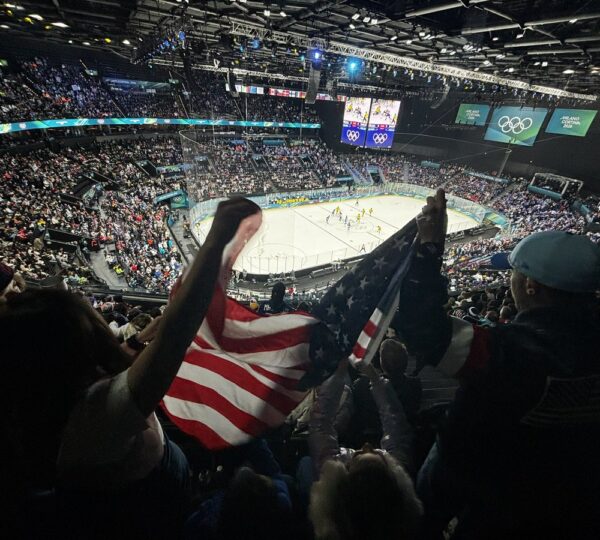
Spain was attending a United States women’s hockey match — featuring the U.S. team competing in the Winter Games — when she realized she was seated only a few rows behind J. D. Vance, who is also serving as the head of the U.S. delegation at the 2026 Olympics.

As reported by multiple outlets, Spain said that approximately 12 minutes into the first period, she noticed a sudden influx of what she described as a much larger security presence around the area where Vance and other officials were sitting — including Marco Rubio — which shifted the atmosphere around her.
A Human Reaction, Not a Political Statement
On her podcast, Spain explained that her discomfort wasn’t rooted in political animosity toward Vance himself, but in the visceral reaction her body had to the sudden environmental shift:
-
She described the security presence — large suits, earpieces, agents moving into place — appearing in her vicinity unexpectedly, creating a stark contrast with the fans around her.
-
Spain said her body reacted before her mind caught up, describing a physical sensation of being “ill” or unsettled upon seeing Vance in such close proximity. She even referred, metaphorically, to how it felt as though she had “looked at a demon,” though she clarified she did not intend the phrase literally.
Her reaction, she emphasized, was a personal response to surprise and sensory shift, not a broad statement about Vice President Vance’s character or policies.
Spain framed it as the kind of instinctive unease that people sometimes feel when their surroundings change suddenly, especially in a setting — like an Olympic sporting event — that participants expect to be neutral and focused on sport rather than security.
Security and Sightlines
Beyond the emotional reaction, Spain also spoke about the practical effect the arrival of high‑level officials and their security detail had on her experience of the event. She said:
-
Secret Service and protective agents were positioned in ways that partially obstructed her view of the hockey game.
-
Photographers and media attention briefly shifted toward presidential delegates and political figures instead of the athletes on the ice, which she found frustrating given her role covering women’s sports.
Spain’s focus on the game and on the athletes’ performance — rather than political optics — was a central point of her reflection:
the presence of powerful public figures and their security teams, while necessary, had an unanticipated impact on her ability to enjoy and engage with the sporting event in the way she had intended.

Politics at the Olympics: A Wider Context
The Winter Olympics have long been an intersection of sport, national pride, and global diplomacy, and this year’s Games were no exception.
Prior to the women’s hockey match Spain attended, Vice President Vance and his wife appeared on the stadium screens during the opening ceremony’s Parade of Nations.
According to some reports and attendee accounts, that appearance drew a mixed reaction from the crowd, including audible boos alongside applause for the American athletes — reflecting political sentiments from the global audience.
This reaction is not unusual at international Olympics; images of political figures on big screens often elicit a range of responses depending on stadium atmosphere, historical context, and individual viewers’ political views.
But for Spain, the presence of high‑ranking officials seemed to underscore how political life can seep into events that are primarily about athletic achievement and unity.
In her podcast remarks, Spain did not dwell on the political views of the vice president. Instead, she reflected on the emotional tone shift that accompanied his presence and the security detail — noting how even in spaces meant for shared excitement and celebration, political context can be felt simply through proximity and circumstance.

Public Reaction and Online Discussion
Spain’s comments quickly drew attention online, with social media users and commentators interpreting her words in various ways.
Some echoed her insistence that she was describing a visceral personal reaction — an instinctive uneasiness triggered by an unexpected sensory shift — rather than a new political argument.
Others reacted critically, arguing her language was overly dramatic or personal. Regardless of the spectrum of opinions, the story became widely discussed, showing how easily personal experiences can become public conversation when political figures are nearby.
Spain’s podcast commentary did not dive into analysis of Vance’s policies, politics, or role beyond describing how unexpected proximity to a political leader altered her emotional and physical experience in a sporting environment.
The Physicality of Emotional Responses
Part of what made Spain’s account compelling to some listeners was her emphasis on the bodily nature of the reaction she described.
She said it wasn’t fear, and it wasn’t anger — but rather the kind of reflexive discomfort people sometimes feel when their physical environment changes abruptly.
Psychologists note that the human nervous system is highly attuned to changes in familiar settings. Sudden shifts — such as the arrival of a large security detail or a high‑profile public figure — can trigger a subconscious response before the brain fully interprets the situation.

It’s a survival instinct rooted in humans’ evolutionary wiring, and it doesn’t necessarily equate to conscious judgement of a person’s character or intentions.
Spain’s framing of her reaction as a “pause, then reflection” rather than a political statement highlights this distinction: human beings are sensitive to abrupt shifts, and those responses are not inherently rooted in animosity or political ideology.
Security at Major Public Events
It’s important to note that the presence of Secret Service agents and other protective details at events attended by senior U.S. officials — including the vice president of the United States — is standard practice.
Major international sporting events like the Olympics routinely involve integrated security protocols to protect dignitaries, athletes, spectators, and staff.
hese precautions, while sometimes noticeable to nearby attendees, are intended to ensure safety and order in crowded public spaces.
Spain acknowledged this practical aspect of her experience: she did not frame increased security as unwarranted, only as a contextual factor that changed how she experienced the game — particularly because attendees like herself did not expect such a shift in an otherwise ordinary seating area.
️ Beyond the Moment
In the broader conversation about how political figures appear at global games, Spain’s story touches on a theme familiar to many spectators: the tension between the celebratory spirit of sports and the realities of political presence on the world stage.
International events like the Olympics often represent ideals of unity, athletic excellence, and cross‑cultural fellowship. At the same time, they inevitably intersect with diplomacy, national representation, and political symbolism.
Ranking officials often attend such events as official representatives of their countries, offering support for athletes and engaging in ceremonial roles that symbolize national participation.
Spain’s reflection — that the moment made her uncomfortable because of the sudden transition in the environment rather than because of deliberate conflict — resonates with many people who have experienced similar sensory surprises in public life: an unexpected sound, a sudden shift in crowd attention, or an unanticipated appearance by a notable figure can all elicit instinctive reactions before the brain makes sense of the situation.
Her conclusion in the conversation was not one of hostility or confrontation, but of reflective observation: that human awareness is deeply sensitive to change, and that discomfort doesn’t always mean danger or opposition — sometimes it simply signals that the body has noticed something shift in its surroundings.
⚽ A Broader Conversation About Shared Spaces
The attention Spain’s comments drew illustrates how deeply politics and everyday life have become intertwined in modern public spaces.
Sporting events, cultural gatherings, and other communal activities are no longer insulated from the broader political atmosphere.
Whether it’s the reaction of crowds at ceremonies, the presence of national leaders in attendance, or the commentary of media figures, political context has become a common part of public life — even in spaces traditionally seen as neutral.
Spain’s reflection is a reminder that personal experience — especially one as immediate as a moment of physical discomfort — can offer insight into how people navigate the increasingly blurred lines between social life and political presence.
Her story also suggests that when people share experiences like these, the goal might not be to inflame debate, but to invite calm reflection on how we interpret unexpected moments in shared public spaces.
In a world where lines between politics and daily life are often intersecting, simple personal reactions can spark broader conversations about presence, context, and emotional awareness.
Conclusion: Reaction Before Reflection
Spain’s experience at the Winter Olympics — sitting near Vice President Vance, observing a sudden surge of security, and feeling bodily discomfort before she consciously evaluated the situation — offers an interesting case study in how humans respond to unexpected environmental changes.

More than a political critique, her story shows something quieter: how instinctive reactions operate beneath the surface of conscious thought, how public life travels into even recreational spaces, and how people can acknowledge discomfort without turning it into conflict.
In the end, what Sarah Spain described wasn’t about politics, policy, or personal attack — it was about the human experience of change, presence, and awareness in shared public moments.
Not everything needs escalation.
Sometimes, experiences just ask to be understood — and then allowed to pass.
