
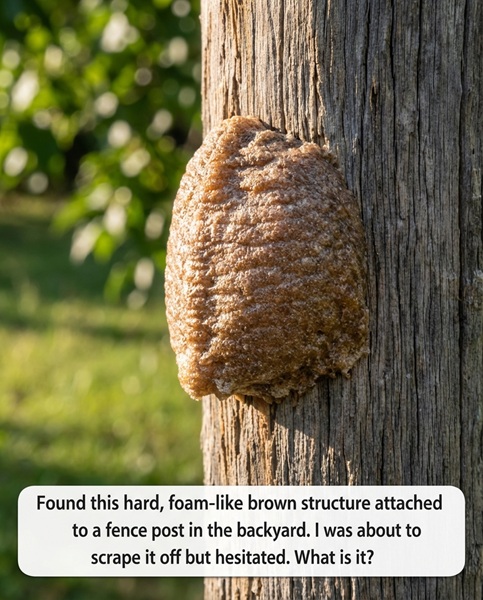
At first glance, it may seem like a strange, uninviting object—a hard, foam-like brown lump clinging stubbornly to a fence post, tree branch, or garden stake.
Its appearance is curious and somewhat off-putting. It’s not quite a nest, not a piece of fungi, and certainly not something you remember placing there yourself.
Most people, upon encountering it, instinctively reach for a tool to scrape it away, ready to remove what seems like an odd obstruction in their yard. Then, almost immediately, hesitation sets in.
Is it dangerous? Could it be alive? Could knocking it off inadvertently destroy something valuable? This pause, this moment of careful consideration, is crucial.
What appears strange, mundane, or even unpleasant at first glance can often be one of the clearest indicators that your backyard ecosystem is functioning as it should—quietly, efficiently, and with nature’s subtle elegance.
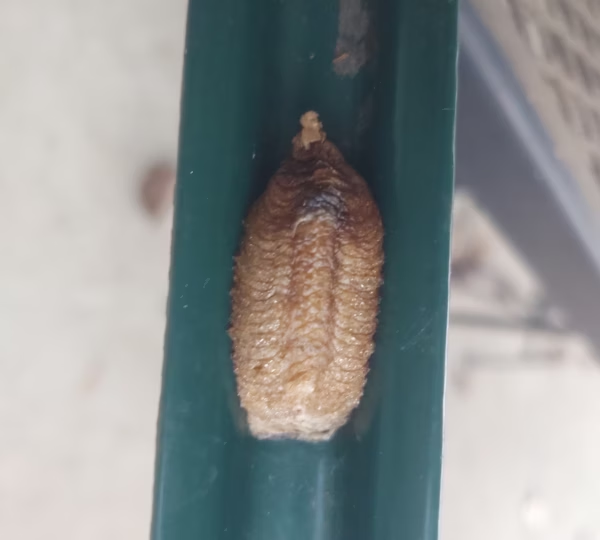
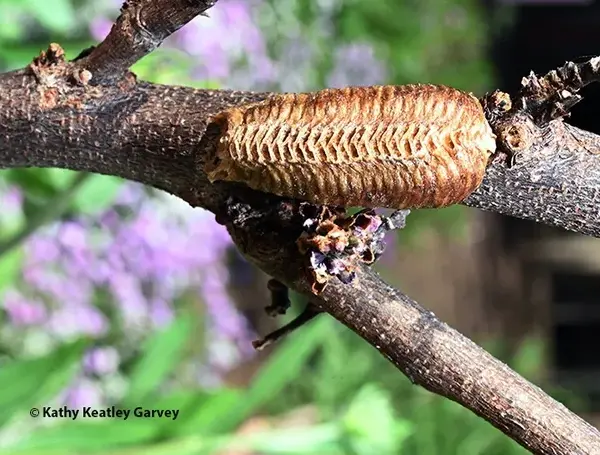
In many cases, the mysterious structure is none other than a praying mantis egg case, scientifically known as an ootheca.
These small, foamy pods are the final product of a fascinating reproductive strategy perfected over millions of years. Female mantises construct these protective capsules in late summer or early fall, shortly after mating.
The timing is critical: the eggs contained within must endure the cold, harsh months of winter, and the ootheca is their first line of defense. The process is remarkable in its simplicity and ingenuity.
The female begins by excreting a frothy, sticky substance around her clutch of fertilized eggs. Within minutes, the foam hardens into a tan or light brown, ridged, spongy shell, forming a structure that is both lightweight and surprisingly resilient.
Typically, an ootheca measures around one to two inches long, though variations exist depending on the species of mantis and the number of eggs it contains.
Its texture is firm but slightly spongy, designed to absorb minor impacts while shielding the developing embryos inside from both weather extremes and potential predators.
From a distance, it may appear unremarkable, blending seamlessly with twigs, posts, and other garden structures.
The camouflage is deliberate; evolution has honed the ootheca’s appearance so that it is unlikely to attract the attention of birds, rodents, or even other insects that might feed on the eggs.
Beneath this modest exterior, however, lies a marvel of life. Each ootheca can contain dozens, sometimes hundreds, of tiny eggs, each one a potential predator in its own right.
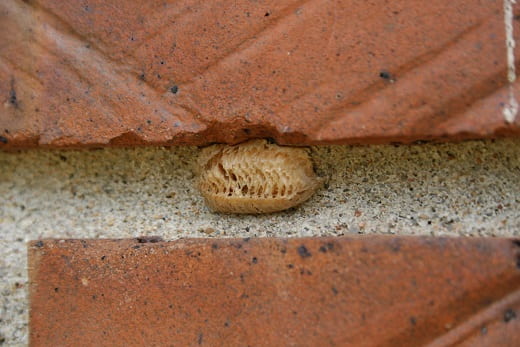
These embryos develop throughout the winter months, safe from frost, rain, and the curious fingers of humans and animals alike. Then, as temperatures rise in early spring, a spectacular transformation occurs.
The eggs hatch, releasing a swarm of minute, delicate mantises, each equipped with the instincts and physical adaptations needed to hunt and survive.
The life cycle of these emerging mantises is a testament to nature’s intricate balance. Tiny but highly effective predators, they immediately begin seeking out insects to eat, naturally controlling populations of common garden pests.
Aphids, small caterpillars, flies, and other soft-bodied insects quickly fall prey to the young mantises. Their presence is often welcomed by gardeners because it reduces the need for chemical pesticides, fostering a healthier, more balanced ecosystem.
In this way, what may initially appear to be an odd or even unsightly object—a simple egg case—turns out to be a powerful ally in the garden, quietly maintaining the delicate equilibrium between predator and prey.
The ootheca’s role in supporting biodiversity extends beyond just the mantises it produces. By regulating populations of pest insects, these predators indirectly support plant health, promoting robust growth of flowers, vegetables, and fruit-bearing plants.
This cascade effect benefits pollinators, soil health, and the broader community of organisms in a backyard ecosystem. In this sense, a single brown foam case attached to a fence post can represent the culmination of countless ecological interactions, a small but vital cog in the machinery of life.
Despite their unassuming appearance, oothecae (the plural of ootheca) are remarkably resilient. Research has shown that the foam-like casing can withstand a variety of environmental stresses.
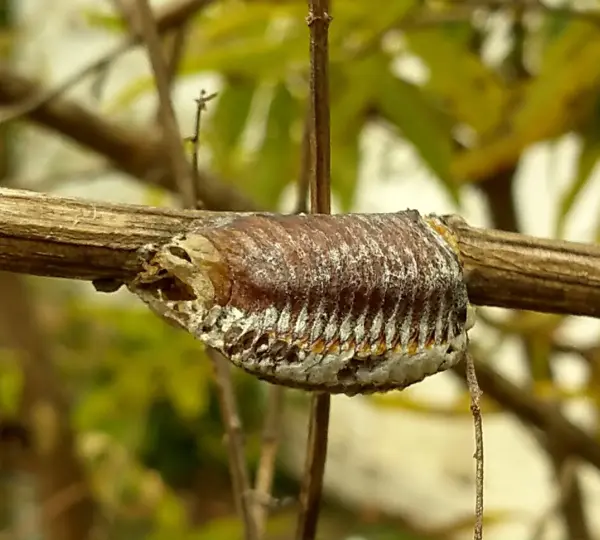
Winter storms, sudden temperature fluctuations, and even moderate physical disturbances are unlikely to compromise the integrity of the eggs inside.
The protective structure ensures that even if some eggs fail to hatch due to environmental pressures or predation, enough will survive to continue the species’ cycle.
Nature’s design emphasizes redundancy, resilience, and the clever use of simple materials to achieve complex goals.
For the homeowner or gardener who discovers an ootheca in their yard, the question often arises: should it be removed or left undisturbed? In most cases, the best course of action is to leave it in place.
The egg case is harmless to humans and pets; there is no reason for concern or fear. Interfering with it, whether through scraping, squashing, or relocating without care, disrupts the natural cycle and eliminates potential predators before they can perform their ecological role.
If an ootheca is in a location where it may be accidentally damaged, careful relocation is possible. Using a pair of sharp scissors or pruners, one can cut the small branch or stem to which the ootheca is attached, ensuring the structure remains intact.
It can then be secured in a sheltered, protected area, such as the side of a shed or a hidden tree branch, safe from foot traffic and harsh sun or rain.
Observing an ootheca up close can also provide insight into the incredible diversity of the natural world. The ridged, foamy texture, the subtle color variations, and the meticulous placement by the female mantis all demonstrate instinctual precision honed by evolutionary pressures.
Each case represents not just reproductive effort but also the continuation of a lineage that has survived, adapted, and thrived over millions of years.
For those interested in entomology or natural history, studying oothecae offers a window into the survival strategies of one of nature’s most skilled hunters.
The hatchlings that emerge from the ootheca are a wonder to behold. Tiny, delicate, and yet already competent predators, they begin life with a remarkable set of skills.
Within hours, they are capable of capturing prey, moving with stealth and agility, and demonstrating behaviors that are instinctive rather than learned.
Their success is not accidental; it is the result of generations of adaptation, fine-tuning both physical form and behavior to ensure survival.
The sheer number of eggs produced, often in the dozens or hundreds, ensures that even with natural attrition, enough individuals will reach adulthood to sustain the population.
Beyond their role in pest control, praying mantises and their oothecae serve as an important educational tool. Children and adults alike can learn about life cycles, predator-prey relationships, and the intricate balance of ecosystems simply by observing these creatures.
The ootheca, in its humble appearance, encapsulates lessons about patience, protection, survival, and the hidden complexity of nature.
It demonstrates that not all impactful events are immediately visible; sometimes, the most significant forces are quiet, gradual, and subtle, shaping the environment in ways that are not immediately apparent.
Gardeners and naturalists who recognize the value of oothecae often take special measures to protect them. Some will even create “mantis-friendly” gardens, providing not only shelter for egg cases but also a rich environment for the mantises to thrive once they hatch.
This might include planting nectar-producing flowers to support adult mantises, ensuring a supply of small insects for hatchlings, and avoiding the use of pesticides that would harm these beneficial predators.
Over time, such efforts contribute to a more resilient and self-sustaining ecosystem, where natural pest control reduces reliance on chemical interventions and supports overall biodiversity.
One fascinating aspect of oothecae is their variation among different mantis species. Some cases are smooth and elongated, while others are more compact and heavily ridged.
Some are affixed to vertical surfaces, while others are tucked into horizontal crevices or hidden under foliage. Despite these differences, the underlying principle remains the same: protection, camouflage, and survival.
Observing the subtle distinctions between species can be both educational and aesthetically intriguing, revealing the remarkable adaptability of these insects to different environments and challenges.
While many people may initially find the sight of an ootheca disconcerting, closer observation often inspires fascination and respect.
The egg case, innocuous as it may appear, is a symbol of life persisting in the face of winter, a miniature fortress safeguarding the future of an entire species. It serves as a reminder that even the smallest creatures play vital roles in the complex web of life, contributing to soil health, plant vitality, and the overall balance of ecosystems.
Over the years, countless gardeners and naturalists have shared stories of discovering oothecae in unusual places: atop garden trellises, clinging to swings, hidden among hanging flower pots, and even on the exterior walls of houses.
Each case tells a story of maternal effort, instinctual foresight, and survival strategy. The female mantis, guided entirely by instinct, selects the location with care, optimizing protection and maximizing the chances that her offspring will reach maturity.
By observing these decisions, humans can gain a deeper appreciation for the intelligence embedded in natural processes, a form of wisdom encoded through millennia of evolution.
When spring arrives and the eggs begin to hatch, the spectacle is breathtaking. From what seemed like an inert, brown foam mass emerges a flurry of tiny mantises, each a fully formed predator ready to take its place in the garden ecosystem.
The hatching process itself is gradual and mesmerizing. Small fissures appear along the ootheca’s surface, and the first juveniles emerge, delicate and pale, their tiny bodies wriggling as they adjust to the outside world.
Over several days, the entire clutch may hatch, producing dozens or even hundreds of offspring that immediately disperse, blending seamlessly into the surrounding vegetation. Watching this process offers a direct view of one of nature’s most elegant cycles of life, death, and renewal.
For gardeners, observing the hatchlings provides both excitement and reassurance. These tiny mantises will soon become effective predators, naturally controlling pest populations and contributing to a healthier, more sustainable environment.
Unlike chemical pesticides, the mantises target only insects, leaving beneficial organisms unharmed. Their presence reflects a well-functioning garden ecosystem, where every organism plays a role in maintaining balance and supporting growth.
In conclusion, what may initially appear as a strange, hard, foam-like mass on a fence post is far more than a backyard curiosity—it is a symbol of life, resilience, and natural balance.
The praying mantis ootheca represents the ingenuity of evolution, the dedication of a mother mantis to her offspring, and the quiet, effective predator-prey interactions that sustain ecosystems.
By taking the time to observe, understand, and protect these small structures, we participate in a larger cycle of life, supporting biodiversity, fostering sustainable gardens, and connecting more deeply with the natural world around us.
So next time you spot a tan, foam-like case clinging to a branch or fence, resist the urge to scrape it away. Instead, pause. Watch. Appreciate.
That unassuming structure holds the promise of hundreds of tiny hunters, guardians of your garden, and a living example of nature’s quiet, persistent magic.
What first seemed odd or even unpleasant may ultimately become one of the most rewarding discoveries in your backyard—a small, yet powerful reminder that life, in all its forms, continues to thrive, adapt, and astonish us with its resilience.
By honoring this process, gardeners and nature enthusiasts alike can foster a richer, more balanced outdoor environment while witnessing the quiet miracles that unfold in the spaces just beyond our notice.
The ootheca, humble in appearance yet extraordinary in purpose, reminds us that every living thing, no matter how small or seemingly insignificant, has a role to play—and when we observe and respect that role, the natural world rewards us with beauty, balance, and wonder.
