
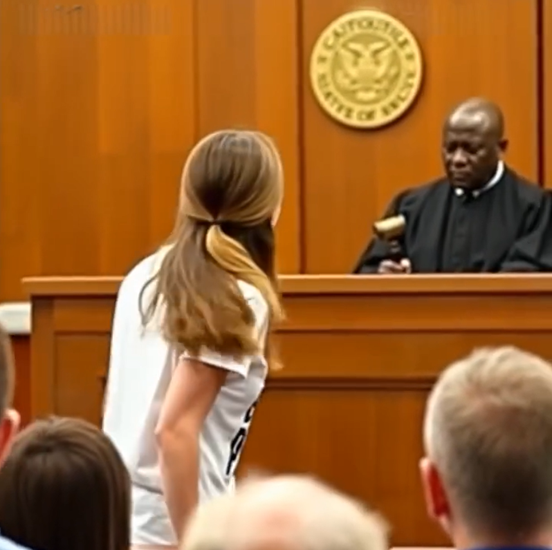
As Brianna Cole stood in the center of the courtroom, her usual bravado began to crumble. For the first time in her life, she was silent—not out of compliance, but out of sheer disbelief.
The reality of her situation started to seep into her consciousness, spreading like a slow, heavy fog over every thought and feeling. She had always been quick with words, sharp-tongued and daring, but now the energy that once propelled her arrogance seemed to vanish.
The weight of the moment pressed down on her shoulders, forcing her to confront a truth she had long avoided: this was no longer a game she could bluff her way through.
Judge Avery’s gaze swept the room, calm yet unwavering, a pillar of authority that demanded acknowledgment. He had seen countless defendants, each with their own mix of bravado and fear, but there was something uniquely defiant about Brianna.
Her recent behavior in and out of court—her choices, her attitude, and the controversial messages she had chosen to display publicly—had drawn a level of scrutiny that was impossible to ignore.
“This courtroom represents the rule of law,” Judge Avery began, his voice deliberate and resonant, echoing in the high-ceilinged chamber. “A principle that transcends personal beliefs and biases. It is a sanctuary for justice, and it demands respect from all who enter.”
The words hung in the air, heavy with gravity. The audience, previously restless and whispering among themselves, fell silent, leaning in to catch every syllable. Brianna felt a shiver run down her spine, realizing that this wasn’t a casual lecture—this was a reckoning.
Judge Avery’s eyes fixed on her, steady and unyielding, as he continued, “The actions of the defendant, both in and out of this courtroom, have shown a blatant disregard for the law and for the humanity of others. The message on your shirt, while perhaps intended as a statement, is not merely offensive. It is a testament to your unwillingness to coexist peacefully in a diverse society.”
Brianna shifted uncomfortably, her fingers clenching and unclenching as if trying to grasp some invisible anchor. The courtroom, usually a backdrop to her performances of wit and defiance, now felt confining, almost suffocating.
Her heartbeat accelerated as she realized that every whisper, every judgmental glance, every silent appraisal of her character was locked upon her. This was the moment she could no longer control.

Judge Avery paused, giving the room—and Brianna—a moment to absorb his words. Silence stretched, punctuated only by the faint creak of wooden benches and the subtle rustling of papers. He allowed the gravity of the courtroom to settle fully before continuing, his tone firm but measured.
“The court has reviewed the evidence of your conduct, Miss Cole,” he said, emphasizing each word deliberately. “Your actions have continually disrupted public peace, disregarded communal norms, and exhibited a pattern of aggression that cannot be overlooked.
This is not about punishment alone—it is about accountability and the acknowledgment of responsibility for your actions.”
The court clerk approached quietly, carrying a thick document, the weight of it seeming almost symbolic. Judge Avery took the pages, glanced at them briefly, and then returned his focus to Brianna. The hush in the room was palpable; even the air seemed suspended in anticipation.
“In light of your repeated offenses,” he said, his voice steady, “including the new evidence presented today, I have made my decision.”
The words fell like a hammer, heavy and final. Brianna’s stomach lurched, a wave of panic rising as the audience leaned forward, their collective breath held in anticipation. The judge’s eyes bore into her, an unspoken demand for understanding.
“Miss Cole,” he continued, and every eye in the room turned back to her, “you will serve a sentence of six months in county jail. This time is not merely a measure of punishment; it is an opportunity.
An opportunity to reflect on your actions, to comprehend the consequences of your choices, and to understand the profound impact that words, gestures, and deeds have on the lives of others.”
The courtroom erupted—not in noise, but in murmurs, gasps, and subdued exclamations. The gravity of the sentence, though not unprecedented, felt immense in this moment.
Brianna, who had often wielded her defiance like armor, felt her courage waver. Her face, once a mask of smug confidence, now betrayed her vulnerability. For the first time, she truly felt the consequences of her actions pressing upon her, real and undeniable.
As the judge continued to speak, Brianna’s mind raced. She recalled every moment that had led to this point—the late-night confrontations on social media, the heated debates in public spaces, the deliberate provocations that had been documented as evidence.
Each act, which she had once considered harmless or empowering, now took on a heavier, darker significance. She could see, perhaps for the first time, how her choices had affected others: the shock, the hurt, and even the fear she had instilled.
Judge Avery’s voice softened slightly, yet retained its authority. “It is essential, Miss Cole, that you recognize this sentence is not the end of your journey but rather a crucial juncture. Reflection, accountability, and change are the true measures of justice.”
A courtroom deputy stepped forward, signaling that the formalities were nearly complete. Brianna swallowed hard, her throat dry, and felt a rush of conflicting emotions: fear, regret, and a faint glimmer of understanding.
She had always prided herself on her ability to navigate the world on her terms, to challenge norms and provoke reactions—but now she understood that defiance without responsibility carried consequences far more serious than she had imagined.
As the clerk read aloud the official terms of her sentence, the room was filled with a quiet, tense energy. Every word seemed to echo in Brianna’s mind: six months, county jail, opportunity to reflect, consequences, responsibility.
They were words she would carry with her, a stark reminder that actions, no matter how justified in one’s own mind, do not exist in isolation.
Judge Avery concluded the session with one final admonition, his voice firm but infused with a measure of hope. “You are accountable, Miss Cole.
You have been given a clear mandate: to learn, to grow, and to emerge as someone who not only understands the law but respects the rights and dignity of those around you. Let this be a turning point, not merely a sentence.”
Brianna nodded slightly, a gesture almost imperceptible but profoundly significant. She felt a tightness in her chest, a mixture of fear and introspection that she had never experienced before.
For the first time, she recognized that courage was not simply about facing others—it was about facing oneself, acknowledging mistakes, and seeking a path forward.
The courtroom slowly began to empty, the spectators whispering among themselves, some sympathetic, others judgmental. The weight of the judge’s words lingered, not just on Brianna, but across the entire room.
Legal experts later noted that Judge Avery’s handling of the case was a textbook example of balancing justice with rehabilitation, emphasizing accountability while providing an opportunity for personal growth.
Outside the courtroom, Brianna’s supporters and detractors alike would dissect every element of the proceedings. Social media was soon flooded with commentary, analysis, and debate.
Headlines emphasized the six-month sentence, the controversial shirt, and the judge’s admonition, while commentators discussed the broader implications of public behavior, freedom of expression, and societal responsibility.
Yet, for Brianna herself, the moment was profoundly personal. The sentence was not merely a public statement—it was a call to internal reflection. In the quiet moments after leaving the courtroom, she began to understand the true weight of influence: how her choices, words, and actions resonated far beyond her own life.
For weeks that followed, Brianna would wrestle with what she had learned in that courtroom. Friends and family noticed a change—a newfound humility, a careful consideration before speaking, and an emerging awareness of the consequences her actions could carry.
Six months, once a daunting prospect, became a period of introspection and learning, a transformative chapter in her life.
By the time she served her sentence, Brianna had begun to develop a deeper understanding of justice, responsibility, and empathy. She realized that courage was not only standing up for oneself in the face of opposition but also recognizing when one’s behavior causes harm to others and taking deliberate steps to correct it.
When she finally stepped out of the county jail, Brianna carried with her more than just the experience of confinement; she carried a profound awareness of accountability.
Her once-brash confidence was tempered by understanding, her voice no longer merely a weapon, but a tool to build bridges, foster dialogue, and contribute to a more thoughtful society.
Judge Avery’s courtroom had become a crucible—not merely a site of punishment, but a transformative space where Brianna confronted the consequences of her actions and began the long journey toward self-awareness and growth.
For the first time in her life, she saw the connection between choices and outcomes, between words and impact, and between freedom and responsibility.
And though the courtroom had emptied, the lessons of that day would remain with Brianna Cole forever, shaping her actions, her interactions, and her perspective on justice for years to come.
