
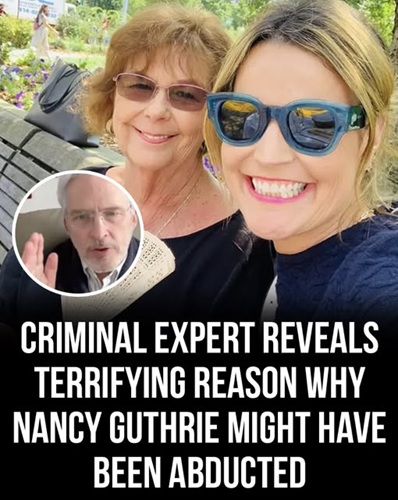
More than two weeks after 84‑year‑old Nancy Guthrie vanished from her Tucson‑area home, investigators are pursuing multiple leads and refining their understanding of what may have happened in the early hours of January 31, 2026.
The high‑profile disappearance — widely covered across U.S. and international media — has drawn public attention, expert analysis, and urgent appeals from Nancy’s family, including her daughter, Today show co‑anchor Savannah Guthrie.
Authorities in Pima County, Arizona have classified Nancy’s disappearance as a criminal matter rather than a routine missing‑person case, pointing to evidence at the scene that suggests she was taken against her will.
As more details become public, forensic specialists and former law enforcement officials continue to weigh in with professional theories — outlining how physical evidence, security footage, and device data may fit into an increasingly troubling picture.
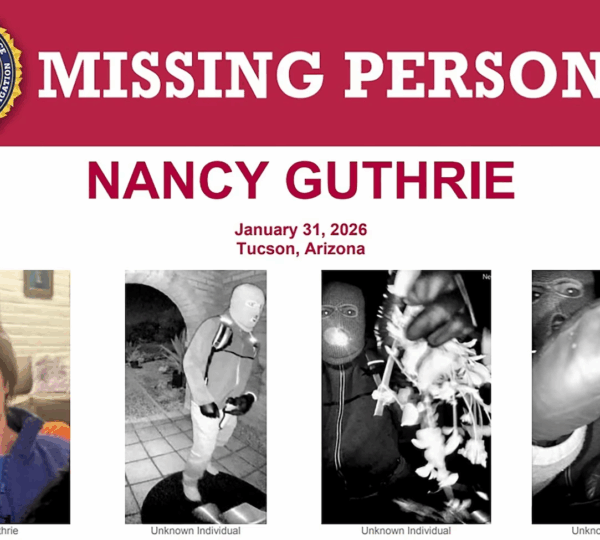
Timeline: Last Known Whereabouts and Missing Report
Nancy Guthrie was last seen at her home in the Catalina Foothills area just outside Tucson on the evening of Saturday, January 31, 2026, when she was dropped off by her son‑in‑law, Tommaso Cioni, following a family dinner.
Cioni — who is married to Nancy’s daughter Annie Guthrie — is the last known person to see her at approximately 9:50 p.m. that night.
The following morning, Nancy did not appear on her regular church livestream, an event she attended reliably, according to relatives.
Concern mounted rapidly, and family members went to her home around 11 a.m. on February 1 only to find her missing. Personal items — including her phone and essentials — remained inside the house, heightening concerns about foul play.
A 911 call was placed shortly thereafter, and the Pima County Sheriff’s Department (PCSD) initiated an investigation.
Early Evidence: Forensic Findings at the Scene
Investigators treated Nancy’s residence as a crime scene from the outset. Law enforcement noted several pieces of evidence that led them to conclude that she had not left voluntarily:
-
Blood droplets and DNA evidence were found on the porch and driveway of her home. Forensic experts have confirmed that the blood belonged to Nancy, and its pattern has raised serious questions about what may have occurred at the scene.
-
The PCSD also located a single black glove in the general area of her property. DNA analysis from that glove was submitted to the FBI’s laboratory and entered into national databases — although initial results shared by the sheriff’s department indicated no match to known profiles in the FBI system.
Forensic pathologist Dr. Michael Baden, speaking with media outlets, described the blood pattern as consistent with bleeding from the face or hands, perhaps from an abrupt struggle or confrontation rather than a simple accident or minor injury.
That suggestion aligns with the theory that Nancy may have been hurt at the onset of the incident, rather than left unharmed.
Doorbell Camera Footage and Suspect Description
A major breakthrough in the case came with the recovery and release of previously unrecoverable doorbell camera footage.
The footage, which the FBI and PCSD were able to extract from the device’s internal files despite initial corruption, shows a masked individual outside Nancy’s front door at approximately 2:00 a.m. on the morning of February 1.
The suspect seen in the video is described as:
-
A male, approximately 5′9″ to 5′10″ tall
-
Of average build
-
Wearing gloves, a ski mask, and carrying a black 25‑liter Ozark Trail backpack
-
Appearing to tamper with or attempt to disable the doorbell camera before approaching the porch area
Former law enforcement and cybersecurity experts have noted that the subject appears aware of the camera’s location — a detail indicated by moments where the individual avoids directly facing the lens and adjusts or blocks visible sensors.
This behavior has been interpreted as more deliberate than what might be expected in a spontaneous trespass, suggesting familiarity with security systems or calculated intent.
The FBI and sheriff’s department have released several still images and video clips from this footage to the public in hopes that someone might recognize the individual or provide additional leads. Despite the release, no suspect has yet been publicly identified or charged.
Expert Theories: Possible Abduction Sequence
While investigators have not confirmed a definitive sequence of events, criminal analysts have offered scenarios that could help make sense of the available evidence.
One prevailing theory is that the incident may have started as an unauthorized intrusion or burglary that unexpectedly escalated.
Former law enforcement professional Morgan Wright suggested that if an intruder initially intended to commit a property crime and was suddenly confronted by Nancy or otherwise recognized, the situation could have turned into a violent abduction.
Wright pointed to the fact that sudden escalation from burglary access to violence can occur when an offender fears identification or believes they cannot leave a witness behind.
The presence of the gloves, the deliberate movements in the footage, and the lack of interior struggle signs have led some analysts to propose that the suspect might have sought to minimize noise and detection — a behavior often associated with planned unlawful entry rather than a random encounter.
Others point out that without more direct evidence, motive remains unconfirmed and may not be limited to burglary gone wrong. Authorities have not publicly confirmed any motive.
Pacemaker Data: Narrowing the Timeline
Another key piece of data in the investigation comes from Nancy’s pacemaker device. While investigators have not publicly released detailed medical logs, information available from officials indicates that the device stopped communicating with its paired phone at approximately 2:28 a.m. on February 1.
Pacemaker connectivity to phones or monitoring apps can cease for benign reasons, such as distance between the charger and the paired device.
However, experts note that changes in heart rate or abrupt loss of signal during a stressful event could provide a valuable timeline reference.
Dr. Michael Lauer, a cardiologist and former deputy director at the National Institutes of Health, has likened pacemaker data to a kind of “black box” that may help investigators pinpoint when things went wrong if the device recorded physiological irregularities before communication dropped — though definitive conclusions require technical access to the device’s internal logs, which may not be publicly available.
Search Efforts, Leads, and Investigative Actions
Since Nancy’s disappearance was reported on February 1, law enforcement agencies including the Pima County Sheriff’s Department, FBI, and several local police departments have been involved in an ongoing investigative effort that includes:
-
Field searches of nearby areas using ground teams, search dogs, and aerial drones
-
Execution of search warrants at locations within a few miles of her home, including residential properties. One such search was conducted near First and Orange Grove in Tucson; no arrests were made, but forensic evidence and follow‑up leads were collected.
-
Traffic stops and detentions of individuals connected to investigative leads, including one man in Rio Rico, who was detained and interviewed before being released without charges.
-
Collaboration with neighboring agencies, including Marana, Oro Valley, and Sahuarita police, as part of coordinated search and interview procedures.
Authorities have emphasized that the investigation remains active and fluid, with detectives continuing to follow up on tips.
DNA, Forensics, and Ongoing Testing
In addition to the blood evidence and glove sampling, investigators are also analyzing other DNA discoveries at the scene.
According to sheriff’s department statements, DNA found inside Nancy’s residence that did not belong to her or household contacts has been submitted for testing to help identify possible connections to the suspect or suspects. These results have not yet been publicly disclosed.
The FBI has also been processing DNA from the glove that may match the suspect’s profile. Results are being cross‑referenced against national databases in hopes of generating actionable matches.
These forensic steps illustrate the meticulous, time‑consuming nature of strong investigative work — and reflect authorities’ emphasis on building a factual, evidence‑based case rather than relying on social media speculation.
Clearing the Family of Suspicion
Early in the investigation, online speculation arose about whether family members — particularly the son‑in‑law who last saw Nancy — could be involved.
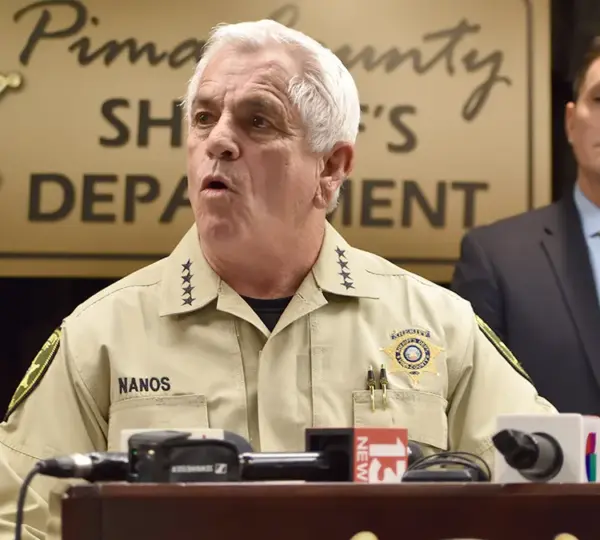
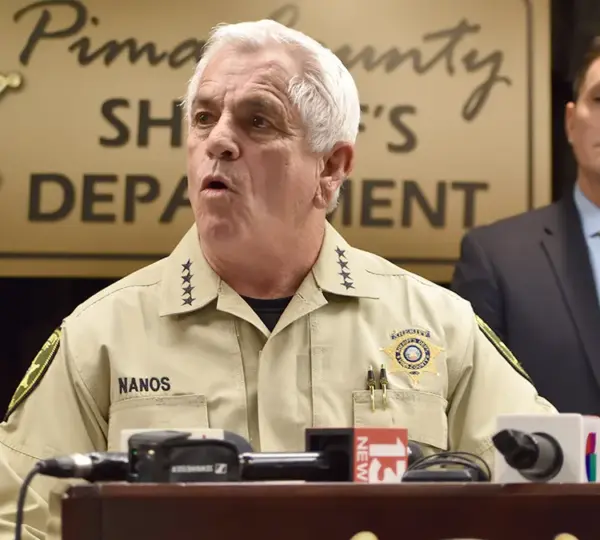
In a public statement, Sheriff Chris Nanos made it clear that **all Guthrie family members, including siblings and their spouses, have been cleared as possible suspects.
He emphasized that the family has been cooperative and that suggesting otherwise is “cruel” and unhelpful to the search effort.
This public clarification was intended to reaffirm the investigative focus on evidence and credible leads, not conjecture — and to underscore that the Guthrie family themselves are victims in this traumatic situation.
Public Appeals and Increased Reward
As the investigation continues, authorities and Nancy’s family have made repeated public appeals for information.
Savannah Guthrie has personally urged the individual or individuals responsible to “do the right thing” and release her mother safely, emphasizing that any information — no matter how small — could be crucial to finding Nancy alive.
The FBI has also significantly increased the reward for information to $100,000, doubling the initial offer to encourage tips that can lead to Nancy’s safe return or to the arrest and conviction of a suspect or suspects.
Authorities continue to urge the public to submit credible information directly to law enforcement rather than relying on online speculation or unverified commentary on social media platforms.
Unresolved Questions and Ongoing Search
Despite the mounting evidence and expert input, many questions remain unanswered:
-
Where is Nancy Guthrie now? As of this writing, she has not been located.
-
What was the motive behind the apparent abduction? Investigators have not publicly stated a motive or concluded why Nancy may have been targeted.
-
Is the suspect acting alone or with accomplices? Law enforcement has not ruled out the possibility of more than one individual being involved.
Sheriff Nanos has acknowledged that the search could take “weeks, months, or longer” and that investigators “won’t quit” in following leads and analyzing evidence in hopes of resolving the case.
️ Family Impact and Public Concern
Nancy’s disappearance has affected not only her family but also communities beyond Arizona. Viewers of the Today show, local residents, and true‑crime observers across the country have followed the case with concern and empathy.
Savannah Guthrie’s heartfelt public appeals have amplified awareness and reinforced the urgency of the search.
Family members have consistently expressed their hope that Nancy is still alive and can be returned safely. Meanwhile, law enforcement continues to emphasize that investigators have evidence suggesting foul play and are committed to using every available resource to find answers.
Conclusion: An Ongoing and Active Investigation
As the Nancy Guthrie case enters its third week, the investigation remains open, complex, and evolving. Experts’ analysis of the physical evidence — including blood patterns and doorbell footage — has helped shape professional theories about what may have unfolded during the early morning hours of February 1.
Law enforcement has publicly highlighted key pieces of evidence and continues to work with federal partners to track leads and identify suspects.
For now, official updates, forensic testing, and public cooperation are central to the effort. With a national spotlight on the case, authorities maintain that credible tips and well‑documented evidence are the most effective ways to advance the investigation and, ultimately, bring Nancy Guthrie home safely.
