

Christina Applegate has never been someone to hide behind polished headlines or carefully filtered public statements.
At 54, the Emmy-winning actress has chosen candor over comfort, speaking openly about the realities of living with multiple sclerosis (MS) and the profound impact it has had on her body, her career, and her sense of self.
Five years after revealing her diagnosis in 2021, Applegate says the disease has dramatically reshaped her daily life.
While she continues to use humor — a trademark that has defined her career since her breakout role on Married… with Children — she is also unflinchingly honest about the pain, exhaustion, and limitations she faces.
A Diagnosis That Changed Everything
In August 2021, Applegate publicly shared that she had been diagnosed with multiple sclerosis. Writing on X (formerly Twitter), she described the experience as “a strange journey,” adding that she had been supported by others living with the condition.
Even in that first announcement, her signature wit was present. “It’s been a tough road,” she wrote. “But as we all know, the road keeps going. Unless some a**hole blocks it.”
Behind the humor, however, was the beginning of a life-altering chapter.
Multiple sclerosis is a chronic autoimmune disease in which the body’s immune system mistakenly attacks the protective covering of nerve fibers in the brain and spinal cord.
This damage disrupts communication between the brain and the rest of the body, leading to symptoms that can include muscle weakness, stiffness, balance problems, vision issues, fatigue, and cognitive changes. The disease varies widely from person to person and currently has no cure.
According to the National Multiple Sclerosis Society, nearly one million people in the United States live with MS, and women are two to three times more likely than men to be diagnosed.
Treatments aim to manage symptoms, reduce relapses, and slow progression, but there is no known way to reverse the damage once it occurs.
Bedridden for Much of the Day
In a recent interview with People magazine, Applegate spoke candidly about how MS affects her daily routine. She revealed that she is often bedridden for much of the day due to fatigue, pain, and mobility challenges.

Yet there is one daily ritual she refuses to give up: taking her 15-year-old daughter, Sadie, to school. Sadie is her daughter with husband Martyn LeNoble, and that short drive has become one of the most meaningful parts of her day.
“I want to take her; it’s my favorite thing to do,” Applegate shared. “It’s the only time we have together by ourselves.” She explained that she prepares herself mentally for the effort it requires.
“I tell myself, ‘Just get her there safely and get home so you can get back into bed.’ And that’s what I do.”
For many parents, the school drop-off is routine. For Applegate, it is a carefully measured use of limited physical energy — a daily reminder of what MS has taken, and what she is determined to hold onto.
Recognizing the First Symptoms
Applegate began noticing subtle but concerning symptoms while filming the first season of Dead to Me, the critically acclaimed Netflix dark comedy in which she starred opposite Linda Cardellini.
She experienced tingling in her toes and a sensation that her legs were unstable, as though they might give out beneath her.

At first, the symptoms were easy to dismiss. Long shooting days are physically demanding, and exhaustion can cause anyone to feel off balance.
“We’d been shooting probably 14 or 15 hours,” she recalled in past interviews. “It seemed completely reasonable that anybody would be collapsing.”
But the symptoms persisted and intensified. Within months, she arrived on set in a wheelchair. Eventually, testing confirmed that she had multiple sclerosis.
The diagnosis came while production on Dead to Me was underway. Filming paused to allow her time to begin treatment. When production resumed, the show’s team adjusted schedules and camera angles to accommodate her physical limitations.
The third and final season of the series was completed under these new realities, marking what may be her final on-screen acting performance.
A Public Return — Barefoot and Honest
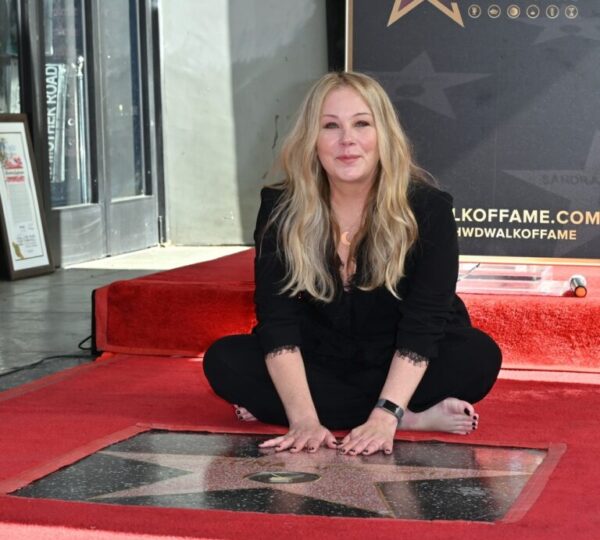
In November 2022, Applegate made her first major public appearance since announcing her diagnosis. She received a star on the Hollywood Walk of Fame, an honor recognizing her decades of work in television and film.
She arrived barefoot, leaning on a cane for support.

Later, she explained on X that for some people with MS, the sensation of wearing shoes can be painful or destabilizing. “For some with MS, the feeling of shoes may hurt or make us feel off balance,” she wrote. “So today I was me. Barefoot.”
She also acknowledged that she cannot stand for extended periods. The moment was emotional, filled with gratitude but also marked by the visible reality of her condition.
It was not a triumphant return in the traditional Hollywood sense — it was something more powerful: an honest representation of disability.
“It’s Never a Good Day”
In 2023, Applegate described the day-to-day unpredictability of MS in blunt terms. “With the disease of MS, it’s never a good day,” she said in an interview.
“There are just certain things that people take for granted in their lives that I took for granted.”
She listed simple activities — going down the stairs, carrying groceries — that now feel daunting or impossible. Fatigue, a hallmark symptom of MS, can be overwhelming and unrelenting. Pain, nerve sensations, and balance issues compound the difficulty.
On the Armchair Expert podcast, hosted by Dax Shepard, Applegate revealed that she has approximately 30 lesions on her brain.

These lesions, areas of damaged nerve tissue, can cause a variety of neurological symptoms. She described experiencing what she called a “seizure-y” sensation in her head at times — a frightening and disorienting feeling.
“This is the worst thing that has ever happened to me,” she admitted. “I hate it so much. I’m so mad about it.”
Her anger is not directed at any one person or event; it is the frustration of someone whose independence and identity have been altered without consent. MS is unpredictable, and that uncertainty can be emotionally exhausting.
Humor as Armor
Despite the seriousness of her condition, Applegate continues to use humor as a coping mechanism. At the 2024 Emmy Awards, she received a standing ovation when she appeared on stage.
With characteristic irreverence, she joked, “Thank you so much. Oh my God. You’re totally shaming me with disability by standing up; it’s fine. Body not by Ozempic.”
The comment blended self-awareness, sarcasm, and cultural commentary — hallmarks of her comedic style. For Applegate, humor is not denial; it is survival.
A Career That May Have Reached Its Final Chapter
Applegate has indicated that Dead to Me may have been her final on-screen acting role. The physical demands of production, combined with the unpredictability of MS, make traditional filming schedules extremely difficult.
However, she has expressed interest in remaining in the entertainment industry in other capacities, such as producing or voice acting.
Voice work, in particular, could allow her to continue performing without the physical strain of on-camera work.
Her career spans decades, from her early fame as Kelly Bundy on Married… with Children to acclaimed performances in films and television.
She has won an Emmy Award and earned multiple nominations for her work. Stepping back from acting is not a decision taken lightly, but one shaped by medical reality.
A History of Resilience
MS is not the first serious health battle Applegate has faced. In 2008, she was diagnosed with breast cancer and underwent a double mastectomy.
She later became an advocate for early detection and genetic testing, having tested positive for a BRCA gene mutation.
Her experience with cancer, followed years later by an MS diagnosis, has reinforced her understanding that life rarely follows a tidy script.
“People’s lives, sorry for lack of a better term, f**ing suck sometimes,” she said candidly. “So I’m being as honest and raw as I possibly can.”
That honesty extends beyond her physical health. In her upcoming memoir, You With the Sad Eyes, set for release on March 3, Applegate explores her childhood, early fame, and personal struggles.
Writing From Bed
Because MS leaves her in bed for much of the day, Applegate has described her bed as both refuge and workspace.
It became the place where she wrote her memoir — a deeply personal project that reflects on her journey from child actor to global celebrity, and the challenges that accompanied that path.
She has described the book as “about a little girl with sad eyes who ended up becoming Christina Applegate.” The memoir addresses her experiences with teen fame, complicated relationships, her mother’s struggles with substance dependency, and her own battles with illness.
Her mother, Nancy Priddy, known for her work on Bewitched, raised Applegate as a single parent.
Applegate has spoken about growing up in an environment that included instability and exposure to adult problems at a young age. She has said that writing about those years was emotionally difficult but necessary.
She has also discussed surviving inappropriate behavior and unhealthy relationships in her youth, explaining that she sometimes gravitated toward “broken birds” she hoped to fix.
Rather than framing her memoir as purely inspirational, she has emphasized its honesty.
Protecting Her Mental Health
Living with a chronic, progressive disease has required Applegate to prioritize her mental health. She has shared that beginning therapy was “a big thing” for her — an important step in processing anger, grief, and fear about the future.
Chronic illness often brings a form of mourning: mourning the body you once had, the ease of daily movement, the spontaneity that physical strength allows.
For someone whose career involved public performance and physical expression, that loss can feel particularly acute.
Still, Applegate continues to show up — for her daughter, for interviews, for advocacy, and for her own healing process.
Living With MS, Publicly and Honestly
Christina Applegate’s openness has contributed to broader awareness about multiple sclerosis.
By speaking plainly about lesions, fatigue, mobility aids, and emotional impact, she challenges the misconception that chronic illness must be hidden or minimized.
Her story is not one of simple triumph or easy optimism. It is a story of adaptation. Of anger and humor existing side by side. Of a mother determined to drive her daughter to school even if it means spending the rest of the day recovering in bed.
At 54, she is navigating a reality she did not choose. Yet she remains, unmistakably, herself — sharp-tongued, self-aware, vulnerable, and resilient.
Her life may look very different than it did five years ago. The red carpets are fewer. The acting roles may be finished. The daily routine is shaped by energy levels and physical limits.
But Christina Applegate continues to speak with clarity and courage about what it means to live with multiple sclerosis.
And in doing so, she offers something valuable to others facing chronic illness: permission to be angry, permission to be tired, permission to laugh, and permission to tell the truth.
