
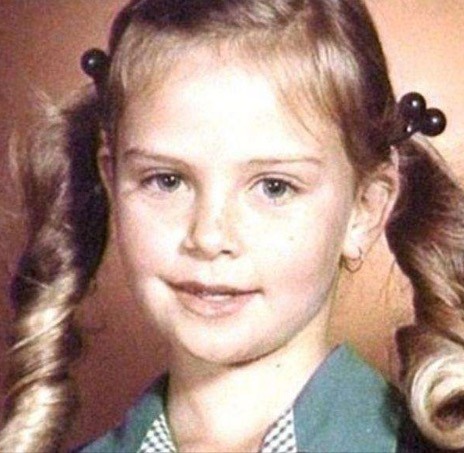
As a young girl growing up in South Africa, she experienced a tragedy that would forever shape the course of her life. At just 15 years old, she witnessed her mother fatally shoot her abusive father in an act of self-defense.
It was a moment of terror, survival, and irreversible change. Yet from that darkness emerged one of the most respected and accomplished actresses in modern cinema — Charlize Theron.
Today, she is recognized not only as an Academy Award winner but also as a producer, activist, and one of the most influential figures in Hollywood.
Her journey to global fame was not paved with privilege or easy opportunity. Instead, it was forged through hardship, resilience, and an unwavering determination to rise above circumstances that might have broken someone else.
Early Life in South Africa
Charlize Theron was born on August 7, 1975, in Benoni, a small city near Johannesburg, South Africa. She was raised on her parents’ farm outside the city.
Her father, Charles Theron, and her mother, Gerda Maritz, worked in road construction, and the family was part of the Afrikaner community, with ancestry tracing back to Dutch, French, and German settlers.
Some of her French ancestors were among the early Huguenots who settled in South Africa centuries ago. She is also distantly related to Danie Theron, a military figure from the Second Boer War.
Afrikaans was her first language. English came later, as she attended school and began imagining a life beyond her rural upbringing. Though she would eventually become known for her polished American accent, her roots remained deeply South African.
From the outside, her childhood might have appeared stable. But behind closed doors, life was far more complicated.
A Difficult Childhood
Growing up, Theron often felt like an outsider. She has openly spoken about being bullied in school, particularly between the ages of seven and twelve.
She wore thick glasses due to poor eyesight and described herself as awkward and unsure of where she fit in socially.
In interviews, she has recalled being infatuated with a popular girl at school and feeling devastated when she was excluded. She longed to belong but often felt invisible.
The teasing and isolation left an emotional mark, though she has said she grew more resilient by the time she reached high school.
While school presented its own challenges, the more profound struggles were at home.
Her father struggled with alcoholism. Theron has described him as a tall man with skinny legs and a big belly, someone who could be serious yet also enjoyed laughter and life.
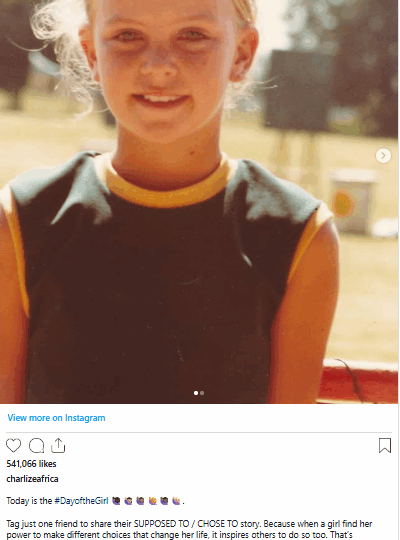
However, his addiction created instability and fear within the household. She has clarified that he was not physically abusive toward her, but he was verbally abusive, and his drinking led to volatility and tension.
Living with addiction in the family shaped her understanding of trauma from a young age. She has since spoken openly about how growing up with an alcoholic parent affects a child’s sense of security and emotional development.
The Night That Changed Everything
On June 21, 1991, when Charlize was 15 years old, events escalated in a way that would permanently alter her life.
Her father came home intoxicated and enraged. According to Theron’s own accounts in interviews with outlets such as NPR and The New York Times, he began threatening both her and her mother. The situation quickly turned dangerous.
Theron and her mother retreated into her bedroom and leaned against the door, attempting to prevent him from entering. He stepped back and fired three shots through the door. Miraculously, none of the bullets struck them.
Fearing for their lives, Gerda Maritz retrieved her own handgun and shot her husband. He died from his injuries. The shooting was investigated and legally ruled an act of self-defense. Her mother faced no criminal charges.
Though the courts determined the action was justified, the emotional consequences were immense. Theron has said that the trauma did not end that night. In many ways, the aftermath — the silence, the processing, the weight of what had occurred — lingered even more deeply.

She has never framed the event as a scandal or a source of shame. Instead, she has spoken about it as part of a broader conversation about family violence and addiction.
“This kind of violence that happens within the family is something that I share with a lot of people,” she has said. “I’m not ashamed to talk about it.”
Her openness has resonated with many who have experienced similar trauma. Rather than allowing the tragedy to define her in a negative way, she used it as a source of strength.
From Ballet Dreams to Hollywood
Before acting became her primary ambition, Theron trained as a ballet dancer. As a teenager, she attended a boarding school focused on the arts in Johannesburg. At 16, she won a local modeling competition, which allowed her to travel to Milan for work. Modeling gave her financial independence and exposure to the world beyond South Africa.
Eventually, she moved to New York City to pursue ballet more seriously. However, a knee injury ended her aspirations of becoming a professional dancer. Devastated but determined, she shifted her focus toward acting.
At 19, she moved to Los Angeles with little money and no industry connections. According to her own accounts, a chance encounter helped launch her career. While arguing with a bank teller over a bounced check, a talent agent noticed her intensity and presence. That agent introduced her to casting opportunities.
It was not an overnight success story. She faced auditions, rejection, and the struggle of being perceived primarily as a beautiful face rather than a serious performer.
Breaking Through in Film
Her early roles included appearances in films such as 2 Days in the Valley (1996). But her breakthrough came in 1997 with The Devil’s Advocate, where she starred alongside Al Pacino and Keanu Reeves. The performance brought her mainstream attention.
Throughout the late 1990s and early 2000s, she took on a range of roles, steadily building credibility. However, it was her transformation in Monster that cemented her status as a powerhouse actress.
In Monster, she portrayed serial killer Aileen Wuornos. Theron underwent a dramatic physical transformation for the role, gaining weight and altering her appearance to accurately represent Wuornos. The performance was widely acclaimed.

In 2004, she won the Academy Award for Best Actress for her work in Monster. The win was historic, making her the first South African to win an acting Oscar. Film critic Roger Ebert called it one of the greatest performances in cinema history.
Rather than choosing glamorous roles that reinforced Hollywood stereotypes, Theron consistently selected complex, layered characters.
Reinventing Herself in Action Cinema
As she entered her late 30s and early 40s — a period when many actresses find roles diminishing — Theron once again redefined her career.
In Mad Max: Fury Road, she portrayed Imperator Furiosa, a fierce and commanding warrior. The film was a critical and commercial success, and her performance was widely praised. Furiosa became an iconic character, demonstrating that female-led action roles could dominate blockbuster cinema.
She followed this with roles in films like Atomic Blonde and The Old Guard, proving her versatility in action genres traditionally dominated by men.
Portraying Darkness with Understanding
Theron has portrayed several characters connected to violence or moral complexity. Some observers have noted the irony of her willingness to explore dark roles given her personal history. But she has explained that she is deeply interested in the “why” behind human behavior.
Regarding Aileen Wuornos, she has said that society often labels individuals without seeking to understand the root causes of their actions. Her approach as an actress has been to humanize even the most difficult characters, not to excuse their actions but to explore the humanity beneath them.
Her ability to confront darkness without fear may stem from having already faced profound trauma in her own life.
Advocacy and Influence
Beyond acting, Theron has become an advocate for women’s rights and HIV/AIDS awareness, particularly in Africa. She founded the Charlize Theron Africa Outreach Project (CTAOP), focusing on youth health and education in her home country.
In 2016, Time magazine named her one of the 100 most influential people in the world. She has also received a Golden Globe Award and multiple nominations for other major honors.
Her career demonstrates longevity, adaptability, and a refusal to be confined by industry expectations.
Strength Through Survival
Theron has described herself as a survivor. Rather than allowing trauma to silence her, she has used her voice to speak openly about addiction, domestic violence, and resilience.
“I survived that, and I’m proud of that,” she told The New York Times. She has emphasized that she is not afraid of darkness, but rather intrigued by what it reveals about human nature.
Her story is not one of overnight success or simple triumph. It is a story of persistence — of a young girl who endured bullying, family violence, and personal loss, and who transformed those experiences into strength and empathy.
From a farm in Benoni to the global stage of the Academy Awards, Charlize Theron’s journey reflects courage, discipline, and authenticity. She refused to be boxed in, refused to be defined solely by beauty, and refused to let tragedy dictate her future.
In an industry that often sidelines women as they age, she continues to evolve, produce, and lead. Her life stands as evidence that even the most painful beginnings do not determine one’s destiny.
Instead, they can become the foundation for extraordinary achievement.
