
At first glance, the image seems deceptively simple: a vibrant, cartoon-style field filled with cheerful sheep standing close together.
Their wool is soft and fluffy, their faces round and friendly, and their large eyes are wide open, giving an impression of uniform attentiveness.
For anyone casually glancing at the picture, the scene may appear calm and straightforward—a pastoral tableau of innocent, identical creatures grazing side by side.
Yet, upon closer inspection, a few subtle differences begin to emerge. Some sheep have their eyes closed, peacefully asleep, while the majority remain alert, gazing outward.
This tiny variation is the crux of the puzzle. Your task is clear: count how many sheep are sleeping among the crowd of wide-eyed grazers.
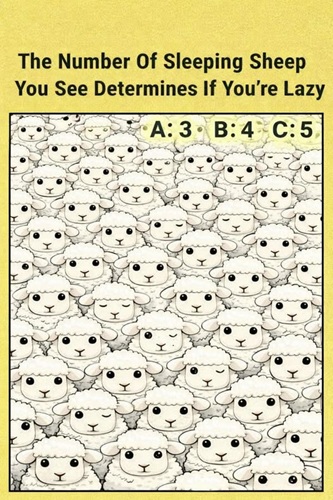
On the surface, this seems easy. However, the challenge becomes surprisingly intricate the longer you stare, revealing the remarkable ways our brains process visual information.
For many observers, the answer seems obvious at first, but differing counts quickly emerge. Some viewers spot three sleeping sheep, others identify four, and a few claim there are five.
The discrepancy is not about trickery or deception in the illustration; it lies in how human perception works. This playful puzzle, often accompanied by captions suggesting your answer reflects your personality type, actually offers insight into attention to detail, visual discrimination, and cognitive processing.
Why Counting Sleeping Sheep Is Harder Than It Seems
The difficulty in identifying sleeping sheep lies in the subtlety of the visual cues. Most of the sheep are cartoonishly similar: round woolly bodies, similar ear shapes, identical cheerful expressions.
Because of this uniformity, the human brain tends to group them together, assuming sameness—a phenomenon known in cognitive psychology as pattern recognition and visual grouping.
Pattern recognition allows us to process complex visual information efficiently. In real-world scenarios, this ability helps us quickly identify friends in a crowd, recognize familiar objects, or spot predators in nature.
Our brains are wired to detect repeating shapes and forms, which is an evolutionary advantage. However, this efficiency comes at a cost: small differences, like a closed eye or a minor facial expression change, can easily be overlooked.
When you look at the cartoon field of sheep, your brain initially scans for the dominant pattern: a sea of wide-eyed, cheerful faces. Only when you slow down, refocus, and examine each sheep individually do the subtle variations—sleeping sheep—become apparent.
This explains why some participants in the puzzle spot only three sleeping sheep, while more meticulous observers can find four or five.
What Your Count Says About You
While playful personality tests often accompany these puzzles, there is some truth in how they reflect observation style and cognitive habits:
-
Three Sleeping Sheep: If you found three, you likely rely on quick scanning and big-picture thinking. You process visual information efficiently but may prioritize speed over detailed analysis. This approach can be advantageous in fast-paced environments but might miss subtle nuances.
-
Four Sleeping Sheep: Spotting four suggests a balanced cognitive style, combining speed with careful verification. You notice patterns quickly but also double-check details when necessary. This ability is often useful in both professional and personal contexts where accuracy and efficiency are important.
-
Five Sleeping Sheep: Identifying five sleeping sheep indicates a high attention to detail and strong visual discrimination skills. You carefully examine patterns, notice irregularities, and are willing to slow down to ensure accuracy. Such a meticulous approach is beneficial in fields like research, quality control, and problem-solving tasks that require thoroughness.
It is important to note, however, that these interpretations are not definitive psychological assessments. The number of sleeping sheep you spot is more about perceptual style and focus at a given moment than a strict personality categorization. Still, puzzles like this are valuable exercises for cognitive agility and attentional skills.
The Science Behind Hidden-Object Puzzles
This sleeping sheep challenge belongs to a broader category of hidden-object puzzles, a type of visual brain teaser designed to engage the mind’s ability to detect subtle differences.
These puzzles rely on several fundamental principles of cognitive neuroscience and visual psychology:
-
Visual Discrimination: The capacity to identify minor differences in shape, color, or orientation among similar objects. In the sheep puzzle, this involves distinguishing the sleeping sheep’s closed eyes from the alert ones.
-
Selective Attention: The process by which the brain focuses on certain visual elements while ignoring others. Initially, your attention may be drawn to the overall pattern—the sea of alert sheep—rather than the small deviations.
-
Gestalt Principles: Psychological theories about how humans perceive patterns and organize visual elements. The principle of similarity suggests that objects that look alike are grouped together. In this puzzle, the similarity of the sheep creates a “visual crowding” effect, making it easy to overlook the differences.
-
Top-Down vs. Bottom-Up Processing: Top-down processing involves using prior knowledge and expectations to interpret sensory information. Bottom-up processing is data-driven, relying on careful examination of individual elements. Observers who rely more on top-down processing might miss the sleeping sheep, while bottom-up thinkers are more likely to detect all of them.
Through repeated practice with hidden-object puzzles, people can strengthen their visual discrimination and attention control, improving cognitive flexibility and working memory—the ability to hold and manipulate information in your mind.
Why Puzzles Like This Matter
While at first glance a cartoon field of sheep may seem purely whimsical, engaging with such puzzles has real cognitive benefits:
-
Enhancing Observation Skills: Regularly challenging the brain to find subtle differences trains it to notice fine details, which can be applied in everyday life and professional tasks.
-
Boosting Focus and Patience: Successfully finding hidden objects often requires slowing down and examining the environment carefully, fostering mindfulness and patience.
-
Improving Memory: Many hidden-object puzzles require remembering the locations of previously inspected items, enhancing both visual and spatial memory.
-
Stress Relief and Mental Exercise: Engaging with puzzles stimulates the brain while offering a playful break from routine stress, encouraging neuroplasticity, the brain’s ability to form new connections.
In essence, hidden-object puzzles serve as both entertainment and mental exercise, blending fun with practical cognitive training.
Tips for Finding the Sleeping Sheep
If you want to maximize your chances of spotting all the sleeping sheep, consider applying these strategies:
-
Take Your Time: Don’t rush. Let your eyes move methodically across the entire field, row by row.
-
Look for Subtle Differences: Focus specifically on small deviations in eye shape, ear positioning, or facial expression.
-
Use Peripheral Vision: Sometimes, scanning the image from the corner of your eye helps catch details that direct focus might miss.
-
Divide and Conquer: Mentally segment the field into smaller sections and examine each one separately. This approach reduces the cognitive load and makes spotting differences easier.
-
Relax Your Brain: Paradoxically, relaxing your mind can make hidden details more noticeable. Overthinking or intense focus may prevent your brain from recognizing subtle variations.
By applying these strategies, even those who initially spot only three sleeping sheep may discover all five with careful observation.
The Broader Implications of Visual Puzzles
Beyond the entertainment factor, hidden-object puzzles like this sheep challenge reflect fundamental aspects of human cognition. Researchers in psychology and neuroscience study similar tasks to understand how humans perceive, interpret, and respond to visual stimuli.
-
Perception and Pattern Recognition: Humans excel at detecting patterns and anomalies in the environment—a skill that historically helped in survival by identifying predators, prey, or environmental changes.
-
Cognitive Bias and Expectation: The tendency to assume uniformity in visual patterns is linked to cognitive shortcuts, known as heuristics, which streamline perception but can sometimes lead to errors.
-
Learning and Adaptation: Repeated exposure to subtle visual challenges improves accuracy, demonstrating the brain’s capacity for learning and adaptive problem-solving.
By turning a simple cartoon image into a cognitive exercise, the sleeping sheep puzzle exemplifies how playful activities can enhance mental acuity, providing a low-stakes yet effective way to strengthen visual processing skills.
Why We Love Brain Teasers
Humans are naturally drawn to puzzles because they offer a sense of curiosity, challenge, and reward. Successfully identifying hidden elements triggers dopamine release, the neurotransmitter associated with pleasure and motivation.
Even simple visual tasks, like spotting sleeping sheep, can stimulate the brain’s reward system and leave us feeling accomplished.
Additionally, puzzles often provide a safe environment to practice problem-solving skills. Unlike real-life challenges, visual brain teasers have no real consequences for errors, allowing the mind to experiment, adjust strategies, and learn without risk. This reinforces cognitive resilience and creative thinking.
Conclusion: A Simple Image, Profound Insights
What began as a playful cartoon image of sheep hiding subtle clues about which of them are asleep becomes much more than a mere guessing game.
It offers insight into how the human mind processes information, balances speed with accuracy, and detects subtle deviations in seemingly uniform patterns.
Whether you found three, four, or all five sleeping sheep, you engaged in a meaningful cognitive exercise. The number of sheep you spotted may reflect your observation style, attention to detail, and problem-solving approach, providing a small but valuable window into your cognitive processes.
In a world often dominated by rapid scrolling, multitasking, and fleeting attention spans, puzzles like this encourage mindful observation, patience, and reflection.
They remind us that even simple, seemingly whimsical activities can challenge the brain, sharpen perception, and cultivate mental agility.
So next time you glance at a group of cheerful cartoon sheep, remember: there’s more than meets the eye. And the hidden sheep aren’t just a test of vision—they’re a window into the fascinating, intricate ways our brains make sense of the world.
“Whether you spot three, four, or five sleeping sheep, you exercised your attention, honed your observational skills, and gave your brain a fun workout. And that, in itself, is always a win.”
