
Optical illusions and brain teasers have a unique way of capturing our attention, often drawing us in with the promise of fun, mystery, and intellectual challenge.
Unlike standard puzzles that rely solely on logic or memory, optical illusions engage our perception, attention to detail, and cognitive processing in ways that are both entertaining and educational.
They remind us that our brains are not always literal interpreters of what we see; instead, they constantly make assumptions, fill in gaps, and sometimes deceive us.
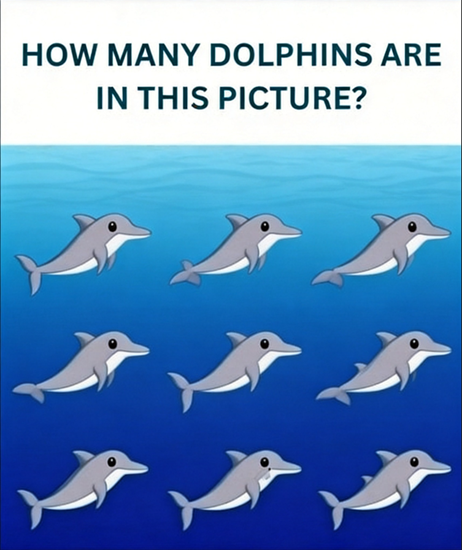
Among these captivating visual puzzles, one of the most intriguing is a dolphin illusion, which combines natural beauty with a hidden cognitive challenge.
At first glance, this dolphin illusion appears deceptively simple. The image depicts a serene ocean scene with dolphins swimming gracefully in the water.
The dolphins are portrayed mid-leap or gliding just beneath the surface, surrounded by gentle waves, ripples, and subtle highlights of sunlight reflecting off the sea. The colors are soothing—shades of turquoise, deep blue, and silvery gray—providing a calm and inviting atmosphere.
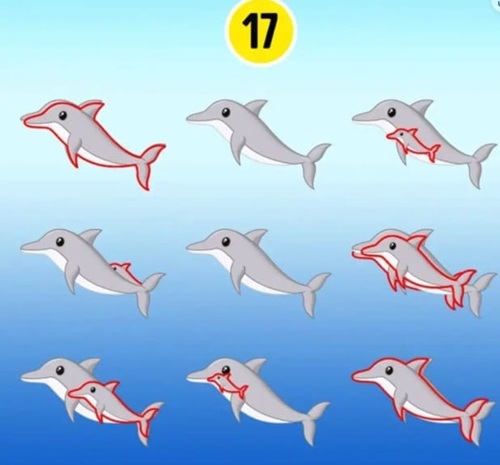
At first, it seems like nothing more than a beautiful marine illustration. Many viewers might stop there, admiring the aesthetics of the image. But the real magic lies beneath the surface—hidden within the shapes, contours, and overlapping lines are 17 dolphins cleverly camouflaged in the design.
The Challenge: Spotting All 17 Dolphins
The core challenge of this illusion is to find all 17 dolphins. While some are clearly visible, leaping or swimming prominently, others are intricately hidden within the shapes of the scene.
Their outlines are subtly integrated into the waves, reflections, or even other dolphins’ silhouettes, creating a scenario where your brain must carefully discern patterns from background elements.
For many people, spotting every dolphin in a single viewing is nearly impossible, highlighting the complexity of human perception and attention.
To help guide viewers without giving away too much, the dolphins are distributed across three main visual zones in the image:
First Row – 5 Dolphins:
The top portion of the image features five dolphins. These are generally easier to locate, as their shapes contrast with the lighter sky and surface reflections. Some leap mid-air, while others glide just beneath the water’s surface.
Their streamlined bodies and distinct dorsal fins make them stand out to a careful observer. However, even here, some dolphins are partially obscured by overlapping waves, requiring focused attention to identify the subtle curves of their fins or tails.
Second Row – 6 Dolphins:
The middle section of the image contains six more dolphins, which are often more challenging to see. These are integrated into wave patterns, foam shapes, and the reflective highlights of the water, meaning the brain must distinguish between shapes that are part of the water itself and those that constitute a dolphin’s form.
It’s in this section that many viewers struggle most, as the shapes rely heavily on contextual interpretation and subtle visual cues. Some dolphins appear only as a suggestion of motion—a small arc or shadow that completes the image when combined with your perceptual inference.
Third Row – 6 Dolphins:
The bottom part of the image includes another six dolphins, some of which are cleverly camouflaged against darker water or overlapping elements. These are often missed at first glance because they blend naturally with the surrounding ocean patterns.
They demonstrate the principle of “figure-ground perception,” where the brain must separate a subject (figure) from its background. Until you consciously train your attention, these dolphins remain almost invisible, hiding in plain sight.
Successfully spotting all 17 dolphins requires careful observation, patience, and repeated scrutiny of each part of the image. Many viewers find that after locating a few of the hidden dolphins, the remaining ones become gradually easier to identify.
This effect occurs because the brain learns to recognize subtle patterns, such as repeated curves or familiar dorsal shapes, allowing you to distinguish figure from ground more efficiently.
What Makes This Illusion So Effective?
The dolphin illusion exemplifies several key principles of visual perception:
Pattern Recognition:
Our brains are wired to identify patterns quickly, an evolutionary advantage that allowed humans to detect predators or prey.
In the case of this illusion, the brain initially perceives the overall scene—waves, water reflections, and obvious dolphins—but struggles with smaller, less distinct shapes. This demonstrates how pattern recognition can sometimes mislead us, especially when shapes are intentionally integrated into complex backgrounds.
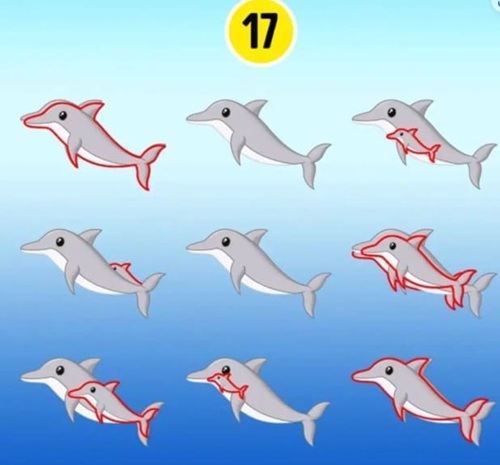
Figure-Ground Segregation:
This is a classic principle in cognitive psychology, referring to the brain’s ability to separate a figure (the object of interest) from the surrounding background.
Hidden dolphins rely on the principle that our perception tends to blend contours with the surrounding environment, making it difficult to separate the figure from its background unless you focus intently.
Cognitive Load:
The brain’s ability to process multiple stimuli at once has limits. When confronted with a detailed scene, like the dolphin illusion, the cognitive load can cause us to overlook smaller or subtler shapes.
The more elements present in the visual field—waves, reflections, splashes—the more challenging it becomes to spot the hidden forms.
Gestalt Principles:
Gestalt psychology explains how humans perceive objects as whole forms rather than isolated components. Hidden dolphins are often designed using Gestalt principles such as continuity, closure, and similarity.
For example, the curve of a wave may imply the shape of a dolphin’s back, even though it’s technically part of the water. Observers must mentally integrate these visual cues to recognize the hidden forms.
Why Optical Illusions Are So Engaging
Optical illusions like this dolphin challenge captivate us because they engage multiple mental processes:
Observation Skills: They force you to slow down and notice details you might otherwise overlook.
Critical Thinking: You must analyze shapes, contrasts, and spatial relationships to find the hidden elements.
Perception Training: Over time, repeated exposure to these illusions improves your ability to recognize subtle patterns and inconsistencies in your environment.
Entertainment: The element of surprise—realizing that shapes you thought were part of the background are actually dolphins—triggers a pleasurable “aha moment.”
Studies in cognitive science suggest that visual puzzles enhance attentional control, which is the ability to focus selectively on certain stimuli while ignoring irrelevant information.
This makes optical illusions more than just a pastime—they can be an informal exercise in sharpening the mind.
Tips for Spotting All the Dolphins
For anyone attempting this illusion, here are strategies that can help improve your chances of finding all 17 dolphins:
Start with the obvious: Begin by locating the most visible dolphins, typically those leaping above the water or appearing in high-contrast areas. This gives your brain reference points for the rest of the image.
Examine each section: Divide the image into three horizontal zones—the first, second, and third rows. Focus on one zone at a time, carefully scanning every detail.
Look for curves and shapes: Hidden dolphins often appear as subtle arcs, curved lines, or partial silhouettes. Don’t only look for full-body shapes; dorsal fins, tail tips, or shadows can signal the presence of a dolphin.
Step back and squint: Sometimes viewing the image from a distance or squinting slightly can help separate figure from background. Changing your visual perspective can make hidden shapes stand out.
Patience is key: It may take several minutes—or even multiple attempts—to identify all 17 dolphins. Remember, the challenge is designed to be subtle; the joy comes from the process as much as the solution.
The Educational Value of Optical Illusions
Beyond being entertaining, optical illusions like this dolphin puzzle offer valuable educational benefits:
Visual Literacy: Understanding how images are constructed, how shapes relate, and how perception can be manipulated enhances visual literacy.
Problem-Solving Skills: Trying to find hidden elements encourages creative thinking and strategy development.
Mindfulness and Focus: Concentrating on small details promotes a calm, meditative state, reducing mental clutter and improving attention span.
Scientific Insight: These puzzles illustrate principles of psychology, neuroscience, and perception, providing a hands-on example of how our brains interpret sensory information.
Educators and cognitive scientists often use illusions like this in classrooms and research to demonstrate perception limits and the brain’s interpretative processes. They provide a fun, approachable way to explore concepts like attention, pattern recognition, and sensory processing.
A Final Reflection on Hidden Dolphins
When you finally locate all 17 dolphins, the satisfaction is immediate. You may find yourself revisiting the image repeatedly, now able to spot the previously hidden dolphins with ease.
This improved perception illustrates a key principle: once your brain has learned to recognize a pattern, it can detect it much faster in the future. This phenomenon extends beyond puzzles to real-world skills, improving observational abilities in daily life.
It’s also a reminder that what we see is not always the full picture. Just as dolphins hide in plain sight in this image, in life, subtle details often go unnoticed unless we take the time to look closely.
Developing patience, attention, and careful observation can lead to greater awareness—not just in visual tasks, but in broader problem-solving and learning situations.
Whether you are a casual observer, a puzzle enthusiast, or a student of cognitive science, the dolphin illusion provides both entertainment and insight, highlighting the remarkable capabilities and occasional limitations of human perception.
