
Optical illusions and brain teasers have fascinated humans for centuries, captivating the imagination while subtly revealing the intricate ways our brains process information.
From the earliest inkblot tests to modern digital puzzles, these exercises challenge perception, memory, and problem-solving skills in ways that are both entertaining and educational.
Whether you are a casual observer, a puzzle enthusiast, or someone who simply enjoys a visual twist, engaging with these brain teasers provides a unique blend of cognitive stimulation and playful curiosity.
Among the myriad of optical illusions available, those that feature animals—particularly ones as dynamic and beloved as dolphins—offer an added layer of delight.

Not only do they challenge the mind, but they also invite a sense of wonder and connection with nature.
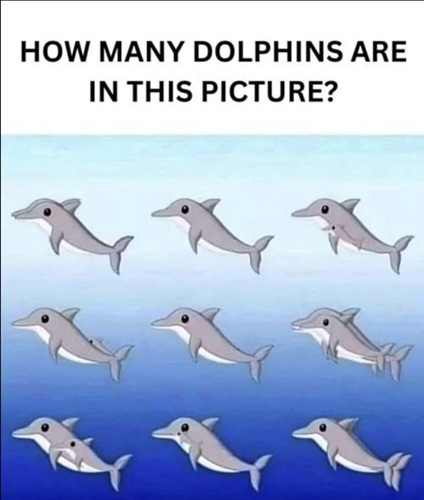
Consider, for example, a brain teaser that presents a seemingly simple image: a group of dolphins frolicking in a calm, sun-dappled sea.
At first glance, the image might appear straightforward, almost ordinary. There is the gentle curve of waves, the shimmering sunlight reflecting off the water, and the sleek silhouettes of dolphins leaping and diving gracefully.
The scene evokes feelings of serenity, reminding viewers of the playful, intelligent nature of these marine mammals. Yet, as with many optical illusions, the apparent simplicity is deceptive.
A closer, more attentive look reveals layers of complexity and hidden surprises that challenge the observer to engage deeply with the image.
Hidden within this tranquil seascape are 17 dolphins, each carefully concealed in ways that test the limits of visual perception. Some dolphins are prominently displayed, their distinctive dorsal fins and curved bodies easily recognized.
Others, however, are camouflaged, integrated into the outlines of larger dolphins or subtly woven into the shapes formed by the waves.
Spotting all 17 requires patience, focus, and a willingness to look beyond first impressions. It is a task that mirrors cognitive exercises used in psychology to assess attention to detail, visual scanning, and pattern recognition.
To make the search more manageable, one might consider the image row by row. The first row contains five dolphins, though some are positioned so that their tails or fins blend seamlessly into the background.

The second row houses six dolphins, some of which are partially obscured by splashes of water or cleverly aligned with the natural curves of the ocean waves.
The third row also contains six dolphins, each integrated with precision so that only a careful observer will notice the subtle cues that differentiate them from their surroundings. Even the most eagle-eyed viewers often miss one or two, illustrating how easily the brain can overlook details when distracted by more obvious visual cues.
This exercise is more than just a test of eyesight; it is a fascinating demonstration of how our brains interpret complex visual information.
The human visual system excels at detecting patterns, but it can be fooled by clever arrangements that exploit our expectations and assumptions.
In the case of this dolphin teaser, the mind must differentiate between background textures and the shapes of the dolphins themselves, a task that requires both analytical observation and imaginative thinking.
Once all 17 dolphins are identified, the satisfaction of discovery is immediate and profound—a perfect blend of challenge and reward.
For those who enjoyed the dolphin puzzle, there are countless other brain teasers designed to stretch the mind in equally intriguing ways.
Consider, for instance, a visually deceptive image featuring a family of tigers hidden within a lush jungle scene. At first glance, the scene appears peaceful, a serene tableau of greenery interspersed with the majestic forms of tigers lounging amidst foliage.
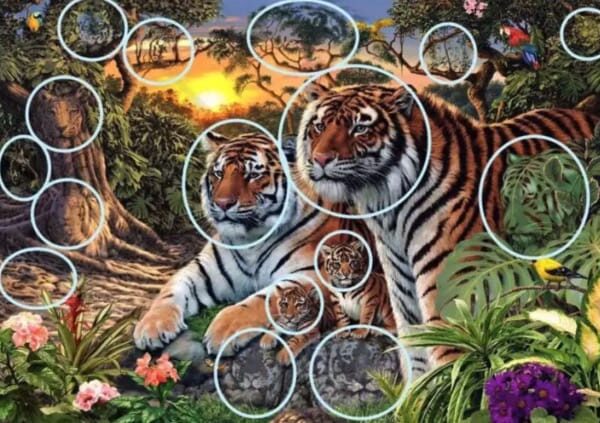
Yet upon closer inspection, one realizes that the image contains 16 tigers, each concealed with remarkable cleverness.
Some tigers are hidden entirely within the outlines of leaves and tree branches, others integrated into the shapes of the other animals or even the shadows cast by the vegetation.
Finding these tigers requires a similar combination of attention, patience, and analytical reasoning. Observers must train their eyes to recognize subtle variations in shape and color, a skill closely linked to visual-spatial intelligence.
As viewers scan the image, they learn to differentiate between foreground and background, to anticipate where hidden figures might be located, and to question initial assumptions.
Each discovery—each tiger spotted—provides a small thrill, a reward for the observer’s concentration and perceptual skills. The exercise is not only enjoyable but also strengthens cognitive functions such as attention to detail, problem-solving, and mental flexibility.
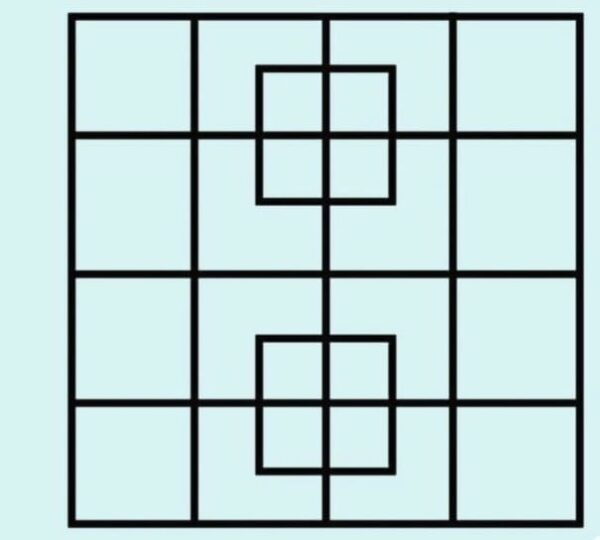
Beyond animal-themed optical illusions, brain teasers can also take on abstract or mathematical forms. A classic example involves counting squares within a larger grid.
At first glance, a simple square puzzle might seem easy: a set of squares arranged in rows and columns, appearing straightforward to the casual observer.
However, the true challenge lies in recognizing overlapping squares and those formed by combining smaller units. In many versions of this puzzle, there are multiple layers of squares hidden within each other, requiring careful observation and systematic counting.
For example, an image that appears to contain only a handful of squares might actually contain 40 or more, depending on how the viewer interprets the connections between lines.
These puzzles are not only entertaining—they provide measurable cognitive benefits. Studies in neuroscience and psychology have shown that engaging in visual-spatial tasks, such as optical illusions and pattern recognition exercises, improves memory retention, enhances attention, and strengthens neural connections involved in problem-solving.
In essence, each time someone hunts for a hidden dolphin, tiger, or square, they are giving their brain a workout, training both analytical reasoning and creative thinking simultaneously.
The appeal of brain teasers extends beyond the cognitive benefits. They also foster social engagement and community interaction.
Sharing puzzles with friends and family encourages discussion, collaboration, and friendly competition. For example, one observer might notice a hidden dolphin that others overlooked, prompting shared strategies and techniques for spotting the remaining animals.
Similarly, group participation in identifying the 16 hidden tigers or counting overlapping squares can lead to lively debates and joyful moments of collective discovery.
These experiences highlight another important aspect of brain teasers: their ability to create connection and conversation, a shared sense of achievement and playful curiosity.
Optical illusions also illuminate broader truths about human perception and cognition. They reveal how easily our minds can be deceived by context, contrast, and expectation.
Our brains constantly make assumptions to process the vast amount of sensory information we encounter, and optical illusions exploit these assumptions to create surprising and often delightful effects.
For instance, in the dolphin puzzle, some figures are only visible once the observer understands the specific cues to look for—shifts in curvature, subtle variations in shading, or the alignment of shapes.
Similarly, the hidden tigers require the observer to interpret colors and textures not as passive background elements but as integral components of the hidden figures.
The satisfaction derived from these puzzles is both psychological and neurological. Successfully identifying all hidden elements triggers a release of dopamine, the neurotransmitter associated with pleasure and reward.
This creates a positive feedback loop: the brain feels rewarded for solving the puzzle, which encourages further engagement, persistence, and mental stimulation.
In practical terms, regular engagement with such exercises can help maintain cognitive sharpness, improve attentional control, and enhance visual memory over time.
In addition to the cognitive and neurological benefits, brain teasers provide emotional satisfaction. They encourage patience, persistence, and mindfulness.
Unlike many modern digital distractions that offer immediate gratification, solving a complex visual puzzle requires sustained attention and deliberate focus.
The process of scanning, hypothesizing, and verifying hidden elements mirrors a form of meditation, where the mind is engaged yet calm, focused yet flexible.
Observers often report feelings of flow, a psychological state characterized by full immersion and enjoyment in an activity, when engaging with these challenges.
For educators and parents, these exercises also serve as valuable tools for teaching observation skills, critical thinking, and perseverance.
Encouraging children to find all 17 dolphins or all 16 tigers promotes careful analysis, strengthens visual literacy, and teaches the value of persistence.
It also fosters creativity, as children must often imagine how one element might be hidden within another, blending logical deduction with imaginative thinking.
Adults, too, benefit from the cognitive engagement, making these puzzles a multigenerational tool for mental enrichment.
In a broader sense, brain teasers remind us of the joy of curiosity and discovery. In an age dominated by rapid information consumption and constant distraction, these exercises encourage us to slow down, look closer, and truly engage with what we see.
Whether it is the thrill of spotting the final hidden dolphin, discovering a tiger camouflaged within the jungle, or counting the last overlapping square, the sense of accomplishment is genuine and enduring.
Finally, brain teasers like these encourage reflection on perception itself. They illustrate that what we see is not always what is actually there, highlighting the distinction between objective reality and subjective interpretation.
They teach humility and patience, as initial assumptions are often challenged, requiring us to reconsider and reevaluate. By training ourselves to observe carefully, analyze systematically, and consider multiple perspectives, we enhance not only our visual cognition but also our overall problem-solving abilities in everyday life.
So, the next time you encounter an optical illusion or a brain teaser, take a moment to slow down. Allow your eyes to explore every corner of the image, follow every line, and consider every possible hidden element.
Try to spot all 17 dolphins, all 16 tigers, and all 40 squares. Challenge friends and family to do the same. Discuss your findings, compare observations, and enjoy the thrill of discovery together.
In doing so, you are not just solving a puzzle—you are exercising your brain, sharpening your perception, and experiencing the joy of human curiosity in its purest form.
Whether for education, entertainment, or personal cognitive development, brain teasers and optical illusions remain a timeless tool for mental stimulation.
They remind us that the world is rarely as simple as it appears, that hidden complexity often lies beneath the surface, and that the joy of discovery is one of the most rewarding experiences our minds can have.
So how many did you find? Whether you spotted all 17 dolphins on your first try, needed several careful passes, or are still counting the hidden tigers, take pride in your persistence. Every discovery strengthens your mind, enhances your focus, and reinforces the incredible capacity of the human brain to observe, interpret, and learn.
