
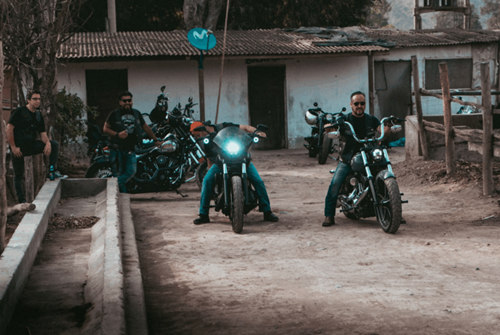
At my daughter’s wedding, forty-two bikers arrived without warning and blocked the doors of the church, preventing anyone from entering.
Even now, when I think back to that morning, I can still hear the low rumble of motorcycle engines echoing off the stone walls and see the confusion spreading across the faces of our guests.
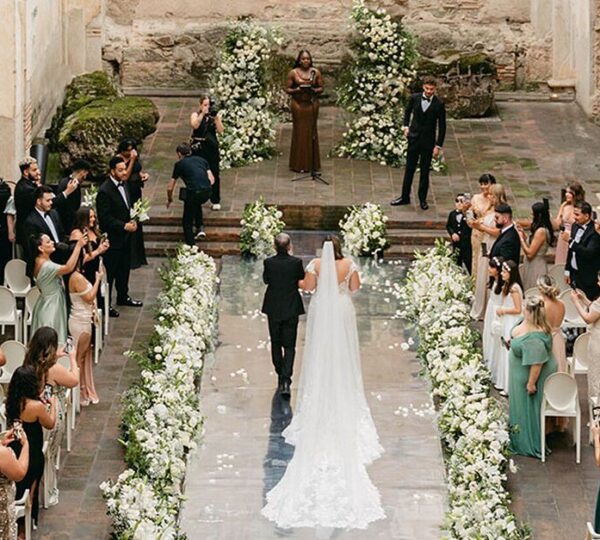
It was supposed to be the happiest day of Sarah’s life. The church stood at the end of a quiet tree-lined street, decorated with white roses and soft ivory ribbons that fluttered gently in the late summer breeze.
Two hundred guests had gathered outside, dressed in elegant suits and pastel dresses, chatting and laughing as they waited for the ceremony to begin. Inside, the florist was finishing the altar arrangements. The string quartet was tuning their instruments. Everything was perfectly planned down to the last detail.
Then the motorcycles came.
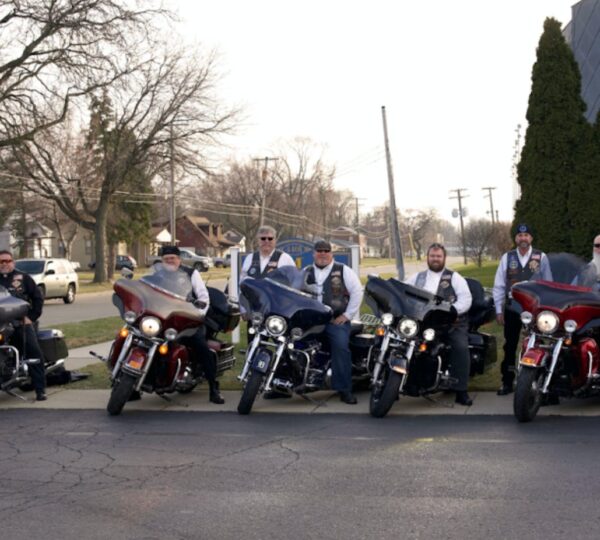
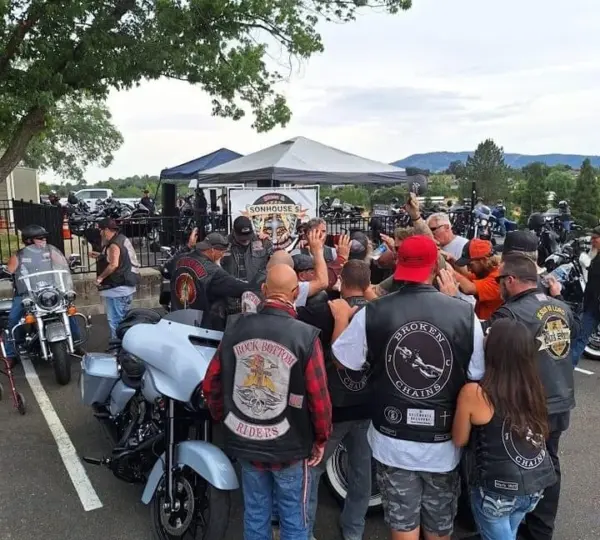
They rode in together, a long procession of leather jackets, heavy boots, and chrome shining in the sunlight. The engines cut off almost in unison, and the sudden silence felt heavier than the noise.
One by one, the riders dismounted and positioned themselves in front of the church doors, forming a human wall.
At first, I assumed it was some kind of misunderstanding. Maybe they had the wrong address. Maybe there was an event nearby. But when they didn’t move—and instead crossed their arms and stood firm—I felt my chest tighten with anger.
I marched toward them, my heels clicking sharply against the pavement.
“What do you think you’re doing?” I demanded. “You’re blocking the entrance. This is a private wedding.”
The man who appeared to be their leader stepped forward. He was tall and broad-shouldered, with streaks of gray in his beard and faded scars tracing both of his forearms. His leather vest bore a club patch I didn’t recognize. His name, stitched over his chest, read “Marcus.”
His eyes, though, were not threatening. They were red-rimmed and glassy with emotion.
“Ma’am,” he said quietly, “we can’t let this wedding happen. Your daughter doesn’t know the truth about her fiancé.”
The audacity of that statement made my blood boil.
“You have no right to interfere,” I snapped. “David is a respected attorney. He comes from a good family. If you don’t leave immediately, I will call the police.”
Behind me, I could hear murmurs growing louder. Guests were whispering. Some had already taken out their phones.
Marcus didn’t raise his voice. He simply reached into his saddlebag and pulled out a thick folder. The edges were worn, as though it had been handled many times.
“You deserve to see this,” he said.
I almost refused. But something about the way his hands trembled—not with anger, but with grief—made me hesitate.
Inside the folder were photographs. Medical reports. Printed text messages. Copies of police filings. The first image I saw was of a young woman with dark hair and bright eyes. In the next photo, those same eyes were swollen shut, her cheek bruised deep purple.
“Her name was Rachel,” Marcus said, his voice breaking. “She was my sister. She was engaged to David three years ago.”
The world seemed to tilt.
“That’s impossible,” I said immediately. “David told us he’d had one serious relationship years ago, but it ended mutually.”
Marcus shook his head. “Two weeks before their wedding, Rachel died. They called it suicide.”
I felt my stomach drop.
He explained that Rachel’s death had been ruled self-inflicted, but the circumstances never sat right with her family. According to Marcus, Rachel had confided in them about escalating abuse after she became engaged.
It started subtly, he said—criticism disguised as concern, demands about who she could see, pressure to quit her job because he wanted her “focused on their future.”
Then came the isolation.
David allegedly convinced her to distance herself from certain friends. He monitored her phone. He controlled their finances. Marcus described a pattern that experts often identify in abusive relationships: charm in public, control in private.
I flipped through more documents, my hands shaking.
Medical records detailed fractured ribs. A dislocated shoulder. Multiple ER visits attributed to “accidents.” There were copies of police reports that, according to Marcus, were later dismissed or withdrawn. He claimed David’s father—an influential judge—had intervened.
Another biker stepped forward and handed me a folded letter in a plastic sleeve.
“It’s a copy,” he said gently. “The original was kept as evidence.”
It was Rachel’s suicide note.
Her words were filled with exhaustion and fear. She wrote about feeling trapped. She described threats—that if she left, her life would be ruined. She mentioned bruises she covered with makeup and long sleeves. She wrote that no one would believe her because David’s family was powerful and respected.
I struggled to breathe.
Before I could process everything, I heard Sarah’s voice.
“Mom? What’s going on?”
She stood a few feet away in her wedding dress, sunlight catching the delicate beading on the bodice. She looked radiant—and confused.
“It’s nothing,” I said quickly, instinctively wanting to shield her. “Just a misunderstanding.”
Marcus stepped forward carefully, keeping his distance.
“Sarah,” he said, his voice soft but steady, “you deserve the truth.”
She looked between us, her smile fading.
He explained who Rachel was. He explained the timeline. He didn’t shout. He didn’t accuse wildly. He simply laid out what they had gathered over three years—evidence they said had been ignored.
Sarah listened in stunned silence.
“That’s not possible,” she whispered. “David has never treated me like that.”
Marcus nodded slowly. “He didn’t treat Rachel like that either—at first. It started after the engagement.”
Sarah’s face drained of color.
She admitted that, recently, David had become more possessive. He didn’t like her going out with certain friends. He questioned her clothing choices. He insisted on reviewing their shared finances more closely than she expected. She had brushed it off as stress from the wedding.
I felt cold all over.
“I need to talk to him,” Sarah said.
“No,” I said firmly, something primal rising in me. “Not alone.”
At that moment, David emerged from the church’s side entrance, clearly irritated.
“What is this circus?” he demanded. “Why isn’t the ceremony starting?”
When he saw the bikers, his expression shifted from annoyance to fury.
“This is harassment,” he said sharply. “You have no proof of anything.”
Marcus met his gaze.
“Show them your left forearm,” Marcus said.
David stiffened.
“Why would I do that?”
“Because Rachel left a scar there the night she fought back.”
The silence that followed felt endless.
Under the pressure of dozens of eyes, David rolled up his sleeve. A long, jagged scar ran across his forearm.
“It was a kitchen accident,” he said quickly.
Marcus didn’t argue. Instead, he held up a printed still image from a video file—timestamped weeks before Rachel’s death—showing a struggle. The angle was grainy, but the injury location matched.
David’s composure cracked.
Within minutes, police cars arrived, called by someone in the crowd. Reporters, alerted by the unusual scene, began gathering at the edge of the property.
Sarah removed her veil.
“There won’t be a wedding today,” she said quietly.
The guests dispersed slowly, whispering in disbelief.
In the weeks that followed, the story spread. Additional women reportedly came forward with allegations of controlling and abusive behavior. Rachel’s case was formally reopened for review. Professional consequences followed for David as investigations unfolded.
The bikers, initially cited for trespassing and disorderly conduct, cooperated fully with authorities. Given the evidence they provided and the circumstances, the charges were ultimately dropped.
Sarah moved back home temporarily. The emotional aftermath was immense. She struggled with guilt, confusion, and the realization of how close she had come to committing her life to someone she no longer recognized.
Healing took time. Therapy helped her process not only the betrayal but also the subtle warning signs she had overlooked—small red flags that, in isolation, seemed insignificant.
Two years later, Sarah stood in another church—but this time as maid of honor at Marcus’s wedding. Life has a strange way of weaving unexpected connections. Marcus had met someone kind and compassionate, and Sarah wanted to support the man who had once stood in front of her own wedding doors to protect her.
After the ceremony, she hugged me tightly.
“If they hadn’t shown up,” she whispered, “I would have married him.”
I held her close, overwhelmed by gratitude.
She keeps her unused wedding dress carefully stored. Not as a symbol of heartbreak, but as a reminder. A reminder that appearances can be deceiving. That respectability and polished reputations do not always reflect private behavior. That courage sometimes comes from unexpected places.
The bikers did not fit the image many people associate with protectors. They wore leather and rode loud motorcycles. They looked intimidating.
But that day, they stood for accountability.
They stood for a sister who had lost her voice.
And they stood for my daughter.
Sometimes the people who seem frightening at first glance are the ones willing to confront uncomfortable truths. Sometimes protection arrives in a form you would never expect.
The wedding day we had planned never happened. The flowers wilted. The cake was donated. The music never played.
But my daughter is alive, safe, and building a future on her own terms.
And for that, I will always be grateful that love—real love—rode in on forty-two Harleys and refused to move.
