
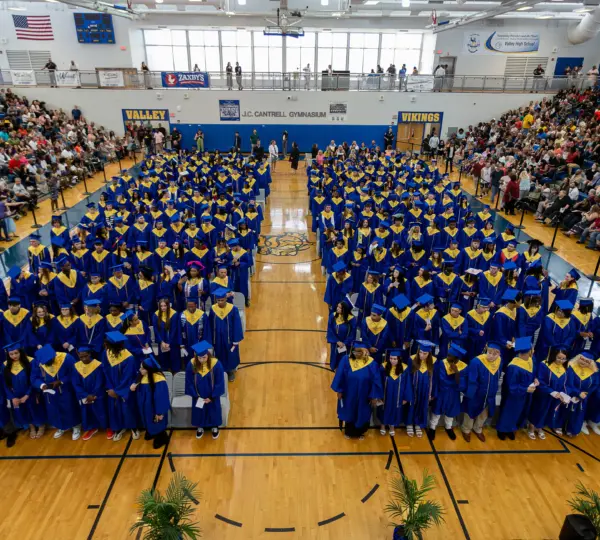
The gymnasium hummed with the layered sounds of celebration — folding chairs scraping across polished floors, proud relatives calling out names, camera shutters clicking in bursts of excitement.
Blue and gold streamers hung from the rafters, and rows of graduation caps rested neatly on the heads of students trying their best to look composed.
The scent of fresh flowers and pressed fabric lingered in the air. It was the kind of afternoon families remember for decades.
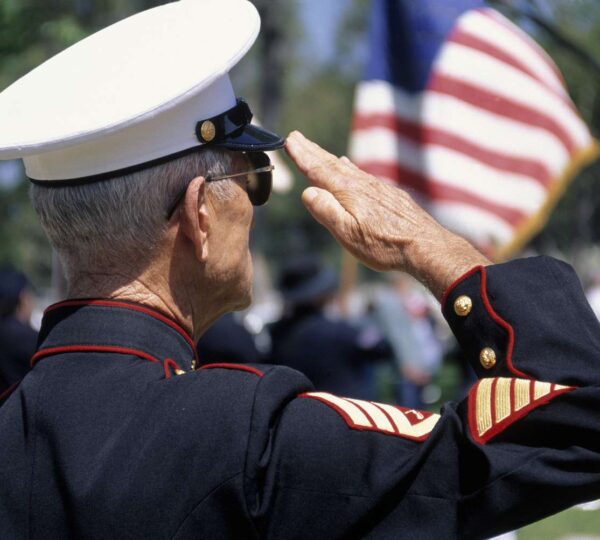
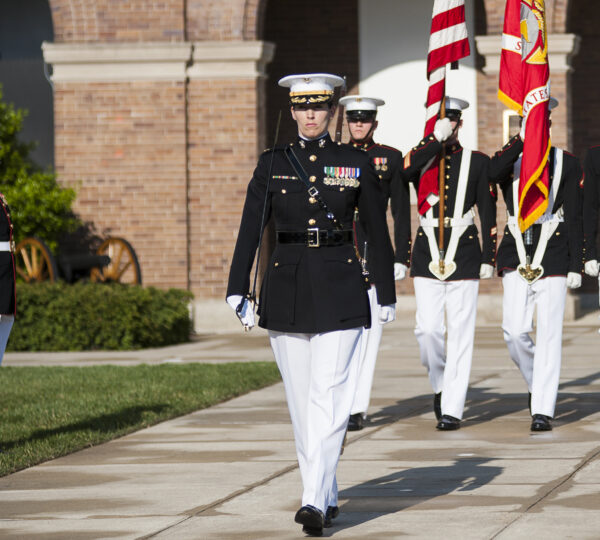
When retired Marine Sergeant Solomon Dryden stepped through the double doors in his crisp dress uniform, the movement caused a subtle shift in the atmosphere.
Conversations quieted for a fraction of a second. A few heads turned instinctively. It was not an intentional spotlight, and Solomon did not seek one. He had not come to draw attention. He had come to keep a promise.
Years earlier, during a quieter and more uncertain chapter of his life, he had made that promise to his wife. Tucked inside the inner pocket of his jacket that day was a small photograph of her — worn slightly at the edges from time and handling.
In the picture, she was smiling at the camera while holding a much younger Tyran in her arms. Before she passed away, she had asked Solomon to make sure their son reached this milestone.
“See him graduate,” she had said. “Be there.” It had not been a dramatic request. It had been simple and sincere. For Solomon, that made it sacred.
Today was not just a high school ceremony. It was the fulfillment of a shared dream.
A Father Formed by Service
Solomon Dryden had spent more than two decades in the United States Marine Corps. His posture — straight-backed, shoulders squared — was not performative.
It was ingrained through years of training and discipline. He had served through deployments that took him across oceans and into environments defined by unpredictability and sacrifice.
There were long stretches when communication with home meant brief, static-filled phone calls or carefully worded letters. Through all of it, he carried two steady motivations: duty to country and devotion to family.
Military life had required him to miss birthdays, school plays, and ordinary evenings at the dinner table. Yet whenever he returned home, he made those moments count.
He taught Tyran how to tie his shoelaces with patience, how to stand respectfully during the national anthem, and how to shake someone’s hand with confidence.
More importantly, he modeled resilience. He showed his son that responsibility is not about recognition, but about commitment.
When his wife passed away after a prolonged illness, Solomon’s world shifted. Grief became a quiet companion. But his sense of purpose did not fade.
If anything, it sharpened. He had promised her he would guide Tyran to adulthood — not just in age, but in character.
The Ceremony Begins
Solomon found his seat among the other families. He blended into the crowd, though the uniform inevitably drew glances. Some observers saw a veteran. Others saw a father. A few likely saw both.
The school band began to play, the brassy notes echoing off the gymnasium walls. The students filed in, walking carefully to avoid tripping over the edges of their gowns.
Laughter mixed with nervous whispers. Solomon’s eyes scanned the rows until they found Tyran. There he was.
Tall, composed, and carrying himself with quiet confidence, Tyran moved with purpose toward his assigned seat. The tassel on his cap caught the light briefly, glinting as he turned his head. In that instant, Solomon felt the weight of memory settle in his chest.
He remembered kneeling beside him at the kitchen table to help with homework during short periods of leave. He remembered teaching him how to salute properly — not as a performance, but as a gesture of respect.
The applause in the gym grew louder as the principal began calling names. Yet to Solomon, the sound seemed distant, as though filtered through layers of recollection. He was grateful — profoundly grateful — that he had lived to witness this day.
An Unexpected Interruption
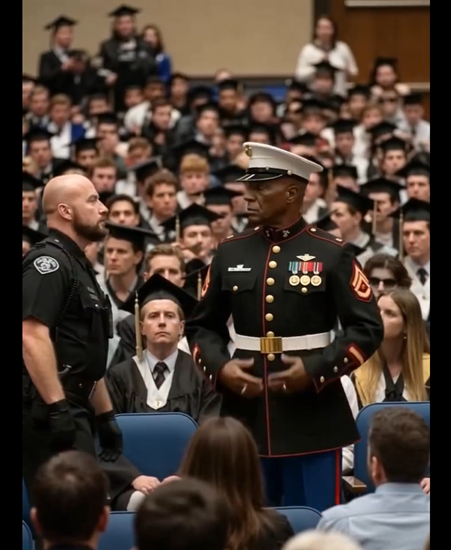
Then, without warning, two school security officers approached his row.
Their demeanor was professional, though tinged with uncertainty. One leaned slightly toward Solomon and spoke in a measured tone. “Sir, we just need to verify your credentials. Your uniform has caused some concern.”
It was not an accusation. It was procedure.
In today’s climate, security staff are trained to remain cautious, especially at large gatherings. A military dress uniform in a civilian setting can attract attention.
Solomon understood this instinctively. Years in the service had taught him that calm de-escalates confusion. He nodded once, steady and composed, and reached toward his inner pocket where his identification rested.
Around them, a ripple of murmurs passed through nearby rows. Some parents exchanged questioning glances. Others craned their necks to see what was happening.
Before Solomon could present his ID, movement from the student section drew attention.
A Public Show of Respect
Six young men stood up in unison. They wore matching Navy T-shirts — a simple but symbolic display. They were classmates of Tyran, and each had already committed to enlist in the armed forces after graduation.
One of them stepped forward slightly, voice clear and firm.
“He’s good,” the student said. “That’s Sergeant Dryden — Tyran’s dad. He’s the reason we’re signing up.”
The gym fell silent.
For a brief moment, even the faint hum of conversation ceased. The only audible sound was the soft flutter of the flags near the stage, stirred by circulating air.
The school principal, alerted by the pause in proceedings, approached quickly. After a short exchange and a glance at Solomon’s identification, the misunderstanding was resolved. The principal stepped toward the microphone.
“We are honored to have Sergeant Dryden with us today,” she announced. “Thank you for your service.”
The crowd rose in a spontaneous standing ovation.
Solomon did not seek applause, and he did not embellish the moment. He simply inclined his head slightly in acknowledgment.
His eyes, however, glistened. Not because of the recognition — but because of what it represented. His son had not only graduated. He had inspired others through the example set at home.
The Name That Mattered Most
When Tyran’s name was finally called, time seemed to slow again.
He walked across the stage, shook hands with school officials, and accepted his diploma. Then, instinctively, he turned his gaze toward the audience.
He found his father immediately.
Solomon was standing, hand placed respectfully over his heart — a gesture both personal and symbolic. Their eyes met. No words were exchanged, but none were needed.
That image — father in dress uniform, son in graduation cap — became the moment many in attendance would remember long after the decorations were taken down.
Lessons Beyond Words
After the ceremony concluded and families gathered for photographs, the six young men approached Solomon.
One by one, they extended their hands.
Each expressed appreciation — not in grand speeches, but in straightforward language. They spoke of observing how Tyran carried himself. They mentioned stories shared about Solomon’s service and integrity. They explained that those examples had influenced their own decisions to serve.
Solomon listened carefully.
He understood that military service is a serious commitment, one that demands sacrifice. He did not romanticize it. Instead, he encouraged them to approach their future with preparation, discipline, and humility.
In that exchange, it became clear that influence does not always require a podium. Sometimes it grows quietly in the everyday habits children witness at home — punctuality, respect, perseverance, and accountability.
A Promise Kept
Later that evening, after the crowds had dispersed and the gym lights dimmed, Solomon sat alone for a moment in his car. He removed the small photograph from his jacket pocket.
“We did it,” he murmured softly.
He did not frame the day as a personal triumph. It was a shared victory — his wife’s memory, his son’s effort, and years of steadfast commitment converging in a single milestone.
The journey to that graduation stage had not been defined by ease. It had included deployments, loss, long stretches of absence, and the quiet weight of single parenthood. Yet through it all, Solomon had remained anchored by his promise.
Enduring Values
This story is not solely about military service or public recognition. It is about integrity sustained over time. It is about the kind of leadership that happens in kitchens, on front porches, and in small conversations before bedtime.
Solomon Dryden’s presence at his son’s graduation did not require speeches or medals to be meaningful. The lesson was visible in posture, in composure, and in example.
When Tyran embraced his father outside the gymnasium, cameras captured the hug. But the true significance lay beyond the photograph. It was in the continuity of values passed from one generation to the next.
The Quiet Power of Example
In a world often driven by headlines and dramatic narratives, some of the most powerful influences remain understated. Solomon never set out to inspire six future enlistees.
He simply lived according to principles he believed in: honor, responsibility, and perseverance. That day, those principles were visible.
As families drove home and graduates celebrated their achievements, the memory of a Marine standing tall for his son lingered in many minds.
It served as a reminder that fulfillment is not measured only by rank or recognition, but by promises kept and relationships honored.
For Solomon, the applause was secondary. The true reward had been seeing Tyran cross that stage — healthy, confident, and prepared for the next chapter.
Sometimes the greatest lessons a parent teaches are never spoken aloud. They are lived, consistently and faithfully, until one day they stand on a stage and carry themselves forward.
And in that quiet continuity, a legacy endures.
