
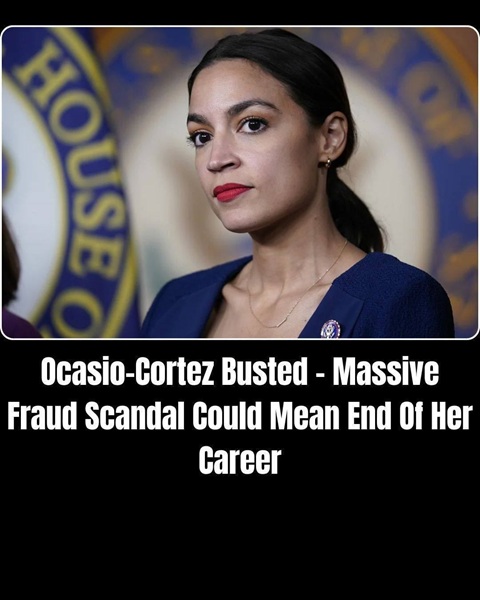
Thanksgiving in New York City is traditionally a time of generosity, communal spirit, and heightened awareness of local needs — from families struggling with food insecurity to volunteers organizing holiday meals.
In late November 2025, amid this backdrop, a widely circulated fundraising email associated with Representative Alexandria Ocasio‑Cortez (D‑NY) generated significant national controversy and intense online debate over how political campaigns and charitable appeals intersect.
What started as a message centered on helping families celebrate Thanksgiving quickly drew scrutiny when recipients realized that donations would be processed as political contributions rather than designated as traditional charitable gifts for food assistance.
This raised questions about disclosure, intent, political fundraising practices, and the ethics of blending charitable imagery with political campaign fundraising.
The Thanksgiving Appeal: What Happened
In November 2025, Rep. Alexandria Ocasio‑Cortez, who represents parts of New York City in the U.S. House of Representatives, sent a fundraising email to supporters.
The message was framed around the Thanksgiving holiday and appeared to solicit contributions ostensibly to support local families — especially in underserved communities — by helping provide Thanksgiving meals such as turkeys.
The email’s wording emphasized traditional holiday themes like community support, food security, and generosity.
It invited recipients to “chip in” a suggested donation amount to help “bring the joy of the holiday season into homes around NYC” in the weeks before Thanksgiving.
However, when donors clicked on the link to give, they were directed to a fundraising page hosted on ActBlue, the well‑known online platform used by Democratic candidates and committees to collect campaign contributions.
The ActBlue page indicated that contributions were being made to “Alexandria Ocasio‑Cortez for Congress,” noting that donations were campaign contributions that did not qualify as charitable tax deductions.
ActBlue: How the Platform Works
ActBlue is a longstanding fundraising platform that serves as a conduit for processing small‑dollar donations to Democratic candidates, committees, and progressive causes.
It is structured as a political action committee (PAC) rather than a charity, and contributions made through ActBlue are subject to Federal Election Commission (FEC) reporting and campaign finance regulations, not charitable organization rules.
Because funds raised via ActBlue are attributed to campaigns or committees, they are not tax‑deductible like donations made to registered nonprofit organizations.
They are also required to be reported in public campaign finance disclosures, including the identity of donors and amounts, in accordance with federal law.
Why the Controversy Emerged
The controversy stemmed from several core points:
1. Messaging and Expectations
Critics said the Thanksgiving appeal created the impression that contributions would directly support charitable food assistance — such as providing turkeys or groceries to struggling families — rather than go to a political campaign account.
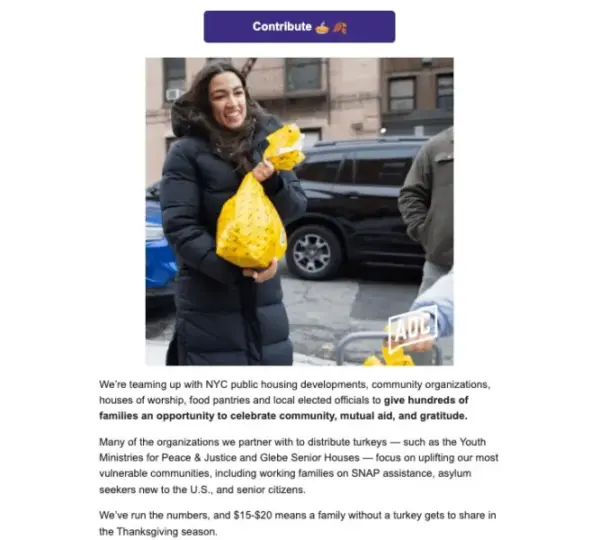
The email’s emphasis on holiday giving, community needs, and helping families led some readers to assume they were donating to a traditional charity or nonprofit food drive.
Opponents labeled this a “bait‑and‑switch,” arguing that donors expecting to fund charitable relief for Thanksgiving were instead contributing to a political campaign.
They contended that tying holiday messaging and charitable language to a campaign fundraising link could blur the distinction between charitable support and partisan political activity.
2. Disclosure and Transparency
The ActBlue page did include a disclaimer indicating that donations were for the congressional campaign and not eligible for tax deduction, but critics maintained this disclosure was not prominent enough relative to the email’s charitable framing.
Ethical observers and commentators questioned whether the initial message should have more clearly stated the political nature of the donation request to avoid confusing supporters.
Campaign finance law requires certain disclosures to help donors understand where their money is going, but interpretations vary about how explicit such language must be for content that bridges political appeals and humanitarian themes.
This has led to broader discussion about transparency standards for political fundraising communications.
3. Public Reaction and Media Attention
The story drew national attention and sparked debate across social media, talk radio, and news outlets.

Conservative commentators, local activists, and some political figures criticized the fundraising approach as misleading or inappropriate for a time often associated with charitable giving.
Some questioned whether it was suitable for political campaigns to use holiday‑related struggles, such as food insecurity, as a backdrop for fundraising appeals — even if the campaign also supported genuine community assistance efforts elsewhere.
Meanwhile, other observers noted that political campaigns often mobilize around issues that resonate emotionally with voters and supporters, and using widely shared concerns (like hunger during Thanksgiving) as a context for fundraising is not unusual in political communications.
They argued that as long as legal disclosures are included and donors are aware of the destination of their funds, political fundraising is within the rights of a campaign.
Understanding the Broader Context
The Role of Political Fundraising in Modern Campaigns
Political candidates and campaigns in the United States routinely solicit donations from supporters for a wide range of purposes: operational expenses, advertising, staff salaries, travel, and community outreach events.
Platforms like ActBlue and its Republican counterpart WinRed have become central to how campaigns — especially those on the left — mobilize small‑dollar grassroots donors.
Fundraising emails often leverage urgent language, emotional themes, and timely issues to encourage immediate contributions.
This includes references to crises, community needs, voter mobilization, or broader issues affecting constituents. In this sense, holiday themes are one of many contextual frames campaigns may use to connect with potential donors.
Political Campaigns vs. Charitable Organizations
Legally, political campaigns and charitable organizations are distinct. Charitable contributions to nonprofits that serve public needs — such as feeding the hungry — are governed by state and federal nonprofit laws and may qualify for tax deductions.
Political contributions, by contrast, are regulated by campaign finance law and are not deductible for tax purposes.

This distinction is more than technical: it affects donor expectations, tax treatment, reporting requirements, and public perception.
Mixing charitable‑sounding language with political contribution mechanisms can create confusion if not clearly communicated.
Response from Supporters and Defenders
Supporters of Rep. Ocasio‑Cortez argue that her longstanding community engagement — including past Thanksgiving turkey giveaways and food drives — reflects a genuine effort to address local needs.
They note that in previous years, some of the food distributions were coordinated with community partners, nonprofits, and volunteers working to serve families in New York City.
From this perspective, incorporating fundraising for campaign‑supported community events is consistent with broader grassroots organizing strategies.
Advocates contend that as long as the legal disclosures are present and the campaign complies with campaign finance laws, appeals framed around community assistance topics are legitimate political communications.
Critics and Ethical Concerns
Critics, including political opponents and some ethics observers, voiced concerns that using holiday imagery and charitable themes in a political fundraising appeal may undermine donor confidence and blur lines between public service and political objectives.
They warn that when supporters believe they are giving to help someone in need, the expectation of direct, tangible assistance is natural — and seeing those funds instead go into campaign coffers can feel misleading.
Some critics characterized the situation using phrases like “bait‑and‑switch,” arguing that this approach could erode trust in both political fundraising and genuine charitable outreach.
They have called for clearer disclosure standards in similar campaign communications.
It’s worth noting that discussions around political fundraising platforms like ActBlue have been part of broader scrutiny.
In recent years, the platform has been examined in political and legislative contexts for how it handles donations and compliance with federal law, though these broader debates are separate from the specific Thanksgiving fundraising appeal.
Legal and Regulatory Framework
Under federal election law, political fundraising communications must include certain disclaimers and authorization statements, such as indicating who paid for the communication (e.g., “paid for by Alexandria Ocasio‑Cortez for Congress”).
This helps ensure transparency about political messaging and prevents deceptive solicitations. Platforms like ActBlue serve as intermediaries that process and report political donations in compliance with FEC rules.
Political messages are protected speech under the First Amendment, and campaigns have considerable latitude in how they frame fundraising appeals.
However, they must adhere to disclosure rules and avoid making false or misleading representations about where funds are going. The standards for what constitutes misleading political communication are set through a combination of FEC regulations, judicial interpretations, and administrative guidance.
Legal experts generally agree that as long as the required disclaimers are included and campaigns do not make false statements about the use of funds, solicitations are permissible.
But debates arise when rhetoric and imagery strongly evoke charitable giving while the legal destination of funds is political, because that can create inference gaps in public perception.
Public Debate and Broader Implications
The Thanksgiving fundraising appeal triggered conversations about how political campaigns use emotionally resonant themes — like family, community care, and holidays — to drive engagement and contributions.
The incident illustrates the tension between political communication strategies and public expectations about charitable giving.
Supporters argue that engaging constituents on issues that matter to them and linking fundraising to real‑world concerns is part of effective political representation.
Critics worry that blending these themes without crystal‑clear disclosure could dilute trust in both political and charitable institutions.
Social media debates amplified polarizing viewpoints, with some framing the narrative as evidence of political opportunism and others defending the communication as a routine part of campaigning.
Regardless of one’s political stance, the episode highlights the importance of clear, transparent messaging when political appeals touch on sensitive and emotional topics.
Conclusion
The 2025 Thanksgiving fundraising appeal associated with Representative Alexandria Ocasio‑Cortez drew significant attention because it intersected holiday themes of generosity and political fundraising.
What began as a charitable‑sounding email urging support for families in need during Thanksgiving led to broader scrutiny when donations were routed as campaign contributions via ActBlue.
The controversy underscores how political campaigns must balance emotional messaging with transparent communication about where funds are going and how they will be used.
While legal disclaimers were present, some critics argued they were not sufficiently prominent relative to the charitable framing of the message — raising broader questions about public expectations, ethics, and the evolving landscape of political fundraising.
As political communication continues to evolve, incidents like this illuminate the complex terrain where politics, public service, fundraising, and community engagement overlap — and the ongoing importance of clarity and honesty in how leaders ask for support.
