
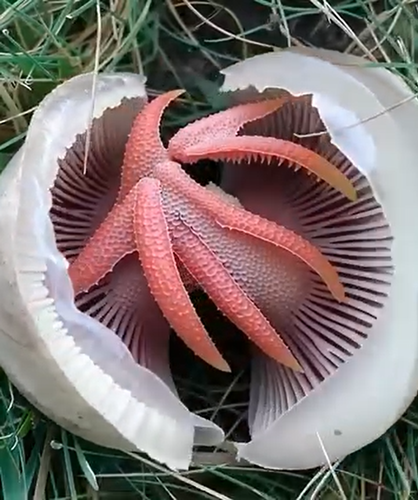
The sun had barely begun to rise, spilling a soft, golden hue across the dewy yard. A delicate, almost ethereal light played across the tips of the grass.
Illuminating droplets of morning moisture like tiny diamonds. I stepped outside with my usual routine in mind — watering the flowers, checking the garden, and savoring a few quiet moments before the day’s demands fully encroached.
The air was calm, fragrant with damp earth and the subtle perfume of early blooms, carrying the crisp freshness of morning dew. It was the kind of serene start to a day that I had come to cherish, a fleeting slice of peace in a life often cluttered by obligations and noise.
Yet, as I approached the flowerbed near the edge of the yard, a change in the air caught me off guard. A pungent, nearly suffocating odor suddenly assaulted my senses, sharp and putrid, with an unmistakable undertone of decay.
It was the kind of smell that makes the stomach twist and the back of the throat burn — the stench of rotting meat or some long-dead creature left to decompose in the sun.
My initial reaction was one of confusion and alarm. I paused, scanning my surroundings with widening eyes, trying to locate the source.
My first thoughts were practical: perhaps a small animal had died somewhere near the yard, or maybe a bag of compost or trash had been left out too long in the sun.
I began to inspect the area carefully, looking for anything that might explain the overwhelming stench — a decomposing bird, a small rodent, or spoiled organic material.
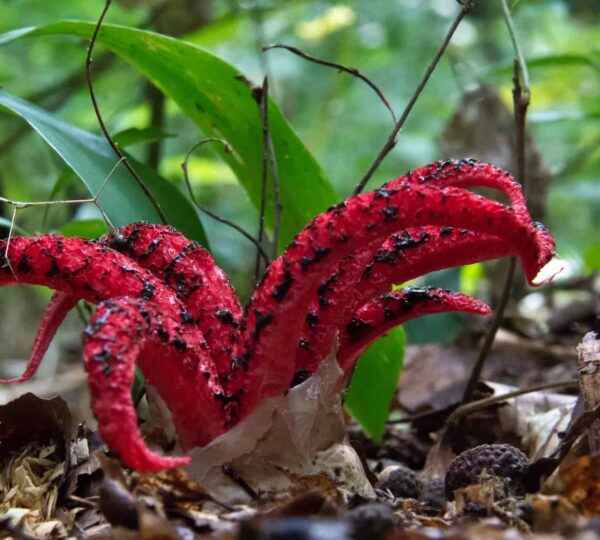
But as my gaze swept across the yard, I noticed something that immediately made me pause: a strange, reddish object partially hidden in the grass, its shape unusual and difficult to define.
At first, I couldn’t make sense of what I was seeing. The object appeared to pulse faintly, as if alive, though not in the slow, rhythmic manner of a breathing animal.
Its movements were subtle, almost hypnotic — a slow, curling, writhing motion, like something responding to the environment or unfolding itself in response to the morning light.
The surface glistened, moist and slimy, catching the sunlight in a way that made it look almost wet with sweat or covered in some sticky coating. My heart started to race as fear and curiosity clashed within me.
The mass was bright red, an intense, unnatural hue that seemed to vibrate against the green backdrop of grass and foliage.
From a central point, multiple finger-like projections stretched outward, tapering into sharp tips, each one appearing as though it had been dipped in fresh blood. The smell was now almost unbearable, a nauseating combination of rot and chemical tang that made my eyes water.
My initial suspicion that this was an animal faded with every passing second. Whatever this was, it wasn’t familiar — at least not to me.
I stepped back, unsure whether to investigate further or retreat entirely. My mind raced through a series of possibilities, each more alarming than the last.
Could this be some marine creature, perhaps dragged into my yard by a cat or raccoon? Was it part of a decomposed animal, remnants of something much larger?
Or was it something completely alien, a creature not meant to exist in the ordinary world? Despite the revulsion, I felt a pull of fascination that kept me rooted in place.
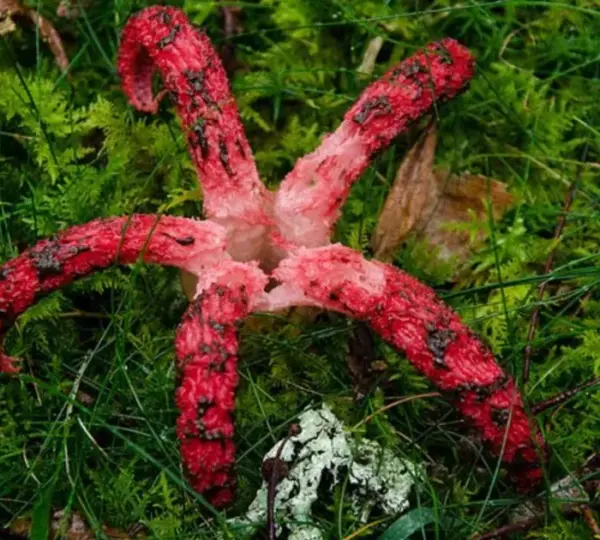
Unable to ignore my curiosity, I reached into my pocket and pulled out my phone, quickly snapping a photo of the bizarre object.
The image itself was unsettling, capturing the vivid red hue and the shiny, slimy texture, the unnerving finger-like projections seemingly twitching in the morning light.
I opened my browser, typing the most accurate description I could formulate: “red slimy mushroom with bad smell.” Almost immediately, the search engine returned results, each one more shocking than the last. Images of a fungus known as Anthurus archeri, or the Devil’s Fingers mushroom, filled my screen.
Relief and disbelief washed over me simultaneously. It wasn’t an animal at all. The nightmarish mass in my yard was, in fact, a bizarre species of fungus, a living organism whose grotesque appearance and overpowering odor were perfectly natural.
Native to Australia and Tasmania, this fungus has spread to other parts of the world, appearing unexpectedly in gardens, forests, and occasionally even suburban backyards.
The fungus begins its life within a white, egg-like sac, known as a volva, from which the red, finger-like structures emerge.
These projections are coated in a sticky, black spore-containing substance that emits the smell of decaying flesh, a strategy designed to attract insects — primarily flies — to aid in spore dispersal.
As I read more about the Devil’s Fingers mushroom, I learned that its evolution is a masterclass in ecological adaptation. The pungent odor is not accidental; it is a deliberate, evolutionary strategy.
Flies and other insects are drawn to the scent of decay, landing on the fungus and inadvertently carrying spores to new locations.
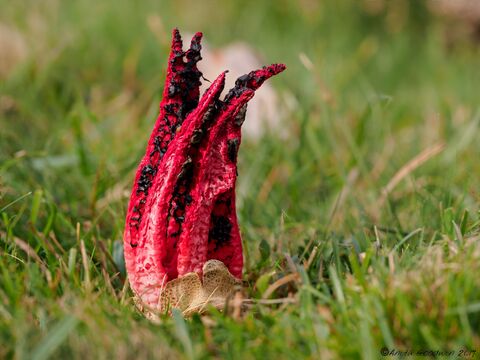
This natural mechanism ensures the continuation of the species, using the biological behavior of other creatures to propagate its life cycle. In a way, it was both disturbing and awe-inspiring — a small, grotesque example of nature’s ingenuity.
The morphology of the fungus is equally fascinating. The “fingers” emerge slowly from the white sac, twisting and curling outward in an almost choreographed display.
The black, slimy coating contains thousands of spores, which glisten like liquid tar in the light. The texture is moist and sticky to the touch, though I did not dare to handle it myself.
The coloration — bright, almost neon red — serves as a warning in the natural world, signaling danger or unpalatability to animals that might otherwise consume it.
In addition to its physical characteristics, the Devil’s Fingers mushroom has a unique and unsettling reproductive strategy.
Unlike more conventional mushrooms, which release spores into the air or rely on animals grazing on them, Anthurus archeri relies on deception.
By mimicking the scent of rotting flesh, it convinces insects that a food source is nearby. The fungus has no need for photosynthesis — it is saprotrophic, meaning it feeds on decaying organic matter in the soil, breaking down complex organic compounds into simpler nutrients.
In doing so, it contributes to the ecosystem by recycling nutrients and enriching the soil.
I stepped closer, examining the fungus with a combination of scientific curiosity and lingering unease. Its placement, at the edge of the flowerbed, made me wonder whether it had appeared spontaneously or if some environmental factors had contributed to its growth.
A closer look revealed that the surrounding soil was unusually rich and damp, a perfect substrate for fungal growth. The decomposition of mulch and organic matter in my garden likely created a fertile environment for this unexpected visitor.
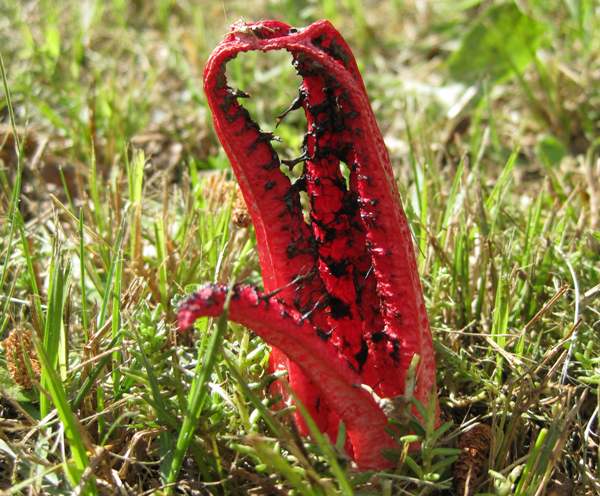
The more I observed, the more I appreciated the subtle artistry in its form. Despite the grotesque impression it initially gave, the fungus displayed a certain symmetry and elegance.
The finger-like projections, though irregular in length and curvature, radiated from the central point in a pattern that was almost hypnotic.
The surface glistened with a translucent sheen, catching the morning sun in a way that made it appear alive, almost pulsating with an energy of its own.
As I documented the fungus further with my phone, I discovered that the Devil’s Fingers mushroom has a curious cultural history as well.
In Australia and Tasmania, indigenous populations have long recognized the species, giving it names that reference its uncanny resemblance to clawed appendages or writhing limbs. It has been featured in botanical studies and popular media as an example of the more bizarre and macabre corners of the natural world.
Its shocking appearance and repugnant odor make it a favorite subject in educational programs about fungi, evolution, and ecological interactions.
I could not help but reflect on the broader lessons of this encounter. Here was a creature — a living organism — that initially evoked fear, disgust, and alarm, yet was entirely natural, functioning according to its evolutionary design.
It reminded me that nature often operates outside human notions of beauty, hygiene, or normalcy. Some of the most incredible adaptations exist precisely because they defy our expectations.
The Devil’s Fingers mushroom is grotesque to the human eye, yet its design is nothing short of genius.
Over the next few days, I returned to the spot periodically. The fungus did not reappear immediately, though I observed that the area around the flowerbed had small depressions and subtle signs that the volva had embedded itself deeply in the soil.
Gardeners online had warned me that spores from Anthurus archeri could survive underground for months or even years, lying dormant until conditions were favorable for germination.
This knowledge added a layer of unease to my otherwise peaceful garden routine — I now approached the corner of the flowerbed with caution, scanning the soil for any signs of a new emergence.
I also began reading extensively about the biology of stinkhorn fungi, the family to which the Devil’s Fingers belong. Stinkhorns are known for their unusual reproductive strategies, often relying on olfactory cues to attract insects rather than wind or water to disperse spores.
This strategy highlights a key principle in evolutionary biology: survival is not always about elegance or beauty but about effectiveness and adaptation.
In the case of Anthurus archeri, the grotesque odor and vivid color ensure the species’ survival in a competitive environment.
Though the initial encounter was frightening, it eventually became a source of fascination and education. I shared my photographs and notes with local mycological societies, contributing to citizen science efforts aimed at mapping the distribution of unusual fungi.
Reports indicate that the Devil’s Fingers has slowly spread beyond its native regions of Australia and Tasmania, appearing sporadically in North America, Europe, and parts of Asia. Its sudden appearance in a suburban garden is rare but not unprecedented.
Reflecting on the experience, I realized that this encounter had shifted my perception of the natural world. I had confronted something that initially seemed alien and terrifying, only to learn that it was entirely natural and purposeful.
The fungus had forced me to confront my instincts of fear, disgust, and caution, while simultaneously sparking wonder, curiosity, and a deep appreciation for the ingenuity of evolution.
Today, the memory of that red, slimy, writhing fungus lingers. I no longer fear the corner of my garden, but I maintain a respectful distance, acknowledging the quiet persistence of life that exists all around us — often in forms we cannot anticipate.
Nature, I have learned, is full of surprises: some beautiful, some terrifying, and many that defy expectation. The Devil’s Fingers mushroom is a reminder that even in the familiar surroundings of our own backyards, the world contains mysteries that can startle, teach, and inspire awe in equal measure.
It stands as a testament to the extraordinary diversity of life on Earth, a living lesson in adaptation, survival, and the unending creativity of evolution.
Encountering Anthurus archeri was, in essence, a lesson in humility — an invitation to look closer, to question what we think we know, and to recognize that even the most grotesque phenomena can serve a vital purpose in the intricate web of life.
Since that morning, my garden has returned to a semblance of normalcy, but the lesson endures. The memory of the Devil’s Fingers mushroom — its shocking color, uncanny shape, and unmistakable odor — serves as a daily reminder that nature is never predictable, and its wonders can emerge when and where we least expect them.
And while I may never encounter it again, I carry with me the knowledge that the natural world is both stranger and more fascinating than anything I could have imagined.
