
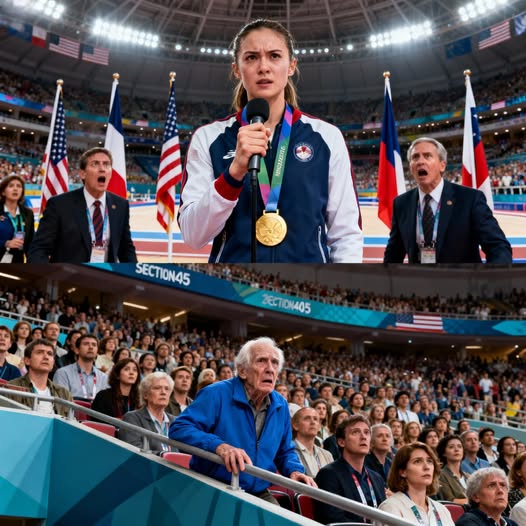
The live global broadcast of the 2026 Olympic Gymnastics Finals was scheduled to conclude the way such nights traditionally do — with medals awarded.
An anthem rising, and the steady swell of applause echoing through a brightly lit arena. Instead, it concluded in a way no producer had scripted: with stillness, reflection, and a quiet act of gratitude that reframed everything that had just happened.
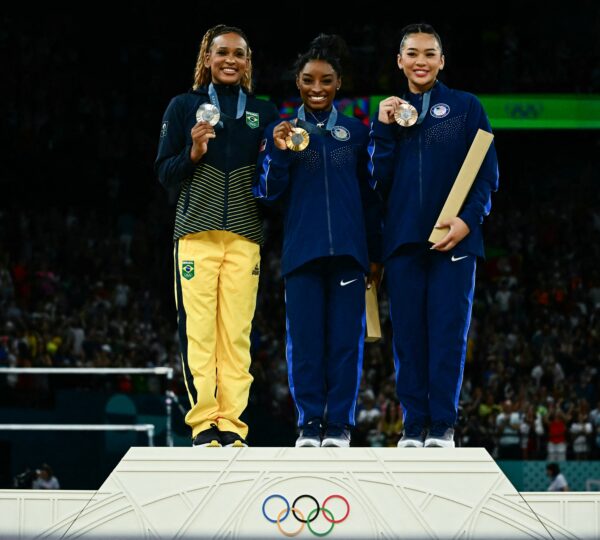
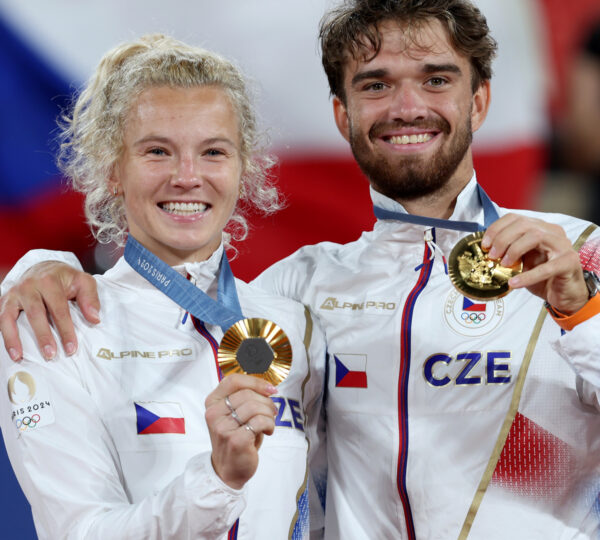
Maya Porter, newly crowned Olympic gold medalist in women’s artistic gymnastics, stood on the podium beneath the white intensity of championship lights.
Her floor routine minutes earlier had been the performance of her life — powerful yet controlled, expressive yet disciplined.
Judges rewarded her with a score that placed her at the top of the standings. Commentators praised her technical precision and mental composure under pressure. Around the world, viewers saw excellence.
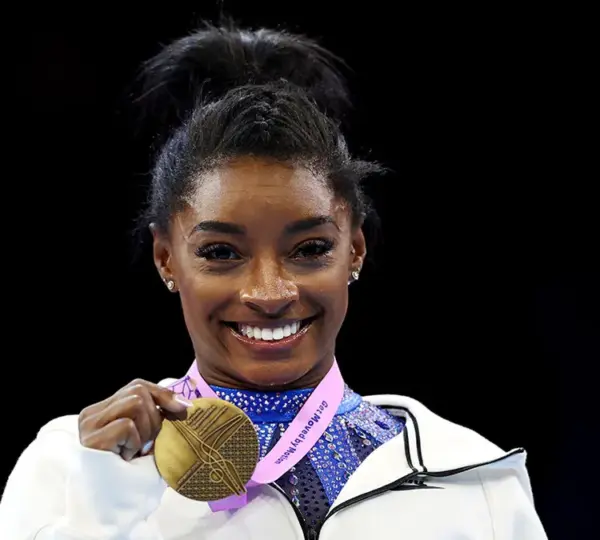
But few understood the years of work — and the people — beneath that moment.
As officials prepared for the medal ceremony, Maya did something unexpected. Instead of standing silently while the formalities began, she requested a microphone.
“I’m not leaving this podium,” she said calmly, her voice steady through the arena speakers, “until security brings me the man in Section 405, Row 12, Seat 4.”
For a brief second, confusion rippled across the production floor. Then cameras instinctively turned toward the upper tiers of the arena.
Fifteen thousand spectators followed with their eyes. High above, almost out of frame, sat an elderly man in a worn blue jacket. His name was Earl Whitmore. He had arrived alone. He had expected to leave the same way.
A Dream That Changed Form
Earl Whitmore had once been an athlete himself. In 1976, as a young gymnast competing at national trials, he came within reach of something extraordinary. He finished just two spots shy of making the U.S. Olympic team.
For months afterward, that near-miss lingered. It was not bitterness exactly — more an unfinished sentence. He replayed routines in his mind, analyzed small deductions, wondered about fractions of a point.
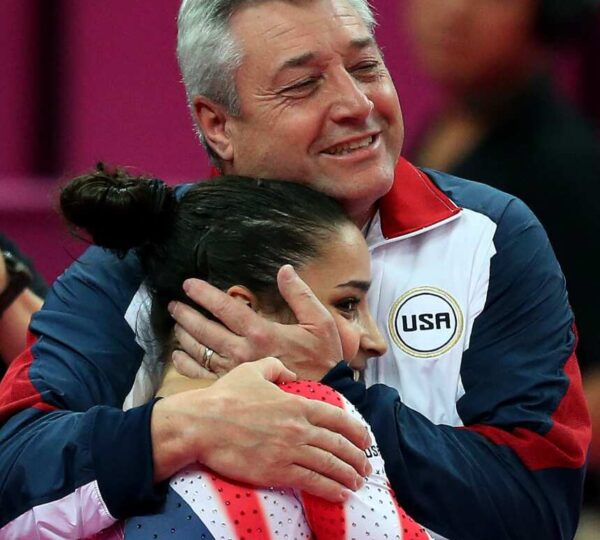
Rather than walk away, Earl began coaching at a small-town recreation center in Greyfield. The facility was modest — low ceilings, aging equipment, limited funding — but it was alive with young athletes eager to learn.
Earl found something unexpected in teaching. Where competition had centered on personal performance, coaching required patience, observation, and belief in others. He did not abandon his dream. He transformed it.
The Closing of the Center
Years later, economic strain forced the recreation center to close. Budget cuts eliminated programs one by one until gymnastics was the last to go.
On the final week before its doors shut permanently, Earl spent hours disassembling uneven bars and salvaging balance beams that would otherwise be discarded.
On the final afternoon, while locking up equipment, he noticed movement across the parking lot.
A young girl — no older than nine — was practicing cartwheels and round-offs on cracked pavement. Her movements were not random imitation.
They were intentional. Her landings were aligned; her arms finished strong. Even without formal training, she demonstrated awareness of body positioning rare for her age. Her name was Maya Porter.
Her mother, Grace Porter, worked long hours as a waitress to support the two of them. Formal gymnastics training, with its tuition fees and travel expenses, was financially out of reach.
Maya had been learning by watching library videos and practicing wherever space allowed — driveways, schoolyards, parking lots.
Earl approached gently, careful not to startle either of them. He introduced himself not as a former competitor, but as a coach. He offered to mentor Maya at no cost.
Grace hesitated. She was protective — not skeptical of Earl’s intentions, but cautious about promises that might not be sustainable.
After several conversations, and after hearing Earl’s own story of near-miss and injury, she agreed. Trust was placed quietly, thoughtfully.
Weekend Training
Training began on weekends in borrowed spaces: school gyms after hours, church fellowship halls, eventually a rented warehouse corner outfitted with salvaged equipment.
The beams Earl had rescued from the recreation center became Maya’s first formal apparatus. Mats were repaired with duct tape. Springs were tightened by hand.
Earl paid for leotards from his retirement savings. He covered entry fees for local competitions when Grace could not. He never described these actions as sacrifice. To him, they were extensions of responsibility — the natural cost of mentorship.
Earl answered each one patiently. He emphasized fundamentals: posture, repetition, mental discipline. “Talent opens the door,” he would say. “Discipline keeps it open.”
They progressed from local meets to regional competitions. Judges began to take notice. What distinguished Maya was not only difficulty level, but consistency. She rarely appeared rattled.
Strain at Home
While Maya’s trajectory ascended, Earl’s personal life grew more complicated.
His son, Dany Whitmore, had grown up around gyms and competitions. As a child, he attended meets, held clipboards, listened to his father’s coaching cues. But he also carried an unspoken feeling that gymnastics always came first.
Conversations about baseball games missed or school events unattended accumulated quietly. Earl believed he was providing through purpose. Dany often felt secondary to that purpose.
The distance between them widened over time, not through confrontation, but through silence.
Around the same period that a national scout noticed Maya at a regional championship — leading to her earning a scholarship at a nationally recognized training center — Earl’s wife, Linda Whitmore, received a terminal diagnosis.
Linda had always understood her husband’s devotion to the sport. She had supported it, even when it required long evenings at the gym. During her illness, she watched Maya’s progress with pride.
“Some dreams aren’t meant to be worn,” Linda told Earl one evening, her voice thin but certain. “They’re meant to be carried forward.”
She passed away before Maya entered her first Olympic training camp.
Grief settled into the Whitmore household. Earl continued coaching, not as distraction, but as continuity. Dany withdrew further, unsure how to navigate both loss and long-standing resentment.
The Olympic Journey
Maya’s ascent to international competition required years of disciplined training at the national center. Coaches refined her technique. Sports psychologists strengthened her focus. Nutritionists and physiotherapists supported her physical development.
Throughout it all, Earl remained a steady presence — not always physically in the gym, but emotionally consistent. He attended meets when permitted.
He wrote letters when travel limited visits. He reminded her of the fundamentals learned in those early warehouse sessions.
When she qualified for the 2026 Olympic Games, media outlets focused on her athletic story — the small-town beginnings, the scholarship, the perseverance. Earl declined interviews. He believed the spotlight belonged to the athlete, not the mentor.
For the finals, he purchased a single ticket.
He chose a seat far from camera range.
The Final Performance
The Olympic floor final demanded precision under extraordinary pressure. The arena lights were unforgiving; the audience silent before each pass.
Maya opened with a tumbling combination executed with exact timing. Her landings were controlled, her transitions fluid.
Commentators noted her composure. Judges awarded high execution marks. When her final score placed her first, she exhaled — not dramatically, but with quiet acknowledgment of years converging.
In the stands, Earl wept. Not loudly. Not visibly to most around him. The tears were less about the medal than about continuity — about seeing a journey that had once ended in his own near-miss find new expression.
He began preparing to leave after the ceremony, content to have witnessed the outcome from a distance. Then security personnel approached.
A Letter and a Reunion
As officials identified Section 405, Row 12, Seat 4, Earl looked up in confusion. Behind him stood his son, Dany.
Earlier that year, Dany had discovered a letter his late mother had written before her passing. In it, she urged him to reconsider his father’s life not as neglect, but as imperfect devotion — a man who sometimes struggled with balance, but whose intentions were rooted in belief.
Dany purchased a ticket without informing Earl. He intended to watch from a different section. When he heard Maya call for the man in Section 405, realization dawned.
Father and son descended together.
A Medal Repositioned
Back on the podium, Maya stepped down from her elevated position. Cameras followed, initially uncertain whether protocol was being interrupted. She approached Earl directly.
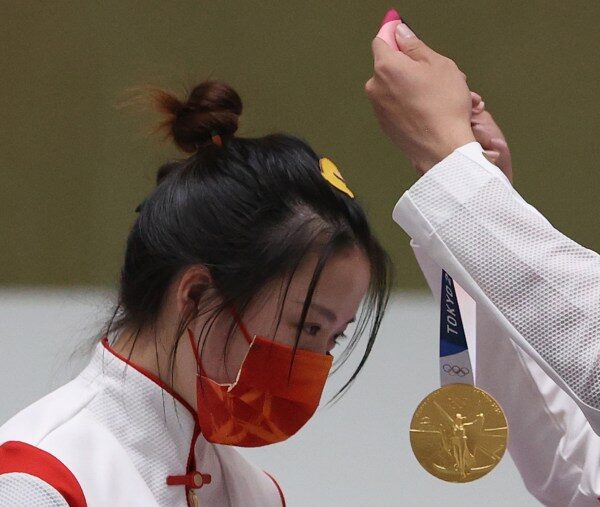
She removed the gold medal from around her neck and placed it gently over his shoulders.
“You once told me you missed the Olympic team by two spots,” she said into the microphone, her voice steady. “You didn’t miss it. You were building something bigger.”
The arena fell silent.
It was not a rejection of her achievement. It was recognition of its roots.
Earl shook his head at first, instinctively uncomfortable with attention. But Maya insisted, holding the medal in place for a brief moment before returning it to her own neck.
The gesture was symbolic — not a transfer of victory, but an acknowledgment of mentorship.
What Endures
The broadcast concluded without spectacle. No dramatic music was added. Producers allowed the silence to linger.
Viewers witnessed more than athletic excellence. They saw a student honoring a teacher. They saw a father and son standing side by side after years of distance.
They saw grief, perseverance, and gratitude intersect in a way that required no embellishment.
Great victories are rarely solitary. Talent may belong to one person; formation rarely does. Behind discipline stands instruction. Behind confidence stands someone who believed early, before cameras arrived.
Earl once believed his Olympic story ended in disappointment. In truth, it matured into legacy. Not all dreams are fulfilled in the form we expect. Some are fulfilled in the lives we help shape.
Maya’s gold medal did not diminish because she shared its meaning. If anything, it became clearer. Success shines brightest when it remembers its foundations.
The arena lights eventually dimmed. Spectators filed out. Broadcast crews dismantled equipment. But for those who witnessed it — in person or across screens worldwide — the final image endured:
An athlete at the peak of her career.
A mentor who chose redirection over resentment.
A family quietly reconciling.
And a reminder that achievement, at its best, is built on gratitude.
