
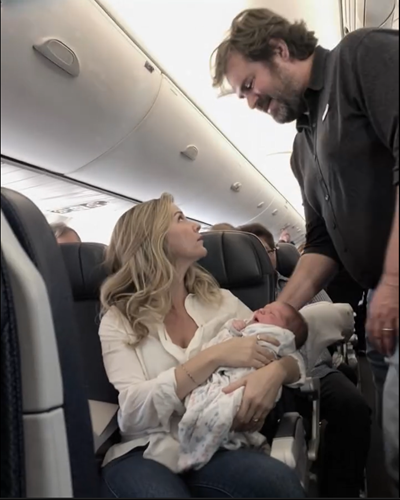
I was completely exhausted that morning—physically, emotionally, and spiritually. Traveling alone with my infant son, Ethan, on a crowded commercial flight was something I had dreaded for weeks.
But the exhaustion went far deeper than lack of sleep. Just a few months earlier, my husband, David, had passed away unexpectedly.
One ordinary day he was there—laughing in the kitchen, holding Ethan in his arms, talking about the future—and the next, he was gone. The shock of losing him had shattered my sense of stability.
Grief had become a constant companion, following me through every quiet moment and every long night. Since his passing, I had been trying to adjust to life as a single mother.
The word “widow” still felt foreign, like it belonged to someone else. I was learning how to make decisions alone, how to manage finances, how to comfort a baby while silently crying myself.
There were nights when Ethan would finally fall asleep, and I would sit in the dark beside his crib, overwhelmed by the silence. David had always been my partner in everything. Now, every responsibility felt heavier.
This trip was necessary, but it terrified me. It was my first time flying since David’s death. Airports had always been places of shared excitement for us—quick coffees before boarding, teasing each other about who packed too much, holding hands during turbulence.
Walking into the airport alone, pushing a stroller and carrying a diaper bag, felt like stepping into a world that had moved on without me.
The airport was busy, filled with the hum of rolling suitcases, overhead announcements, and hurried conversations.
I tried to keep myself composed as I navigated security, folded the stroller, and balanced Ethan on my hip. He was fussy that morning, perhaps sensing my anxiety.
Babies are perceptive in ways we often underestimate. They feel tension, they respond to shifts in tone, and they absorb emotion even when they cannot understand it.
By the time we boarded the plane, I was already drained. The cabin was packed. Passengers squeezed past one another in the aisle, searching for overhead space and settling into tight rows.
I found my assigned seat in economy—middle seat. My heart sank for a moment, but I reminded myself that this was temporary. Just a few hours. I could handle a few hours.
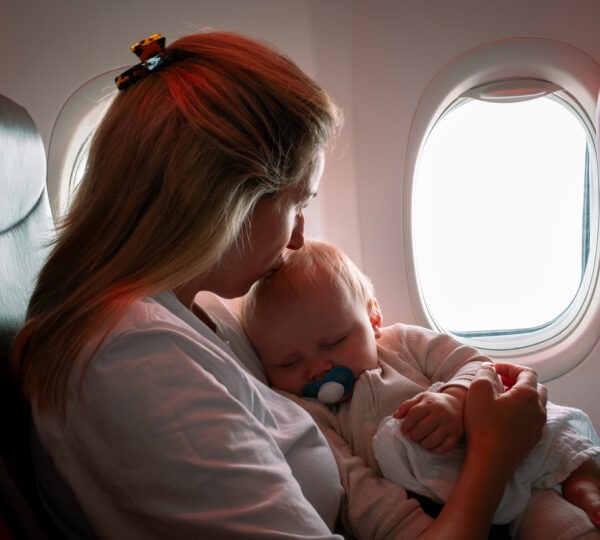
Ethan was quiet during boarding, resting against my chest. I whispered soft reassurances to him, brushing my lips against his hair.
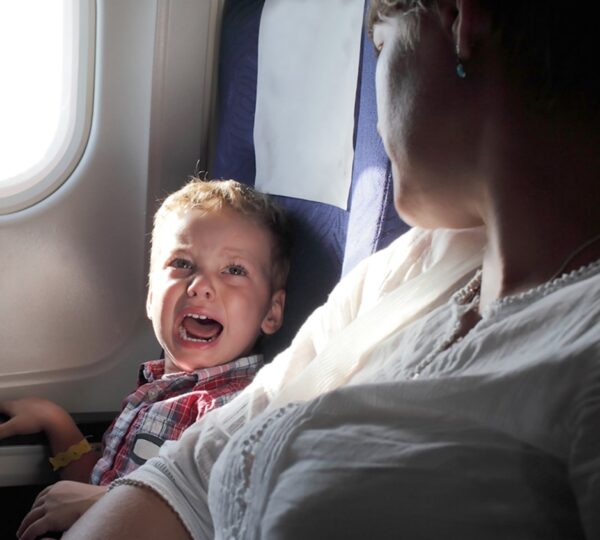
But as the plane began taxiing down the runway and the engines roared to life, he startled. When the wheels lifted off the ground, his tiny face crumpled, and he began to cry.
At first, it was a soft whimper. I shifted him gently, speaking in a calm voice. “It’s okay, sweetheart. Mommy’s here.” But within seconds, the whimper grew into full, desperate sobs. His body stiffened, his cries echoing sharply in the enclosed cabin.
I did everything I could think of. I fed him. I rocked him as much as the cramped seat allowed. I hummed the lullaby David used to sing. I bounced him gently against my shoulder. Nothing worked. The crying intensified, sharp and relentless.
I could feel the atmosphere around us changing. Subtle sighs. A shift in posture from the passenger on my left. Someone across the aisle glancing back with irritation.
I kept my eyes lowered, focusing entirely on Ethan, but the awareness of everyone’s frustration pressed down on me.
Then the man seated to my right let out a long, exaggerated sigh. He turned toward me, his expression tight with annoyance.
“Can you take the baby to the restroom or something?” he said sharply. “Maybe just stay there until the flight is over.”
For a moment, I thought I had misheard him. His words felt surreal, suspended in the air between us. But his expression made it clear—he meant every syllable.
The cruelty of the suggestion stunned me. The restroom? For the entire flight? My face flushed with embarrassment. I blinked rapidly, fighting back tears.
I knew Ethan’s crying was disruptive. I knew people were tired, maybe stressed. But his tone wasn’t simply impatient—it was dismissive and unkind.
My chest tightened. Grief has a way of thinning your emotional defenses. Normally, I might have responded calmly, maybe even firmly. But in that moment, I felt fragile. I gathered Ethan closer, whispering apologies to no one in particular.
“I’m sorry,” I murmured, my voice barely audible.
I reached for our small bag, carefully stood up, and stepped into the aisle. I didn’t know what I planned to do. I just needed to escape the judgment in that row. Each step toward the back of the plane felt heavy, my heart pounding in my ears.
Before I could reach the restroom, I noticed movement ahead of me. A tall man in a dark suit had risen from his seat near the front of the cabin. He walked toward me with measured steps, his expression calm.
“Ma’am,” he said gently, positioning himself so I wouldn’t have to navigate further down the aisle. “Please, come with me.”
I hesitated. My mind raced with uncertainty. But his voice carried no irritation—only steadiness. There was something reassuring about his presence.
He guided me toward the front of the plane, where an open seat in business class awaited. The contrast was immediate. The space felt quieter, less compressed. The seats were wider, the lighting softer.
“Please, sit here,” he said kindly.
I lowered myself into the seat, still holding Ethan close. The moment I settled in, something shifted. Perhaps it was the calmer environment, or perhaps Ethan sensed my relief.
Within minutes, his cries softened. Then they stopped entirely. His breathing evened out, and his small body relaxed against me.
For the first time in hours—maybe longer—I felt peace wash over me. I exhaled deeply, realizing how tightly I had been holding my breath.
I didn’t know who the man was. I only knew that he had stepped in when I felt most vulnerable.
What I didn’t see was what happened next.

The man in the suit quietly returned to economy and took my former seat—the one beside the passenger who had spoken so harshly. According to others nearby, that passenger smiled smugly and remarked, “Finally, some peace and quiet.”
He believed the inconvenience had been removed. What he didn’t know was that the man now seated beside him was Mr. Coleman—his employer.
After a few moments of silence, Mr. Coleman turned to him.
“Mr. Cooper,” he said calmly.
The use of his name caused the passenger’s posture to stiffen.
“I observed your behavior earlier,” Mr. Coleman continued, his voice steady but firm. “Your lack of compassion was deeply concerning.”
The surrounding passengers grew quiet, sensing the shift in tone.
Mr. Coleman spoke about professionalism—not just in the workplace, but in character. He explained that leadership and integrity extend beyond office walls.
He told Mr. Cooper that treating a grieving mother and infant with such dismissiveness reflected poorly not only on him as an individual but on the values of the company he represented.
Then, in measured words, he informed him that upon landing, he would be expected to return all company property. His employment was terminated, effective immediately.
The smug expression reportedly vanished. Shock replaced it.
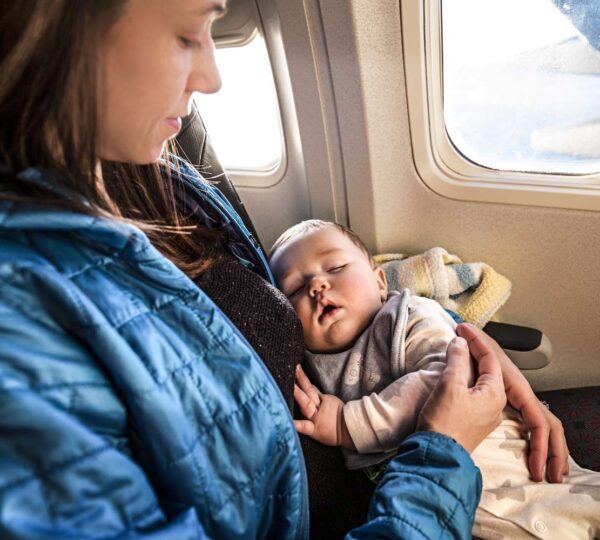
Up in business class, I remained unaware of the exact conversation unfolding. I sat holding Ethan, who now slept peacefully in my arms. His tiny fingers curled around the fabric of my sweater.
I looked out the window at the clouds stretching endlessly below us. For months, I had felt invisible in my grief—like the world had continued forward while I remained suspended in sorrow. That small act of kindness had pierced through the heaviness.
Before landing, Mr. Coleman approached my seat.
He leaned slightly toward me and said softly, “You’re doing a good job.”
Five simple words.
But in that moment, they felt monumental.
Since David’s passing, I had questioned myself constantly. Was I strong enough? Was I patient enough? Could I give Ethan the life he deserved without his father? Grief often whispers cruel doubts.
Hearing someone acknowledge my effort—even briefly—brought tears to my eyes. Not because I needed praise, but because I needed reassurance that I wasn’t failing.
“You’re doing a good job.”
Those words reminded me that resilience isn’t loud. Sometimes it’s simply showing up, boarding the plane, holding your child, and trying your best.
That flight began as one of the hardest days of my life. It became a lesson I will carry forever.
Kindness matters. Compassion is powerful. Leadership is not about authority alone—it is about empathy. A single moment of understanding can transform someone’s entire day.
In a world that often feels hurried and impatient, there are still people who pause. People who see beyond inconvenience. People who choose to act with grace.
As we landed and prepared to disembark, I adjusted Ethan’s blanket and kissed his forehead. He stirred slightly but remained asleep.
I walked off that plane not just as a grieving widow or an exhausted mother—but as someone reminded that I am capable.
And as for Ethan, he slept peacefully the rest of the flight. I like to believe he felt safe. In my arms. In that quiet space. In a world that, despite everything, still holds kindness.
