
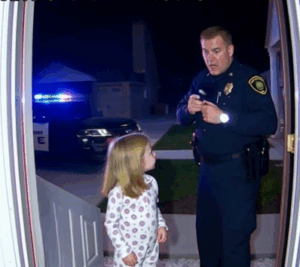
The suburban neighborhood lay wrapped in stillness that night, the kind of quiet that usually signals safety and routine.
Streetlights glowed softly, casting pale circles on empty sidewalks, while houses rested in peaceful darkness. The only sound breaking the calm was the distant, rising wail of police sirens.
Faint at first, then gradually closer—cutting through the night air like a warning that something had gone terribly wrong.
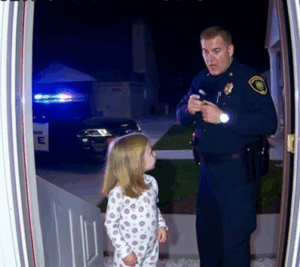
Inside a modest home at the end of the block, two police officers paused briefly at the doorway. Years of experience had taught them to recognize moments like this—when the air itself feels heavy, when instinct whispers that what lies ahead will not be easy to forget.
They exchanged a brief glance before stepping inside, already carrying the weight of the emergency call that had brought them there.
It was not an adult who had dialed for help.
It was a child.
On the other end of the phone line, earlier that night, a small voice had spoken words no dispatcher ever wants to hear from someone so young. The voice had been soft and trembling, yet strangely composed.
“My mommy and daddy won’t wake up,” the child said. “They’re sleeping… but something’s wrong.”
Those few sentences were enough. Emergency responders were sent immediately, understanding the urgency hidden within the simplicity of the words. The caller was a seven-year-old girl named Lily, and without realizing it, she had already shown extraordinary courage.
As the officers stepped into the home, a profound silence greeted them. It wasn’t the peaceful quiet of a sleeping household—it was dense, unmoving, almost suffocating.
Their boots creaked against the floor as they moved carefully through the living room. The faint beam of their flashlights traced the outlines of familiar household objects: a couch with neatly folded blankets, family photos lining the walls, a child’s backpack resting by the door.
Everything looked ordinary.
That was what made it unsettling.
The officers followed the hallway toward the bedroom, guided by training and intuition. The closer they came, the heavier the atmosphere felt, as if the house itself were holding its breath. When the beam of light finally swept across the bed, time seemed to slow.
A man and a woman lay side by side, their hands loosely clasped together. Their faces appeared calm, almost peaceful, as though they were asleep. But there was a stillness about them that did not belong to rest. It was complete. Absolute.
“Sir… ma’am?” one officer called gently, his voice barely louder than a whisper.
There was no response.
The second officer stepped forward to check for signs of life. His movements were steady, professional, practiced.
Yet before the assessment was even complete, the truth settled in. He looked up slowly and met his partner’s eyes. The expression on his face said everything words could not.
They were gone.
In that moment, the silence became overwhelming. Every sound—the hum of electricity, the distant sirens, even their own breathing—felt amplified. The officers stood still for a moment, honoring the gravity of what they had found.
Then they remembered why they were there.
A child was in the house.
They returned to the living room, where Lily stood quietly near the couch, clutching a small stuffed animal tightly against her chest.
The toy was worn, its fur flattened from years of comfort. Lily’s eyes were wide and searching, moving between the officers and the hallway that led to her parents’ room. She did not cry. She did not speak. She simply waited.
One officer knelt down to her level, careful to soften his voice.
“Hi, Lily,” he said gently. “You did the right thing by calling us. You were very brave.”
She nodded slowly. Her hands trembled just enough to reveal the fear she was holding inside.
The officers guided her to sit on the couch and turned on a nearby lamp, filling the room with a warm, reassuring glow. Until paramedics and additional support arrived, they stayed close to her, offering quiet presence rather than overwhelming questions.
They spoke about simple things.
Her favorite color.
Her favorite subject at school.
The name of her stuffed animal.
Each small conversation was a way of anchoring her, keeping her grounded while events unfolded beyond her understanding.
As time passed, Lily began to explain what had happened earlier that night. After dinner, everything had been normal. Her parents had followed the same bedtime routine they always did.
Her mother read her a story. Her father kissed her forehead and reminded her that he loved her. The house had felt safe, familiar, warm.
Later, Lily woke from a bad dream. Like many children her age, she sought comfort in the presence of her parents. She walked quietly down the hall and entered their room.
At first, she thought they were playing a game or pretending to sleep.
She called their names.
She climbed onto the bed.
She waited.
When they didn’t respond, fear slowly replaced confusion. Minutes passed. The room stayed silent. Something inside her told her that this was not normal.
And then, showing presence of mind far beyond her years, Lily went to the phone.
She asked for help.
When paramedics arrived, their assessment confirmed what the officers already knew. The parents had passed away.
The cause was not immediately clear, and investigators began their work carefully and respectfully. Every detail mattered. Every object was documented. The home was treated not as a crime scene, but as a place of answers waiting to be understood.
There were no signs of forced entry.
No signs of struggle.
No indication of harm or danger to Lily.
The house appeared exactly as it had been left the night before—frozen in time.
Outside, neighbors gathered quietly at a distance. Some stood in pajamas, others wrapped in coats, whispering softly as they watched emergency vehicles line the street.
No one knew exactly what had happened, but everyone understood that something irreversible had occurred.
A social worker arrived soon after, a woman named Amanda, whose calm presence brought a sense of steadiness to the chaos. She wrapped Lily in a soft blanket and spoke gently, offering reassurance without overwhelming her.
“You’re safe,” she said. “You’re not alone. There are people who will take care of you.”
Lily looked up at her and asked a question that broke every heart in the room.
“When will my mommy and daddy wake up?”
There were no easy answers.
But there was compassion.
As dawn approached, pale light filtered through the windows, illuminating a home forever changed. The emergency response slowly transitioned into the next phase—investigation, support, planning for Lily’s future.
Relatives were contacted. Arrangements were made to ensure Lily would be surrounded by familiar faces and loving care.
Authorities later confirmed that Lily had never been in danger. While the cause of her parents’ passing required further examination, there was no indication of wrongdoing toward her. That fact, small as it seemed, brought a measure of relief amid overwhelming grief.
In the days that followed, the community responded with quiet kindness. Flowers appeared on the front porch. Cards arrived with handwritten messages of love and support. Neighbors who had barely exchanged greetings before now stood together, united by compassion.
At Lily’s school, teachers created a space for remembrance and healing. Classmates drew pictures and wrote notes, many simply saying, “We’re glad you’re here.”
Over time, Lily began the long process of healing. With the support of extended family, counselors, and a community that refused to let her feel alone, she slowly returned to routine. She went back to school. She began drawing again—often pictures of stars, skies, and light.
When asked about her parents, she once said softly, “They live in the stars now. They watch me.”
Therapists described Lily as resilient, thoughtful, and deeply empathetic—a child shaped by loss but not defined by it. She learned to speak about her feelings, to ask for comfort, and to understand that bravery does not mean the absence of fear.
It means acting despite it.
Years later, the officers who responded that night still remember Lily. Every year on her birthday, she receives a card signed simply:
“From your friends who came when you called.”
It is a reminder that compassion matters. That listening matters. That courage can come from the smallest voice in the darkest moment.
Lily’s story is not just one of tragedy. It is a testament to the strength children can show, the importance of community, and the power of kindness in moments when the world feels unbearable.
That quiet night, broken by sirens and sorrow, also revealed something extraordinary: that even in the face of unimaginable loss, love, courage, and human connection can endure.
And sometimes, the bravest hero is simply a child who knows to ask for help.
