

For more than five decades, Rev. Jesse Jackson stood as one of the most recognizable and influential figures in America’s modern civil rights movement.
A close ally of Dr. Martin Luther King Jr., a gifted orator, a Baptist minister, and a two-time Democratic candidate for president, Jackson built a public life defined by activism, advocacy, and an unwavering belief in economic and racial justice.
On February 17, 2026, Jesse Jackson passed away peacefully at the age of 84, surrounded by his wife of more than six decades and his children.
His family confirmed his passing, though the specific cause of death was not publicly announced. His death marked the end of an era — the closing chapter of a life that had spanned the turbulent 1960s, the rise of modern American politics, and the evolving landscape of social justice activism in the 21st century.

Yet Jackson’s story, like that of many public figures, was not defined solely by his accomplishments. Alongside his celebrated public service, his life included deeply personal challenges — including an extramarital affair that became national news in 2001 and led to the birth of a daughter, Ashley Laverne Jackson.
Over time, what began as a painful public scandal evolved into a story of responsibility, growth, and a new generation forging its own path.
A Life Shaped by Faith and Civil Rights
Born in Greenville, South Carolina, in 1941, Jesse Jackson rose to national prominence during the civil rights movement of the 1960s.
As a young activist, he worked closely with Martin Luther King Jr., eventually becoming a key figure in Operation Breadbasket, the economic arm of King’s Southern Christian Leadership Conference (SCLC).
After King’s assassination in 1968, Jackson founded Operation PUSH (People United to Save Humanity), which later merged with the Rainbow Coalition to form the Rainbow/PUSH Coalition.
Through this organization, he advocated for economic empowerment, voter registration, corporate accountability, and international human rights.
In 1984 and again in 1988, Jackson ran for the Democratic presidential nomination. His campaigns were historic. In 1988, he won several primaries and caucuses and built what he called the “Rainbow Coalition,” uniting African Americans, Latinos, working-class whites, farmers, and young voters.
Though he did not secure the nomination, his campaigns significantly expanded political participation among minority communities and reshaped the Democratic Party’s approach to coalition-building.
Throughout the decades, Jackson remained active in national and international diplomacy, civil rights advocacy, and social justice initiatives. His voice was often heard at moments of crisis, protest, and political transition.

The 2001 Affair and Public Admission
In January 2001, Jackson publicly acknowledged that he had engaged in an extramarital affair that resulted in the birth of a daughter.
The revelation came before tabloids had fully reported the story, and Jackson addressed the matter directly in a statement and interviews.
At the time, he told ABC News: “This is no time for evasions, denials or alibis. I fully accept responsibility, and I am truly sorry for my actions.”
The child, Ashley Laverne Jackson, had already been born in 1999 and was approximately 20 months old when the story became public. Her mother, Karin Stanford, had worked at Jackson’s Rainbow/PUSH Coalition office in Washington, D.C.
Jackson’s admission sparked intense media attention and public scrutiny. Many critics questioned how a prominent Baptist minister and civil rights leader could reconcile his moral teachings with his personal actions. The situation also drew attention because of the broader political context.
At the time of the affair, Jackson had been serving as an informal spiritual adviser to President Bill Clinton during the fallout from the Monica Lewinsky scandal.
Political analyst George Stephanopoulos noted that Jackson had prayed with President Clinton at the White House and had counseled members of the Clinton family during that turbulent period. The timing intensified public reaction.
Despite the controversy, Jackson did not deny responsibility. In his statement, he emphasized his commitment to supporting his daughter and her mother, both financially and personally.
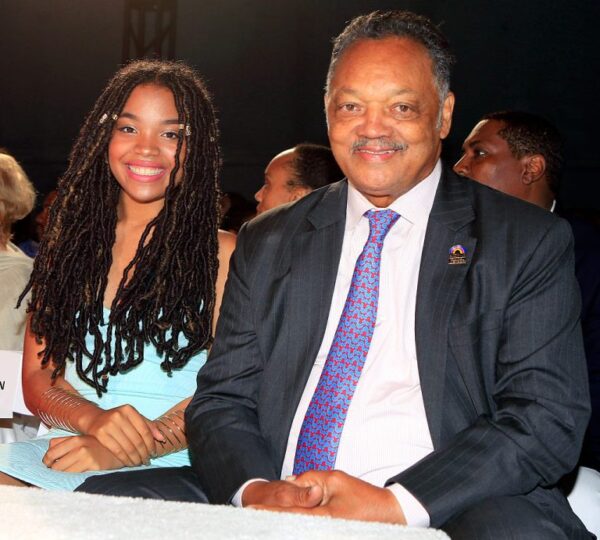
He acknowledged the weight of the situation, especially given that he himself had been born out of wedlock and understood the stigma such circumstances could carry.
“I was born of these circumstances,” he said at the time, “and I know the importance of growing up in a nurturing, supportive, and protected environment.”
Reports from the Associated Press indicated that Karin Stanford received $3,000 per month in child support and additional financial assistance, including support for relocation expenses. Jackson also established provisions for life insurance and future college education for his daughter.
Following the public revelation, Jackson stepped back temporarily from some public engagements to focus on his family and personal responsibilities.
Family, Accountability, and Moving Forward
Jackson had been married to Jacqueline Brown since 1962. Together, they raised five children before the public acknowledgment of Ashley’s birth.
The affair was understandably painful for his family, and Jackson spoke openly about working to repair trust and maintain unity within his household.
Over time, while the scandal remained a documented chapter in his life, it did not erase his decades of activism. Jackson continued his public work, though the episode remained part of his complex legacy.
Importantly, Ashley Laverne Jackson grew up largely outside the glare of constant media attention. While her father was one of the most recognizable civil rights leaders in America, she was afforded relative privacy during her formative years.
As she reached adulthood, however, she began carving out her own public identity.
Ashley Laverne Jackson: Education and Career
Today, Ashley Laverne Jackson is an accomplished actress, writer, and producer.

She earned her Master of Fine Arts degree from the Peter Stark Producing Program at the University of Southern California in 2025.
The Peter Stark Program is one of the entertainment industry’s most respected producing tracks, known for training future studio executives and producers.
Ashley became the first graduate of Spelman College to complete the program, marking a significant academic milestone.
As an actress, she is known for her role as Niyah in the Netflix film Beats, which premiered in 2019. The film, set in Chicago, explored themes of music, mentorship, and resilience.
Beyond acting, Ashley has been involved in television development and creative production. She participated in Disney’s inaugural Apprenticeship Program and supported projects including Grown-ish, a popular series addressing contemporary issues facing young adults.
In October 2025, Ashley revealed she was developing a docuseries examining her father’s legacy through her own perspective.
The project aimed to explore not only his public activism but also his role as a father, offering a personal lens on a man often viewed primarily as a political figure.
Advocacy and PUSH The Next Generation
Ashley has also embraced activism in her own way. Through her nonprofit initiative and podcast, PUSH The Next Generation, she promotes youth civic engagement, cross-generational dialogue, and social awareness.
While inspired by her father’s legacy, her approach reflects the priorities of her own generation — blending storytelling, digital platforms, and grassroots organizing.
She has also championed food justice initiatives, working to bring plant-based education and access to healthier food options into underserved communities.
Rather than replicating her father’s exact path, Ashley has adapted the broader mission of empowerment and equity to contemporary social issues.
Her work reflects continuity — but also independence. She carries forward a legacy of activism while building her own professional identity in entertainment and advocacy.
A Daughter’s Farewell
Following Jesse Jackson’s passing in February 2026, Ashley shared a heartfelt public letter honoring her father.
In her message, she expressed gratitude for his love and the role he played in shaping her life. She wrote that she was “immensely grateful” to have been held by his love — a love she described as powerful enough to move nations and change lives.
She reflected on what it meant to grow up as his daughter and to learn from someone she viewed not only as a public figure, but as “Dad.”
In her tribute, she acknowledged both his global influence and the everyday ways he moved through the world “with conviction and heart.”
Her words suggested reconciliation, pride, and deep affection — offering a personal dimension to a man often seen through the lens of politics and public life.
A Complex and Enduring Legacy
Jesse Jackson’s life cannot be reduced to a single headline — neither his achievements nor his personal mistakes.
He was a towering figure in civil rights, a presidential candidate who expanded political participation, and an advocate who consistently pushed for economic justice.
At the same time, he was human — capable of missteps that affected his family and required accountability.
His acknowledgment of his daughter in 2001, and his commitment to supporting her, demonstrated a willingness to confront personal failure publicly.
In the years that followed, Ashley Laverne Jackson emerged not as a footnote to scandal, but as a professional and advocate in her own right.
As the nation reflects on Jackson’s life, it sees both the public leader and the private father. His activism helped shape modern American politics.
His personal journey included challenge and growth. And through his daughter’s work, a new generation continues conversations about justice, representation, and opportunity.
In the end, Jesse Jackson leaves behind a multifaceted legacy — one built on faith, political courage, resilience, and family.
