Resident Spots Submerged Vehicle in River and Contacts Authorities
For nearly twelve years, families, friends, and communities in central Russia lived with a painful sense of uncertainty and unanswered questions after the sudden disappearance of a young couple, Ilya Zhirnov, 25, and Kira Cherkasova, 22, in December 2005. On that cold, snowy evening, Ilya had borrowed his father’s car to pick up Kira from her workplace.
Friends recall that it was a small, ordinary act of love and routine, the kind of gesture that marked their relationship: Ilya driving to collect Kira after a long day, sharing stories on the ride home, perhaps planning the next weekend together. That night, however, neither Ilya nor Kira returned home, and a wave of fear immediately gripped their families.
From the moment they were reported missing, relatives, neighbors, and local authorities launched frantic searches. Volunteers combed the surrounding roads, fields, and wooded areas. Posters with their photographs were printed and posted in shops, bus stations, and city centers. Phone calls were made, tips were followed, and every potential lead was pursued.
Yet, day after day, week after week, the trail remained cold, leaving no hint of the couple’s whereabouts.
The car they had been driving on that fateful night was nowhere to be found, and the absence of any concrete clues cast a long, gnawing shadow over the hearts of those who loved them.
Families lived for years in a kind of suspended limbo, trapped between hope and despair, unable to mourn fully, unable to accept any conclusion that did not exist, and unable to reclaim the normal rhythms of their lives.
Every day, every hour, every seemingly ordinary moment carried the weight of uncertainty.
Every phone call from an unknown number, every report from a stranger claiming to have glimpsed them somewhere, sparked a mixture of hope and despair in equal measure, each new lead briefly lighting the spark of expectation only to be extinguished by disappointment.
As time stretched into months and years, the case grew colder and colder.
Police files were repeatedly closed and reopened, each time incorporating new technologies and investigative techniques that were unavailable during the initial search.
The regional media occasionally revisited the story, reminding the public of the unresolved tragedy, keeping it alive in the collective memory of the community even as the years piled up.
Friends and relatives of Ilya and Kira found subtle ways to mark anniversaries quietly, lighting candles in their homes or sharing memories on social media in the faint hope that someone, somewhere, might finally have a clue, that someone might remember something they themselves had overlooked.
Yet, despite these quiet acts of remembrance, the years stretched into over a decade, and the young couple remained missing, their absence becoming a constant, aching presence in the lives of those who loved them.
And still, despite the relentless passage of time, the families never lost hope, clinging to the possibility, however faint, that some answer would one day come.
Every Christmas, every birthday, every anniversary, every seemingly ordinary day became a reminder of what they had lost and what they still longed to know.
Memories were tinged with pain and speculation, and ordinary moments often spiraled into reflections on what might have been, leaving hearts heavy with questions.
Then, in 2017, more than eleven years after the couple had vanished without a trace, answers arrived in a way that nobody could have anticipated, a discovery so sudden, so unexpected, that it sent ripples of emotion throughout the community.
A local diving enthusiast, exploring the Volga River near a well-known public beach, noticed an unusual outline beneath the surface of the water, something that initially seemed like a shadow or a patch of debris caught in the currents.
As he approached, the outline gradually revealed itself to be a car, submerged beneath the icy waters and partially obscured by sediment and plant growth.
Recognizing the potential significance of this discovery, the diver immediately contacted local authorities, aware that this might finally hold the answers the families had been waiting for over a decade.
The news of the submerged vehicle spread quickly throughout the small town, stirring both hope and anxiety in equal measure, as people gathered along the riverbank in anticipation of what the recovery might reveal.
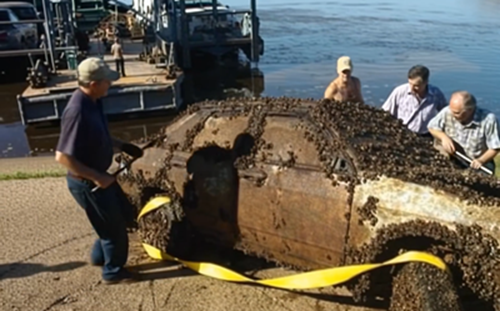
By the following day, a coordinated team of divers, emergency services personnel, and forensic specialists had arrived, prepared to carefully raise the car from the river without causing further damage and in a manner that would preserve critical evidence.
The recovery operation was meticulous, slow, and demanding, requiring careful planning, specialized equipment, and precise coordination to ensure that the vehicle could be lifted safely while leaving the surrounding environment intact.
Locals watched quietly, some in hushed anticipation, others silently praying that this discovery might finally provide the clarity that had eluded them for so many years.
When the vehicle was finally raised from the river, investigators quickly confirmed that it belonged to Ilya Zhirnov.
Personal documents and belongings within the car verified the identities of both Ilya and Kira, finally ending a long and painful chapter of uncertainty and speculation that had haunted their families for more than a decade.
For the families, the revelation brought a complicated mixture of heartbreak and relief, grief and closure intertwined in ways that words could barely capture.
Though the discovery confirmed that the young couple had died tragically, it also offered a long-awaited answer that had been impossible to attain during the years of waiting.
Authorities determined that icy and treacherous road conditions on that winter night likely caused the car to slide off the road and into the river, leading to the deaths of both Ilya and Kira.
The investigation revealed no evidence of foul play, and officials concluded that the accident had been entirely unintentional, a heartbreaking combination of misfortune and environmental conditions.
For the families, this knowledge allowed them, for the first time in over a decade, to experience the possibility of proper mourning.
They were finally able to hold memorial services, lay flowers, visit gravesites, and honor the memory of Ilya and Kira in a way that had been impossible while their fate remained unknown.
The knowledge that the disappearance had been the result of a tragic accident, rather than a deliberate act, offered a bittersweet comfort that, while not erasing the pain, shifted it into a space where grief could coexist with closure and remembrance.
The discovery also highlighted the extraordinary role of the citizen diver, whose attentiveness and diligence had brought the truth to light after more than eleven years.
Without his curiosity, responsibility, and prompt action in notifying authorities, the car might have remained hidden indefinitely, leaving the families’ questions unanswered and perpetuating a state of endless uncertainty.
His actions were a powerful reminder to the community of the importance of vigilance, civic duty, and the profound impact that a single individual can have on the lives of others.
In the days and months following the recovery, local authorities and media meticulously documented the process, providing detailed accounts of the methods used to retrieve the vehicle, preserve the evidence, and verify the identities of Ilya and Kira.
Reports noted the car’s position in the river, the traces of ice and minor damage, and how these details corroborated the conclusion that the accident had been caused by treacherous winter driving conditions.
While undeniably tragic, the story served as a sobering reminder of the unpredictable dangers that icy roads pose, especially in rural regions during winter months.
The emotional impact of the discovery was profound and far-reaching. Families finally had tangible proof to lay their loved ones to rest.
They were able to visit gravesites, hold commemorative ceremonies, and pay tribute to Ilya and Kira in a way that had been impossible for over twelve long years.
The relentless weight of uncertainty that had hung over birthdays, holidays, anniversaries, and ordinary days was finally lifted, replaced by a painful but necessary sense of resolution.
The quiet, respectful closure brought by the discovery allowed families and the community to reclaim a sense of calm, even as sorrow lingered.
In the aftermath, the story of Ilya and Kira’s disappearance and the eventual discovery of their car became a cautionary tale about life’s fragility, the dangers of winter driving, and the enduring hope that can sustain families through prolonged uncertainty.
It was also a testament to the power of individual action, as the diver’s careful observation and immediate reporting changed the course of lives, allowing families to move forward after years of unanswered questions.
Over time, the community documented the event thoroughly, highlighting both the investigative processes and the personal stories of those affected.
The discovery allowed relatives to shift their focus from endless speculation to remembrance and reflection.
Friends and family shared stories, photographs, and memories, celebrating the lives of Ilya and Kira rather than the uncertainty that had haunted them.
Although the couple had been lost far too young, the tragic resolution finally made space for grief to exist alongside peace.
The memory of Ilya and Kira, preserved through photographs, narratives, and ritual acts of remembrance, continued to live on in the hearts of those who loved them.
Even though grief never fully disappears, the knowledge of what had occurred allowed the families to navigate their pain more meaningfully, transforming it from a source of unending torment into a space for honoring and celebrating the lives of Ilya Zhirnov and Kira Cherkasova.
After more than a decade of unanswered questions, the Volga River had finally revealed the truth, giving both families and the community a chance to move forward, however cautiously.
The story stands as a reminder that life is fragile, that hope can endure even in the coldest of circumstances, and that even the smallest acts of attentiveness can uncover truths that change lives forever.
For nearly twelve years, families, friends, and communities in central Russia lived with a painful sense of uncertainty and unanswered questions after the sudden disappearance of a young couple, Ilya Zhirnov, 25, and Kira Cherkasova, 22, in December 2005. On that cold, snowy evening, Ilya had borrowed his father’s car to pick up Kira from her workplace.
Friends recall that it was a small, ordinary act of love and routine, the kind of gesture that marked their relationship: Ilya driving to collect Kira after a long day, sharing stories on the ride home, perhaps planning the next weekend together. That night, however, neither Ilya nor Kira returned home, and a wave of fear immediately gripped their families.
From the moment they were reported missing, relatives, neighbors, and local authorities launched frantic searches. Volunteers combed the surrounding roads, fields, and wooded areas. Posters with their photographs were printed and posted in shops, bus stations, and city centers. Phone calls were made, tips were followed, and every potential lead was pursued.
Yet, day after day, week after week, the trail remained cold, leaving no hint of the couple’s whereabouts.
The car they had been driving on that fateful night was nowhere to be found, and the absence of any concrete clues cast a long, gnawing shadow over the hearts of those who loved them.
Families lived for years in a kind of suspended limbo, trapped between hope and despair, unable to mourn fully, unable to accept any conclusion that did not exist, and unable to reclaim the normal rhythms of their lives.
Every day, every hour, every seemingly ordinary moment carried the weight of uncertainty.
Every phone call from an unknown number, every report from a stranger claiming to have glimpsed them somewhere, sparked a mixture of hope and despair in equal measure, each new lead briefly lighting the spark of expectation only to be extinguished by disappointment.
As time stretched into months and years, the case grew colder and colder.
Police files were repeatedly closed and reopened, each time incorporating new technologies and investigative techniques that were unavailable during the initial search.
The regional media occasionally revisited the story, reminding the public of the unresolved tragedy, keeping it alive in the collective memory of the community even as the years piled up.
Friends and relatives of Ilya and Kira found subtle ways to mark anniversaries quietly, lighting candles in their homes or sharing memories on social media in the faint hope that someone, somewhere, might finally have a clue, that someone might remember something they themselves had overlooked.
Yet, despite these quiet acts of remembrance, the years stretched into over a decade, and the young couple remained missing, their absence becoming a constant, aching presence in the lives of those who loved them.
And still, despite the relentless passage of time, the families never lost hope, clinging to the possibility, however faint, that some answer would one day come.
Every Christmas, every birthday, every anniversary, every seemingly ordinary day became a reminder of what they had lost and what they still longed to know.
Memories were tinged with pain and speculation, and ordinary moments often spiraled into reflections on what might have been, leaving hearts heavy with questions.
Then, in 2017, more than eleven years after the couple had vanished without a trace, answers arrived in a way that nobody could have anticipated, a discovery so sudden, so unexpected, that it sent ripples of emotion throughout the community.
A local diving enthusiast, exploring the Volga River near a well-known public beach, noticed an unusual outline beneath the surface of the water, something that initially seemed like a shadow or a patch of debris caught in the currents.
As he approached, the outline gradually revealed itself to be a car, submerged beneath the icy waters and partially obscured by sediment and plant growth.
Recognizing the potential significance of this discovery, the diver immediately contacted local authorities, aware that this might finally hold the answers the families had been waiting for over a decade.
The news of the submerged vehicle spread quickly throughout the small town, stirring both hope and anxiety in equal measure, as people gathered along the riverbank in anticipation of what the recovery might reveal.
By the following day, a coordinated team of divers, emergency services personnel, and forensic specialists had arrived, prepared to carefully raise the car from the river without causing further damage and in a manner that would preserve critical evidence.
The recovery operation was meticulous, slow, and demanding, requiring careful planning, specialized equipment, and precise coordination to ensure that the vehicle could be lifted safely while leaving the surrounding environment intact.
Locals watched quietly, some in hushed anticipation, others silently praying that this discovery might finally provide the clarity that had eluded them for so many years.
When the vehicle was finally raised from the river, investigators quickly confirmed that it belonged to Ilya Zhirnov.
Personal documents and belongings within the car verified the identities of both Ilya and Kira, finally ending a long and painful chapter of uncertainty and speculation that had haunted their families for more than a decade.
For the families, the revelation brought a complicated mixture of heartbreak and relief, grief and closure intertwined in ways that words could barely capture.
Though the discovery confirmed that the young couple had died tragically, it also offered a long-awaited answer that had been impossible to attain during the years of waiting.
Authorities determined that icy and treacherous road conditions on that winter night likely caused the car to slide off the road and into the river, leading to the deaths of both Ilya and Kira.
The investigation revealed no evidence of foul play, and officials concluded that the accident had been entirely unintentional, a heartbreaking combination of misfortune and environmental conditions.
For the families, this knowledge allowed them, for the first time in over a decade, to experience the possibility of proper mourning.
They were finally able to hold memorial services, lay flowers, visit gravesites, and honor the memory of Ilya and Kira in a way that had been impossible while their fate remained unknown.
The knowledge that the disappearance had been the result of a tragic accident, rather than a deliberate act, offered a bittersweet comfort that, while not erasing the pain, shifted it into a space where grief could coexist with closure and remembrance.
The discovery also highlighted the extraordinary role of the citizen diver, whose attentiveness and diligence had brought the truth to light after more than eleven years.
Without his curiosity, responsibility, and prompt action in notifying authorities, the car might have remained hidden indefinitely, leaving the families’ questions unanswered and perpetuating a state of endless uncertainty.
His actions were a powerful reminder to the community of the importance of vigilance, civic duty, and the profound impact that a single individual can have on the lives of others.
In the days and months following the recovery, local authorities and media meticulously documented the process, providing detailed accounts of the methods used to retrieve the vehicle, preserve the evidence, and verify the identities of Ilya and Kira.
Reports noted the car’s position in the river, the traces of ice and minor damage, and how these details corroborated the conclusion that the accident had been caused by treacherous winter driving conditions.
While undeniably tragic, the story served as a sobering reminder of the unpredictable dangers that icy roads pose, especially in rural regions during winter months.
The emotional impact of the discovery was profound and far-reaching. Families finally had tangible proof to lay their loved ones to rest.
They were able to visit gravesites, hold commemorative ceremonies, and pay tribute to Ilya and Kira in a way that had been impossible for over twelve long years.
The relentless weight of uncertainty that had hung over birthdays, holidays, anniversaries, and ordinary days was finally lifted, replaced by a painful but necessary sense of resolution.
The quiet, respectful closure brought by the discovery allowed families and the community to reclaim a sense of calm, even as sorrow lingered.
In the aftermath, the story of Ilya and Kira’s disappearance and the eventual discovery of their car became a cautionary tale about life’s fragility, the dangers of winter driving, and the enduring hope that can sustain families through prolonged uncertainty.
It was also a testament to the power of individual action, as the diver’s careful observation and immediate reporting changed the course of lives, allowing families to move forward after years of unanswered questions.
Over time, the community documented the event thoroughly, highlighting both the investigative processes and the personal stories of those affected.
The discovery allowed relatives to shift their focus from endless speculation to remembrance and reflection.
Friends and family shared stories, photographs, and memories, celebrating the lives of Ilya and Kira rather than the uncertainty that had haunted them.
Although the couple had been lost far too young, the tragic resolution finally made space for grief to exist alongside peace.
The memory of Ilya and Kira, preserved through photographs, narratives, and ritual acts of remembrance, continued to live on in the hearts of those who loved them.
Even though grief never fully disappears, the knowledge of what had occurred allowed the families to navigate their pain more meaningfully, transforming it from a source of unending torment into a space for honoring and celebrating the lives of Ilya Zhirnov and Kira Cherkasova.
After more than a decade of unanswered questions, the Volga River had finally revealed the truth, giving both families and the community a chance to move forward, however cautiously.
The story stands as a reminder that life is fragile, that hope can endure even in the coldest of circumstances, and that even the smallest acts of attentiveness can uncover truths that change lives forever.