

Jennifer Lawrence is used to having almost every detail of her appearance photographed and analyzed.
A new coat can become a fashion headline. A pair of shoes can attract attention.
Even something as simple as the way she wears a scarf can become a topic of conversation.
That is exactly what happened when the Oscar-winning actress began appearing in public with a scarf wrapped unusually around parts of her face.
Photographs circulated.
People noticed.
And some observers naturally assumed the look was intentional fashion styling.
It was intentional.
But not for the reason many imagined.
Lawrence was thinking about her skin.
The scarf was doing a job
In a September 2026 interview with Vogue, Lawrence explained what had been happening.
The 36-year-old actress revealed that she deals with melasma, a common pigmentation condition that causes darker patches to develop on the skin.

For Lawrence, the affected areas include parts of her cheeks and chin.
She had also started using tretinoin, commonly called Tret, as part of her skincare routine.
That combination made sun protection particularly important to her.
So Lawrence found a straightforward solution.
She began covering the areas with a scarf when she went outside.
Then the paparazzi noticed.
What looked fashionable was actually practical
Because Lawrence is a major celebrity, the scarf was inevitably interpreted through the lens of fashion.
Was she experimenting with a new look?
Was this a trend?
Was there some hidden styling inspiration behind it?
Lawrence found the interpretation amusing.
She told Vogue that people were photographing her wearing the scarf and assuming she was making a fashion statement.
Her own description was considerably less glamorous.
She joked about feeling haggard and dealing with scaling skin while trying to protect herself.
That explanation changed the meaning of the photographs.
The scarf was not primarily about looking stylish.
It was about covering specific areas of her face.
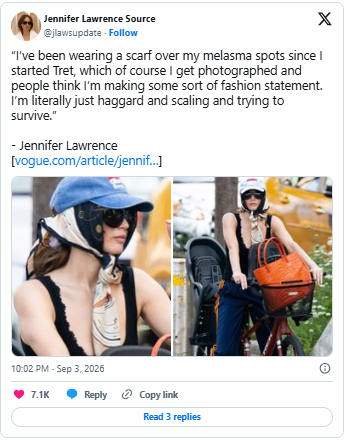
And she made it clear that looking slightly unusual bothered her far less than worsening the melasma.
What is melasma?
Melasma is a common skin condition involving increased pigmentation.
It often appears as flat brown or gray-brown patches on the face.
Common locations include the cheeks, forehead, chin and area above the upper lip.
Women develop melasma more frequently than men.
Several factors can contribute to it.
Hormonal changes can play a role.
Genetic susceptibility can matter.
And light exposure is particularly important because sunlight can make existing pigmentation darker or more noticeable.
That is why dermatologists place so much emphasis on sun protection for people managing melasma.
But there is another important point.
Melasma is generally a cosmetic pigmentation condition.
It is not the same thing as skin cancer.
And it usually does not cause physical symptoms such as pain or itching.
Still, reducing its appearance can require ongoing care.
Sunlight can make management more difficult
Someone treating melasma can make progress only to see pigmentation become more noticeable again after significant light exposure.
For that reason, dermatologists commonly recommend consistent protection.
Broad-spectrum sunscreen is one important tool.
Protective clothing can help too.
So can seeking shade.
A wide-brimmed hat can provide additional coverage for the face.
For some people with melasma, dermatologists may recommend tinted sunscreen containing iron oxide because visible light can also contribute to pigmentation.
Lawrence took the idea of physical coverage in another direction.
The scarf covered the areas she was particularly concerned about.
Simple.
Visible.
And apparently effective enough for her to keep doing it despite the attention.
But the tretinoin part of her explanation also deserves context.
Tretinoin can irritate skin
Tretinoin is a topical prescription retinoid.
It has been used in dermatology for decades and can be prescribed for concerns including acne and signs of photoaging.
It may also be used as part of certain treatment approaches for melasma.
But tretinoin can cause irritation, particularly when someone begins using it.
Dryness can occur.
Peeling can happen.
Some people experience redness, stinging or increased sensitivity.
That makes Lawrence’s comments about scaling skin understandable.
It also explains why someone using tretinoin may become particularly attentive to a careful skincare routine.
But there is an important distinction.
Tretinoin should not be described as the cause of Lawrence’s melasma based on her comments.
She said she had been covering her melasma areas since beginning Tret.
Those are not the same claim.
Her story is not a treatment recommendation
When a celebrity discusses skincare, specific products can suddenly attract enormous attention.
But Lawrence’s personal routine should not be interpreted as medical instructions for everyone else.
Tretinoin is prescription medication.
It can be extremely irritating for some people.
And it is not appropriate for everyone.
A dermatologist or other qualified healthcare professional can evaluate pigmentation and determine whether it actually is melasma.
That matters because different skin conditions can sometimes create similar-looking discoloration.
Treatment also varies.
What works for one person may not be appropriate for another.
So the useful part of Lawrence’s story is not that everyone should copy her routine.
It is that sun protection is an important part of managing melasma.
Sunscreen is not only for the face
Lawrence also discussed protecting other exposed areas of her skin.
That includes her hands.
Hands receive a significant amount of sunlight over time, yet they can easily be forgotten during sunscreen application.
The same can happen with ears.
The neck.
The upper chest.
And other exposed areas.
Dermatologists generally recommend protecting exposed skin from ultraviolet radiation rather than thinking only about the face.
Of course, sunscreen is only one part of sun protection.
Clothing and shade can add another layer.
And in Lawrence’s case, so did a literal layer of fabric.
Paparazzi photographs tell only part of the story
Celebrity photographs frequently arrive without context.
Someone leaves a restaurant.
A photograph is taken.
Within hours, people are discussing the outfit.
Sometimes there really is an elaborate styling decision behind it.
Other times, the explanation is incredibly ordinary.
A person is cold.
They are trying to avoid the sun.
Their shoes are comfortable.
Or, in Lawrence’s case, they are managing a skin condition while using a skincare treatment.
The viewer sees a fashion photograph.
The person inside the photograph may be thinking about something completely different.
That contrast is what made Lawrence’s explanation so memorable.
She was willing to look unusual
There is also something characteristic about the way Lawrence described the situation.
She did not present her routine as glamorous.
She laughed about it.
And she made her priorities very clear.
If covering the melasma meant wearing a scarf in a way that people thought looked unusual, she was comfortable with that.
The pigmentation mattered more to her than looking perfectly styled in every paparazzi photograph.
That attitude is particularly notable in an industry where actresses are constantly photographed.
Even an ordinary trip outside can become a public image.
Lawrence effectively decided that skincare came first.
The photographs could take care of themselves.
Melasma can require patience
One reason people managing melasma may become serious about sun protection is that pigmentation can be persistent.
Treatment does not necessarily produce immediate results.
Even when discoloration improves, continued light exposure can contribute to recurrence.
That means prevention and treatment often need to work together.
Someone might use a dermatologist-prescribed treatment while also protecting the skin consistently from sunlight.
Without that second part, progress can be harder to maintain.
Lawrence’s scarf therefore fits into a larger strategy rather than representing some mysterious celebrity beauty trick.
It is physical coverage.
Nothing more complicated than that.
Not every beauty story is really about beauty
That may be the most interesting part of the entire situation.
People saw Jennifer Lawrence wearing a scarf and interpreted it as style.
She saw it as protection.
Those two perspectives existed in the same photograph.
For observers, it became another celebrity fashion moment.
For Lawrence, it was apparently much more mundane.
Melasma.
Tretinoin.
Dry skin.
Sun protection.
And trying to get through the day without worrying about whether the paparazzi thought her scarf looked strange.
The mystery finally had a simple answer
For months, photographs could make Lawrence’s unusual scarf styling look deliberately mysterious.
Now the explanation is out.
She has melasma affecting parts of her face.
She uses tretinoin.
She wants to protect those areas.
So she covers them.
There is no need to turn the story into something more dramatic.
Melasma is common.
Skin treatments can be irritating.
Sun protection matters.
And celebrities sometimes make practical decisions for exactly the same reasons everyone else does.
The difference is that most people do not have photographers documenting those decisions on the sidewalk.
Jennifer Lawrence’s scarf may have looked like a fashion statement.
But according to the actress herself, fashion was never really the point.
Underneath that carefully wrapped fabric was a much simpler priority.
Protecting her skin.

