

Some physical features attract attention because they are unusual. Others attract attention because people have spent generations giving them meaning.
Venus dimples belong to the second group. They are the small indentations that sometimes appear on the lower back, usually just above the buttocks and on either side of the spine.
Some people have two very obvious dimples. Others have only faint depressions.
And many people do not have visible ones at all.
All of those possibilities are normal.
The name sounds more mysterious than the anatomy.
They are often called dimples of Venus, back dimples, or simply Venus dimples.
The reference to Venus comes from the Roman goddess associated with love and beauty.
That cultural connection helped turn a normal anatomical variation into a beauty feature.
But the body itself is not creating them for cosmetic reasons.
The explanation begins with the pelvis.
Venus dimples usually sit over the region of the posterior superior iliac spines, often shortened to PSIS.
These are bony landmarks at the back of the pelvis.
In some people, the skin and connective tissues over this area are attached in a way that creates visible indentations.
The skin is pulled slightly inward.
The surrounding tissue sits a little higher.
That contrast produces the dimple.
Nothing is missing.
There is no hole in the pelvis.
And there is no special organ underneath.
It is simply the way the surface anatomy sits over the structures below.
That raises another obvious question.
Why do some people have them while others do not?
There is no single answer.
Body structure varies from person to person.
Pelvic shape varies.
The placement of connective tissue varies.
Muscle distribution varies.
Fat distribution varies.
Skin thickness varies.
All of those factors can influence whether the dimples are obvious, subtle, or invisible.
Genetics may contribute because body structure can run in families.
But the common claim that Venus dimples are caused by one simple dominant gene is not strongly established.
Human anatomy is often more complex than simple classroom examples of dominant and recessive traits.
So it is reasonable to say heredity may influence them.
It is less accurate to pretend there is one proven “Venus dimple gene.”
Body composition can also affect visibility.
Someone with less fat covering the lower back may show the dimples more clearly.
More muscle definition can also change the contours around the area.
That is why the dimples may become more noticeable after weight loss or changes in body composition.
But that does not mean exercise creates them from nothing.
A person can train intensely and never develop visible Venus dimples.
Another person can have them without doing any special exercise at all.
The underlying anatomy still matters most.
This is where one of the biggest myths begins.
Some people claim that visible Venus dimples prove someone is unusually fit.
They do not.
A person with them is not automatically healthier.
A person without them is not less healthy.
They are not a medical fitness test.
They are not a sign of superior circulation.
And they do not prove that someone has an ideal body-fat percentage.
They are simply easier to see in some bodies than others.
The same caution applies to claims about sexual function.
Online posts often say Venus dimples indicate better sexual pleasure or stronger orgasms.
There is no established scientific evidence supporting that claim.
The dimples are not special sensory organs.
They are not known to contain a unique nerve structure that improves sexual response.
They are visible surface anatomy.
Attractiveness is subjective.
Physiology is a different question.
Someone may personally find the feature attractive.
That is a matter of taste.
It does not turn the dimples into a medical indicator.
Fertility myths are equally unsupported.
Venus dimples are not used by doctors to determine reproductive health.
Having them does not prove fertility.
Not having them does not indicate a fertility problem.
A lower-back shape cannot substitute for medical evaluation.
Still, the myths remain popular.
That is partly because people enjoy believing visible body features reveal hidden information.
The shape of a hand.
A birthmark.
A navel.
A facial dimple.
A line on the palm.
The body becomes a kind of code.
But most of the time, anatomy is much simpler.
Visible differences usually reflect normal variation.
That is exactly what Venus dimples represent.
But there is one important distinction that should not be ignored.
Not every indentation near the lower spine is a Venus dimple.
This is where sacral dimples enter the picture.
A typical Venus dimple is usually part of a pair.
The two depressions sit on either side of the lower back.
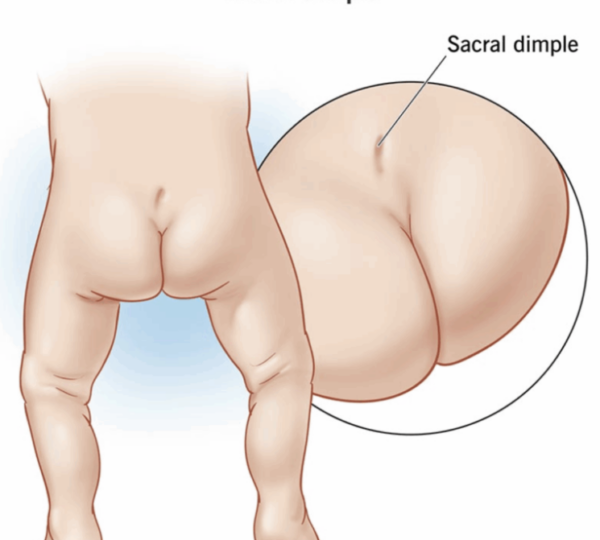
A sacral dimple is generally different.
It is usually a single indentation located closer to the center line and near the crease between the buttocks.
Sacral dimples are most often discussed in newborns and infants.
Most are harmless.
That point matters.
A baby with a small, simple sacral dimple does not automatically have a spinal problem.
In many cases, no treatment is needed.
But doctors sometimes pay closer attention to sacral dimples because certain unusual features can occasionally be associated with underlying spinal differences.
The location matters.
The depth matters.
The size matters.
Nearby skin changes matter.
A clinician may look for a patch of hair.
A skin tag.
Discoloration.
An unusually deep pit.
Or a dimple positioned higher than expected.
If those features are present, further evaluation may sometimes be recommended.
In young infants, ultrasound may be useful.
In other situations, MRI can provide more detailed imaging.
The purpose is not to treat the surface dimple itself.
It is to make sure there is no deeper spinal abnormality.
That is a very different situation from ordinary Venus dimples.
And it is one reason people should not assume all lower-back indentations are the same thing.
There is another condition that can also be confused with dimples.
Pilonidal pits.
These are usually located in or near the cleft between the buttocks.
They can become irritated or infected.
Hair and debris may become trapped.
Pain can develop.
Swelling can appear.
Drainage may occur.
That is not how normal Venus dimples behave.
Venus dimples are usually painless.
They do not suddenly swell.
They do not drain fluid.
They do not become infected simply because they exist.
That difference is important.
A stable pair of harmless dimples that has always been there is very different from a newly painful or inflamed pit.
Symptoms change the interpretation.
So does timing.
If a lower-back indentation suddenly changes, becomes painful, red, swollen, or begins draining, it should not automatically be dismissed as a cosmetic dimple.
Medical attention may be appropriate.
The same applies if someone develops neurological symptoms such as weakness, numbness, or bladder and bowel changes.
Those symptoms are not typical effects of Venus dimples.
They could reflect a completely separate condition.
The visible dimples should not be blamed simply because they are nearby.
Lower-back pain itself has many possible causes.
Muscle strain.
Joint problems.
Disc problems.
Nerve irritation.
Injury.
Posture.
And other conditions can all contribute.
A pair of Venus dimples does not identify the source of pain.
This is another useful reminder.
The most visible feature is not always the medically important one.
Venus dimples can remain visible for years without causing any symptoms at all.
That is normal.
Their appearance may also change over time.
Weight gain can make them less noticeable.
Weight loss can make them more visible.
Changes in muscle mass can alter the surrounding contours.
Pregnancy can change body shape.
Age can change skin and fat distribution.
None of that means the dimples themselves are becoming healthier or less healthy.
The surface appearance is simply changing.
There is no medically required depth or shape.
Some are tiny.
Some are broader.
Some are nearly symmetrical.
Others are slightly uneven.
Human bodies are not perfectly identical from side to side.
Minor variation is expected.
And this is where the cultural part becomes interesting again.
Why were these dimples associated with Venus at all?
Because people noticed them.
Then beauty standards did the rest.
Certain body features become admired because art, culture, fashion, and social trends give them meaning.
Venus dimples became linked with attractiveness.
That reputation survived.
But cultural admiration does not transform an anatomical feature into a health marker.
The same is true of the term Apollo holes.
Some people use that name for similar lower-back dimples on men.
The different label sounds more masculine.
Anatomically, however, the feature is not fundamentally different.
There is no separate male structure.
The name changes.
The anatomy does not.
That alone shows how much of the story is cultural.
A pair of identical indentations can receive a different mythological label depending on who has them.
The body is the same.
The interpretation changes.
And now the deeper payoff begins to appear.
For years, people have tried to make Venus dimples mean more than they actually do.
Better health.
Stronger circulation.
Superior fitness.
Greater sexual response.
Special genetics.
Hidden biological advantages.
But the evidence does not support those claims.
The real explanation is simpler.
They are a normal anatomical variation created by the relationship between skin, connective tissue, and the bony structures of the pelvis.
Some people have visible dimples.
Some do not.
Some can barely see them.
Others have very pronounced ones.
None of those differences needs a medical explanation.
None of them determines whether someone is healthy.
And none of them gives a person a biological advantage.
The feature became famous because humans like attaching meaning to appearance.
That tendency is not unusual.
We do it with facial dimples.
Freckles.
Hair texture.
Eye color.
Birthmarks.
Body shape.
We turn physical variation into symbolism.
Sometimes beauty.
Sometimes personality.
Sometimes supposed health information.
But symbolism is not science.
Venus dimples are a good example of why the distinction matters.
If someone likes how they look, that is fine.
If someone does not have them, there is no reason to try to create them for health.
If they become more visible after changes in body composition, that is simply anatomy becoming easier to see.
No hidden transformation has occurred.
The only truly important medical distinction is recognizing when an indentation is not a typical Venus dimple.
A paired, stable, painless set of lower-back dimples is usually a normal feature.
A single sacral dimple in an infant is often harmless too, but unusual characteristics may need evaluation.
A painful pit near the buttock cleft may represent something entirely different.
That is where location and symptoms become useful.
Not myths.
Not beauty standards.
Not social-media claims.
Actual anatomy.
That may sound less exciting than saying Venus dimples reveal secret information about the body.
But the truth is still interesting.
A tiny difference in connective tissue and pelvic structure can create a feature humans have admired enough to name after a goddess.
That says almost as much about culture as it does about anatomy.
And perhaps that is the most accurate way to understand Venus dimples.
They are real.
They are natural.
They are harmless in the typical form.
They can be attractive to some people.
But they do not need to mean anything more.
Sometimes two small dimples are simply two small dimples.

