
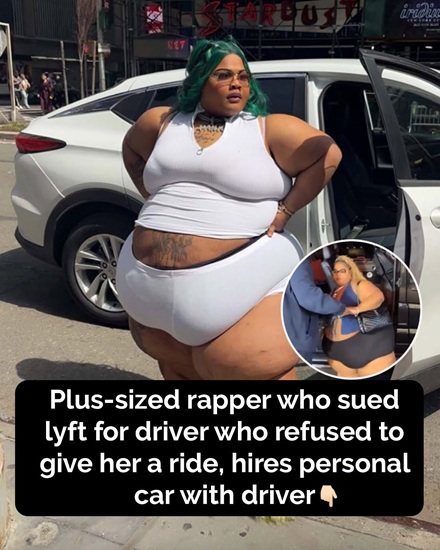
Dank DeMoss became widely known outside Detroit music circles because of a rideshare dispute. Months later, another vehicle brought the whole argument back.
This time, however, she was not standing beside a sedan arguing with a driver. She was being driven in a much larger van.
And social media immediately noticed.
The contrast was difficult to miss.
A woman who had previously sued Lyft after a driver refused to transport her because of her size was now traveling in a spacious vehicle with significantly more room.
For some commenters, that seemed to prove a point.
For others, it proved nothing at all.
The online debate started almost instantly.
But the story makes more sense when it is followed from the beginning.
Dank DeMoss is the stage name of Detroit rapper Dajua Blanding.
She is an independent artist who has promoted body confidence and self-acceptance as part of her public image.
Her music includes songs such as “Feel My Pain,” “No Love,” and “Big Girls.”
She has also been involved in independent music through FSD Records, a label connected to her late father.
Before the Lyft controversy, she was already building an audience around music, personality, and social media.
Then came January 2025.
Blanding requested a Lyft ride.
A driver arrived in a Mercedes-Benz sedan.
The trip never began.
According to Blanding and video from the encounter, the driver locked the doors and told her he did not believe she would fit in the car.
She disagreed.
“I can fit in this car,” she said during the exchange.
The driver insisted that she could not.
He also raised concerns about the vehicle, including whether her weight might affect the car or tires.
He suggested that she request a larger vehicle instead.
The driver also indicated that he would cancel the ride so she would not be charged.
That might have ended as an uncomfortable disagreement.
It did not.
Blanding believed the refusal was about her weight.
And in Michigan, weight discrimination can have legal significance.
The state’s Elliott-Larsen Civil Rights Act includes weight among protected characteristics.
That means discrimination based on weight can be legally relevant in areas covered by the law, including public accommodations.
Blanding later told local media that she had ridden in smaller vehicles before.
She said the incident hurt her feelings.
Soon afterward, she filed a lawsuit.
Her attorneys argued that she had been denied service because of a protected characteristic.
From that point on, the dispute was no longer only about whether someone could physically fit into a Mercedes.
It became a civil-rights question.
And almost immediately, the internet split into camps.
Some people supported Blanding.
They argued that a paying customer should not be denied a ride based only on assumptions about body size.
Others defended the driver.
They argued that rideshare drivers use real vehicles with real physical limits.
They pointed to seat capacity, payload ratings, tires, and possible damage.
Then another group did something much simpler.
They mocked her.
Blanding’s body quickly became the center of the conversation.
Many comments had little to do with the law.
Others had little to do with vehicle safety.
The story became another viral argument in which a serious question was buried beneath jokes.
That made it harder to separate what could actually be established from what people merely assumed.
A vehicle’s safe load is not determined by looking at a passenger.
Manufacturers specify weight limits.
Those limits vary by model and configuration.
Existing passengers and cargo matter.
The exact vehicle matters.
Without that information, an online observer cannot reliably calculate whether one specific car would have exceeded its rated capacity.
That does not automatically mean the driver was wrong.
It means the technical question requires more information than a short video provides.
The legal question was different.
Blanding’s attorneys were focused on why the ride had been refused.
Was the driver making a legitimate vehicle-specific safety decision?
Or was he refusing service based on her weight?
That distinction was central.
And it was never something strangers in comment sections could definitively resolve.
Lyft publicly stated that it opposes discrimination.
The company also referred to rules against discriminatory conduct on its platform.
The case then moved forward.
For months, people waited to see what would happen.
Would there be a trial?
Would a court decide whether the driver’s conduct violated Michigan law?
Would damages be awarded?
Eventually, the case ended without a public courtroom showdown.
In 2025, the lawsuit was reported as resolved.
Blanding’s legal team confirmed that the dispute had been settled.
But the terms were not publicly disclosed.
That detail matters.
There was no confirmed public payout figure.
There was no public explanation of every condition.
And there was no detailed court verdict establishing every disputed fact.
That means many claims circulating online afterward went further than the available evidence.
A private settlement is not the same thing as a full public trial judgment.
It can end a lawsuit without producing a definitive public ruling on every allegation.
The legal dispute was over.
The public argument was not.
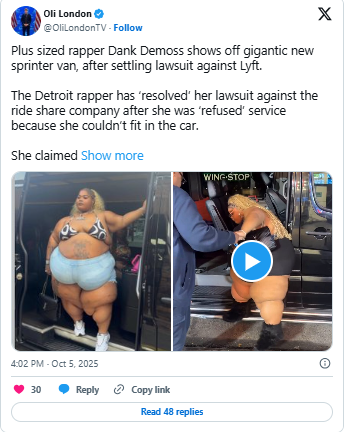
Then the van appeared.
Videos began circulating showing Blanding traveling in a large, spacious vehicle with a driver.
The difference from the original Mercedes was obvious.
There was far more room.
And for critics, that became instant material.
Some said she had effectively admitted that a larger vehicle was more appropriate.
One common reaction was that she should have bought the same type of car involved in the original dispute if she wanted to prove she had been denied unfairly.
Others saw that argument as misleading.
Choosing a larger vehicle later does not automatically answer whether the earlier refusal was discriminatory.
A person can prefer more space today and still believe a previous service refusal was unlawful.
Both things can be true.
But the image of the van was powerful.
And online debates often favor images over nuance.
The van became symbolic.
To critics, it looked like validation of the driver.
To supporters, it looked like Blanding choosing comfort and control over her own transportation.
The exact same video produced opposite conclusions.
That is often what happens when a viral controversy becomes part of someone’s public identity.
New information is interpreted through the old story.
Even when it does not actually settle the original question.
Blanding has also spoken publicly about her weight beyond the lawsuit.
She has described weight management as a long-term struggle.
She has said that the issue has affected her since childhood.
She has also mentioned a thyroid condition in discussing her health.
Those statements reflect her account of her own experience.
They should not be expanded into medical conclusions that she has not publicly documented.
Weight is complex.
Genetics can matter.
Hormones can matter.
Medications can matter.
Food intake matters.
Physical activity matters.
Sleep matters.
Environment matters.
And individual health conditions can matter.
No stranger can look at one person’s body and accurately diagnose the full cause of their weight.
That has not stopped people online from trying.
Blanding has also discussed efforts to change her weight.
She has said that she exercises.
She has spoken about vitamins and health routines.
And she has publicly reported losing more than 100 pounds.
That progress adds another layer to the story.
She has promoted self-confidence.
She has also pursued weight loss.
Those two ideas are not automatically contradictory.
Body acceptance does not require someone to promise that their weight will never change.
A person can believe they deserve respect at their current size while also working toward personal health or weight goals.
That distinction is often lost online.
People prefer simple categories.
Either someone embraces their body exactly as it is forever.
Or they are trying to change it.
Real life is more flexible.
Someone can do both.
They can reject humiliation.
And still want change.
They can believe discrimination is wrong.
And still prefer a more spacious vehicle.
That is why the new van does not provide the neat conclusion many people wanted.
It is tempting to say:
“She bought a bigger vehicle, so the driver was right.”
But that skips several steps.
The exact Mercedes model and load rating matter.
The amount of cargo matters.
The driver’s reasoning matters.
Whether the refusal was based on an actual calculation or an assumption matters.
The law matters.
And the settlement did not publicly answer all of those questions.
The opposite claim would also go too far.
The fact that the lawsuit settled does not automatically prove that Blanding’s allegations were completely validated in court.
There was no public trial verdict establishing that.
Both sides of the online argument tend to overstate what is known.
The available facts are narrower.
A driver refused the trip.
He said Blanding would not fit and raised concerns about the vehicle.
She disagreed.
She filed a discrimination lawsuit.
The case was resolved privately.
Later, she appeared in a larger chauffeur-driven vehicle.
Everything beyond those facts requires interpretation.
That is where the discussion becomes more interesting.
There are real competing principles here.
Drivers have responsibilities.
Passengers have rights.
Vehicles have physical limits.
Civil-rights laws have legal limits.
A driver should not knowingly operate a vehicle beyond its safe capacity.
A customer should not be denied service because of an unsupported assumption tied to a protected characteristic.
Both principles make sense.
The difficulty comes when they collide.
That is what made the original incident complicated.
And it is why memes cannot settle it.
The driver may have believed he was protecting his vehicle.
Blanding may have believed she was being judged unfairly.
Those perceptions can coexist.
The legal system was one place to examine them.
The case eventually ended privately.
The public never got the full judicial answer some people wanted.
That uncertainty left room for the debate to survive.
Then the larger vehicle gave the internet something new to argue about.
But there is another reason this story keeps returning.
Blanding became famous to many people for a dispute rather than for her music.
That can happen very quickly online.
An artist may work for years building songs, performances, and an audience.
Then one confrontation reaches millions more people than the art ever did.
Suddenly, that one moment becomes the first thing strangers know.
For Blanding, the Lyft incident became that defining viral event.
Some people who had never heard one of her songs knew her name because of the lawsuit.
That attention created visibility.
It also created scrutiny.
People began commenting on more than the legal dispute.
Her body.
Her health.
Her lifestyle.
Her career.
Her food.
Her transportation.
Her personal decisions.
That is the cost of becoming a viral subject rather than simply a public figure.
People begin to believe every new detail belongs to the original controversy.
The van is a perfect example.
Maybe it was chosen because it is comfortable.
Maybe it fits her work.
Maybe it makes travel easier.
Maybe she simply likes it.
Those ordinary explanations can exist without transforming the vehicle into evidence about a settled lawsuit.
Yet online discussion rarely stays ordinary.
Every object becomes a symbol.
Every choice becomes a statement.
That is how one transportation decision can reignite a story months later.
The same pattern appears in discussions about her reported weight loss.
Some people use it to argue that criticism of her earlier size was justified.
Others use it as proof that body positivity and health goals can coexist.
Neither interpretation is required by the number on a scale.
Her reported weight loss is simply part of her own health journey.
It does not retroactively determine whether a driver’s conduct was lawful.
It does not establish what the settlement meant.
And it does not make strangers experts on her medical history.
Those are separate issues.
Keeping them separate produces a much clearer story.
There was a legal dispute.
There was a public argument about body size.
There was a private settlement.
There was later a larger vehicle.
There was an ongoing personal weight-loss effort.
All of those events can be true without one explaining every other one.
And that is where the delayed payoff becomes clearer.
At first, the story looks like it is about whether Dank DeMoss could fit inside one Mercedes.
Then it becomes about discrimination law.
Then about vehicle safety.
Then about obesity.
Then about settlement rumors.
Then about a large van.
But the deeper issue is about assumptions.
What can a driver assume about a passenger?
What can a passenger assume about a driver’s motive?
What can the public assume from a short video?
What can anyone assume from a private settlement?
And what can one new vehicle really prove?
Usually, much less than people think.
That does not make the original dispute unimportant.
It means the available evidence deserves boundaries.
Blanding’s treatment could be questioned legally without turning the driver into a villain.
The driver’s concerns could be discussed without turning Blanding’s body into a joke.
Her health journey can be acknowledged without diagnosing her.
Her weight loss can be noted without treating it as a moral victory.
And her new vehicle can be described without pretending it functions as a courtroom verdict.
That approach may be less entertaining than picking a side immediately.
But it is more accurate.
The documented timeline is enough.
In January 2025, Dajua Blanding requested a Lyft ride.
The driver refused to transport her after saying he believed she would not fit and expressing concern about his vehicle.
She said she could fit.
She later sued.
Michigan law includes weight as a protected characteristic.
Lyft publicly opposed discrimination.
The lawsuit was eventually resolved privately.
The terms were not publicly disclosed.
Later, Blanding appeared in videos traveling in a larger vehicle with a driver.
That sparked a fresh wave of commentary.
She has also publicly discussed weight loss and said she has lost more than 100 pounds.
Those facts are already enough to explain why people continue talking about the case.
The rest requires caution.
And perhaps the biggest irony is that the formal dispute ended before the public debate did.
A settlement closed the lawsuit.
A larger van reopened the argument.
That is how viral stories work.
The paperwork can end.
The internet rarely does.

