
Ten days had passed since catastrophic flooding struck parts of Nepal. With every passing hour, the search for missing workers became more difficult.
Roads had been damaged. River valleys were covered with debris. Hydropower facilities had been devastated.
Some tunnel entrances were buried beneath mud and rock.
And hundreds of workers connected to hydropower projects were still unaccounted for.
Then rescuers received the news they had desperately hoped for.
Someone was alive underground.
The survivor was a Chinese worker named Lu Haitao.
He had been trapped at the Upper Trishuli-1 Hydropower Project following the devastating August 26 flooding.
Rescuers reached him on September 5.
Reports said he was approximately 225 meters, or about 738 feet, inside the tunnel.
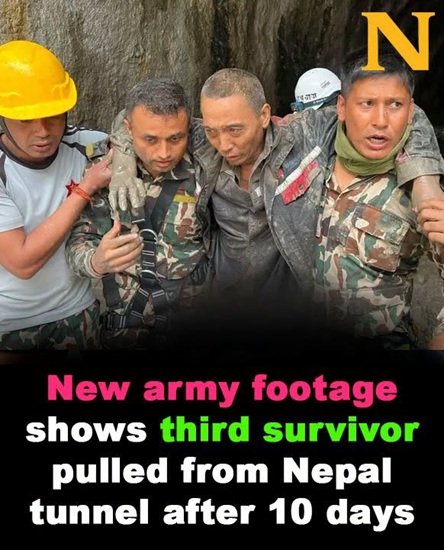
After 10 days underground, he was finally brought back into daylight.
Footage from the operation showed just how exhausting the ordeal had been.
Lu appeared weak.
Walking without assistance was difficult.
Soldiers supported and carried him as they moved toward a waiting helicopter.
An army medical worker immediately began assessing his condition.
Initial reports indicated mild hypothermia but no obvious severe external injuries.
He was then taken for further medical care.
Simply finding him alive would have been extraordinary under any circumstances.
But this rescue had additional significance.
Because Lu was not the first.
Only one day earlier, rescuers had reached two other workers trapped underground.
They were Sanjay Sah, whose surname was also rendered as Shah in some reports, and Kabir Maharjan.
The two Nepalese workers had been trapped for nine days.
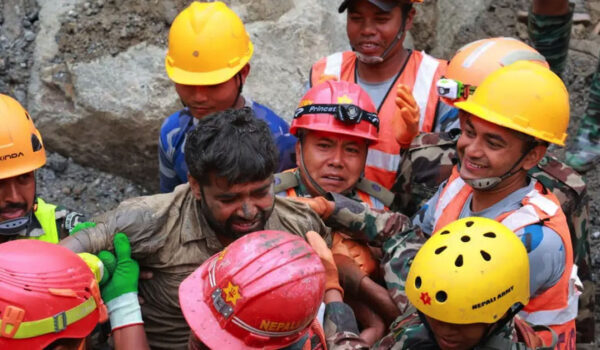
Their location, however, was different from Lu’s.
Sah and Maharjan were rescued from the Upper Trishuli 3A Hydropower Station.
Lu was found at Upper Trishuli-1.
That distinction is important because early accounts sometimes blurred the different Trishuli hydropower sites together.
The three men were connected by the same wider disaster.
But they were not all rescued from exactly the same tunnel.
The first breakthrough came at Upper Trishuli 3A.
Reaching Sah and Maharjan was anything but straightforward.
The flood had transformed the area.
Mud covered access points.
Large rocks blocked routes.
Water created dangers that could not always be seen from outside.
Rescuers knew workers might be somewhere beyond those barriers.
They did not know exactly what conditions they would find.
That uncertainty changed everything.
Digging too quickly could be dangerous.
Removing the wrong obstruction could release trapped water.
Breaking through unstable material could trigger another collapse.
The people conducting the rescue therefore had to balance two competing pressures.
Move quickly enough to reach survivors.
But slowly enough not to destroy the space protecting them.
Every meter mattered.
Engineering information became crucial.
Knowledge of the tunnel layout helped rescuers estimate where workers might have gone when the flood arrived.
Maps and drawings could help identify possible chambers or elevated sections.
But plans could not reveal exactly what the flood had changed underground.
The tunnel rescuers entered was no longer necessarily the tunnel shown on paper.
Mud had moved.
Water had entered.
Rocks had shifted.
Passages could be blocked.
And the next obstruction might conceal either a survivable pocket or a dangerous volume of water.
At some points, rescuers had to deal with enormous pieces of rock.
Controlled methods, including explosives in parts of the operation, were reportedly used to clear obstacles.
Progress was painstaking.
Then something changed.
Rescuers heard a sound.
A human voice.
After days without certainty, someone answered them.
That moment transformed the operation.
The rescuers were no longer digging toward a possibility.
They knew people were alive.
Sah and Maharjan were eventually reached.
After nine days underground, both men emerged alive.
Images from the rescue showed them covered in mud.
The physical condition of the tunnel told part of the story.
Their survival told another.
For the teams still searching elsewhere, it provided something they had not possessed before.
Proof.
People could survive underground for more than a week after this disaster.
That did not guarantee that other missing workers were alive.
But it changed what rescuers could reasonably hope for.
Australian tunnelling expert Arnold Dix was among those advising the Nepal operations.
Dix was already known internationally for his involvement in the 2023 rescue of 41 workers trapped inside India’s Silkyara tunnel.
The Nepal disaster presented a very different challenge.
Silkyara had centered on one collapsed tunnel.
Nepal’s flooding affected numerous hydropower facilities across a broad mountainous region.
There was no single rescue site.
There were many.
Each had its own tunnel layout.
Its own flood damage.
Its own access problems.
And potentially its own trapped workers.
The successful rescue at Upper Trishuli 3A therefore offered more than emotional encouragement.
It offered information.
If two people had survived for nine days in one underground environment, rescuers could examine why.
Was there a dry section?
Was the location above the highest floodwater level?
Was breathable air maintained?
Could similar spaces exist elsewhere?
Those questions suddenly became more urgent.
Then, the following day, came Lu Haitao.
Ten days.
Another hydropower project.
Another tunnel.
Another survivor.
The psychological effect on rescue teams was difficult to ignore.
After more than a week of searching through devastating conditions, exhaustion had become unavoidable.
The disaster was enormous.
The numbers were grim.
And yet a living person had just emerged from underground.
Again.
The wider catastrophe had begun on August 26.
A massive flood struck Himalayan valleys in Nepal and areas across the border.
Reports linked the disaster to a glacial collapse or related high-mountain event, although investigations into such disasters can evolve as scientists examine satellite data, weather conditions and terrain.
What was beyond dispute was the destructive force of the flood.
Water carried mud.
Rocks.
Sediment.
Trees.
And other debris.
Communities along river valleys were hit with enormous force.
Homes were damaged or destroyed.
Roads disappeared.
Bridges were lost.
Communication became difficult.
And hydropower infrastructure was heavily affected.
That last point created a particularly complicated rescue problem.
Hydropower projects in mountainous terrain often include tunnels and underground structures.
During normal operation, those structures are essential.
During a catastrophic flood, they can become extremely difficult to access.
Workers who were underground may have been cut off almost instantly.
But being underground could create a strange contradiction.
The tunnel might trap someone.
It might also protect them from some of the destruction occurring outside.
That possibility became impossible to ignore after the first survivors emerged.
A tunnel can contain elevated sections.
It can contain chambers.
Air may remain trapped.
Some sections may remain relatively dry even when others flood.
But none of those possibilities can be assumed.
Every tunnel is different.
Every flood behaves differently.
One underground chamber may remain survivable.
Another may fill completely with water.
That is why rescue teams could not simply apply the successful Upper Trishuli 3A strategy everywhere.
They had to investigate each site separately.
And they had to do it while the wider disaster continued to demand enormous resources.
By September 5, contemporary reporting put Nepal’s confirmed death toll above 1,300.
Thousands more people were still listed as missing.
Those numbers could change as authorities verified reports, restored communication and reached previously inaccessible communities.
That is why disaster totals should always be tied to the date on which they were reported.
The situation was still evolving.
The flood also caused deaths and disappearances on the Tibetan side of the border.
Search and rescue therefore extended across an enormous geographic area.
Against that background, finding one survivor could seem statistically small.
For one family, it was everything.
And for rescuers, it could change the next decision.
Reports during the response indicated that hundreds of hydropower workers remained missing across multiple projects.
Estimates also suggested that many might have been trapped in tunnels.
Those were working estimates rather than final confirmed counts.
Communication failures made precise accounting difficult.
Someone initially listed as missing could later make contact.
A worker could have escaped without being able to reach family members.
Others could remain trapped.
Some might have been swept away.
Rescue teams had to work without knowing which possibility applied to each name.
That uncertainty is one of the hardest parts of a large disaster.
Families want answers.
Rescuers need evidence.
Officials must avoid giving false hope.
But they also cannot declare the search hopeless simply because communication has stopped.
The three tunnel survivors demonstrated exactly why.
Silence underground does not necessarily mean nobody is alive.
Phones may have no signal.
Batteries may be dead.
Power may be unavailable.
Radio signals can struggle to penetrate rock.
A survivor could be only a relatively short distance away and still be completely unable to communicate with the outside world.
That makes tunnel rescue fundamentally different from many above-ground searches.
Aircraft can survey open terrain.
Drones can inspect inaccessible areas.
Thermal cameras can sometimes help locate people.
Satellite images can show landscape changes.
But underground, rock blocks vision.
Mud blocks passages.
Water hides structures.
And radio communication can disappear.
A rescuer may be only meters from a survivor and have no idea.
That is why hearing a voice at Upper Trishuli 3A was such an important moment.
It converted uncertainty into a known location.
But even then, the team could not simply rush forward.
The same barriers protecting the trapped men might also have been keeping floodwater away from them.
Removing material in the wrong order could have changed the underground environment.
This is one of the cruel paradoxes of tunnel rescue.
The obstacle preventing rescuers from reaching someone may also be part of what is keeping that person alive.
Engineering judgment therefore becomes essential.
Where is the water?
Where can pressure build?
Which rocks are supporting other rocks?
What happens if one is removed?
Where is the tunnel relative to the river?
Could water enter behind the rescue team?
These questions sound technical.
In practice, they can determine who survives.
That is why specialist advice mattered.
So did local knowledge.
Engineers familiar with the hydropower projects could explain how structures had been built.
Workers who knew the tunnels could describe internal layouts.
Military personnel could provide manpower and logistical support.
Medical teams needed to be ready when survivors emerged.
Helicopters could move people quickly when roads were unusable.
Different skills became parts of the same operation.
Technology helped.
But technology had limits.
A drone cannot fly through a solid wall of mud.
A thermal camera cannot reliably see through hundreds of feet of rock.
A satellite cannot show whether someone is sitting inside an underground air pocket.
Eventually, some questions can only be answered by reaching the location.
That takes time.
And time was exactly what rescuers feared they were running out of.
Then came day nine.
Two survivors.
Then day 10.
A third.
Those rescues did not erase the tragedy.
They did not mean every missing worker would be found alive.
They did not change the enormous number of people whose families were still waiting.
But they changed one assumption.
After more than a week, survival was not merely theoretical.
It had happened.
More than once.
That distinction mattered.
Hope without evidence can become false reassurance.
Hope supported by a successful rescue is different.
Rescuers now knew that at least some underground environments had remained survivable.
That knowledge could guide where they looked next.
The location of each survivor could be studied.
Engineers could ask what characteristics those areas shared.
Were they higher than surrounding tunnel sections?
Did debris create barriers against incoming water?
Was there access to water suitable for survival?
How was air maintained?
Which structural features mattered?
Not every answer would transfer to another tunnel.
But each successful rescue could improve understanding.
That is one reason Lu’s rescue mattered beyond his individual survival.
He was the third worker found alive after an extraordinarily long period underground.
And he was found at a different hydropower project from the first two.
That expanded the evidence.
Survival was not limited to one specific pocket at one specific facility.
At least two sites had produced living workers after many days.
For exhausted teams, that was powerful information.
It meant other tunnels deserved careful assessment wherever conditions suggested a survivable space might exist.
Still, rescue work could not become reckless.
The existence of survivors increases urgency.
It does not remove danger.
Rescuers themselves can be killed in unstable structures.
Secondary flooding can occur.
Rock can move without warning.
Damaged tunnels can collapse.
A successful rescue therefore requires more than courage.
It requires restraint.
Sometimes the safest action looks painfully slow from outside.
A rock must be inspected before being moved.
Water needs to be pumped before digging continues.
A new access route may need to be created.
Engineers may have to reconsider a plan.
Families waiting outside may understandably want immediate action.
The rescuers know why immediate action can sometimes make things worse.
That tension continued across Nepal.
Meanwhile, people above ground were dealing with their own emergencies.
Some had lost homes.
Others were searching for relatives.
Road damage complicated aid deliveries.
Medical services faced pressure.
Remote communities were difficult to reach.
The tunnel operations were only one part of a much larger humanitarian response.
That context should not disappear simply because one rescue produces dramatic images.
A helicopter carrying a survivor makes powerful television.
Thousands of displaced people rebuilding their lives may receive less attention.
Both are part of the same disaster.
So are the families whose relatives remain missing.
For them, every successful rescue can create conflicting emotions.
Joy that someone survived.
Hope that their own relative might still be alive.
And fear that time is continuing to pass.
No responsible report can promise them an outcome.
But after September 5, one thing could be said with certainty.
Ten days underground had not made survival impossible.
Lu Haitao was alive.
Sah and Maharjan had survived nine days.
Those facts became part of the evidence available to every team still searching.
And that is where the deeper meaning of the rescues begins to emerge.
At first, the story appears to be about three men.
It is.
But it is also about what those three survivors taught the people still searching.
Every rescue provides clues.
Where did the survivor shelter?
What conditions remained?
Which rescue method worked?
What failed?
How long could a similar location remain viable?
Could another tunnel contain the same kind of protected space?
The survivors themselves became evidence.
That may sound clinical.
But in disaster response, evidence saves lives.
One successful method can influence another operation.
One discovered air pocket can change how engineers interpret a different tunnel.
One voice heard through debris can convince a team to continue another few meters.
And one person found alive on day 10 can prevent rescuers from assuming day 11 is automatically too late.
That does not mean searches should continue forever regardless of conditions.
Decisions still depend on evidence, safety and feasibility.
But the Nepal rescues shifted what was known to be possible.
That was their delayed payoff.
The third survivor did more than leave a tunnel alive.
His rescue strengthened the reason to keep evaluating other tunnels carefully.
Not blindly.
Not recklessly.
But seriously.
The flood had taken an enormous toll.
Many outcomes would still be tragic.
Yet amid the mud, destroyed infrastructure and uncertainty, rescuers had now demonstrated something three times.
Underground survival could last longer than expected.
That changed the emotional atmosphere.
It changed the technical conversation.
And for families still waiting, it changed the meaning of another passing day.
Day nine had produced two survivors.
Day 10 produced another.
Nobody could know what day 11 would bring.
But after Lu Haitao was carried toward that helicopter, one conclusion was difficult to dismiss.
As long as engineering evidence suggested that a survivable pocket might exist, the possibility of finding someone alive could not simply be written off because the calendar had moved forward.
The catastrophe remained enormous.
The losses remained real.
The missing remained missing.
But three men had returned from places where hope had been fading.
And sometimes, in the middle of a disaster, that is enough to make exhausted rescuers keep looking into the darkness a little longer.

