
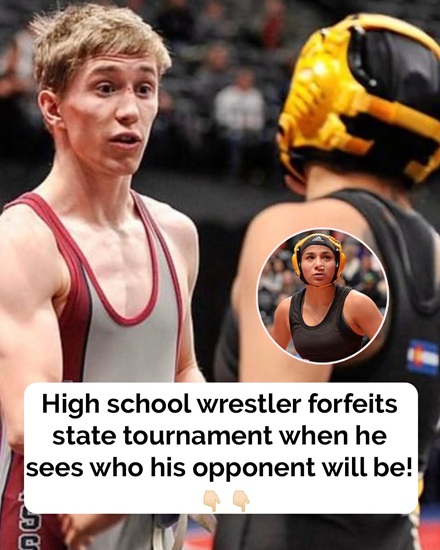
For a high school wrestler, reaching the state tournament is usually the reward for years of discipline.
There are long practices. Early mornings. Strict routines. Injuries.
Weight cuts. Losses that have to be forgotten quickly. And wins that still do not guarantee anything.
By the time an athlete reaches senior year, the final state tournament can feel like the last chance to prove everything.
That was the position Brendan Johnston faced in Colorado in 2019.
He was 18 years old.
He was a senior at The Classical Academy in Colorado Springs.
And he had built a strong wrestling season.
The state tournament was supposed to be the final chapter.
But his bracket created a problem he had already decided he could not ignore.
His first opponent was Jaslynn Gallegos of Skyview High School.
She had qualified to compete in the Class 3A 106-pound division.
She was also a girl.
Johnston chose not to wrestle.
He forfeited the match.
That decision immediately drew attention.
Some people admired the fact that he was willing to accept a competitive loss rather than act against his beliefs.
Others saw the decision very differently.
But the tournament was far from over.
Johnston continued through the bracket.
Later, another match appeared.
His opponent this time was Angel Rios of Valley High School.
Again, he faced the same choice.
Compete.
Or walk away.
He chose to forfeit again.
The second decision effectively ended his high school wrestling career.
That made the story much bigger.
Johnston had not simply declined a routine regular-season match.
He had given up opportunities at the final state tournament of his senior year.
The cost was immediate.
His chances of finishing higher were gone.
And there would be no next high school season.
For Johnston, however, the decision was not spontaneous.
He had previously refused to wrestle female opponents.
His position was already established before the state tournament.
The stage simply made the consequences more visible.
Johnston later explained that his decision came partly from his Christian faith.
He also said the physical nature of wrestling made him uncomfortable competing against a young woman.
That point mattered to him because wrestling involves very close contact.
Competitors grip one another.
They fight for leverage.
They use body pressure.
They attempt takedowns.
They control one another on the mat.
It is aggressive by design.
Johnston said that kind of contact with a girl crossed a personal boundary for him.
He did not say the girls lacked athletic ability.
He also rejected the idea that he considered women less valuable than men.
Instead, he explained that he believed men and women were different while still being equal in worth.
He connected that belief with both his faith and the way he had been raised.
For him, the distinction was important.
But the athletes on the other side of the forfeits had their own perspective.
And that is where the story becomes more complicated.
Jaslynn Gallegos had spent years training as a wrestler.
She was not interested in being seen primarily as a girl who happened to wrestle.
She wanted to be recognized as a wrestler.
That difference mattered.
Her goal was to compete.
To earn wins.
To test herself against whoever was placed in front of her.
When an opponent declined to wrestle because of her gender, she found it frustrating.
She had already dealt with the feeling that being female sometimes mattered more to people than her ability.
For her, wrestling was a way to challenge that assumption.
Step onto the mat.
Compete.
Let the result decide.
A forfeit removed that opportunity.
Still, Gallegos did not respond with hostility.
She said she respected Johnston’s decision.
That statement is important because it captures the tension better than most headlines did.
She could respect his right to make a personal choice.
And she could still be disappointed by what that choice meant for her.
Those two reactions are not contradictory.
They are part of the same story.
Angel Rios also continued competing.
And eventually, the tournament produced a historic result.
Rios finished fourth.
Gallegos finished fifth.
They became the first girls to place at Colorado’s state wrestling tournament.
That achievement was bigger than one opponent’s refusal to wrestle.
Both girls had trained for years.
Both had qualified.
Both had competed successfully against boys.
And both earned places on the podium.
That part of the story can sometimes disappear when attention stays focused only on Johnston.
But it should not.
The state tournament became important for more than one reason.
It became a story about personal conviction.
And also a story about girls pushing deeper into a sport historically dominated by boys.
Those two narratives collided in the same bracket.
Johnston believed that stepping onto the mat against a girl would violate a personal and religious boundary.
Gallegos and Rios believed they had earned the right to compete under the same tournament rules as everyone else.
Neither position erased the other.
That is what made the situation difficult.
Johnston did not try to remove the girls from the tournament.
He did not demand that officials change the bracket.
He made an individual decision not to participate.
And he accepted the loss that came with it.
The tournament moved forward.
The girls received the wins by forfeit.
Competition continued.
That procedural detail matters.
It separates the story from many of the more dramatic versions shared later online.
This was not a case where the tournament stopped.
It was not a case where the girls were banned.
It was not a case where Johnston was forced onto the mat.
The rules allowed the forfeits.
And the consequences were applied.
That meant every athlete retained agency.
Johnston could refuse.
Gallegos and Rios could continue.
The bracket kept moving.
But even when the rules work, the emotions can remain complicated.
For Gallegos, the forfeit was another reminder that gender could affect how opponents saw her.
She had been wrestling since childhood.
She had already experienced boys who underestimated her.
Some expected an easy match.
Then the match started.
And assumptions changed.
That is one of the appeals of individual sports.
The result is difficult to fake.
Preparation matters.
Technique matters.
Conditioning matters.
Position matters.
The scoreboard eventually answers the question.
But a forfeit creates no such test.
That was part of Gallegos’s frustration.
She wanted the chance to compete.
Johnston, however, viewed the same matchup through an entirely different lens.
The issue was not whether he thought he could win.
It was whether he believed he should participate at all.
That distinction shaped everything.
He had already accepted forfeits earlier in his career.
So when the state tournament brought the same situation back, he remained consistent.
Consistency can be costly.
At a state tournament, it can be especially costly.
Every match matters.
One loss can change the entire bracket.
A second can end the run completely.
For a senior, there is no future season to repair the result.
That was the price Johnston accepted.
And he later indicated that he would make the same choice again.
That detail gives the story a different tone.
He did not describe the decision as a mistake.
He did not say pressure had forced him into it.
He treated it as a consequence of living according to a boundary he had already established.
That does not mean everyone has to agree with him.
It means the decision was deliberate.
And disagreement followed.
Some people saw his actions as a demonstration of religious conviction.
They focused on the fact that he willingly sacrificed a sports goal.
Others saw the forfeits as unfair treatment of female athletes.
They focused on the fact that Gallegos and Rios were treated differently because they were girls.
Both views emerged from the same event.
That is why the story became widely discussed.
It touched several difficult questions at once.
What should happen when personal religious beliefs conflict with normal competition rules?
What does equal participation mean in a contact sport?
How should girls be treated when they compete in divisions historically dominated by boys?
And how much responsibility should an athlete have to participate in a matchup that makes him personally uncomfortable?
Those questions do not have simple emotional answers.
Sports organizations need clear rules.
Athletes need predictable competition.
But individual athletes also bring personal values with them.
Sometimes those values fit easily within the system.
Sometimes they do not.
Forfeiture is one way of resolving that conflict without stopping the event.
The athlete refusing the match loses.
The other athlete advances.
The tournament continues.
That is what happened here.
But the human side remains.
Johnston lost opportunities.
Gallegos lost the opportunity to actually wrestle one of the opponents in her bracket.
Rios experienced the same thing.
Everyone moved forward with something different than they originally expected.
That is why portraying one person as a complete hero and another as a complete victim does not capture the full picture.
Johnston accepted real consequences.
Gallegos experienced real frustration.
Rios continued competing.
All of those things are true at the same time.
There is another point that deserves attention.
Girls’ wrestling was changing rapidly.
More female athletes were entering the sport.
More schools were supporting them.
Separate girls’ divisions were developing in many places.
But at that moment in Colorado, female wrestlers could still find themselves competing directly against boys in state-level competition.
That created unusual situations.
Not every athlete was comfortable with them.
Not every coach agreed.
Not every family saw the issue the same way.
But the growth of girls’ wrestling was undeniable.
Gallegos and Rios represented that change.
Their podium finishes made it visible.
They were not there simply because they wanted attention.
They had earned their places.
That distinction matters.
When a girl enters a wrestling tournament and wins matches, her participation becomes more than symbolic.
She is competing.
Gallegos did that.
Rios did that.
Their performances made history.
And the history should not be reduced to the fact that one wrestler forfeited.
The forfeits were part of the story.
Not the entire story.
Johnston’s own athletic record deserves the same fairness.
He was an accomplished high school wrestler.
He had won many matches.
He had reached the state tournament.
The idea that he forfeited because he was afraid of losing to a girl is not supported by what he said.
His stated objection was personal and religious.
That is the explanation the available reporting supports.
Nothing more needs to be invented.
That principle is important whenever an old sports story resurfaces.
Social media tends to simplify.
One sentence becomes the whole narrative.
“He refused to wrestle girls.”
“She proved him wrong.”
“He sacrificed everything for faith.”
“She was discriminated against.”
Each sentence can contain part of the truth.
None contains all of it.
The real event was more nuanced.
Johnston made a choice based on his beliefs.
Gallegos disagreed with the practical effect of that choice but still respected his right to make it.
Rios kept competing.
Officials applied the rules.
The tournament continued.
Then history was made.
And that final part is where the payoff becomes clearer.
At first glance, the story appears to be about an athlete refusing two matches.
By the end, it becomes a story about three athletes responding differently to the same changing sports environment.
Johnston’s test was whether he would abandon a stated personal boundary when the stakes became high.
He did not.
Gallegos’s test was whether she would continue fighting to be seen as simply a wrestler despite opponents focusing on her gender.
She did.
Rios faced the same larger challenge and kept competing too.
The results reflected all three choices.
Johnston’s tournament ended lower than he had hoped.
Gallegos finished fifth.
Rios finished fourth.
And two girls became the first female wrestlers to place at Colorado’s state tournament.
That is why the story remains interesting years later.
Not because everyone has to choose the same side.
But because nobody involved got everything they wanted.
Johnston wanted athletic success without crossing a personal boundary.
The tournament eventually forced him to choose between the two.
Gallegos wanted to compete without gender becoming the first thing opponents noticed.
The forfeit reminded her that this was not always possible.
Rios wanted the same opportunity to keep advancing.
She took it.
Three athletes.
Three perspectives.
One tournament.
And one uncomfortable collision between personal conviction and equal competition.
That is more complicated than a simple headline.
But it is also more accurate.
Johnston was willing to accept defeat rather than participate in matches he believed violated his values.
Gallegos was willing to continue proving herself in a sport where she was often treated as different.
Rios continued through the bracket and helped create a milestone for girls’ wrestling in Colorado.
None of those facts cancels the others.
That may be the most useful way to understand what happened.
Respect does not always mean agreement.
Equality does not mean every person interprets a situation identically.
And conviction means little if it disappears the moment it becomes costly.
By the end of the tournament, all three athletes had paid some kind of price for being part of a changing sport.
But two of them also walked away with something Colorado wrestling had never seen before.
A place on the state podium for female wrestlers.
That is the part that turned one controversial series of forfeits into a much larger sports story.

