
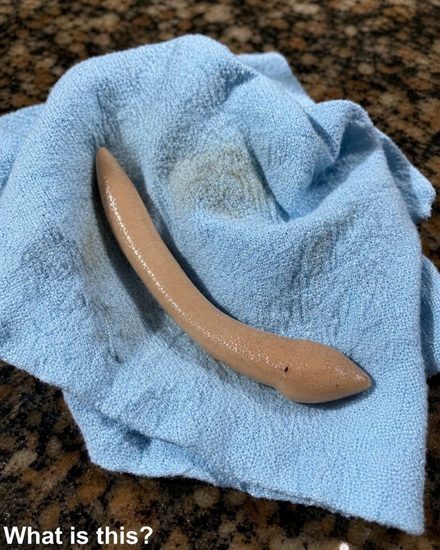
It started as an ordinary evening, with nothing suggesting that a simple trip to the bathroom would turn into a small mystery.
According to the account, a man entered his girlfriend’s bathroom and suddenly stopped near the doorway.
Something unusual was lying on the floor.
At first glance, it was difficult to understand what he was looking at.
The object was pale, smooth and slightly curved. Its shape seemed somewhere between a worm, a slug and a soft piece of rubber.
For a few seconds, it did not even appear to be alive.
Then something changed.
It moved.
That single movement immediately made the situation feel far more unsettling.
What had looked like an unusual object was clearly some kind of living creature.
But identifying it was another matter entirely.
The man reportedly looked around the bathroom for clues.
The sink appeared normal.
The shower did not seem disturbed.
There was nothing unusual around the toilet either.
No obvious trail explained where the creature had come from.
That lack of an explanation only made it seem stranger.
Instead of touching it directly, the animal was carefully moved and photographed.
The photograph soon produced plenty of opinions.
Unfortunately, the guesses did not agree.
Some people thought it could be a tapeworm.
Others suggested a leech.
A few believed it might be a slug.
There were even suggestions that it could be some kind of soft household or cosmetic material.
The more theories appeared, the less clear the answer became.
And that is one of the problems with identifying unfamiliar animals from photographs.
Something perfectly ordinary in its natural environment can look deeply unsettling when it appears somewhere unexpected.
A small creature moving through damp garden soil might attract little attention.
The same animal moving across a bathroom floor can immediately inspire much darker explanations.
The setting changes the reaction.
But the appearance of the creature contained useful clues.
Its body was broad and noticeably flattened.
It did not have the familiar segmented appearance of an earthworm.
Its surface looked moist and almost rubber-like.
Those characteristics were consistent with a terrestrial flatworm, also commonly known as a land planarian.
That identification dramatically changed the nature of the mystery.
Land flatworms are free-living animals.
They are not simply another name for the intestinal tapeworms that infect humans or animals.
This distinction was especially important because some of the earliest guesses had focused on the possibility of a human parasite.
The photograph did not support that conclusion.
Instead, the animal’s shape and movement pointed toward something that normally lives in moist terrestrial environments.
Still, another question remained.
Why would a land flatworm be inside a bathroom?
The answer begins with moisture.
Terrestrial flatworms have soft bodies that can lose moisture easily.
As a result, they generally favor humid and protected environments.
Outdoors, they may be found beneath rocks, leaves, logs, plant material and other damp hiding places.
Periods of wet weather can also make some of them more visible.
A bathroom therefore offers several conditions that may temporarily suit a wandering flatworm.
There can be moisture around the shower, sink, pipes or damp floor coverings.
Small gaps may also provide entry points for tiny animals.
But an animal appearing indoors does not automatically mean it traveled through the plumbing.
That assumption may sound logical when something is found near a bathroom drain, but location alone does not prove the route it used.
There was another possibility that eventually became much more important.
Plants.
Terrestrial flatworms can sometimes be transported unintentionally in soil and around rooted plants.
A flatworm hiding inside damp potting soil can remain unnoticed until the plant is moved.
That means a creature discovered indoors may have entered the home long before anyone actually noticed it.
But at this stage of the story, that connection had not yet been made.
There was also the question of what to do with the animal.
Handling an unidentified flatworm with bare hands is not recommended.
Some terrestrial flatworms produce mucus or defensive secretions, and it is sensible to avoid unnecessary skin contact when the exact species is unknown.
Gloves or another protective barrier can be used instead.
The original account describes the creature being placed into a sealed container.
The surrounding area was then cleaned.
That approach avoided unnecessary contact while allowing the situation to be examined more carefully.
Another tempting reaction should also be avoided.
Cutting an unidentified flatworm into pieces is not necessarily an effective solution.
Planarians are widely known for their regenerative abilities, although the exact capacity varies among species.
For that reason, attempting to destroy one simply by cutting it may not produce the expected result.
There was no need for dramatic action inside the bathroom.
The more useful step was to think about how it might have arrived there.
The room was checked again.
Possible gaps were considered.
Moist areas were examined.
The possibility of an animal entering accidentally from outside remained reasonable.
Then one detail began to stand out.
A potted plant had recently been brought into the bathroom.
According to the account, the man’s girlfriend had placed the plant there because its leaves needed washing.
At first, that ordinary household detail had seemed completely unrelated.
Now it offered a possible explanation.
A terrestrial flatworm could have been hiding in the plant’s soil or around the pot.
Once the plant was moved into the warm, damp bathroom, the animal may simply have crawled away.
Suddenly, the mystery became much less mysterious.
There was no evidence that the creature had emerged from a person.
There was no reason to assume it represented a hidden medical problem.
And there was no need to imagine something living permanently inside the plumbing system.
A small outdoor animal may simply have traveled indoors with a plant.
That possibility also explained why neither person had noticed anything unusual beforehand.
The flatworm could have remained hidden in moist soil until environmental conditions encouraged it to move.
Once outside the pot, the bathroom provided enough humidity for it to continue crawling.
The conversation between the couple reportedly ended up being far less uncomfortable than expected.
The girlfriend was also surprised by the discovery.
The plant connection made sense to both of them.
What had initially triggered embarrassment and increasingly alarming theories ultimately had a much simpler explanation.
But the story also illustrates something broader about how people react to unfamiliar wildlife.
Humans naturally use context to interpret what they see.
A strange animal outdoors is usually understood as part of nature.
Inside a bedroom, kitchen or bathroom, the same animal can suddenly feel threatening.
That emotional reaction can happen before identification takes place.
Online discussions can intensify the effect.
When photographs of unusual animals are posted on social media, confident answers often appear immediately.
Some may be accurate.
Others may be guesses based only on superficial resemblance.
Different species can look remarkably similar in poor photographs.
Lighting, perspective and movement can also distort important identifying characteristics.
That is why dramatic conclusions should be avoided when an exact species cannot be confirmed.
There are many different terrestrial flatworms around the world.
Some have pointed heads.
Some have broader or rounded heads.
Colors and patterns vary significantly.
Certain species have stripes, while others may appear nearly uniform.
Because of that diversity, saying that an animal is probably a terrestrial flatworm does not automatically establish its exact species.
Geographic location also matters.
An animal considered native in one region may be introduced in another.
That is another reason why identification from a photograph alone should remain cautious.
Some land flatworms are also ecologically important.
Many are predators of other small invertebrates.
Depending on the species, their prey can include earthworms, slugs, snails and other soil animals.
Several terrestrial flatworms have become invasive outside their native ranges after being transported through international plant and soil movement.
That does not mean every flatworm found near a home is automatically an invasive species.
It means accurate identification can sometimes matter.
If an unusual terrestrial flatworm repeatedly appears around a property, contacting an appropriate agricultural, environmental or extension authority may be useful.
Those organizations can consider photographs, location and physical characteristics together.
That provides a much stronger basis for identification than internet speculation alone.
Inside the home, prevention can also be simple.
Checking newly purchased or recently moved potted plants may help detect hitchhiking animals.
Reducing unnecessary standing moisture can make indoor conditions less attractive to many moisture-dependent creatures.
Gaps around doors, windows and pipe openings can also be inspected.
If only one animal appears, however, it does not automatically indicate an infestation.
A single accidental visitor can simply be that — a single accidental visitor.
That was ultimately the most reassuring part of this story.
The discovery looked disturbing because it happened in the worst possible setting for an unfamiliar worm-like animal.
A bathroom naturally encouraged people to connect it with plumbing or human health.
Yet the available details supported a much more ordinary explanation.
The creature was identified broadly as a terrestrial flatworm.
Its biology explained why it preferred moisture.
Its possible association with soil explained how it could have entered a home.
And the recently moved potted plant provided a plausible route into the bathroom.
The final answer therefore required no extraordinary theory.
It required only a closer look at the animal and the environment around it.
That is often the case with unusual wildlife encounters.
The first explanation people imagine is not always the correct one.
Sometimes the most alarming-looking discovery becomes ordinary once the right biological context is added.
The photograph may still make some viewers uncomfortable.
Its unusual shape certainly does not resemble the animals most people expect to encounter indoors.
But unusual appearance alone is not evidence of danger.
Nor is an unexpected location proof of a medical problem.
In this case, the mystery gradually moved from speculation to a much simpler possibility.
A moisture-loving land flatworm appears to have ended up inside a bathroom, possibly after traveling with a potted plant.
What looked at first like something deeply disturbing was most likely an outdoor animal that had accidentally taken a very unfortunate route through the house.
And once that final detail came together, the bathroom mystery largely disappeared.

