
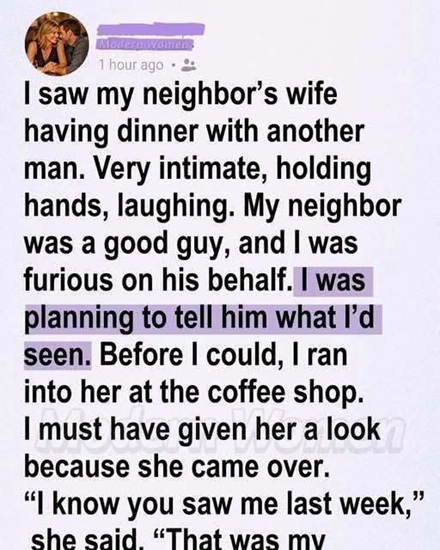
I thought I understood exactly what I was looking at.
That was my first mistake.
It happened during dinner at a quiet Italian restaurant, the kind of place where the lights are low, the tables are close together, and people tend to speak softly.
I had barely settled into my meal when I noticed someone across the room.
Sarah.
She lived nearby with her husband, Mark.
And she was sitting with another man.
At First, Nothing Looked Dramatic
There was no argument.
No secretive behavior.
No obvious attempt to hide.
That somehow made the scene more unsettling.
The man sat close beside her.
Their knees nearly touched beneath the table.
At one point, he placed his hand over hers.
Sarah smiled.
Then she leaned closer while he spoke.
The gesture looked intimate.
And within seconds, my mind had decided what it meant.
I Thought Sarah Was Cheating
The conclusion arrived almost immediately.
I did not know the man.
I did not know why they were meeting.
I had no idea what they were discussing.
But I believed I had seen enough.
Sarah was married.
The man was not Mark.
Therefore, something was wrong.
That simple chain of thought felt completely convincing.
And once I accepted it, anger followed.
Mark Was Easy to Feel Sorry For
He was the kind of neighbor people naturally liked.
He helped when someone needed something.
He noticed small problems before they became big ones.
He was friendly without being intrusive.
If a fence needed fixing, he might offer a hand.
If the sidewalk needed clearing, he was often already outside.
I pictured him at home while Sarah sat across from another man.
The imagined betrayal began to feel personal even though it had nothing to do with me.
By the time dinner ended, I had already decided what should happen.
Mark needed to know.
I Convinced Myself I Was Doing the Right Thing
That part happened very quickly.
I told myself this was not gossip.
It was loyalty.
It was honesty.
It was protection.
If I knew something important and stayed quiet, wouldn’t I be helping the deception continue?
That reasoning made intervention feel almost noble.
I left the restaurant believing I had a responsibility.
I would tell Mark.
I just needed to find the right moment.
For Several Days, I Practiced What I Would Say
I imagined knocking on his door.
I pictured myself speaking gently.
I would tell him I was sorry.
I would explain that I had seen something uncomfortable.
I would emphasize that I did not want to interfere.
But I would interfere anyway.
The more I rehearsed the conversation, the more certain I became.
And certainty can feel remarkably similar to truth.
That distinction almost caused real harm.
Then I Saw Sarah Again
It was early in the morning at a coffee shop.
Rain covered the windows in thin streaks.
I was waiting near the counter when Sarah walked in.
For a moment, I considered avoiding her.
Then she looked directly at me.
Up close, she looked different from the woman I had watched at the restaurant.
Something was wrong.
She Looked Exhausted
Her face seemed thinner.
Her skin was pale.
There were dark shadows beneath her eyes.
She did not look secretive.
She looked tired.
Not ordinary tired.
Something deeper.
For the first time, the story I had constructed started to feel less certain.
Then Sarah walked toward me.
She did not wait for me to speak.
She Knew I Had Seen Her
“I know you saw me,” she said.
My stomach tightened.
I had expected to confront her eventually.
Instead, she had confronted the situation first.
I opened my mouth, but I did not know what to say.
Then she explained who the man was.
And the first part of my certainty collapsed instantly.
The Man Was Her Brother
He had traveled from overseas.
He was not a romantic partner.
He was family.
The hand on hers had not been flirtation.
The closeness had not been secrecy.
The familiarity I thought I recognized had been real.
I had simply identified the relationship incorrectly.
Embarrassment hit immediately.
But Sarah was not finished.
What came next made my mistaken assumption seem almost insignificant.
She Told Me She Was Seriously Ill
Sarah said she had stage-four cancer.
She told me doctors had given her a very limited amount of time.
The sentence seemed to remove all sound from the room.
A few seconds earlier, I had been thinking about infidelity.
Now I was standing in front of someone who believed she might not have much life left.
Then she told me one more thing.
Mark did not know.
She Had Not Found the Courage to Tell Him
At first, I could not understand how she had kept such news from her husband.
Then she explained.
Telling Mark would not simply give him information.
It would change the future they had imagined together.
Plans would suddenly have deadlines.
Ordinary conversations would become loaded with fear.
Every day might become a countdown.
Sarah knew she had to tell him.
She simply did not know how.
Her Brother Was the One Person She Did Not Have to Protect
That was why he had come.
He already knew.
She did not have to smile for him.
She did not have to pretend everything was normal.
She could sit beside him and be frightened.
She could cry.
She could laugh.
She could be silent.
The dinner I had interpreted as betrayal was actually one of the few places where Sarah did not have to hide how afraid she was.
The meaning of the entire scene changed.
The Hand on Her Hand Suddenly Meant Something Else
I remembered it clearly.
The gesture had bothered me more than anything else.
Now it looked completely different.
He had not been touching her because they were secretly involved.
He was comforting his sister.
Nothing about the physical scene had changed.
Only the context had changed.
And context changed everything.
Sarah Said She Tried to Tell Mark Every Day
She would wake up determined.
Today would be the day.
Then breakfast happened.
Or work.
Or a normal conversation.
Maybe Mark made a joke.
Maybe he talked about something they would do next month.
And Sarah lost the courage.
At night, she would lie down knowing she had delayed it again.
Then morning would come.
And she would promise herself once more.
I Finally Understood What I Had Actually Seen
Not an affair.
Not betrayal.
Fear.
Grief.
A sister leaning on her brother.
A woman trying to gather enough strength to break devastating news to the person she loved.
I had seen only the surface.
Then I had supplied the rest.
That realization felt awful.
I Told Her What I Had Been Planning
I admitted that I had considered speaking to Mark.
I told her I had believed she was cheating.
I apologized.
There was no way to make it sound better.
I had judged her.
I had almost acted on that judgment.
Sarah listened quietly.
Then she gave me a small, tired smile.
She did not seem interested in punishing me for being wrong.
She had much bigger things to carry.
A Week Later, She Asked Me for Help
Not the kind of help I expected.
Sarah had finally decided to tell Mark.
She asked me to be there.
Not to speak for her.
Not to explain.
Not to mediate.
She just wanted someone nearby in case she could not finish.
I agreed.
And I walked into their living room knowing something Mark did not.
That feeling was completely different from the certainty I had carried a week earlier.
Everything in Their House Looked Painfully Normal
Sunlight crossed the floor.
There were ordinary household sounds.
Mark talked about work.
He mentioned dinner.
He made some small joke.
Nothing about the room suggested that his life was about to change.
Sarah sat across from him.
I watched her try to begin.
Then she finally did.
She Told Him the Truth
She told him she was sick.
She told him the cancer was advanced.
She told him what doctors had said.
Mark did not respond immediately.
For a moment, he seemed unable to process the words.
Then the meaning reached him.
And I will never forget the sound he made.
It Was Not a Sentence
It was just air.
A broken sound.
Something between disbelief and pain.
Then he moved toward Sarah.
He held her tightly.
As if holding her hard enough could somehow keep time from moving.
I looked down.
I suddenly became painfully aware of how close I had come to forcing this moment before Sarah was ready.
I Had Nearly Turned Fear Into Accusation
Imagine if I had gone to Mark first.
Imagine if I had said Sarah was seeing another man.
Imagine if Mark had confronted her while she was already trying to process a terminal diagnosis.
I would have introduced suspicion into a moment already full of grief.
I would have created conflict where there was actually support.
And I would have done it believing I was helping.
That thought stayed with me.
Good Intentions Are Not Enough
I had meant well.
That did not mean my planned action would have been good.
People often treat intention as protection against harm.
It is not.
You can care deeply and still be wrong.
You can believe you are protecting someone and still make their situation worse.
Without enough information, even kindness can become interference.
What I Saw Was Real
That is important.
I did not hallucinate the restaurant scene.
Sarah really was there.
A man really sat close beside her.
His hand really covered hers.
She really leaned toward him.
The facts were accurate.
The conclusion was not.
That distinction became one of the most important lessons of the entire experience.
Facts Without Context Can Tell the Wrong Story
A photograph can be real and still mislead.
A moment can be observed accurately and interpreted badly.
A person can tell the truth about what they saw while being completely wrong about what it meant.
That is exactly what happened to me.
I had evidence.
I simply did not understand it.
Certainty Made the Mistake Worse
If I had remained curious, the situation might have been different.
Who is that man?
Why is Sarah meeting him?
Is there something I do not know?
Instead, I skipped those questions.
I went directly from observation to accusation.
The less I knew, the more certain I became.
That is a dangerous combination.
Our Minds Hate Missing Information
When something does not make sense, we fill in the gaps.
We create motives.
We connect details.
We choose a story.
Often, we choose the most emotionally powerful explanation.
Betrayal is dramatic.
Grief is quieter.
From across the restaurant, betrayal was easier to imagine.
The real story was much more complicated.
Sarah Was Not Hiding Romance
She was hiding fear.
That is very different.
She had not told Mark because she wanted to deceive him.
She had not told him because the truth terrified her.
There are forms of silence meant to manipulate.
There are also forms of silence created by people who cannot yet say something painful aloud.
From outside, the difference is not always visible.
Her Brother Was Not Part of the Problem
He was part of her support system.
He had come because she needed family.
He gave her a place where she did not have to explain everything.
He could sit beside her without needing the story softened.
He already knew what she was facing.
The same closeness I had treated as suspicious was helping her cope.
That reversal stayed with me.
I Began Thinking About Other Snap Judgments
Someone does not answer a message.
We decide they are ignoring us.
A coworker seems distant.
We decide they are rude.
A couple looks tense in public.
We decide their relationship is failing.
A neighbor stops making small talk.
We decide they dislike us.
Sometimes those interpretations are correct.
Sometimes they are nowhere close.
The problem is how rarely we distinguish what we know from what we assume.
I Had Mistaken Assumption for Responsibility
Once I believed Sarah was cheating, I felt responsible for fixing the situation.
That was another mistake.
Responsibility should come from actual knowledge, not imagined certainty.
I had appointed myself messenger in someone else’s marriage.
Nobody had asked me.
I did not know the full story.
Yet I was prepared to change their lives anyway.
Sarah’s News Belonged to Sarah
That became obvious later.
Mark needed to hear the truth.
But he needed to hear it from his wife.
She needed to choose the moment.
She needed to find the words.
She needed to control something in a situation where so much had already been taken out of her control.
Had I spoken first, I would have stolen that from her.
Restraint Can Be a Form of Respect
Before that experience, I often associated doing the right thing with immediate action.
Speak up.
Step in.
Fix it.
But sometimes restraint is the more compassionate choice.
Wait.
Ask.
Listen.
Accept that you may not know enough.
Not every delay is cowardice.
Sometimes it is wisdom.
That Does Not Mean Silence Is Always Right
There are situations involving genuine danger where action matters.
There are circumstances where ignoring evidence could cause harm.
But a few seconds of ambiguous behavior across a restaurant do not automatically provide enough evidence to intervene in someone else’s life.
The lesson was not “never say anything.”
It was “know what you actually know.”
That Question Changed Everything for Me
What did I see?
What did I assume?
What did I know?
Those are not the same thing.
I saw Sarah with a man.
I assumed romantic involvement.
I believed she was betraying Mark.
I planned to act on that belief.
Only the first statement was fact.
Everything else came from me.
I Thought About the Restaurant Again Later
This time, I replayed the scene knowing the truth.
Sarah sat beside her brother.
She knew she had advanced cancer.
She did not know how to tell her husband.
Her brother had traveled to be with her.
He placed his hand over hers.
She smiled for a moment.
Perhaps she needed that small moment of normality.
Perhaps she needed someone who knew how frightened she was.
The exact same memory suddenly looked tender rather than suspicious.
The Scene Had Never Changed
I had.
Or at least my understanding had.
That was humbling.
I had been prepared to make a major moral judgment based on information that fit inside a few seconds.
Then one conversation overturned the entire thing.
If truth can change that quickly, certainty deserves more caution than we usually give it.
Mark’s Reaction Stayed With Me
I still remember him holding Sarah.
That became the image that replaced the restaurant in my mind.
The restaurant represented the story I invented.
Their living room represented the truth.
One was filled with suspicion.
The other with grief and love.
I had nearly confused them.
The Most Dangerous Thing Was Not the Secret
For days, I believed I was carrying dangerous information.
I was not.
The dangerous thing I carried was confidence.
I believed I had enough evidence.
I believed my motives were good.
I believed action was justified.
That certainty almost sent me to Mark’s door.
Certainty Can Make People Feel Righteous
That is why it can be so powerful.
Doubt slows us down.
Certainty speeds us up.
Once I convinced myself that I knew the truth, restraint began to feel like cowardice.
Interference began to feel like courage.
That should have been a warning.
It was not.
Sarah Changed How I Think About Other People’s Lives
I no longer assume that the first explanation is the best one.
Especially when the situation belongs to someone else.
People carry private burdens.
Illness.
Grief.
Family problems.
Financial stress.
Fear.
Loss.
Most of it does not announce itself.
What looks strange from the outside may make perfect sense inside the full story.
I Also Learned That Privacy Has Value
Sarah was not ready to tell Mark.
That did not mean she planned to keep the truth hidden forever.
She needed time.
Her life had changed instantly.
Her emotions had not caught up yet.
Privacy gave her a little space to process something enormous.
People deserve some control over how deeply personal information enters the world around them.
The Brother I Had Judged Never Even Knew
That thought also bothered me.
I had turned a stranger into the villain of a story without knowing his name.
He had crossed an ocean to support his sister.
And in my version, he was helping her cheat.
That is how easily people become characters inside stories they never agreed to enter.
It Made Me More Careful With Other People’s Motives
Behavior is visible.
Motives are usually not.
That difference matters.
You can see what someone does.
You may not know why they do it.
Sometimes the reason is exactly what you suspect.
Sometimes it is something you never would have imagined.
Sarah taught me to leave room for that second possibility.
I Still Believe Honesty Matters
Nothing about this experience changed that.
Mark deserved to know about Sarah’s diagnosis.
And eventually he did.
But honesty is not the same thing as rushing to deliver information you do not understand.
Truth deserves accuracy.
And accuracy requires context.
Without context, what looks like honesty can become misinformation.
There Was No Hero in My Version of the Story
At first, I had cast myself as one.
The reluctant truth-teller.
The decent neighbor.
The person willing to say the hard thing.
That role felt flattering.
Reality was less comfortable.
I was simply someone who had seen something, misunderstood it, and almost interfered.
That version taught me much more.
The Lesson Was Humility
Not silence.
Not indifference.
Humility.
Recognizing that other people know things I do not.
Recognizing that my interpretation may be incomplete.
Recognizing that good intentions do not guarantee good judgment.
That is a harder lesson than simply being told to mind your own business.
It requires thinking before acting.
One Page Is Not the Whole Book
That image has stayed with me.
The restaurant was one page.
I believed it contained the entire story.
But there were chapters I had never seen.
A diagnosis.
A brother coming from overseas.
A frightened wife.
A husband who still believed the future was ordinary.
A family about to face something devastating.
I knew none of it.
The Payoff Came in the Living Room
That was where I finally understood how wrong I had been.
When Sarah told Mark.
When he held her.
When the imagined affair disappeared completely and the real crisis became visible.
It was one of the most painful moments I had ever witnessed.
And all I could think was how close I had come to making it harder.
What Looked Like Betrayal Was Actually Support
That remains the clearest summary.
The hand I judged was comforting.
The closeness I distrusted was family.
The secret I imagined was not the real secret at all.
And the person I thought was betraying her husband was trying to find enough strength to tell him she was seriously ill.
The distance between appearance and reality could hardly have been larger.
Now I Try to Pause Before I Decide What Something Means
Not forever.
Just long enough to ask questions.
What else could explain this?
What information might be missing?
Do I actually know enough to act?
Sometimes the answer is yes.
Sometimes it is clearly no.
That small pause can prevent a great deal of damage.
Sarah Never Needed My Judgment
She needed compassion.
Mark did not need my suspicion.
He needed the truth from his wife.
And I did not need to become the person who solved their marriage.
I needed to understand the limits of what I knew.
That realization was uncomfortable.
It was also necessary.
I Almost Made a Permanent Mistake Based on a Temporary Impression
That may be the part I remember most.
The restaurant scene lasted only minutes.
My judgment could have lasted much longer.
Words cannot always be taken back.
Accusations change relationships.
Suspicion can survive even after an explanation arrives.
Had I spoken too soon, an apology might not have repaired everything.
I Will Never Forget What Certainty Almost Cost
The information I had was incomplete.
My confidence was not.
That combination made me dangerous without realizing it.
I believed I was about to protect someone.
In reality, I was close to interfering with a fragile moment that belonged entirely to Sarah and Mark.
Fortunately, I learned the truth first.
And That Is the Lesson I Carried Away
Sometimes what looks like betrayal is grief.
Sometimes intimacy is family.
Sometimes silence is fear rather than dishonesty.
And sometimes the wisest thing a person can do is admit that they may not understand what they are seeing.
I thought I had witnessed an affair.
What I had actually witnessed was a woman leaning on her brother while trying to gather the courage to tell her husband that their life was about to change.
I had seen one small part of the story.
Then I had invented the rest.
I came very close to acting on that invention.
I did not make that mistake.
And I do not intend to make it again.

