
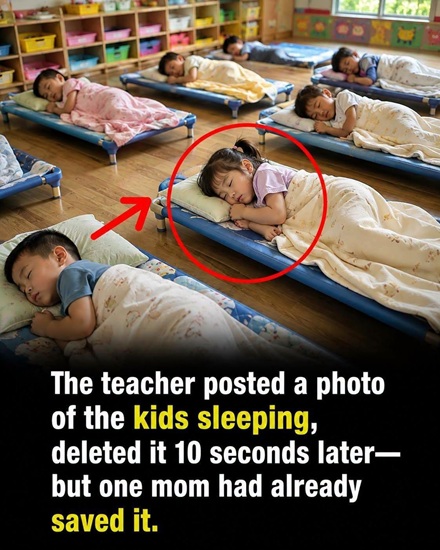
A simple photograph taken during a normal school day may seem completely harmless at first. A teacher might want to show parents that their children are comfortable, calm, and well cared for during classroom rest time. However, once an image of children is uploaded online, even for a very short period, the situation can become more complicated. A photograph may contain much more information than the person sharing it realizes. Faces, clothing, classroom displays, student names, schedules, signs, and other background details can sometimes reveal information about children or their school environment.
The situation described in the original account involves a teacher who posted a photograph of children sleeping during classroom nap time and removed it shortly afterward. According to that account, one parent had already saved the image before it disappeared. The available material does not identify the school, the teacher, the parent, the location, or the exact date of the incident. For that reason, those details should not be invented or presented as confirmed facts. The scenario is better understood as an example of how quickly digital information can move beyond the control of the person who first shared it.
Removing a social-media post can limit future visibility, but deletion does not necessarily erase every copy that may already exist. A person viewing an image can take a screenshot, save the photograph, or forward it before the original post is removed. Depending on the platform, content may also temporarily appear in notifications, previews, caches, or other digital systems. This means that the most important privacy decision often happens before publication rather than afterward. Once another person has obtained a copy, the original poster may no longer be able to fully control where that image goes.
This principle becomes particularly important when photographs involve children. Young children generally cannot fully understand the long-term consequences of having their images placed online. They also have limited ability to influence decisions adults make about those images. A photograph that looks ordinary or innocent today can become part of a child’s digital footprint. This does not mean that every school photograph is inappropriate. Schools often document activities, achievements, projects, and classroom experiences for legitimate educational or communication purposes.
The key issue is how an image is created, stored, and shared. There is a meaningful difference between keeping a photograph inside an approved school system and publishing it on a public social-media account. There is also a difference between showing an image only to authorized families and making it available to an unlimited online audience. Privacy concerns often depend on the purpose of the image, the people who can access it, the school’s policy, and whether parents or guardians have given appropriate permission.
In the United States, student photographs can sometimes fall under privacy protections connected to educational records. Under the Family Educational Rights and Privacy Act, commonly known as FERPA, a photograph or video may be considered an education record when it is directly related to a student and maintained by an educational agency, institution, or someone acting on its behalf. Whether a specific image qualifies depends on the circumstances. Not every photograph containing a student automatically becomes an education record.
Context therefore matters. A photograph specifically created and maintained for an official educational purpose involving a particular student can raise different privacy considerations from a casual photograph taken by a parent at a public school event. Schools may also have their own policies dealing with photography, directory information, consent forms, social-media use, and communication with families. State or local rules can add further requirements. Because of these differences, it would be inaccurate to assume that one rule applies identically to every school and every photograph.
Another law sometimes mentioned in discussions about children’s online privacy is the Children’s Online Privacy Protection Act, usually called COPPA. This law is focused on certain websites and online services that collect personal information from children under the age of 13. Images, videos, and audio recordings that contain a child’s image or voice may qualify as personal information in situations covered by the law. However, that does not mean every photograph of a child posted by an adult automatically represents a COPPA violation.
This distinction is important because legal claims should not be made without enough evidence. A teacher uploading an image, a school maintaining an official educational record, and an online service collecting information directly from children are different situations. Different rules may apply depending on the platform, country, state, school system, and way the information was collected or shared. Responsible discussion should therefore avoid declaring that an unidentified teacher or school broke a particular law when the necessary facts are not available.
Even when the exact legal requirements vary, schools can reduce privacy risks by creating clear and practical policies. Staff members should know which devices can be used to take student photographs, where those photographs may be stored, and which communication platforms have been approved. They should also understand when parental or guardian permission is required. A clear policy can prevent confusion and help teachers avoid making difficult privacy decisions without guidance.
Consent is also an important part of responsible image sharing. Parents should understand what they are agreeing to when they sign a school photography or media permission form. Permission for a photograph to appear inside a private school platform is not necessarily the same as permission for it to appear publicly on social media. Families may want to know whether an image will be used in newsletters, websites, classroom applications, printed materials, or public online accounts. Clear explanations can help parents make informed decisions.
Families can also have personal reasons for limiting the visibility of their children. Those reasons may include privacy preferences, safety concerns, custody situations, or other circumstances that school staff may not fully know about. Because of this, it is generally better to follow established consent procedures rather than assuming that a harmless-looking photograph will be acceptable to everyone. Respecting those preferences helps build trust between families and educational institutions.
Before publishing any authorized school photograph, reviewing the entire image can also help reduce unnecessary disclosure. A child’s face is not the only identifying feature that might appear. Classroom walls may contain student names, schedules, certificates, artwork, or other information. A noticeboard could display dates, routines, or contact details. Even small background details can sometimes reveal more than the photographer intended.
Digital files can also contain metadata, although the information preserved after uploading varies depending on the device and platform. In some cases, a file may contain information related to when or where it was created. This is another reason why schools and staff should follow approved procedures when handling images. Privacy protection involves looking beyond the main subject of the photograph and considering the entire digital file and the environment shown around it.
Schools may also choose alternative ways to document classroom activities when identifying children is unnecessary. For example, a photograph could focus on a project, classroom display, learning activity, or children’s hands rather than clearly showing faces. In some circumstances, faces can be blurred or cropped where appropriate. These methods are not required in every situation, but they can help reduce unnecessary exposure when the identity of the child is not essential to the purpose of the image.
Clear policies also protect teachers. Educators already manage many responsibilities during a school day, and they should not be expected to independently interpret complicated privacy laws every time they take a photograph. Schools can provide training, approved platforms, separate professional accounts, and straightforward review procedures. When employees know exactly what is allowed, mistakes become less likely and responses become more consistent.
If a photograph is posted accidentally, acting quickly is important. Removing the image as soon as the mistake is discovered can reduce continued exposure, although it cannot guarantee that no copies were made. School administrators may also need to determine where the photograph appeared, how long it was visible, and what further steps are required under school policy or applicable law. Accurate information is essential during this process.
Parents should also receive honest communication if an error affects their children. A school should avoid making claims that it cannot verify. If administrators do not know exactly how many people saw or saved an image, they should not pretend to know. Instead, they can explain what is confirmed, what actions were taken, and what changes will be introduced to prevent similar incidents. Specific and transparent communication can help rebuild trust after a mistake.
The actions of people who receive or save a photograph also matter. If a parent saves an image because of a privacy concern, publicly reposting that same image may increase the exposure of the children shown in it. A better approach is generally to report the concern directly to the appropriate school officials and limit further distribution. Evidence can be handled privately when documentation is necessary.
This demonstrates that responsibility for digital privacy does not end with the person who first uploads an image. Every individual who receives a sensitive photograph has some control over whether it is forwarded again. Parents, staff members, administrators, and group participants can all help reduce unnecessary circulation. Protecting children’s privacy is more effective when everyone involved avoids spreading material that does not need to reach a wider audience.
Children themselves should not be expected to manage these situations. A young child sleeping during classroom rest time did not choose the platform, the audience, the school policy, or the sharing settings. Adults are responsible for making those decisions. That is why children’s images deserve additional care before they are published. The ordinary or innocent nature of a photograph does not remove the need to consider privacy.
At the same time, the subject should be discussed without unnecessary fear or exaggeration. Photography can have many positive purposes in education. It can document learning, celebrate achievements, preserve memories, and help families understand what happens during the school day. The goal is not to suggest that teachers should stop taking photographs entirely. Instead, schools should distinguish between responsible documentation and unnecessary public distribution.
Regular policy reviews can help schools keep up with changing technology. Social-media platforms, messaging applications, cloud services, and mobile devices evolve quickly. A policy written several years ago may not address the way staff and families communicate today. Schools can periodically review which accounts are being used, who controls them, where older photographs are stored, and whether current consent procedures still reflect actual practices.
Old content deserves attention as well. Schools may have inactive pages or archived accounts containing photographs that no longer serve a useful purpose. Reviewing these materials can help administrators decide whether certain images should remain publicly available. Good privacy management is not only about preventing future mistakes. It also involves reviewing information that has already been collected and published.
Training programs can make privacy policies easier to understand. Instead of giving staff only broad instructions such as “use good judgment,” schools can provide realistic examples. Teachers can learn how background details can reveal information, how to check whether an account is public, and what to do when they are uncertain about permission. Practical training makes it easier to recognize risks before a photograph is published.
Employees should also know how to respond if an accidental post occurs. A clear reporting process can save valuable time. Staff members can immediately contact the appropriate administrator, remove the material where possible, and document what happened. When procedures are already established, people are less likely to panic or make additional mistakes while trying to correct the original problem.
Families benefit from having a clear reporting process too. Parents who have concerns should know whom to contact and how their complaint will be handled. This can prevent an issue from immediately becoming a public dispute before the facts are known. It also allows the school to investigate, review policies, preserve necessary records, and take appropriate corrective action.
Privacy should not be confused with secrecy. Protecting the identity of children does not mean that schools should hide mistakes. An institution can acknowledge that an error happened without publicly identifying the children involved or redistributing the disputed photograph. Accountability can focus on the procedures that failed, the actions taken afterward, and the changes made to reduce the chance of recurrence.
The same careful approach should be used when discussing stories online. If the available information does not identify a school, teacher, city, or country, those details should not be invented. Readers should also be cautious when social-media posts add dramatic claims that cannot be independently confirmed. A responsible article should clearly separate what is known from what remains uncertain.
This is especially important because online stories can change as they are repeatedly shared. One person may add a location, another may add a name, and a later post may present those additions as facts. Over time, an ordinary privacy discussion can become attached to claims that were never part of the original material. Avoiding that process is an important part of responsible publishing.
Publishers should therefore avoid unsupported statements about criminal activity, legal violations, or intentional wrongdoing. There is no basis for saying that a teacher deliberately endangered children, that a school knowingly exposed students, or that a particular law was violated unless reliable evidence establishes those claims. Dramatic wording may attract attention, but it can also create misinformation.
The same standard applies to quotations. Statements should not be attributed to parents, teachers, administrators, police officers, lawyers, or privacy specialists unless those people actually made them in a reliable source. Invented quotes can make an article sound more detailed, but they reduce accuracy. A factual article is stronger when it acknowledges what information is unavailable.
A neutral tone is also important when discussing school or community issues. An article does not need to claim that something happened in “our town,” “our school,” or “our community” unless that description is genuinely accurate. A publisher can explain a privacy issue from a general informational perspective without pretending to represent local residents. This keeps the discussion focused on the facts rather than creating an artificial local identity.
The broader lesson is that digital sharing happens extremely quickly. A photograph can move from one device to another in only a few moments. That reality makes prevention especially valuable. Taking a short moment to review an image before sharing it can prevent a much more complicated situation afterward.
Before publishing, staff can ask several practical questions. Does the image contain children whose photographs may be shared? Is there any identifying information in the background? Is the account approved for school communication? Is public distribution necessary? Does the school’s policy permit the intended use? These questions do not require complicated technology, but they can significantly reduce avoidable mistakes.
When uncertainty exists, checking with an administrator or reviewing the school’s policy is safer than assuming that permission exists. If public distribution is unnecessary, a secure school communication platform may be a better option. Decisions should be based on the purpose of the photograph and the audience that genuinely needs to see it.
If a mistake still happens, the response should focus on limiting further exposure rather than assigning blame publicly. Removing the post, notifying appropriate administrators, communicating accurately with families, and reviewing procedures are constructive steps. The goal should be to understand what went wrong and reduce the likelihood that it happens again.
The incident described in the original account can therefore be viewed as a useful reminder about digital responsibility. Even a photograph intended to reassure parents can raise privacy concerns if it reaches an audience that was not originally considered. Good intentions do not remove the need for consent, careful review, and appropriate sharing practices.
Parents, teachers, administrators, and online publishers all have roles to play. Teachers can follow approved procedures. Administrators can create clear policies and provide training. Parents can raise concerns through appropriate channels without unnecessarily spreading images. Publishers can discuss privacy issues without adding unsupported details or presenting speculation as fact.
These steps help protect children while still allowing schools to document meaningful moments. Privacy and communication do not have to conflict with each other. Schools can share educational experiences responsibly when they carefully consider who needs access to the information and how that information will be protected.
Ultimately, the most important principle is simple: children’s images should be handled thoughtfully before they are made public. Once an image begins circulating digitally, completely recovering every copy may be impossible. Prevention, clear consent, limited distribution, and responsible communication are therefore more effective than relying only on deletion after a problem occurs.
A classroom photograph may appear to capture nothing more than a quiet moment during the day, but digital privacy extends beyond what is visible at first glance. The surrounding information, the audience, the platform, and the possibility of copying all matter. Careful decisions made before publication can protect both children and the adults responsible for their care.
Most importantly, the children shown in a photograph should never be blamed for a privacy problem created by adult decisions. They did not choose to be photographed, select the audience, or determine how the image would be distributed. Responsibility belongs to the adults and institutions controlling the photograph. Protecting children’s digital privacy requires clear rules, accurate information, thoughtful judgment, and respect for the fact that a child’s image deserves careful handling.

