
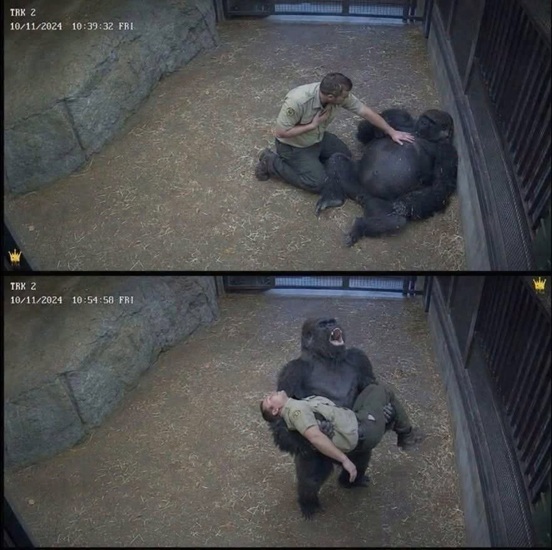
For many years, Daniel had worked with a rescued gorilla at a fictional wildlife sanctuary, where his responsibilities included food preparation, enrichment activities, observation and routine care. Their familiarity had developed slowly rather than through one extraordinary event. Day after day, the gorilla learned Daniel’s voice, movements and predictable routine. Daniel also learned how the animal responded to different situations and understood that trust with a great ape depended on consistency and patience.
Their relationship remained professional, but there was no question that Daniel had become a familiar part of the gorilla’s environment. One morning, Daniel arrived at the sanctuary feeling different from usual. Earlier, he had noticed pressure in his chest and discomfort extending toward one arm. In this fictional story, he initially convinced himself that the symptoms might be related to something minor and continued working rather than immediately seeking medical attention.
He moved through the first part of his routine more slowly than normal but still tried to complete his responsibilities. By the time he reached the gorilla’s area, however, the discomfort had become more difficult to ignore. Daniel entered the protected keeper area used for supervised interactions and familiar care routines. The gorilla approached in the same way it had many times before, watching Daniel and waiting for the activity to begin. Daniel started preparing an enrichment task, but within moments his movements became unsteady.
He suddenly collapsed and stopped responding. The change was dramatic because the person who normally spoke, moved and reacted predictably was now motionless. For an animal accustomed to Daniel’s regular behavior, the difference was immediate. The gorilla initially remained nearby and observed him closely. After receiving no response, the animal touched Daniel and moved around him. In this fictional scenario, the gorilla then began producing louder and more persistent vocalizations than workers usually heard during that part of the day.
Nearby employees recognized that something unusual was happening and moved toward the area. They could not yet see exactly what had occurred, but the unusual behavior was enough to make them investigate. When sanctuary staff reached the protected section, they saw Daniel lying unconscious and immediately activated emergency procedures.
Great apes are powerful animals, so employees could not simply enter without first making sure the gorilla was safely separated from the access point. Trained workers followed established protocols, moved the animal away and entered the area once it was safe to do so. They checked Daniel, contacted emergency medical services and began providing assistance while waiting for paramedics to arrive.
Emergency responders transported Daniel to a hospital, where doctors in this fictional story determined that he had suffered a serious cardiac event. Medical professionals explained that reaching treatment quickly had been extremely important. The gorilla had not diagnosed what was happening and had no understanding of human emergency medicine. What the animal could notice was that a familiar person had abruptly stopped behaving in the normal way. The unusually strong vocal response helped draw the attention of people who were able to provide appropriate medical care.
After Daniel’s condition stabilized, coworkers told him what had happened during the moments when he was unconscious. They described the gorilla remaining close, touching him and eventually producing loud calls that attracted staff. Daniel found the account deeply moving because he had spent years caring for the animal. At the same time, he understood that nobody could know exactly what the gorilla had been thinking. The behavior could reflect confusion, social attention, learned responses or several factors operating at once.
That caution mattered because Daniel had spent much of his career learning not to turn animal behavior into human stories without evidence. Great apes are highly social and capable of recognizing familiar individuals, learning routines and reacting when something in their environment changes. Those abilities are remarkable on their own. There is no need to claim that a gorilla understands a heart attack in human medical terms or consciously designs a rescue plan. In this fictional account, the observable behavior is meaningful without assigning a precise human intention to it.
The incident also made Daniel think differently about the importance of ordinary routine. The years he had spent providing care, enrichment and predictable interaction had created a pattern the gorilla knew well. When that pattern suddenly changed, the animal noticed. Familiarity can make unexpected behavior stand out strongly, especially in social species that pay close attention to other individuals. What looked like a dramatic response had been built on countless uneventful days that came before it.
Sanctuary staff later reviewed the emergency because the successful outcome depended on more than the animal’s response. The gorilla’s vocalizations drew attention, but trained employees still needed to recognize the situation, control access and contact medical professionals. Working around great apes requires strict safety procedures because familiarity does not remove the physical risks associated with such powerful animals. The fictional sanctuary’s protocols allowed the response to happen without exposing the gorilla or workers to additional danger.
Daniel’s experience also provided a reminder about medical warning signs. Chest pain or pressure combined with discomfort in an arm can occur during a heart attack, although symptoms vary from person to person and can have other causes. In real life, symptoms that could indicate a medical emergency should not be dismissed as indigestion or something minor without appropriate evaluation. The fictional narrative is not intended as individualized medical advice, but the lesson about taking potentially serious symptoms seriously remains important.
When Daniel eventually returned to the sanctuary after being medically cleared, his first days were deliberately quiet. Colleagues handled more physically demanding tasks while he gradually resumed familiar duties. His first encounter with the gorilla after the emergency was not presented as a dramatic movie scene. The animal simply responded to his presence with familiar attention. For Daniel, that ordinary reaction was enough. The return of routine carried more meaning than any exaggerated display could have.
He did not need to believe that the gorilla had consciously understood his medical condition. What mattered was that the animal had noticed when something was wrong and had reacted strongly enough to draw human attention. Staff members had then followed their training, emergency responders had provided care and doctors had treated the underlying problem. The outcome resulted from several parts working together rather than one single heroic act.
The fictional event also reflects why scientists and animal behavior specialists are so interested in great apes. Gorillas communicate through posture, facial expression, vocalizations, gestures and physical contact. They can recognize familiar individuals and remember aspects of previous interactions. Their social lives are complex, but that does not mean every action should be interpreted as if it were human behavior. Careful observation allows people to appreciate the sophistication of great apes while remaining honest about the limits of what can be known.
Online animal stories sometimes become less accurate as they are repeatedly shared. A simple observation can eventually acquire invented dialogue, precise thoughts attributed to an animal or dramatic medical details that were never documented. Those additions may make a story seem more emotional, but they also blur the line between fact and imagination. A fictional story avoids that problem when it clearly identifies itself as fiction from the beginning. Readers can engage with the message without being misled into believing an invented event actually occurred.
This distinction becomes especially important when survival from a medical emergency is involved. Saying that an animal “saved a life” can unintentionally minimize the role of trained staff, emergency responders and hospital treatment. In this fictional scenario, the gorilla’s behavior helped attract attention, but the actual medical rescue depended on people who knew how to respond. Workers safely separated the animal, checked Daniel, called for emergency care and made it possible for paramedics to reach him quickly.
Professional relationships between sanctuary staff and great apes also require boundaries that may not be obvious in emotional stories. Great apes can be familiar with caregivers and still remain extremely strong animals capable of causing serious injury. Responsible facilities use protective-contact systems, controlled access and trained procedures rather than assuming trust eliminates risk. Daniel’s fictional relationship with the gorilla therefore exists within a professional safety framework rather than an unrealistic idea that keeper and animal can interact without precautions.
In the weeks after his recovery, Daniel became more careful about his own health. He recognized that dedication to caring for animals did not require ignoring warning signs from his own body. His coworkers also used the incident as an opportunity to review emergency procedures and make sure everyone understood what to do if a staff member became ill while near an animal area. Protecting animals and protecting the people who care for them are both necessary parts of responsible sanctuary management.
The gorilla eventually returned completely to its normal routine. There were enrichment activities to explore, food to forage for and the rest of its social environment to engage with. Humans might continue discussing the emergency for years, but there was no reason to assume the animal attached the same narrative meaning to it. For the gorilla, Daniel’s return may simply have restored a familiar element of everyday life. That interpretation remains intentionally cautious because animal thoughts cannot be directly known.
The broader message of this fictional story is not that gorillas possess a special ability to detect heart attacks. It is about how social animals can become highly familiar with repeated patterns and respond when those patterns suddenly change. A person collapsing without warning creates a dramatic departure from ordinary behavior. An animal reacting to that difference is plausible and consistent with social awareness, but specific motives should not be claimed without evidence.
Descriptions such as loyalty, concern or affection may capture how humans emotionally understand these interactions, but they should be separated from scientific claims. Researchers typically focus on behaviors that can be observed directly. In this story, the gorilla stays near Daniel, touches him and vocalizes. Those actions can be described clearly. Claiming that the animal consciously understood a cardiac emergency would go beyond what such behavior alone could establish.
For Daniel, the event ultimately became a reminder of how much familiarity can develop through patient care. The bond was not defined by one emergency. It had been created over years of consistent work. When Daniel unexpectedly stopped responding, that familiar pattern changed, and the gorilla reacted. Staff noticed, medical care followed and Daniel survived within the fictional narrative. The emotional meaning comes from that sequence rather than from exaggerated claims about what the animal understood.
This is an original fictional story and does not describe a verified incident involving a caretaker named Julius, Daniel or a real wildlife sanctuary. It does not claim that the publisher witnessed such an event, works with gorillas, represents sanctuary employees or speaks as a local voice from any community. The medical emergency and rescue sequence are fictional, while the general discussion of great-ape social awareness and the importance of professional sanctuary safety procedures is presented in broad terms. The purpose is to offer inspirational storytelling without presenting invented events as factual news.

