
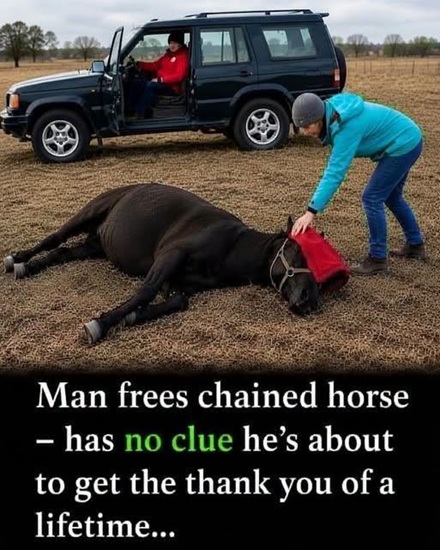
A widely shared rescue involving Romanian veterinarian Ovidiu Roșu captured attention after he helped a free-roaming horse whose legs had been restricted by a metal chain. The incident took place in the Letea area of Romania’s Danube Delta, where populations of semi-feral horses have lived for generations. The restraint prevented the animal from moving normally and created a risk of injury if it remained in place. Approaching a frightened horse in those circumstances required care because an animal of that size can react unpredictably when distressed.
Roșu worked to control the situation before removing the restraint and allowing the horse to move freely again. The rescue became especially memorable because of what happened after the chain was removed. Video associated with the incident showed another horse approaching Roșu and making close physical contact with him. Many viewers interpreted the behavior emotionally, describing it as a gesture of gratitude or even a thank-you kiss. That description is understandable, but it goes beyond what can actually be established from the footage.
Horses communicate through movement, posture, proximity and touch, and an observer cannot know precisely what an animal intended in a particular moment. The most accurate description is simply that another horse approached and nuzzled or touched the veterinarian following the intervention. That distinction does not make the scene any less meaningful. Horses are social animals, and physical contact can form part of their interactions with other horses and with familiar humans.
The approaching horse clearly chose to come close to Roșu, but assigning a specific human emotion such as gratitude would require an interpretation that cannot be verified. Animal-rescue videos frequently attract emotional descriptions because viewers naturally interpret behavior through human experience. Responsible reporting can acknowledge the emotional impact of the footage while separating what is visible from what people imagine the animal may have been feeling.
The chain itself highlighted a separate animal-welfare concern. In some circumstances, horses have been restrained by attaching chains or hobbles around their legs to limit how far they can travel while grazing. Metal restraints can become dangerous when they rub against the skin, restrict normal movement or remain fitted too tightly. Prolonged use can contribute to wounds and other injuries. A horse attempting to move while its legs are restricted may also stumble or fall. The situation involving Roșu therefore required more than simply removing an inconvenient object; the restraint represented a potential threat to the animal’s welfare.
Safely helping a free-roaming horse under those circumstances requires professional judgment. Horses are large, powerful animals, and fear or pain can cause sudden movements capable of injuring both the horse and anyone nearby. Veterinary teams may use controlled immobilization or sedation when necessary to perform treatment safely. Roșu has been involved professionally in field veterinary work with horses in the Danube Delta, including procedures requiring chemical immobilization. Such techniques allow veterinarians to examine or treat animals that cannot be safely handled in the same way as accustomed domestic horses.
The individual rescue also brought wider attention to the horses living around Letea Forest and other parts of the Danube Delta. These animals are frequently called “wild horses” in popular descriptions, but terms such as free-roaming, feral or semi-feral provide additional historical context. The population includes descendants of domesticated horses that have lived with limited direct human management for generations. Horses have been associated with the region for centuries, while their numbers increased significantly during more recent periods of social and agricultural change.
Romania’s political and economic transformation after 1989 played an important role in the modern history of the population. As agricultural systems changed and collective farming structures disappeared, some working horses were released or were no longer managed in the same way. Over subsequent years, animals reproduced freely across parts of the Delta. Their growing numbers eventually became both an animal-welfare issue and an environmental-management challenge. The horses had become strongly associated with the landscape, but increasing populations also created concerns about pressure on protected vegetation and available resources.
Letea Forest is environmentally important, and uncontrolled grazing can affect sensitive habitats. This created a difficult debate because the welfare of individual horses and the protection of the ecosystem both required consideration. Leaving populations entirely unmanaged can contribute to habitat pressure and future shortages of food or other resources. At the same time, aggressive removal or inhumane treatment of the animals creates serious welfare concerns. The situation therefore cannot be accurately reduced to a simple choice between protecting horses and protecting nature. Effective management needs to consider both.
The debate became particularly visible in 2011 when dozens of horses were rounded up and prepared for transport away from the area. Animal-welfare organization FOUR PAWS intervened after concerns emerged that horses were intended for slaughter. According to the organization, the transport was stopped and more than 40 animals were eventually rescued. Following months of care, those horses were returned to the Danube Delta. The incident became an important stage in the development of a longer-term strategy for managing the population without relying on large-scale killing.
Beginning in 2012, FOUR PAWS and veterinary partners implemented a fertility-control program for the free-roaming horses. The approach included immunocontraception, a method intended to temporarily reduce fertility in treated mares. Rather than removing large numbers of animals at once, fertility management can slow population growth gradually over time. The process requires much more than a single treatment session. Veterinarians need to identify animals, administer appropriate treatment, monitor results and return for follow-up work when necessary.
The program illustrates why humane population management can require years of continued effort. Preventing some pregnancies does not immediately reduce the number of animals already living in an area. Instead, the goal is to influence population growth over a longer period. Veterinary teams also need to monitor the health of individual horses and assess how management affects the herd. This makes fertility control fundamentally different from a dramatic one-time rescue. Its results depend on consistency, scientific monitoring and continued cooperation among the organizations and authorities involved.
Veterinary care formed another important part of the work in the Danube Delta. Injured, sick and older horses could require direct treatment, while environmental conditions sometimes created additional challenges. During periods when natural food became difficult to obtain, supplemental feeding was used in some circumstances. Teams also monitored individual animals and broader changes within the population. The chained horse encountered by Roșu represents the kind of immediate welfare problem that can occur alongside the much larger challenge of managing an entire free-roaming population.
Roșu’s work was therefore not limited to the single rescue that became widely shared online. His veterinary involvement included field procedures associated with the management and treatment of semi-feral horses. Scientific work involving Romanian feral horses has also examined methods of chemical immobilization used during veterinary interventions. Such research matters because treating a free-roaming horse can present different challenges from working with an animal accustomed to regular human handling. Safe procedures need to minimize risks to both veterinary personnel and the animals receiving care.
The famous moment involving the second horse is easy to understand as the emotional center of the story. A restrained animal had just been helped, and another horse then approached the veterinarian responsible for the intervention. Viewers naturally connected those two events and interpreted the contact as appreciation. Yet the observable facts are already compelling without claiming knowledge of the horse’s thoughts. The animal approached voluntarily and made contact with Roșu. Whether that behavior represented curiosity, social interaction, reassurance or something else cannot be established conclusively from the video alone.
Using careful language around animal behavior is particularly important online because emotional interpretations can quickly become repeated as factual explanations. A caption saying that a horse “thanked the veterinarian” may eventually be repeated as though researchers had established the animal’s intention. In reality, no such determination can be made from a short video. Describing the behavior as approaching, touching or nuzzling preserves what viewers can actually observe. People are still free to find the moment touching without turning an interpretation into a scientific claim.
The broader horse-management program eventually entered another stage after more than a decade of direct involvement from FOUR PAWS. The organization has stated that from 2025 its equine programs in Romania and Jordan were transferred toward the relevant authorities. In Romania, its work had included both support for working horses and management connected with the free-roaming horses of the Danube Delta. The transition did not mean that the animals suddenly stopped requiring management. Rather, responsibility for maintaining long-term progress increasingly shifted toward national and local structures.
That transition highlights the difference between emergency intervention and sustainable animal welfare. A veterinarian can remove a chain from one horse in a matter of minutes, but protecting a large population requires continued planning. Authorities must consider reproduction, veterinary needs, habitat conditions and interactions between horses and surrounding communities. Population-management programs also require funding, trained personnel and reliable monitoring. Without those elements, improvements achieved over many years can become difficult to maintain.
The environmental side of the issue also remains important. Free-roaming horses are visually associated with the Danube Delta and can attract significant public interest, but protected landscapes have ecological limits. Large grazing populations can alter vegetation and affect habitat if their numbers exceed what an area can sustainably support. Humane management therefore aims to avoid unnecessary suffering while also preventing uncontrolled population growth. Fertility control represents one possible tool for balancing those concerns, although it requires long-term commitment rather than providing an instant solution.
People visiting areas where free-roaming horses are present should also treat the animals with appropriate caution. A horse that appears calm can still react quickly if it feels threatened or crowded. Visitors should follow guidance from local authorities and maintain an appropriate distance rather than approaching animals for photographs or physical contact. Feeding can also encourage horses to associate people with food and may alter natural behavior. The veterinary intervention shown in the rescue video involved trained professionals responding to an animal-welfare problem and should not be treated as an example for untrained visitors to imitate.
The rescue involving Ovidiu Roșu remains memorable because the confirmed events are powerful without embellishment. A horse in Romania’s Danube Delta had its movement restricted by a harmful metal restraint. A veterinarian intervened and removed the chain. Another horse subsequently approached and made physical contact with him. Those events occurred within a region where veterinarians and animal-welfare organizations had already spent years working on the much broader challenges facing a semi-feral horse population.
The larger story is therefore about more than one dramatic rescue. It concerns the complicated relationship between human activity, animal welfare and environmental management in the Danube Delta. Historical changes contributed to the growth of the free-roaming horse population, while later management efforts attempted to address both welfare and ecological concerns. Veterinary treatment helped individual animals, and fertility-control programs offered an alternative to mass removal. Maintaining those results requires continued responsibility even after international animal-welfare organizations reduce their direct involvement.
The moment when the chain fell away may be the part most likely to attract attention, but the quieter work surrounding it is equally important. Population monitoring, veterinary examinations, fertility management and cooperation with authorities rarely produce viral videos. Yet those activities can determine whether future horses avoid preventable suffering. A successful animal-welfare program depends not only on responding when an animal is already in distress but also on reducing the circumstances that allow similar problems to occur again.
This account is based on publicly available information about veterinarian Ovidiu Roșu and horse-management work in Romania’s Danube Delta. It is written entirely from an outside, third-person perspective and does not claim that the publisher witnessed the rescue, lives in Romania, represents local residents or speaks on behalf of Romanian authorities or animal-welfare organizations. The horse’s behavior after the rescue is described as observable physical contact rather than scientifically proven gratitude. The horses are also described as free-roaming or semi-feral where appropriate, reflecting their documented history rather than presenting a simplified claim that they are an entirely untouched wild population.

