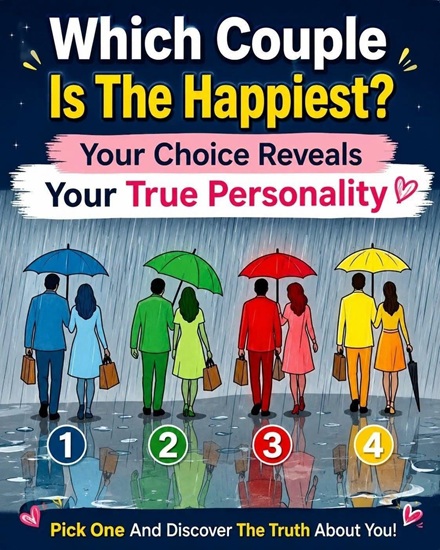
A colorful illustration of four couples walking together in the rain invites viewers to answer one simple question: which pair appears happiest to you? Each couple is represented by a different color—blue, green, red, or yellow—and each choice is given a symbolic interpretation related to relationships. Some viewers may make their decision almost instantly, while others may carefully examine every pair before settling on an answer.
The activity can be an enjoyable way to think about the qualities someone appreciates in a relationship. However, choosing one picture cannot scientifically determine personality or reveal whether a real relationship is healthy. The interpretations are best treated as prompts for personal reflection rather than psychological conclusions. The reason these visual exercises can feel surprisingly personal is that people naturally bring their own experiences and expectations into what they see.
Two viewers can examine exactly the same illustration and form completely different impressions about which couple appears closest or happiest. One person may notice physical affection, while another focuses on body language, distance, or the way the partners share an umbrella. Neither interpretation necessarily reveals what is objectively happening in the drawing. Instead, the choice may reflect what happiness currently means to the person looking at it. That makes the exercise interesting without making it diagnostic.
The first couple is represented by blue. Within the interpretation attached to this puzzle, blue symbolizes calmness, loyalty, emotional security, and dependable companionship. The pair appears comfortable walking together without relying on particularly dramatic gestures. Someone who chooses them may associate happiness with knowing that another person will remain supportive during both ordinary days and difficult periods. The umbrella can symbolically represent facing uncomfortable circumstances together. In this interpretation, love is demonstrated through consistency rather than spectacle.
People attracted to the blue couple may place considerable value on trust. They may appreciate partners who keep promises, communicate patiently, and demonstrate commitment through everyday actions. A quiet evening at home may feel just as meaningful as an expensive romantic gesture. Reliability can provide a sense of emotional safety because neither partner constantly has to question where the relationship stands. For someone with these preferences, peace does not necessarily mean boredom. It can mean feeling comfortable enough to stop performing and simply enjoy another person’s presence.
This kind of stability can become particularly important when life becomes complicated. Relationships exist alongside careers, family responsibilities, financial concerns, health problems, and countless unexpected changes. During those periods, dramatic romance may become less important than knowing that someone will remain present and dependable. A stable partner can provide reassurance without needing to solve every problem. Sometimes consistency itself becomes one of the strongest expressions of care. That idea is central to the symbolic blue interpretation.
Loyalty, however, should not be confused with tolerating everything indefinitely. Someone who values commitment very strongly may sometimes find it difficult to leave a relationship even when repeated harmful behavior has made it unhealthy. Staying simply because leaving feels like failure is different from working constructively through ordinary problems. Healthy loyalty still requires boundaries, respect, and safety. Both people need to take responsibility for how they behave. Commitment should support well-being rather than demand endless endurance.
A calm relationship also does not mean that two people never disagree. Conflict is a normal part of many relationships because individuals have different preferences, needs, and perspectives. The important issue is how disagreements are handled. Partners can be frustrated without becoming cruel, threatening, or degrading. They can listen, apologize, negotiate, and sometimes agree to disagree. Emotional safety comes from knowing that conflict does not eliminate basic respect.
The second couple is represented by green. In this puzzle, green is associated with growth, renewal, adaptability, compassion, and personal development. Someone drawn to this pair may believe that a healthy relationship should allow both people to evolve rather than requiring them to remain exactly as they were when they first met. Life changes people through new experiences, responsibilities, successes, and disappointments. A flexible partnership can make room for those changes. Happiness, from this perspective, involves developing together while still respecting each person’s individual journey.
People who identify with green may enjoy encouraging the ambitions of someone they love. They may take genuine pleasure in watching a partner learn something new, pursue education, develop a career, explore creative interests, or overcome a personal challenge. Support does not necessarily require sharing every goal. One person can care deeply about another’s ambitions even when their own interests are completely different. What matters is taking those goals seriously. Mutual encouragement can help both individuals feel that the relationship expands their lives rather than limiting them.
Adaptability is particularly useful because long relationships inevitably pass through different stages. The routines that work during the beginning of a romance may not work after moving together, changing careers, raising children, caring for relatives, or facing other major transitions. Responsibilities may need to be redistributed, expectations discussed again, and new compromises created. A relationship that refuses to adapt can struggle when circumstances change. Green therefore represents the willingness to learn new ways of supporting each other. Change becomes something to navigate together rather than automatically fear.
Compassion is another important part of this interpretation. A person attracted to green may instinctively try to understand what someone else is experiencing before judging their behavior. Empathy can make difficult conversations more productive because both partners feel that their perspectives are being considered. It can also create an environment where vulnerability feels safer. People are generally more willing to discuss fears and mistakes when they do not expect immediate ridicule. Mutual understanding can therefore become an important foundation for growth.
There is nevertheless a potential downside when compassion becomes completely one-sided. Someone who naturally helps others may begin placing another person’s needs above their own every time. They may repeatedly forgive behavior without seeing meaningful improvement because they believe patience will eventually create change. Supporting someone is valuable, but it does not require accepting unlimited disrespect. Both partners need to participate in the process. Healthy growth is mutual rather than one person permanently carrying all of the emotional work.
There is also an important difference between supporting a partner’s development and attempting to redesign that person. Encouragement respects autonomy, while constant pressure to change can become controlling. A relationship should not depend entirely on the belief that someone will eventually become a completely different individual. Green works best as a symbol of two people choosing to develop themselves while encouraging each other. Neither partner should be treated as a permanent improvement project. Acceptance and growth can exist together.
The third couple is represented by red, one of the most visually noticeable colors in the image. Red is traditionally associated in this puzzle with passion, attraction, romance, intensity, and open emotional expression. Someone who notices this pair first may want love to feel obvious and emotionally alive. Affection may be especially meaningful when it is expressed through words, touch, romantic gestures, or enthusiastic attention. A distant or emotionally restrained partnership might feel unsatisfying to someone who strongly values those qualities. The red interpretation emphasizes visible connection.
Passion can contribute significantly to a romantic relationship. People often want to know that their partner remains interested in them rather than simply assuming affection will always be understood. Compliments, physical closeness, thoughtful surprises, and openly expressed appreciation can help maintain connection. These gestures do not need to be expensive or dramatic. Even small expressions can communicate that another person is still noticed and valued. For someone drawn to red, those signals may be especially important.
However, people express affection differently. One person may frequently say how they feel, while another demonstrates love by helping with practical responsibilities or consistently making time for the relationship. Someone can be emotionally quieter without being less committed. Differences in expression become problematic mainly when partners never discuss what each person needs. Assuming that everyone must show affection in exactly the same way can create unnecessary misunderstandings. The red interpretation becomes healthier when intensity leaves room for different emotional styles.
Passion should also not be confused with instability. A relationship that constantly alternates between explosive conflict and dramatic reconciliation may feel intense, but intensity alone does not demonstrate that the relationship is healthy. Strong chemistry cannot replace trust, safety, or mutual respect. Partners can experience excitement while still communicating responsibly. Healthy passion adds energy to a stable relationship rather than requiring constant emotional chaos. Romance and reliability can coexist.
Someone choosing red may therefore benefit from thinking about which form of intensity actually matters most. Is it physical affection, emotional honesty, excitement, frequent communication, or feeling desired? Understanding the answer can be more useful than simply accepting a personality label attached to the color. The illustration cannot determine why someone chose red. Only the viewer can explore what attracted them to that image. The puzzle starts the conversation rather than completing it.
The fourth couple is represented by yellow. In the symbolic interpretation of the puzzle, yellow is connected with optimism, humor, confidence, creativity, and independence. Against the gray atmosphere of the rainy scene, the color creates an impression of brightness. Someone choosing this pair may admire relationships where both partners can maintain strong individual identities while still enjoying companionship. Love does not have to require doing everything together. Two independent people can choose closeness without giving up the interests that make them individuals.
Personal freedom can be important in a healthy partnership. Friends, hobbies, career ambitions, and time alone do not necessarily compete with romantic commitment. In many relationships, maintaining some independence can provide both partners with opportunities to recharge and continue developing as individuals. Trust reduces the need for constant monitoring or control. A partner can support another person’s independence without interpreting every separate activity as rejection. Yellow therefore represents closeness that still leaves room to breathe.
Humor also fits naturally into this interpretation. Couples who can laugh together may find ordinary routines more enjoyable and difficult periods somewhat easier to navigate. Shared jokes can create a sense of friendship in addition to romantic connection. Optimism may help partners believe that problems can be addressed rather than assuming every difficulty means the relationship is failing. The image of brightness within rain works as an effective metaphor for that attitude. Difficult circumstances can exist without eliminating every positive experience.
Yet optimism can become unhelpful when it is used to avoid uncomfortable realities. Some people dislike negative conversations so strongly that they repeatedly postpone important discussions. Humor can occasionally become a way of changing the subject rather than addressing a genuine concern. Saying that everything will be fine is not always enough. Problems involving boundaries, responsibilities, trust, or communication generally require actual conversation. Healthy optimism provides confidence to face problems rather than pretending they do not exist.
Independence also has limits. Wanting personal space is different from refusing emotional closeness. A person can maintain a strong individual identity while still allowing another person to provide support. Healthy relationships often contain a mixture of autonomy and interdependence. Partners can make their own choices while also recognizing that some decisions affect both people. Yellow is therefore most constructive when freedom exists alongside consideration.
Not everyone looking at the illustration will be able to select one couple. Some people may see desirable qualities in all four. Others may be skeptical about judging happiness from an illustration at all. Both reactions are reasonable because real relationships cannot be divided neatly into four color categories. Stability, growth, passion, and independence can all exist within the same partnership. The categories are symbolic themes rather than mutually exclusive personality types.
A person who refuses to judge the couples by appearance may also recognize an important limitation of the puzzle. A single frozen scene cannot reveal how two people treat each other privately. Body language can offer clues in real interactions, but an illustration does not provide enough information to determine trust, respect, communication, safety, or long-term compatibility. The pair standing closest together is not automatically the healthiest. Appearance is only one tiny piece of information.
Current emotional needs can influence the answer as well. Someone who recently experienced a stressful disagreement may find the calm blue pair particularly appealing. A person beginning a new stage of life may respond strongly to green because growth feels important. Someone excited about a new romance may naturally notice passionate red. A viewer who has recently felt controlled or restricted may find yellow’s symbolism of independence especially attractive. The result may therefore reflect the present moment rather than a permanent characteristic.
Repeating the puzzle months or years later could produce a different answer. That would not necessarily indicate a dramatic personality change. Priorities can shift as circumstances change. Someone may value excitement strongly during one period and stability more during another. Human preferences are flexible, particularly when they relate to complex emotional relationships. A four-color test cannot capture that complexity permanently.
The colors themselves can also influence selection independently of relationship values. Red is visually powerful and may attract attention quickly. Yellow can stand out against a dark or rainy background. Blue and green may create calmer visual impressions simply because of how those colors are commonly perceived and how they appear in the composition. Someone may therefore choose a couple partly because the artwork directs attention toward it. Visual preference should not automatically be interpreted as psychological evidence.
Personal history can further shape what someone notices. A person who experienced unreliable relationships may place an especially high value on the security represented by blue. Someone whose ambitions were discouraged by a former partner may appreciate green’s emphasis on growth. A person who previously experienced emotional distance may want the visible affection associated with red. Someone recovering from a controlling relationship may strongly value the autonomy represented by yellow. Those responses can be personally meaningful without making the test scientifically predictive.
Cultural expectations matter too. Ideas about romance, public affection, marriage, independence, family roles, and communication vary significantly between communities and individuals. A gesture that one viewer interprets as romantic might seem excessive to someone else. Another person may view independence as essential, while someone from a different background may place greater emphasis on shared family responsibilities. The illustration cannot account for all of these cultural differences. Interpretation inevitably comes from the viewer.
Age and life circumstances can similarly influence what happiness looks like. A younger person imagining a first serious relationship may focus heavily on excitement and attraction. Someone managing work, children, and household responsibilities may place greater value on dependability and teamwork. A person rebuilding life after a major change may prioritize personal growth or independence. None of these priorities is universally superior. Relationships need different qualities at different stages.
This is why a better question may be, “What attracted me to this couple?” rather than, “What does this couple prove about my personality?” The first question invites genuine reflection. Choosing blue might reveal a current desire for security. Green may highlight the importance of encouragement and development. Red can open a conversation about affection and emotional expression. Yellow may reveal how strongly someone values freedom and optimism.
Another useful question is whether the qualities someone values are actually reflected in their own behavior. Wanting loyalty means little if promises are repeatedly broken. Valuing growth requires allowing a partner to pursue meaningful goals. Wanting passion also involves communicating affection rather than expecting the other person to provide all of it. Valuing independence requires respecting the partner’s freedom as well as one’s own. Relationship ideals become meaningful through reciprocal behavior.
Couples can even use the illustration as a conversation starter. Each person can choose independently and then explain what made the selected pair appealing. Different answers may reveal preferences that have never been discussed directly. One partner might emphasize emotional security while another talks about independence. Those differences do not automatically indicate incompatibility. They may simply reveal areas where communication can create better understanding.
Choosing the same color does not prove compatibility either. Two people can both choose blue for completely different reasons, just as people choosing different colors may share many of the same values. Relationship compatibility involves far more than one visual preference. Communication, expectations, attraction, boundaries, shared responsibilities, life goals, and practical circumstances can all matter. No image-based exercise can reliably measure all of those factors.
The same limitation applies to claims about emotional intelligence. Finding the “happiest” couple quickly does not demonstrate superior insight into human relationships. There is no objectively correct answer because the illustration does not provide enough information to establish which pair is actually happier. The challenge is based on interpretation rather than measurable fact. Speed therefore has no validated psychological meaning.
The four colors can instead be viewed as four useful relationship themes. Blue represents the security that comes from trust and reliability. Green represents the ability to develop and adapt together. Red represents affection, attraction, and emotional energy. Yellow represents optimism, individuality, and personal freedom. Most healthy relationships may need some balance among several of these qualities rather than relying exclusively on one.
For example, stability without growth can eventually feel restrictive. Growth without stability may feel uncertain. Passion without respect can become exhausting, while independence without emotional connection can become lonely. Combining qualities can create a more balanced partnership. A couple might be reliable like blue, adaptable like green, affectionate like red, and respectful of independence like yellow. The illustration separates those themes for entertainment, while real life frequently mixes them together.
The rainy setting provides another useful metaphor. Difficult periods eventually appear in almost every long-term relationship, just as rain eventually interrupts good weather. The important issue is not whether problems ever occur. It is how partners respond when they do. Do they communicate? Can they support one another without becoming controlling? Are both people allowed to express needs and boundaries? Can responsibility be shared rather than placed entirely on one person?
A shared umbrella may symbolize support, but genuine partnership requires more than appearing close in a picture. It involves repeated actions over time. Trust develops when behavior matches promises. Safety develops when boundaries are respected. Affection becomes meaningful when it is sincere and reciprocal. Independence becomes healthy when it exists without neglect.
That is why the puzzle works best as a conversation rather than a conclusion. It gives viewers four simple symbols and asks them to consider what those symbols mean personally. There is no need to turn the answer into a permanent label. Someone can appreciate the insight produced by the question while recognizing the limits of the method.
If blue immediately caught your attention, perhaps reliability and peace currently feel especially important. If green seemed happiest, mutual growth and encouragement may appeal to you. If red stood out, affection and passion may play an important role in how you imagine romantic connection. If yellow felt most positive, independence, humor, and optimism may be qualities you currently appreciate. These are possibilities for reflection, not diagnoses.
Someone who sees themselves in more than one interpretation should not feel compelled to choose a single category. Human relationships are multidimensional. A person can crave stability while remaining adventurous, value independence while wanting deep intimacy, or enjoy passionate romance while preferring calm conflict resolution. Those combinations are normal. Four illustrations cannot contain every possible relationship preference.
Ultimately, the most meaningful measure of relationship happiness does not come from colors, umbrellas, or a single image. It comes from what happens repeatedly between two people. Honesty, mutual respect, emotional and physical safety, shared responsibility, communication, affection, boundaries, and freedom all contribute to the quality of a partnership. Different couples may express those qualities in very different ways.
The four-couple illustration remains enjoyable precisely because there is no definitive answer. It invites viewers to project their own ideas about love onto a simple rainy scene. Blue offers stability, green suggests growth, red represents passion, and yellow highlights optimism and independence. The choice can reveal what catches someone’s attention or what qualities feel appealing at that moment, but it cannot scientifically define personality.
So whichever couple appears happiest to you, the most interesting part is not the color itself. It is the reason behind your choice. Thinking about that reason may help clarify what you currently value in companionship and what behaviors make a relationship feel secure, supportive, affectionate, or
