
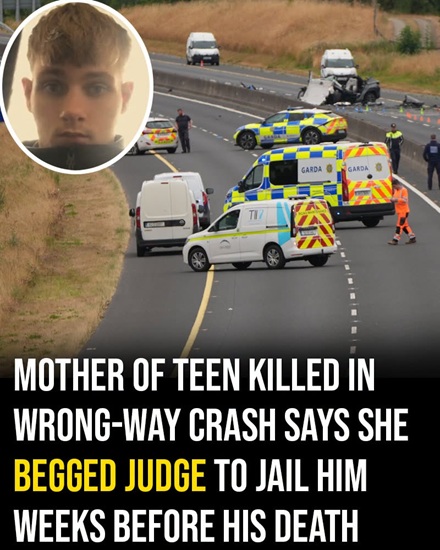
The deadly collision on Ireland’s M9 motorway on August 16, 2026, left five teenagers dead and four members of another family seriously injured. Gardaí said emergency services were alerted at about 3 a.m. to a vehicle travelling southbound on the northbound carriageway near Moone in County Kildare. The wrong-way vehicle then collided head-on with another car that was travelling in the correct direction. Five young males in the first vehicle died, while three women and a seven-year-old boy in the second car were taken to hospital with serious injuries.
The crash immediately became the subject of a major investigation. The five teenagers were later identified as Joe Carthy, 15, Jack Kennedy, 17, Kamil Pustkowski, 17, Alex McCarthy, 16, and Jeremy O’Brien, 18. Their deaths shocked several families and communities and also prompted difficult questions about the events that had happened before the collision. Gardaí continued examining the movements of the vehicle and the circumstances that led to it being driven the wrong way on the motorway.
Family liaison officers were assigned to support relatives of those who died. Investigators also began gathering road, vehicle and witness evidence. The four people in the other car were sisters Alma and Niamh Kinsella, their younger sister Ella Hendricken, and Alma’s seven-year-old son, Yemi. They had been travelling toward Dublin Airport on their way to a family wedding in Britain when the collision occurred. Their vehicle was travelling normally when it was struck. All four survived but suffered serious injuries and required hospital treatment. Their recovery became one of the central concerns in the days after the crash.
Amid the grief and investigation, Kamil Pustkowski’s mother, Emilia Pustkowska, later spoke publicly about the months before her son’s death. Her comments offered a parent’s perspective on a teenager she believed had become increasingly difficult to control. She said she did not accept descriptions of Kamil as the leader of the group. In her account, he was himself struggling and was not capable of directing others. She described him as “lost” rather than dominant.
Pustkowska said problems involving her son had begun escalating over the previous months. According to her account, she was first contacted about possible car-related offending involving Kamil in January 2025. She said the situation then became progressively more difficult. Court appearances followed, and she attended hearings with him in more than one city. In her telling, the legal process did not produce the kind of immediate intervention she believed was necessary.
She said she travelled repeatedly to court with Kamil, including appearances in Limerick and Dublin. Some proceedings, she said, were postponed or adjourned rather than reaching a final outcome. Pustkowska described the experience as frustrating because she believed the seriousness of her son’s behavior was increasing while the cases continued moving slowly. Her comments represented her own account of the court process rather than a full official record of every proceeding.
According to Pustkowska, Kamil had pleaded guilty to some offenses instead of denying everything he was accused of. She said that, from her perspective, this made the lack of a stronger intervention particularly difficult to understand. Eventually, she reached a point where she believed she could no longer keep him safely under control at home. She said she asked a judge to place him in custody.
That request was especially painful because she was asking for her own child to be detained. Pustkowska explained that she did not want prison because she wanted Kamil punished or harmed. Instead, she believed a period in a more controlled environment might interrupt what she saw as an escalating pattern of dangerous behavior. She hoped that time away from the situation might give him an opportunity to mature.
She also said she had spent a long period trying to manage things herself. According to her interview, she locked things away at home and felt increasingly as though she was living under restrictions because of the need to control the situation. Her remarks showed the level of concern she says existed before the crash. Looking back after his death, she now questions whether stronger intervention might have altered the path that eventually led him onto the M9.
At the same time, Pustkowska acknowledged that imagining a different outcome is complicated. She said that if Kamil had been in custody, someone else might have been in the car instead. That would not have made the overall tragedy acceptable. Her point was personal: she had wanted something to stop her son before his behavior reached a point she feared might end badly. After the crash, that fear became a permanent source of regret.
Her comments also challenged online claims that Kamil had been the main influence within the group. She said he was not capable of leading himself and therefore should not be portrayed as the leader of others without evidence. That statement should be understood as a mother’s account rather than a formal investigative conclusion. Authorities had not publicly established the internal relationships between every person in the vehicle.
The crash itself has generated strong public reaction because of the danger created by wrong-way motorway driving. Gardaí confirmed that the BMW was travelling south on the northbound carriageway when it struck the other vehicle. The second car was travelling correctly. That distinction is central to understanding why the four injured people have been described as innocent road users caught in a catastrophic situation.
The injured family had no role in creating the circumstances that led to the collision. They had simply been making an early-morning journey to the airport. Their plans involved a family wedding rather than anything connected with criminal activity or dangerous driving. In a matter of seconds, that ordinary journey became a medical emergency that left all four hospitalized.
Public support for the Kinsella family grew quickly. Fundraising efforts were launched to help with costs associated with treatment and recovery. Vigils and messages of support followed as relatives and friends waited for updates. Reports indicated that the injuries were serious and that recovery could take time. The family’s medical privacy remained important while attention surrounding the wider case continued to grow.
The Garda investigation has focused not only on the moment of impact but also on events earlier that night. Authorities have examined whether the BMW was connected with other incidents before it entered the motorway. They have also reviewed footage, witness information and the movements of the vehicle. Because those investigations remain active, some details have not yet been established publicly with final certainty.
The case was also referred for independent examination of the police-contact element. Such reviews are designed to establish what happened before a serious incident and whether procedures were followed appropriately. The existence of an independent review does not itself prove misconduct. It is a mechanism for establishing a clear factual record after a death following police contact.
That distinction matters because social-media discussion after the crash quickly produced strong claims about what had happened. Some posts presented assumptions as facts before investigators had completed their work. Responsible coverage should avoid repeating those claims unless they are supported by official findings or reliable evidence. The circumstances are already serious enough without adding unverified details.
Jeremy O’Brien’s mother, Margaret Berry, also spoke publicly after losing her son. Her remarks focused heavily on the people injured in the other car. She said she wished Jeremy had never entered the vehicle and made clear that she did not approve of what had happened. Her statement acknowledged the harm suffered by the Kinsella family rather than trying to minimize it.
Berry said she would apologize directly to the injured family if she had the opportunity. She also said she had been praying for their recovery. Her comments reflected a parent trying to mourn a son while recognizing that his involvement was connected with serious harm to innocent people. She did not claim that the dangerous driving was acceptable simply because her son had died.
She also said she did not believe the young men had set out with the intention of hurting anyone. That was her belief about intent, not a formal investigative finding. Whatever their intentions, the consequences were devastating. Five young people died and four others suffered serious injuries. The distinction between intention and outcome does not change the scale of what occurred.
Other family members of the teenagers also used funerals and public statements to acknowledge the consequences of the crash. In some cases, parents urged other young people not to repeat dangerous behavior. These messages tried to separate grief for a loved one from approval of the choices that led to the collision. Mourning someone does not require pretending every action connected with their death was acceptable.
That point became particularly important as online discussion risked turning reckless driving into spectacle. Irish authorities and regulators also began looking more closely at social-media content showing dangerous driving. Some officials expressed concern about the possibility that online attention can encourage risky behavior among young users. These broader questions remain separate from the investigation into the specific M9 collision.
There is no evidence that one social-media platform or one online trend alone caused what happened on August 16. Human behavior is rarely explained by a single factor. However, content that rewards or glamorizes dangerous acts has become part of a wider road-safety discussion. Regulators and policymakers have been examining how platforms respond to material that may encourage reckless behavior.
The M9 crash also renewed attention on wrong-way motorway incidents more generally. Driving against the direction of traffic creates extraordinary danger because approaching drivers may have almost no time to react. Motorways are designed on the assumption that traffic on each carriageway moves in one direction. When that basic rule is violated, the combined closing speeds can make head-on collisions especially severe.
The crash near Moone demonstrated that danger in the worst possible way. One vehicle was travelling against the flow of traffic, while the other was travelling normally. The resulting impact killed everyone in the wrong-way car and seriously injured everyone in the other vehicle. No dramatic language is needed to understand how destructive that situation became.
Pustkowska’s interview added another difficult layer to the public conversation. She said she had recognized that her son’s behavior was becoming dangerous before his death. She also said she had repeatedly sought help through the court process. Her frustration now centers on the belief that stronger intervention might have interrupted what she describes as a downward spiral.
Whether a specific judge or institution could definitely have prevented the crash cannot be established from her interview alone. Court decisions involving teenagers can depend on legal standards, previous history, available placements, evidence and submissions from several parties. The full records of Kamil’s proceedings are not contained in the public reports surrounding the crash. It would therefore be inaccurate to claim that one decision clearly caused or failed to prevent what happened.
What can be stated accurately is that his mother says she asked for him to be detained. That fact matters because it demonstrates how worried she says she had become. She was not describing a situation she first discovered after his death. In her account, she had already been attending court and raising concerns before the fatal collision.
Her comments raise a broader question about what support is available when parents believe they can no longer safely manage a teenager’s behavior. Detention is only one possible intervention and may not be legally appropriate in every case. Other responses can include youth services, supervision, education, family support, mental-health services, diversion programs and community-based interventions.
There is no responsible way to determine from a news article which approach would have worked for Kamil. His circumstances would have required individual assessment by professionals with access to records that are not publicly available. The value of Pustkowska’s testimony lies in showing that she believed the situation had moved beyond what she could handle alone.
Her experience also demonstrates how complicated parental responsibility can become once a teenager begins acting independently. Parents can set rules and seek assistance, but they cannot physically control every decision made outside the home. When dangerous conduct escalates, families may depend on schools, courts, Gardaí, social services and community organizations for additional support.
These systems do not always operate quickly or perfectly. At the same time, it is too simple to assume that any one agency could automatically have stopped the final outcome. Prevention often depends on many institutions working together, and even strong interventions cannot guarantee what a young person will do later.
The crash has therefore become part of a much larger debate about youth offending, road safety and intervention. Those discussions may eventually produce policy changes or reviews. However, they should remain grounded in evidence rather than using one grieving mother’s words as proof of a conclusion that has not been formally established.
Pustkowska has also spoken about the hostility she encountered after the crash. She said she felt afraid that even expressing sympathy for the injured family would attract abuse from people online. That reaction reflects the intensity of public anger surrounding the case. It also shows how parents can become targets for decisions made by teenage children, even when those parents say they had been trying to stop the behavior.
Feeling sympathy for a bereaved parent does not require excusing dangerous driving. Both ideas can exist at the same time. Kamil’s mother can grieve her son while the injured family remains entitled to recognition as innocent victims. Margaret Berry can mourn Jeremy while openly saying she wishes he had never entered the car.
This distinction is one of the most important parts of responsible coverage. The families of the five teenagers are suffering because their children died. The Kinsella family is suffering because they were seriously injured in a collision they did not cause. These are not identical experiences, but both involve real people dealing with trauma.
The injured family’s recovery should therefore remain central. Public discussion about the boys, social media, courts and Garda activity can easily overshadow the four people who survived the collision. They face medical treatment, rehabilitation and uncertainty about the future. Their lives changed even though they had no connection to the actions being investigated.
For Alma, Niamh, Ella and Yemi, the priority is not the public debate. It is recovery. That may include surgeries, rehabilitation, time away from work or school and the emotional effects of surviving a collision in which five other people died. Those consequences can continue long after media attention decreases.
The teenagers’ families will also live with the incident long after headlines disappear. Their sons and relatives will forever be associated publicly with a fatal wrong-way collision. At the same time, family members will remember childhoods, birthdays, private conversations and personalities that existed before the final night. Grief often involves holding those memories beside the reality of serious mistakes.
That is why funerals and family statements can contain both love and condemnation of behavior. A parent can say that a child was deeply loved while also saying the choices connected with the death were wrong. These ideas do not cancel each other out.
The case also illustrates why language matters when writing about young people who die during alleged criminal activity. Describing confirmed facts is appropriate. Assigning motives or roles that investigators have not established is not. A teenager can be named as an occupant of a vehicle without automatically being labeled the leader, planner or main offender unless evidence supports that description.
Pustkowska’s rejection of the “leader” label should therefore be attributed to her. It should not simply replace one unverified claim with another. Her statement tells readers how she understood her son. Investigators may eventually establish more about the group’s interactions, but until then, those relationships remain partly uncertain.
The same caution applies to claims about who was driving. Reliable reports have identified Jeremy O’Brien as the person understood to have been driving the BMW, but the full investigation and any inquest findings remain the most authoritative way to establish the final factual record. When major incidents are still being examined, later official findings can clarify or refine earlier reporting.
This is why news stories should leave room for uncertainty instead of presenting every early detail as permanently settled. Investigators may obtain CCTV, phone data, vehicle evidence or witness accounts that change part of the timeline. Responsible journalism should update facts when better evidence becomes available.
What is already clear does not require speculation.
A vehicle travelled the wrong way on the M9.
A head-on collision followed.
Five teenagers died.
Three sisters and a seven-year-old boy were seriously injured.
Those facts alone explain the seriousness of the event.
The strongest lesson from the crash is not that one particular person or institution can easily be blamed for everything. It is that dangerous driving can destroy lives within seconds. It can harm people who had no involvement in the behavior that created the risk. It can leave families asking questions that may never have satisfying answers.
For Pustkowska, the unanswered question is whether stronger intervention before August 16 could have saved Kamil. She had already reached the point where she says she was willing to see her own son detained. That is an extraordinary admission from a parent and shows how frightened she says she had become.
She now has to live with the knowledge that the intervention she wanted never happened before his death. That does not prove detention would definitely have changed everything. It explains why she is left imagining that possibility.
Grief often produces these alternative histories.
What if someone had stayed home?
What if a hearing had happened earlier?
What if a parent had received different support?
What if one person had refused to enter the car?
These questions can feel overwhelming because they describe worlds that can no longer be tested.
Margaret Berry’s statement contains the same kind of regret in a simpler form.
She wishes Jeremy had never got into the car.
Nothing can change that decision now.
Her hope is directed toward the injured family rather than toward rewriting what happened.
That acknowledgment is significant.
She did not ask people to celebrate the teenagers’ conduct.
She did not dismiss the suffering of the Kinsella family.
She said the tragedy should never have happened.
That message is likely to remain important as younger people hear about the case.
Dangerous driving can sometimes be presented as excitement, rebellion or entertainment.
The M9 crash shows the consequences without any need for dramatization.
Five young people died before most of them had reached adulthood.
Four innocent road users were seriously injured.
Families on both sides were changed permanently.
If the case produces any lasting public lesson, it should be grounded in those consequences.
Road safety is not an abstract rule.
Wrong-way driving is not a harmless stunt.
A few minutes of reckless behavior can produce years of medical recovery and lifelong grief.
At the same time, prevention has to begin before a fatal collision.
Parents, schools, courts, Gardaí and youth services all have roles when warning signs appear.
There may not be one perfect intervention, but repeated high-risk behavior should not be treated as meaningless.
Pustkowska’s story is particularly painful because she says she was already asking for help.
Her account does not prove what the correct legal response should have been.
It does show that a mother believed the situation was becoming dangerous enough that ordinary parenting was no longer working.
That deserves careful consideration rather than simplistic blame.
It also deserves verification where possible.
Her description of court appearances, pleas and conversations with judges should be treated as her account unless supported by official records. This protects readers from turning an emotional post-tragedy interview into a complete legal history.
The same standard should apply to every claim surrounding the crash.
What authorities have confirmed should be presented as fact.
What relatives say should be clearly attributed.
What remains unknown should stay unknown until evidence establishes it.
This approach avoids misinformation without weakening the story.
In fact, the verified story is already powerful enough.
A mother says she asked for her teenage son to be detained because she feared she could no longer control his behavior.
Weeks later, he died in a wrong-way motorway collision.
Another mother says she wishes her son had never entered the car.
Four people in the other vehicle are recovering from serious injuries.
Those facts and attributed statements explain the tragedy without inventing anything.
As the Garda investigation and independent reviews continue, more detail may emerge about the hours before the collision. Those findings may help explain how the BMW came to be travelling against traffic and what interactions occurred beforehand. Until then, the responsible position is to avoid guessing.
For the Kinsella family, future updates will hopefully focus on recovery.
For the families of the teenagers, the future will involve grief and difficult questions about choices that cannot be undone.
For institutions, the case may lead to examination of how young people involved in repeated high-risk behavior are managed.
For the public, the clearest message is simpler.
The injured family did nothing to deserve what happened.
Wrong-way motorway driving is extraordinarily dangerous.
Parents who believe a teenager is becoming impossible to control may need meaningful support.
And online anger should not replace evidence.
Emilia Pustkowska’s words should therefore be understood for what they are: the testimony of a grieving mother looking backward at warnings she believes were already visible.
She says Kamil was lost.
She says she sought stronger intervention.
She says she feared the direction his life was taking.
Now there is no opportunity to see whether another path might have worked.
That uncertainty is part of the tragedy too.
The crash did not leave only one family asking “what if.”
It left several families with questions that will likely remain for years.
One family is recovering from injuries caused while travelling normally.
Five other families are burying teenagers and young men.
The investigation continues.
The consequences do not.
They are already permanent.

