
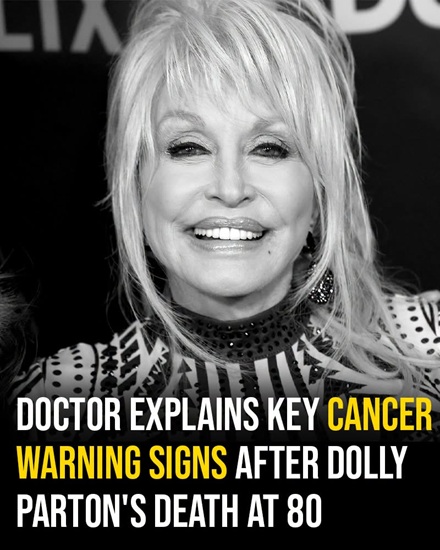
Country music icon Dolly Parton died on August 25, 2026, at the age of 80 after what her representatives described as a brief battle with cancer. She died at Vanderbilt-Ingram Cancer Center in Nashville while surrounded by loved ones. The announcement brought an outpouring of tributes from fans, musicians, actors, and public figures who had followed her career for decades. Her representatives did not reveal which type of cancer she had been diagnosed with.
Because that information remains private, it would be inaccurate to connect her death to any specific type of cancer unless her family or representatives choose to disclose more details. The news also brought renewed attention to a broader health issue that affects people regardless of age, background, or location. Cancer can sometimes cause noticeable symptoms, but it does not always begin with an obvious warning sign. Different cancers behave differently, and symptoms can vary depending on where a cancer develops, how large it becomes, and whether it affects nearby organs or tissues.
Some cancers produce symptoms relatively early, while others may remain difficult to notice for a longer period. This is why medical professionals generally recommend paying attention to persistent or unexplained changes rather than trying to identify cancer from one symptom alone. Fatigue is one example of a symptom that can be easy to overlook. Everyone experiences tiredness, particularly after poor sleep, demanding work, illness, stress, or changes in routine. Ordinary tiredness will often improve after enough rest.
Persistent fatigue that feels unusually strong or does not improve normally may deserve further attention. Cancer can sometimes contribute to significant fatigue, but there are many more common explanations that have nothing to do with cancer. Anemia, thyroid disorders, sleep problems, infections, nutritional deficiencies, medication side effects, stress, anxiety, depression, and many other conditions can all contribute to prolonged exhaustion.
That is why tiredness alone should never be interpreted as evidence that someone has cancer. What matters is whether the symptom continues, becomes noticeably worse, or feels significantly different from a person’s usual level of energy. A healthcare professional can review the complete situation and decide whether further investigation is necessary. In many cases, the explanation will be something far less serious, but persistent symptoms are still worth discussing.
Unexplained weight loss is another change doctors sometimes encourage people to investigate. Weight naturally changes over time, and diet, exercise, stress, illness, medication, and many other factors can influence it. Losing weight after intentionally changing eating habits or becoming more active is very different from losing a noticeable amount of weight without knowing why. Unintentional weight loss can occur with many health conditions, including some cancers. It can also occur with thyroid disorders, digestive problems, diabetes, infection, medication effects, and several other conditions.
If someone is eating normally and has not intentionally changed their lifestyle but continues losing weight, it can be useful to understand what is causing the change. That does not mean cancer is the likely explanation. It simply means unexplained weight loss should not always be dismissed without considering the broader medical picture. A healthcare provider may ask about appetite, eating habits, medications, digestive symptoms, and other changes before deciding whether any testing is needed. The goal is to identify the cause rather than assume the worst.
A cough that refuses to disappear is another symptom that deserves proper context. Coughs are extremely common and are usually caused by conditions unrelated to cancer. Respiratory infections, allergies, asthma, acid reflux, smoking, environmental irritation, and many other factors can lead to coughing. Most ordinary coughs improve as the underlying cause resolves. A cough that continues for several weeks, becomes progressively worse, or behaves differently from someone’s normal cough may be worth discussing with a medical professional.
A persistent cough does not automatically mean lung cancer or another serious disease. In fact, many more common conditions can produce the same symptom. However, additional changes such as coughing up blood, persistent shortness of breath, recurring chest infections, or significant unexplained weight loss may make medical evaluation particularly important. Symptoms should always be assessed together rather than individually. A doctor can determine whether the cough is related to infection, inflammation, a chronic respiratory condition, or something that requires further testing.
New or unexplained lumps are another reason people sometimes seek medical advice. Lumps can develop for many harmless reasons. Swollen lymph nodes frequently occur during infection, and benign cysts or other non-cancerous growths are also common. A lump that persists, becomes larger, feels unusually firm, or appears without an obvious explanation can still deserve assessment. A doctor may be able to identify the likely cause through examination alone or recommend additional testing if necessary.
Skin changes can also be worth monitoring. Many people develop harmless moles, spots, discoloration, or irritation over time. Sun exposure, allergies, infections, hormonal changes, and ordinary aging can all alter the appearance of the skin. However, a new skin lesion, a mole that changes noticeably, an area that repeatedly bleeds, or a sore that does not heal can be reasons to seek medical advice. These signs do not automatically indicate skin cancer, but changes that persist or evolve deserve attention.
Unexplained bleeding is another symptom that can have many different causes. Blood may appear because of hemorrhoids, urinary infections, menstrual changes, digestive conditions, injuries, medications, or other non-cancerous problems. At the same time, repeated or unexplained bleeding should not simply be ignored. Blood in the urine, stool, sputum, or unexpected bleeding from another location may justify medical evaluation. Finding the reason matters regardless of whether cancer is involved.
Changes in bowel habits are equally broad. Occasional constipation, diarrhea, bloating, or changes in stool appearance are common and can be caused by food, stress, infection, travel, medication, or changes in routine. A persistent change that continues without explanation is different. Repeated blood in the stool, ongoing abdominal discomfort, or a sustained change in bowel habits can be discussed with a healthcare professional. These symptoms do not automatically indicate colorectal cancer, but persistent changes deserve appropriate evaluation.
Urinary symptoms can also occur for many reasons. Needing to urinate more frequently, experiencing pain during urination, noticing blood in the urine, or developing other persistent urinary changes can be associated with infections and numerous other medical conditions. Some cancers can also produce urinary symptoms, but they are far from the only explanation. A clinician may use urine testing, blood testing, imaging, or other examinations depending on the individual situation. Self-diagnosis from one symptom is unreliable.
Persistent pain is another symptom that should be considered carefully. Pain is extremely common and is much more often caused by conditions other than cancer. Muscle injuries, arthritis, headaches, digestive problems, inflammation, and many other issues can produce discomfort that lasts for days or weeks. Pain that continues without explanation, repeatedly returns, or gradually becomes worse can still be worth discussing with a doctor. The purpose is not simply to rule out cancer but to determine what is causing the problem and whether treatment is needed.
Difficulty swallowing can also deserve attention when it continues. Temporary throat discomfort frequently occurs during infections or irritation. Persistent difficulty swallowing, repeated pain while eating, or a sensation that food is becoming stuck can have several causes involving the throat, esophagus, reflux, or muscle function. Certain cancers can also cause swallowing problems, but those symptoms should not be treated as proof of cancer. Medical assessment can help identify the actual reason.
Changes in appetite can happen for many reasons as well. Stress, illness, medications, digestive problems, depression, anxiety, and changes in routine can all affect hunger. Some cancers may also influence appetite, either directly or through symptoms such as nausea, abdominal discomfort, or difficulty swallowing. A short period of reduced appetite is often not alarming. A persistent change associated with unexplained weight loss or other unusual symptoms deserves more attention.
Fever and night sweats also need context. Infections are among the most common explanations for fever, and many people occasionally wake sweating because of room temperature, heavy bedding, medication, hormonal changes, or anxiety. Persistent unexplained fever or repeated drenching night sweats can sometimes be associated with more serious conditions, including certain cancers. Even so, these symptoms remain non-specific and should not be used for self-diagnosis. Their meaning depends on the rest of the medical picture.
One of the most important principles in cancer awareness is that individual symptoms rarely provide a complete answer. A person may have fatigue, cough, weight changes, or pain without having cancer. Doctors consider many factors when deciding whether symptoms require further investigation. These can include duration, severity, age, personal medical history, family history, medication use, lifestyle, physical examination findings, and the presence of additional symptoms. Medical testing may then be recommended when appropriate.
Persistence is often particularly important. The human body changes frequently, and many minor symptoms improve naturally. A short-lived cough after a cold, a temporary period of tiredness, or a brief digestive change will often resolve without requiring extensive investigation. A symptom that continues for weeks, repeatedly returns, or steadily becomes worse deserves more attention. That does not mean people should wait for every symptom to become severe before seeking help.
Some symptoms can require quicker attention depending on their seriousness. Significant difficulty breathing, heavy unexplained bleeding, coughing up substantial amounts of blood, severe sudden pain, or neurological symptoms should not be treated the same way as a mild temporary symptom. People experiencing urgent or rapidly worsening symptoms should seek appropriate medical care promptly. General cancer-warning information should never replace emergency medical guidance when symptoms are severe.
Routine cancer screening is also different from visiting a doctor because of symptoms. Screening is performed to look for certain cancers before obvious symptoms appear. Recommendations vary according to age, sex, individual risk, family history, and the specific cancer involved. Screening programs can include mammograms, cervical screening, colorectal screening, and other tests depending on medical guidelines and individual circumstances. Following recommended screening does not mean someone should ignore new symptoms between appointments.
The opposite is also true. Feeling completely healthy does not necessarily mean screening is unnecessary. Some cancers can develop without causing clear early symptoms. Evidence-based screening programs exist because finding certain cancers earlier can sometimes improve treatment options and outcomes. People should discuss appropriate screening schedules with qualified medical professionals rather than relying on generic social-media advice. Personal risk factors can change which recommendations are most appropriate.
Cancer awareness should not become cancer panic. Most headaches are not caused by brain tumors. Most coughs do not indicate lung cancer. Most episodes of fatigue are unrelated to cancer. Most temporary changes in digestion have ordinary explanations. Lists of possible cancer symptoms contain many problems that also occur in healthy people or in people with common, treatable illnesses.
That is why context matters so much.
The responsible approach is to pay attention without automatically assuming the most serious diagnosis. If something improves quickly and has an obvious explanation, it may not require further concern. If it continues, becomes progressively worse, repeatedly returns, or simply feels significantly different from normal, speaking with a healthcare professional can provide clarity. Even if cancer is ruled out, another medical condition may still require treatment. Persistent symptoms are worth investigating because health problems of many kinds can benefit from proper diagnosis.
Dolly Parton’s death should also be discussed with that same level of caution. Her representatives confirmed that she died after a brief battle with cancer, but they did not reveal the specific type. There is currently no verified basis for claiming that she personally experienced persistent coughing, unexplained weight loss, fatigue, or any of the other general warning signs discussed in cancer-awareness guidance. Connecting those symptoms directly to Parton’s illness without evidence would create unnecessary speculation.
Before her death, Parton had publicly acknowledged dealing with health difficulties. She had also explained that caring for her husband, Carl Dean, before his death in 2025 had caused her to neglect some of her own health concerns. Those statements provide limited context about her later years, but they did not publicly identify cancer as the condition she was facing at that time. It would therefore be inappropriate to look backward and claim that every previous health issue was a symptom of the cancer later confirmed by her representatives.
Medical privacy remains important even when the patient is internationally famous. Families are not required to reveal every aspect of a loved one’s diagnosis, treatment, or medical history. If Parton’s family chooses not to disclose the specific cancer type, that decision should be respected. Responsible reporting can explain what has been confirmed while clearly acknowledging what remains unknown. In this case, the confirmed information is that she died at 80 following a brief battle with cancer.
Her death brought an end to an extraordinary entertainment career that lasted for decades. Born in Tennessee in 1946, Parton became one of the most recognizable voices in country music and eventually reached audiences far beyond the genre. Her songwriting produced recordings that became cultural landmarks, including “Jolene,” “9 to 5,” and “I Will Always Love You.” Her distinctive voice, humor, appearance, and public personality made her instantly recognizable across generations. She remained active well beyond the period when many performers step away from public life.
Parton’s influence also extended beyond her own recordings. Other performers recorded songs she had written, and generations of musicians cited her as an influence. Her career crossed music, television, film, live performance, business, and philanthropy. The longevity of that career meant that parents, children, and grandchildren could all become familiar with her work during different decades. Few performers achieve that level of cultural continuity.
Her charitable work became another major part of her legacy. Parton’s Imagination Library grew into a widely recognized literacy initiative that provides books to young children. The program was inspired in part by her father’s inability to read and write. What began as a regional project expanded dramatically over time, reaching families in multiple countries. Her connection to literacy became almost as recognizable as some aspects of her entertainment career.
Parton also supported education, healthcare, disaster relief, and other charitable causes over the years. Her public image often combined humor and glamour with a reputation for generosity. Those contributions became part of the reason tributes following her death extended beyond the music industry. People who had never attended one of her concerts or purchased one of her albums may still have encountered programs connected with her philanthropy.
Her husband, Carl Dean, died in March 2025 after nearly sixty years of marriage. Parton later discussed how deeply the loss affected her. She said caring for him had caused her to place some of her own needs aside. Those comments became more poignant following her death, but they should still be interpreted carefully. There is no verified reason to assume that every health challenge she mentioned was directly connected with her later cancer diagnosis.
Cancer itself is also far too broad a term to support assumptions about her prognosis or treatment. There are many different cancers, and each can behave very differently. Some grow slowly. Others are aggressive. Some can be treated successfully with surgery alone, while others may require chemotherapy, radiation, immunotherapy, targeted therapy, hormone therapy, or combinations of treatments. Without knowing Parton’s specific diagnosis, claims about what treatments she received or what her medical outlook had been would be speculative.
This wider variety is another reason people should avoid comparing their own health directly with a celebrity’s illness. Two people with the same general category of cancer can experience different symptoms, receive different treatments, and have different outcomes. Age, cancer stage, tumor biology, genetics, general health, and many other factors can influence treatment decisions. A famous person’s medical story cannot be used as a personal diagnostic guide.
For readers concerned about their own symptoms, keeping track of changes can sometimes be useful. A person may want to remember when a symptom began, whether it is improving or worsening, how frequently it occurs, and whether anything seems to trigger it. This information can help a healthcare provider understand the situation more clearly. It does not replace professional evaluation, but it can make a medical conversation more informative.
If a symptom remains unexplained after an initial evaluation, follow-up may sometimes be appropriate. Doctors may recommend observation, repeat testing, imaging, blood work, or referral to a specialist depending on the circumstances. A normal first test does not mean every future symptom should automatically be ignored. At the same time, repeated testing is not always necessary for mild or temporary complaints. Healthcare decisions should be based on professional judgment rather than fear.
Early detection can improve outcomes for some cancers, but that message should also be explained carefully. Detecting certain cancers at an earlier stage can provide more treatment options and improve the likelihood of successful treatment. That does not mean early detection guarantees a cure in every case. Different cancers behave differently, and some remain challenging even when identified relatively early. Screening and symptom awareness are tools, not guarantees.
The public reaction to celebrity illness can sometimes create an environment where misinformation spreads quickly. Unsupported posts may assign a specific diagnosis before it has been confirmed. Others may claim that a particular food, supplement, treatment, or lifestyle could have prevented the illness. Some may use the person’s death to promote unproven medical products. These claims deserve caution, particularly when they contradict established medical evidence.
Cancer is not one disease with one cause or one treatment.
There is no universal symptom that proves someone has cancer.
There is no single test appropriate for every cancer.
There is no one treatment that works for every patient.
Responsible health information needs to reflect that complexity.
The death of a well-known person can encourage people to think about their own health, but fear should not replace accurate information. Persistent fatigue, unexplained weight loss, ongoing coughing, unusual bleeding, new lumps, persistent pain, skin changes, or changes in bowel and urinary habits can all occur for reasons unrelated to cancer. When symptoms persist or become concerning, healthcare professionals can help determine whether further investigation is needed.
People should also avoid delaying care because they are afraid of what a doctor might find. Sometimes symptoms have simple explanations and a medical consultation provides reassurance. In other cases, a condition may require treatment even though it is not cancer. Knowing what is causing a problem is generally more useful than continuing to worry without information. Medical evaluation is designed to investigate possibilities rather than automatically confirm the most frightening one.
At the same time, people should not become overly anxious about every temporary change. Bodies are not perfectly consistent from day to day. Energy levels fluctuate. Weight can change slightly. Coughs happen. Digestive patterns change. Minor aches come and go. Awareness becomes useful when combined with perspective.
The central question is often whether something persists.
Does the symptom continue instead of improving?
Does it repeatedly return?
Is it becoming worse?
Is it unusual compared with what is normal for that person?
Those questions can help determine whether contacting a healthcare professional makes sense.
Dolly Parton’s passing has understandably caused sadness because her work was present in popular culture for so long. Some fans discovered her music decades ago, while younger listeners encountered her songs through later recordings, films, social media, or cover versions by other artists. Her ability to remain culturally recognizable across generations was unusual. Her death therefore feels personal to many people even though they never knew her privately.
That emotional response should not lead to speculation about her final illness. Her specific cancer type remains undisclosed. There is no need to invent details about symptoms, diagnosis, treatment, or prognosis to explain her death. What has been publicly confirmed can stand on its own. Parton died at age 80 after a brief battle with cancer, surrounded by loved ones.
Her legacy is considerably larger than the illness that ended her life.
It includes decades of music.
It includes songwriting that became part of popular culture.
It includes acting and entertainment projects.
It includes businesses and philanthropy.
It includes millions of books distributed to children.
Those accomplishments are independent of the limited medical details surrounding her death.
For anyone reading about her death and thinking about cancer, the most useful lesson is practical. Learn what is normal for your own health. Pay attention when something changes in a persistent or significant way. Follow evidence-based screening recommendations that apply to your age and risk factors. Seek qualified medical advice when a symptom concerns you.
Do not attempt to diagnose yourself from a social-media post.
Do not assume one symptom means cancer.
Do not ignore persistent changes simply because they appear minor.
Balanced awareness is more useful than either panic or denial.
Many symptoms that appear on cancer-warning lists ultimately have harmless or treatable explanations. That is reassuring. At the same time, medical evaluation can help identify the smaller number of cases where something more serious is occurring. The purpose of awareness is to encourage appropriate attention, not constant fear.
Parton’s death also illustrates why medical reporting should remain careful when private information has not been released. A lack of detail does not give writers or readers permission to fill the gap with assumptions. Her family and representatives have confirmed cancer but have not publicly identified its type. Until additional verified information is released, that should remain the boundary of responsible reporting.
In the days and weeks following her death, additional tributes will likely continue focusing on her music, humor, generosity, and influence. Those areas are well documented and provide a far fuller picture of her life than speculation about an undisclosed diagnosis. Her career cannot be reduced to the illness she faced at the end. For millions of listeners, she will remain associated with songs and stories that became part of their own lives.
For healthcare discussions, meanwhile, the message should remain separate and factual.
Cancer symptoms can sometimes be subtle.
Many are also caused by conditions that are not cancer.
Persistence matters.
Professional medical evaluation matters.
Screening can matter.
Accurate information matters.
There is no benefit in turning general warning signs into claims about Dolly Parton’s personal symptoms when those details have not been publicly established. Doing so would blur the line between health education and speculation. A better approach is to acknowledge what is known about her death while discussing cancer awareness in general terms.
That approach respects both the reader and the person being reported on.
Dolly Parton died after a brief battle with cancer, according to her representatives. The specific diagnosis remains private. Her death can reasonably encourage a broader conversation about paying attention to persistent or unexplained symptoms, but those symptoms should never be attributed directly to her without evidence.
Anyone experiencing ongoing fatigue, unexplained weight loss, a persistent cough, unusual bleeding, new lumps, or another significant health change should consider discussing it with a qualified healthcare professional. Those symptoms have many possible causes, and most do not automatically mean cancer. A medical evaluation can help establish the real explanation.
The final message is therefore one of awareness without alarm.
Pay attention to your health.
Do not ignore persistent changes.
Do not assume the worst.
Seek professional advice when something does not improve or feels unusual.
And when discussing someone else’s illness, especially when important medical details remain private, separate confirmed facts from speculation.
Dolly Parton’s life will be remembered for far more than her final diagnosis. Her music, personality, philanthropy, and decades of creative work built a legacy that crossed generations. The circumstances of her death deserve accurate and respectful reporting, just as cancer-awareness information deserves careful medical context.
Her passing can remind readers that serious illness does not always begin in an obvious way. It can also remind people that vague symptoms do not automatically indicate serious disease. Both ideas can be true at the same time. Awareness works best when it encourages people to seek appropriate care without creating unnecessary fear.
That balance is ultimately the most responsible message.
Persistent or unusual health changes deserve attention.
Professional medical guidance is more reliable than speculation.
And while Dolly Parton’s specific cancer remains undisclosed, the broader lesson about listening to changes in the body can be shared without inventing details about her private medical history.

