
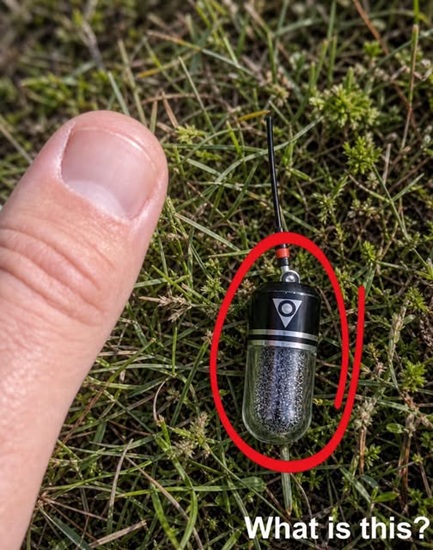
A published online account describes a walk that appeared completely ordinary until a dog suddenly became interested in a small area beside the path. The animal had reportedly been moving normally when it stopped and focused on something in the grass. At first, the person walking the dog could not see anything unusual. The grass looked like an ordinary part of the surroundings, and there was no obvious reason for the dog’s reaction.
After looking more carefully, however, the walker noticed a very small object partly hidden among the blades. That discovery turned a routine moment into an unexpected encounter with something unfamiliar. The object was described as tiny, light-looking, and difficult to identify immediately. According to the account, it had a capsule-like appearance and a thin component resembling an antenna. Because the walker had no immediate explanation for what it was, the object naturally raised questions.
Unfamiliar electronic equipment can appear mysterious when it is found outside the setting where people normally expect to see it. At the same time, an unusual appearance alone does not prove that an object is dangerous or designed for surveillance. Without technical information or expert identification, the most responsible approach is to avoid making conclusions that go beyond the available evidence. The published story says that the walker did not immediately reach into the grass to pick up the object.
Instead, the person reportedly used a phone camera to examine it more closely from a short distance. Enlarging an image can sometimes make small structural details easier to see without requiring immediate handling. In this case, the shape of the object reportedly appeared consistent with a very small radio transmitter or tracking tag. That possibility is scientifically realistic because miniature radio transmitters are genuinely used in wildlife studies. However, identifying a particular device with complete certainty would normally require more than a photograph.
Wildlife researchers have used radio telemetry for many decades to learn where animals travel and how they use their environment. In a basic radio-telemetry system, an animal carries a small transmitter that produces a radio signal. Researchers can then use specialized receivers and antennas to detect that signal and estimate where the animal is located. This method can be useful when direct visual observation would be difficult or impossible. Birds, bats, mammals, and other animals may travel through areas where researchers cannot continuously follow them. Radio telemetry can therefore provide information about movements that might otherwise remain largely unknown.
Modern tracking equipment can be much smaller than many people expect. Advances in electronics and battery technology have allowed researchers to develop transmitters suitable for increasingly small animals. Some devices weigh less than a gram and may be only a few centimeters or even millimeters in certain dimensions. The exact design depends on the species being studied, the duration of the research, the required signal range, and many other technical factors. A transmitter intended for a small bird or insect must be dramatically lighter than equipment used on a large mammal. This helps explain why genuine scientific equipment can sometimes resemble a tiny piece of plastic or wire when seen outside its usual research setting.
Small wildlife tags are not miniature versions of smartphones. Many do not contain cameras, microphones, or the technology required to record nearby people. Some simply transmit a radio signal that can be detected with compatible receiving equipment. The presence of an antenna therefore does not mean that an object is secretly filming or listening to anyone nearby. Different technologies perform different functions, and those functions should not be confused. When a device cannot be identified with certainty, claims about hidden cameras or surveillance should not be presented as fact.
The international Motus Wildlife Tracking System is one example of how automated radio telemetry can be used to study animal movements. Participating researchers attach compatible transmitters to selected animals, and receiving stations can detect those tags when they move within range. The resulting detections can help scientists study migration, habitat use, stopover locations, and other movement patterns. Birds and bats are among the animals commonly associated with this kind of research, and similar technologies have also been adapted for very small species. A tag that looks insignificant on its own can therefore be part of a much larger scientific effort.
Researchers have even investigated tracking technologies small enough for insects. Tiny radio transmitters have been used experimentally with species such as bumble bees to better understand how they move through landscapes. This type of research can help scientists examine where animals search for food, which habitats they use, and how they travel between important locations. Working with animals that small creates major engineering challenges because a transmitter cannot be allowed to become an excessive burden. Researchers therefore have to balance battery size, transmission strength, operating time, and total weight very carefully.
If the object described in the story truly was a wildlife transmitter, there are several ordinary reasons why it might have ended up in the grass without an animal attached. Wildlife tags can be connected using different methods, including collars, harnesses, adhesives, and specially designed attachment systems. Some are intended to remain attached only for a limited period. Others may detach accidentally because of movement, vegetation, weather, wear, or failure of the attachment method. Researchers sometimes intentionally design temporary attachment systems because they do not want an animal to carry equipment indefinitely. These possibilities are well known in wildlife research, although they do not establish exactly what happened to the device described in the account.
The original story does not identify the research project, animal species, institution, or person that may have owned the object. Those missing details matter. Without them, it would be inaccurate to claim that the tag definitely belonged to a particular bird, mammal, or conservation program. The scientifically responsible wording is that the object was described as resembling miniature tracking equipment. Its exact history remains uncertain unless additional identifying information becomes available. Preserving uncertainty is an important part of accurate reporting.
The dog’s behavior is also worth describing carefully. According to the published account, the animal noticed or became interested in the location before the walker saw the object. Dogs have powerful senses, especially their sense of smell, and they can react to environmental details that humans do not immediately detect. However, there is no evidence showing exactly what attracted this dog’s attention. It may have been the object, an odor associated with it, something that had previously touched it, or another nearby stimulus. It would be misleading to claim that the dog somehow understood that the object was a radio transmitter.
This distinction makes the story more believable rather than less interesting. The dog did not need any unusual ability to draw attention toward the grass. Animals regularly investigate unfamiliar smells and objects. A small electronic device that had previously been attached to an animal could potentially carry scents that were interesting to another animal, although that explanation cannot be confirmed in this case. The important fact within the account is simply that the dog’s behavior caused the walker to look more carefully. Without that reaction, the object might have remained unnoticed.
Finding unfamiliar equipment in an outdoor environment can feel unsettling because context is missing. A scientific instrument inside a laboratory is immediately understandable because the surroundings explain why it is there. The same object lying beside a walking path can look strange because there is no researcher, label, or research station nearby. Wildlife biology often takes place directly in natural environments rather than inside traditional laboratories. Researchers may work in forests, grasslands, wetlands, agricultural areas, coastlines, or urban green spaces. Their equipment can therefore occasionally appear in places where members of the public are also present.
That does not mean every unusual object found outdoors belongs to a scientific study. Electronic components can be lost or discarded for many different reasons. A reliable identification normally depends on details such as a manufacturer’s name, serial number, frequency label, project code, institutional marking, or confirmation from someone familiar with the equipment. When those details are unavailable, visual resemblance alone should not be treated as proof. Responsible reporting uses phrases such as “appeared to be” or “resembled” when certainty is not possible.
If a person encounters an unknown object outdoors, avoiding unnecessary handling can be a reasonable precaution. This is especially true if the object is damaged, has an exposed battery, includes sharp parts, carries warning symbols, or cannot be identified safely. There is no need to assume danger, but there is also no need to touch something simply because curiosity is strong. If an object clearly contains identifying information from a research institution, contacting that organization may help determine what it is. If there is a genuine and immediate safety concern, appropriate local authorities or property managers can be contacted instead.
The online account says that the walker ultimately chose to leave the device where it was found. That decision was presented as an attempt to avoid interfering with something that might belong to a research activity. Whether leaving a particular device in place is always the best response depends on the circumstances, and the story does not provide enough information to make a universal recommendation. What can be said is that the walker reportedly chose not to remove an object whose ownership and purpose were uncertain. The article does not establish whether anyone later returned to recover it.
The possibility that the object was related to wildlife research creates a much more interesting scientific discussion than unsupported speculation about secret monitoring. Wildlife tracking allows researchers to gather information about animals that are difficult to observe directly. A small bird may cross large regions during migration. A bat may travel at night and spend the day in hidden roosts. A rodent may move through dense vegetation where continuous visual observation is impossible. Radio telemetry can provide researchers with another way to study those movements.
Movement information can be valuable because animals depend on different places for different activities. One location may be used for feeding, another for nesting, and another as a temporary resting area during migration. Scientists who understand these patterns can better investigate how animals interact with their environment. In some cases, movement studies contribute to conservation research by identifying important habitats or migration corridors. Tracking data alone does not answer every ecological question, but it can provide evidence that would otherwise be difficult to obtain.
For migratory birds, tracking technology can reveal connections between places separated by enormous distances. A bird observed during one season may spend another part of the year hundreds or thousands of kilometers away. Following that movement by direct observation would often be unrealistic. A radio transmitter can help researchers collect detections during parts of the journey. When combined with information from multiple animals and receiver stations, those detections may reveal broader migration patterns. This is one reason miniature transmitters have become valuable tools in modern field research.
The engineering behind these devices is also more complex than their size suggests. A wildlife transmitter has to balance several competing requirements. It must be light enough for the target animal, powerful enough to produce a useful signal, and durable enough to survive the environment. Battery capacity is limited by weight, and a larger antenna or battery can make the device less suitable for small species. Researchers therefore make tradeoffs involving operating time, detection distance, transmission frequency, and physical size. A device that appears simple from the outside may represent careful technical design.
Animal welfare is another important consideration. Researchers generally want tracking equipment to interfere as little as possible with normal behavior. An excessively heavy or poorly fitted tag could affect movement or produce unreliable research results. For that reason, scientists consider the size and biology of the species when selecting tracking methods. Different animals may require very different attachment systems. Research protocols may also involve monitoring animals after deployment to evaluate whether equipment is functioning appropriately.
Temporary attachment methods can be especially useful for small animals. A researcher may want a transmitter to remain attached long enough to collect meaningful data but eventually detach rather than stay on the animal permanently. Adhesives, weak-link systems, or other methods may be used depending on the research design. Consequently, discovering a detached transmitter outdoors would not necessarily mean something went wrong. It could represent normal wear, planned release, or accidental loss. Without the project details, however, no single explanation can be confirmed.
The story also illustrates how human interpretation can change once an unfamiliar object receives a plausible explanation. Before identification, the device seemed mysterious because the walker did not know what it was. After considering the possibility of wildlife telemetry, the same object could be viewed as research equipment rather than a threat. The physical object did not change during that process. What changed was the context available to the observer. This is a common reason unfamiliar technology can initially appear more alarming than it really is.
Accurate context is particularly important when discussing electronic devices online. Claims involving surveillance, hidden cameras, or secret tracking can easily become sensational if they are presented without evidence. A small antenna does not prove that an object is spying on people. A radio transmitter used for wildlife research is designed for a very different purpose. Responsible articles should avoid suggesting harmful or secret capabilities unless reliable evidence supports those claims. Curiosity can be maintained without turning uncertainty into fear.
The original encounter is therefore best understood as a human-interest story connected to a genuine area of science. The personal part of the account involves a dog becoming interested in something the walker had not noticed. The scientific part involves the real existence of miniature tracking tags used by wildlife researchers. Those two elements can be discussed together while still keeping their evidentiary limits clear. The story itself is an account from a published source, while the broader explanation of radio telemetry is supported by established research and conservation practice.
There is no need to invent a specific animal that supposedly carried the device. It could have belonged to a bird, mammal, or another research subject if it truly was a wildlife tag, but the available information does not identify one. Imagining a particular species might make the story more dramatic, but it would also create information that has not been established. Accurate reporting is stronger when unanswered questions are allowed to remain unanswered. Readers can understand the significance of wildlife telemetry without being given fictional details.
There is also no evidence that the device was intentionally placed in the grass for a passerby to find. A detached transmitter could end up somewhere simply because an animal moved through that location. Wind, rain, vegetation, or ordinary movement could then influence where it eventually rested. The article does not document how long the object had been there. It could have been recent or could have remained unnoticed for some time. Again, the correct conclusion is uncertainty rather than speculation.
The same caution applies to the idea that the dog detected an electronic signal. Dogs can hear frequencies humans do not hear and possess extremely sensitive noses, but nothing in the available account demonstrates that this particular dog reacted to radio transmission. A transmitter’s radio signal is not something a dog would ordinarily be described as identifying in the manner of a trained receiver. The animal may simply have smelled or noticed something unfamiliar. Any stronger explanation would require evidence that the story does not provide.
The account becomes more interesting when these unsupported possibilities are removed. Instead of a mysterious device secretly monitoring the surroundings, the object may represent a real method scientists use to understand animal movement. Instead of a dog with unexplained abilities, there is an observant animal that drew attention toward something a human had overlooked. Instead of a dangerous encounter, there is a moment of uncertainty followed by curiosity. Those elements are enough to create a compelling story without exaggeration.
Wildlife research often depends on collecting small pieces of information over long periods. One transmitter detection may reveal only that an animal was near a particular receiver at a particular time. Hundreds or thousands of detections can create a much richer picture. Researchers can examine recurring routes, compare individuals, and look for seasonal patterns. When information from multiple studies is combined, scientists can investigate questions at much larger geographic scales. The tiny hardware carried by an animal is only one part of that process.
Automated receiver networks can reduce the need for researchers to physically follow each tagged animal at all times. A receiver can remain in place and record compatible signals when tagged animals pass nearby. This is particularly useful for species that move long distances or are active when humans are unlikely to observe them. Researchers still need to deploy equipment, manage data, analyze detections, and interpret what those detections mean. The technology supports field science rather than replacing it.
Some tracking methods rely on GPS, while others use traditional radio frequencies, satellite communication, cellular networks, or combinations of technologies. Each approach has advantages and limitations. GPS devices can provide detailed geographic positions but may require more energy or larger batteries. Simple radio transmitters can be lighter but may depend on researchers or automated receivers being within detection range. The smallest animals may require extremely lightweight solutions with limited operating life. This variety is another reason an unfamiliar tag cannot be accurately described based only on one general appearance.
A tiny antenna is particularly common in radio systems because transmitting a signal requires an antenna suited to the device’s design and frequency. To someone unfamiliar with telemetry equipment, the antenna may make the device look unusual. To a wildlife researcher, however, it can be a completely normal feature. Context changes perception once again. Something that looks mysterious to a passerby may be ordinary equipment to a scientist who works with it regularly.
The story also provides a useful reminder that scientific research can occur surprisingly close to everyday life. A person does not need to travel to a remote wilderness to encounter wildlife research. Scientists study animals in suburban landscapes, agricultural areas, parks, city environments, forests, and many other places. Wildlife itself often crosses boundaries between natural and human-dominated environments. Consequently, research equipment can sometimes appear near walking paths or other places used by the public.
Encountering such equipment does not necessarily mean the public is being monitored. Wildlife researchers are interested in the tagged animals and the questions defined by their research project. A radio receiver detecting a wildlife tag is not equivalent to a surveillance camera recording people who happen to pass nearby. These technologies should be described according to their actual functions rather than through assumptions created by the word “tracking.” The subject becomes more informative when terminology is used precisely.
The unexpected discovery can also encourage curiosity about animals that people normally see without knowing where they travel afterward. A bird in a park may later migrate across several regions. A bat seen near a building may travel kilometers during a single night. Small mammals may move between habitat patches while remaining almost completely hidden from human observers. Tracking technology gives scientists a way to examine parts of these movements. The data can reveal a world of activity occurring beyond ordinary human observation.
This does not mean every animal should be tagged or that tracking research is without limitations. Scientists must consider research goals, animal welfare, permit requirements, equipment costs, data quality, and potential impacts on the species being studied. Some animals are difficult to tag safely, and some research questions can be answered through less invasive methods. Telemetry is one tool among many available to wildlife researchers. Its usefulness depends on careful study design.
Technology is also continually changing. Devices have generally become smaller and more capable over time, opening opportunities for researchers studying species that were previously too small for practical telemetry. At the same time, physical limits remain. Very small batteries store less energy, and smaller transmitters may provide shorter detection ranges or operating periods. Engineers and biologists continue working to improve these compromises. The appearance of tiny tracking equipment is therefore part of a broader story about technological development in ecological research.
If the device described in the published account truly belonged to such a project, its presence in the grass may have represented the final stage of a much longer journey. It could have traveled with an animal before becoming detached. It might once have produced signals that researchers recorded somewhere else. It may also have completed its useful operating life before it was discovered. Those are plausible possibilities based on how wildlife telemetry works, but they remain possibilities rather than established facts about this particular object.
That distinction between possibility and certainty is essential for responsible storytelling. An article can explain what might have happened while clearly saying what is not known. There is no need to claim that the device definitely tracked a bird across a specific route or recorded a particular journey. No such information appears in the available account. The scientific background is already interesting enough without inventing a history for the object.
The same principle applies to emotional language. An unknown device can reasonably produce concern, but describing it as dangerous without evidence would be misleading. Once the possibility of a wildlife transmitter is introduced, readers should also be told what that kind of technology normally does. This prevents ordinary scientific equipment from being framed as something sinister. Informative context can replace unnecessary fear with understanding.
For someone actually finding a tagged device, visible identification might be especially helpful. Some research tags or associated equipment may include numbers, labels, or contact information. Researchers can sometimes benefit from recovering lost equipment because transmitters may be expensive or may contain information useful to a study. A person who can safely read identifying information without disturbing wildlife may be able to contact the listed institution. However, there is no indication in the original account that such identifying information was available.
The dog eventually continued the walk according to the story, and the unusual object was left behind. The event itself was brief. No person was harmed, and there was no verified evidence of a dangerous device. What remained was an unanswered question about how something so small had arrived there. That uncertainty became the most memorable part of the encounter.
The experience also demonstrates how easily ordinary surroundings can contain things people do not notice. Grass beside a path may contain insects, seeds, feathers, discarded objects, or equipment too small to attract immediate attention. Humans naturally focus on larger features of their environment and may overlook tiny details. A dog investigating the ground can direct attention toward something that would otherwise disappear into the background. In this case, according to the account, that shift in attention revealed an object that appeared connected to tracking technology.
There is a broader scientific lesson here as well. Much of what researchers learn about wildlife comes from evidence that the public rarely sees. A map showing animal movements may ultimately depend on tiny transmitters, receiving stations, field observations, and countless individual detections. The final scientific result can look simple while the process of collecting the information is extremely complex. Finding a small tag unexpectedly offers a glimpse into that normally invisible process.
A radio transmitter by itself does not tell a complete story. Researchers need to know which animal carried it, when it was deployed, how its signal was recorded, and how those observations fit into the study design. Without that information, a loose transmitter is simply a piece of equipment. The scientific meaning comes from the context and data surrounding it. This is another reason an unidentified object should not be given a detailed fictional history.
The original online story can therefore be enjoyed without treating every detail as independently verified fact. It is an account describing an unusual encounter. The real scientific information comes from what is already well established about wildlife telemetry. Miniature radio transmitters exist. They are used on birds, mammals, bats, insects, and other animals where appropriate. Researchers use their signals to investigate movements and behavior. Those facts provide enough context to understand why a tiny antenna-equipped object might plausibly appear outdoors.
There is no need to connect the event to any local political, social, or domestic issue. The subject is wildlife research and an everyday encounter with unfamiliar technology. It does not depend on pretending to speak for residents of a particular community or attempting to influence a local debate. The story can remain neutral, educational, and focused on scientific context. That approach also makes the content useful to readers regardless of where they live.
The safest conclusion is therefore straightforward. According to a published account, a dog’s reaction during a walk drew attention to a tiny object lying in the grass. The object was described as resembling a miniature radio tracking tag, a type of technology that genuinely exists in wildlife research. However, the precise origin, research project, and previous carrier of that particular object were not independently identified in the available information. Claims beyond those facts would be speculation.
What makes the story memorable is not the idea of a hidden threat. It is the contrast between an ordinary walk and the possibility of unexpectedly encountering equipment connected to scientific research. Something small enough to be missed by a passing human may still have an important purpose when used in the right context. Modern wildlife research often depends on technologies that are deliberately lightweight and unobtrusive. A tiny tag in the grass can therefore open a much larger conversation about how scientists study animals moving through the world around us.
The dog’s role adds a simple human-interest element to that discussion. Its sudden interest reportedly changed where the walker was looking. Without that moment, the object might never have been noticed. There is no need to assign the animal extraordinary abilities or claim it understood what it had found. An ordinary canine reaction to an unfamiliar smell or object is enough to explain why attention shifted toward the grass.
In the end, the strongest version of this story is also the most careful one. A published account describes an unusual discovery, while established science explains why the object may have resembled wildlife-tracking equipment. The exact history of the device remains unknown, and that uncertainty should remain visible. The broader technology, however, is real, well documented, and widely used by researchers seeking to understand animal movements.
A quiet walk can sometimes produce an unexpected reminder of how much activity takes place beyond ordinary human observation. Wildlife moves through parks, fields, forests, and urban spaces while researchers work to understand where animals go and why. Small transmitters can help reveal some of those movements without requiring a scientist to remain physically beside an animal at every moment. Most people will never notice the equipment involved.
That is perhaps the most interesting idea left by the encounter. The surrounding landscape did not need to look unusual for scientific research to have potentially passed through it. A device small enough to disappear between blades of grass could still have been designed for a serious research purpose. Its presence alone does not prove its complete history, but it illustrates how compact wildlife-tracking technology has become.
What began as an apparently uneventful walk therefore became an opportunity to learn about a real scientific method. The dog reportedly noticed something the walker had overlooked, and curiosity led to a closer examination. The object appeared consistent with a small transmitter rather than the more alarming possibilities that unfamiliar technology can sometimes inspire. From there, the story becomes less about mystery and more about understanding.
Miniature wildlife telemetry shows how science can operate quietly in the background of ordinary environments. Researchers do not always need enormous instruments or visible observation stations to collect useful information. Sometimes a device carried by a small animal can provide signals that contribute to a much larger dataset. When such equipment becomes detached from its context, however, it can look puzzling to anyone who happens to find it.
The most responsible reaction to that uncertainty is not to invent an explanation but to separate what is known from what is possible. Wildlife transmitters are real. Tiny radio tags are real. Researchers use them to study animal movement. The specific device in this account was described as resembling one, but its precise identity was not independently confirmed.
That careful distinction allows the story to remain interesting without becoming misleading. There is still the image of a dog stopping unexpectedly, a person examining the grass, and a tiny object appearing where nothing unusual seemed to be moments earlier. There is still the surprising reality that scientific equipment can be small enough to nearly disappear outdoors. And there is still the larger question of how much animal movement around us is being studied in ways ordinary passersby rarely notice.
In that sense, the discovery does not need a dramatic ending. There was no verified secret camera, no proven danger, and no evidence of surveillance directed toward the walker. There was simply an unfamiliar object that appeared consistent with a legitimate scientific technology. Understanding that possibility turns the story from one of fear into one of curiosity.
Sometimes that is enough to make an ordinary moment memorable. A dog becomes interested in a patch of grass, a walker looks more closely, and a tiny object reveals a connection to a much larger scientific subject. The precise story of the device may remain unknown, but the technology behind the possibility is very real. Wildlife researchers continue using increasingly sophisticated tools to study animals whose movements would otherwise be difficult to follow.
A small transmitter can therefore represent far more than its physical size suggests. It can be part of research about migration, habitat, behavior, or conservation. It can travel unnoticed with an animal through landscapes shared by people. And, if it eventually becomes detached, it can suddenly appear in an ordinary place where someone has no idea what it is.
That is what makes the account interesting without requiring exaggeration. The mystery comes from missing context rather than from evidence of anything sinister. Once the possibility of wildlife telemetry is understood, the strange object becomes easier to interpret. At the same time, responsible reporting leaves room for the fact that its exact origin remains unknown.
The walk reportedly continued, the dog eventually moved on, and the object remained behind. Yet the discovery offered an unexpected glimpse into the kinds of technologies researchers use beyond laboratories and research centers. Scientific equipment can be present in landscapes that otherwise look completely ordinary. Sometimes it is so small that only an alert animal, a careful observer, or simple chance brings it to anyone’s attention.
The lasting lesson is therefore one of curiosity combined with caution. Unknown objects should not automatically be described as dangerous, and uncertain details should not be turned into facts. At the same time, asking what something might be can lead to genuinely interesting discoveries. In this case, the answer points toward the fascinating world of wildlife telemetry and the small tools scientists use to understand how animals move through their environment.

