
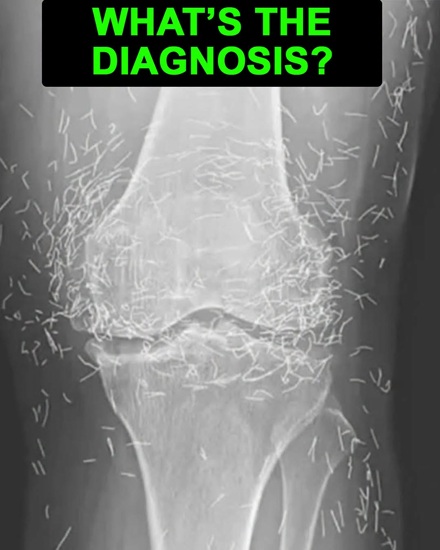
A routine medical examination for persistent knee pain led to an unusual discovery when doctors evaluated a 65-year-old woman with osteoarthritis. Radiographs of her knees showed something far beyond the joint changes normally associated with the condition. Numerous small metallic objects appeared throughout the tissue surrounding both knees. The bright fragments were not naturally occurring deposits or an unexplained medical phenomenon.
They were tiny gold threads that had previously been implanted as part of an acupuncture-related treatment the woman had received for her chronic knee pain. The case was documented by physicians Han-Gyul Yoo and Wan-Hee Yoo and published in the New England Journal of Medicine in 2013. According to the report, the patient had osteoarthritis affecting both knees and had previously used analgesics and nonsteroidal anti-inflammatory drugs, commonly called NSAIDs.
Those treatments had not provided sufficient relief for her symptoms, and she also experienced gastrointestinal discomfort associated with medication. Seeking another approach to her ongoing pain, she turned to acupuncture. Osteoarthritis is a common joint condition that can gradually affect cartilage and other structures within a joint.
The knees are frequently affected because they carry body weight and experience considerable mechanical stress during everyday movement. People with knee osteoarthritis may experience pain, stiffness, swelling, reduced flexibility, or difficulty performing activities that once seemed routine. Symptoms and their severity can differ substantially from one person to another.

For someone experiencing significant knee osteoarthritis, ordinary activities may become increasingly uncomfortable. Walking for longer distances, climbing stairs, standing up after sitting, bending the knee, or participating in certain forms of exercise can become difficult. Some individuals experience stiffness after periods of inactivity, while others notice increased discomfort following physical activity. Because the condition varies so much, treatment usually needs to be adapted to each patient’s symptoms, health, abilities, and personal circumstances.
Treatment can include several approaches rather than a single universal solution. Exercise and appropriate physical activity can play an important role, while weight management may be recommended for some patients. Medications are sometimes used to control pain, and additional nonsurgical interventions can be considered depending on the situation. When osteoarthritis becomes severe and significantly affects quality of life, joint replacement surgery may eventually be discussed for appropriate patients.
In the woman’s case, difficulties with her previous medication contributed to her decision to seek acupuncture. However, the procedure reflected in her X-rays was different from conventional acupuncture sessions in which thin needles are inserted temporarily and then removed. Tiny pieces of gold thread had intentionally been placed around her knee joints and left inside the tissue. This permanent material was responsible for the remarkable appearance of her later medical images.
Because gold is much denser than the surrounding soft tissues, the pieces were highly visible on radiographs. They appeared as numerous bright, narrow fragments scattered around the knees. Someone seeing the images without knowing the woman’s treatment history might initially wonder how so much metallic material became embedded in her body. Her medical history provided the explanation: the objects were remnants of her previous gold-thread acupuncture treatment.
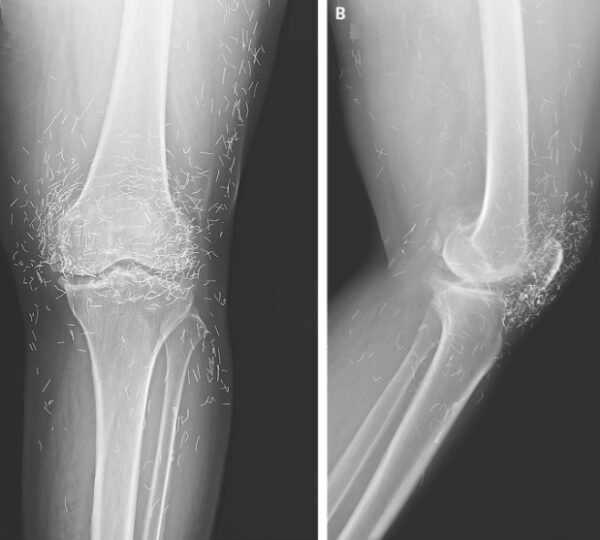
The images therefore should not be interpreted as showing that doctors discovered gold naturally developing inside the patient’s knees. Nothing in the case suggested that her body somehow produced the material. The gold came from an external procedure and had deliberately been implanted. Descriptions suggesting that physicians unexpectedly “struck gold” are simply playful ways of describing the unusual radiographic discovery rather than literal explanations of what happened.
Traditional acupuncture is generally performed by inserting very thin needles through the skin at selected points. The needles used in ordinary sessions are typically removed after treatment. Acupuncture originated as part of traditional Chinese medicine and has since spread internationally, with many people using it primarily for pain management. Techniques and practices can vary considerably, however, and permanent implantation of metallic material should not automatically be treated as identical to standard acupuncture.
Gold-thread implantation represents a less conventional variation in which small pieces of metal remain in the patient’s body. The idea behind such procedures has historically been to provide continued stimulation after the original treatment session. Medical literature has documented permanent acupuncture materials made from metals including gold, silver, and stainless steel. Because these objects remain inside tissue, they can later appear prominently during diagnostic imaging.
The South Korean patient’s X-rays became particularly memorable because there were so many visible pieces surrounding her knees. The fragments produced an almost patterned appearance across the radiographs. Yet the image itself was not the only medically interesting part of the case. It also demonstrated why knowing a patient’s history of complementary or alternative treatments can be important when doctors interpret future examinations.
Metallic foreign material may interfere with or complicate some forms of diagnostic imaging. Objects visible on radiographs can overlap with normal anatomy and potentially make certain structures more difficult to evaluate. Physicians and radiologists therefore benefit from knowing whether unusual objects were intentionally implanted during a previous procedure. Without that information, an unexpected pattern can initially require additional investigation to determine its origin.
The presence of foreign material inside the body also raises potential safety considerations. Human tissue can react to implanted objects through processes that may include inflammation and the formation of fibrous tissue. Depending on factors such as the type of material, location, procedure, and sterility, complications involving infection or other tissue reactions are also possible. This does not mean every implanted object necessarily causes a complication, but permanent implantation is not medically irrelevant simply because the material is small.
Medical reports have also described migration involving some permanently implanted acupuncture materials. An object originally inserted in one location can potentially shift from where it was placed. The possibility and consequences depend on the characteristics and location of the material. These reports are among the reasons why permanently retained acupuncture fragments need to be distinguished from conventional acupuncture needles that are inserted temporarily and removed.
Imaging safety deserves similar care. People who know that metallic objects remain inside their bodies should inform medical professionals before undergoing future imaging procedures, particularly examinations in which metallic implants may be relevant. It is not accurate to assume that every metallic fragment automatically makes every MRI examination impossible. MRI safety depends on the composition, properties, location, and other characteristics of the material, and the decision should be made by qualified medical and imaging professionals.
The same need for nuance applies to claims about whether acupuncture can help people with osteoarthritis. Scientific evidence does not support reducing the subject to the simple statement that acupuncture either works for everyone or has no potential benefit at all. Research has suggested that acupuncture may provide some people with relief from osteoarthritis-related knee pain, although reported benefits can be modest and study results vary.
Current information from the U.S. National Center for Complementary and Integrative Health discusses research indicating that acupuncture may help with certain forms of pain, including osteoarthritis-related knee pain. Reviews involving thousands of participants have found differences between acupuncture, sham acupuncture, and receiving no acupuncture. However, differences between real and sham acupuncture have generally been smaller than differences between acupuncture and no treatment.
This distinction matters when interpreting research. Improvement reported after acupuncture does not necessarily mean every part of the effect results specifically from where or how needles were inserted. Expectations, interactions with practitioners, natural changes in symptoms, and other contextual factors can influence outcomes in pain studies. Researchers therefore use comparison groups and sham procedures in an effort to better understand treatment-specific effects.
Professional medical recommendations similarly recognize uncertainty in the evidence. The American College of Rheumatology and Arthritis Foundation has conditionally recommended acupuncture as an option for osteoarthritis involving areas such as the knee, hip, or hand. The word “conditionally” is important. It indicates that individual circumstances and preferences matter and that acupuncture is not presented as a guaranteed or universally necessary treatment.
Evidence concerning conventional acupuncture should also not automatically be extended to permanent gold-thread implantation. These approaches are substantially different. A clinical study evaluating temporary acupuncture needles does not establish that leaving gold fragments permanently around a joint produces the same result. Consequently, the woman’s striking X-rays should not be treated as proof that gold implantation is an established cure for osteoarthritis.
Nothing in the original medical case demonstrated that the implanted gold reversed the structural changes caused by her arthritis. The report documented the woman’s medical history and radiographic findings. It was noteworthy because of the appearance of the numerous gold threads and their relationship to her previous treatment. A dramatic X-ray alone cannot establish whether a therapy was effective, ineffective, or responsible for changes in a chronic condition.
Safety is another reason to separate properly performed acupuncture from permanent implantation practices. In the United States, acupuncture needles are regulated as medical devices by the Food and Drug Administration. They are required to meet standards including sterility and single-use labeling. Appropriate infection-control practices and practitioner training are important because improper acupuncture techniques can result in complications.
According to current U.S. health guidance, relatively few complications have been reported when acupuncture is performed properly. Serious problems can nevertheless occur when procedures are performed incorrectly or with inappropriate equipment. Documented risks include infections and injuries involving tissues or organs. Anyone considering acupuncture should therefore look for appropriately qualified practitioners who follow recognized safety and hygiene standards.
The woman’s story also highlights a common challenge associated with chronic pain. People living with persistent discomfort may try multiple treatments when their symptoms continue despite initial medical care. Chronic knee pain can interfere with movement, exercise, sleep, employment, hobbies, and ordinary household activities. When standard treatments provide incomplete relief or produce undesirable side effects, interest in complementary approaches is understandable.
That makes accurate information especially important. A therapy being described as traditional does not automatically establish that it is safe or effective, just as conventional treatment is not automatically appropriate for every individual. Medical decisions require consideration of evidence, potential benefits, possible risks, other health conditions, medications, and patient preferences. Those factors are best discussed with healthcare professionals who understand the person’s overall medical situation.
People using complementary treatments should also consider informing their regular healthcare providers. That information can become particularly valuable when treatments involve implanted material or substances that may interact with medications. In this case, knowledge of the woman’s gold-thread acupuncture history provided important context for interpreting the extraordinary radiographic findings around her knees.
The case also demonstrates why primary medical sources are valuable when unusual health stories circulate online. As stories are repeatedly summarized and reposted, dramatic language can gradually replace important context. A headline might suggest that doctors unexpectedly discovered mysterious gold inside someone’s body. Reading the original medical description makes clear that the gold had a straightforward explanation: it had previously been implanted intentionally.
Some retellings have also presented broad claims about acupuncture that require qualification. Saying that there is simply “no evidence” for acupuncture would overlook research suggesting potential benefits for some pain conditions. Saying that acupuncture is definitively proven to cure osteoarthritis would go too far in the opposite direction. A more accurate description is that research suggests possible pain relief for some people, while effectiveness varies and acupuncture does not reverse the underlying structural condition.
The distinction between pain management and curing osteoarthritis is particularly important. A treatment can potentially help someone experience less pain without repairing damaged cartilage or eliminating the underlying disease. Many approaches to chronic musculoskeletal conditions focus partly on reducing symptoms and improving function rather than completely reversing structural changes. Claims about treatment effectiveness should therefore specify what outcome is actually being discussed.
The woman’s case never needed exaggeration to be interesting. A 65-year-old patient experiencing chronic knee pain underwent medical evaluation, and her radiographs revealed numerous pieces of implanted gold around both knees. The material was connected to an earlier acupuncture-related treatment she had pursued after medications had provided inadequate relief and caused gastrointestinal discomfort. Those facts alone created an unusual enough case to appear in the New England Journal of Medicine.
The resulting images remain striking years later. Against the darker structures visible in the radiographs, the metallic fragments appear bright and unmistakable. They surround the affected joints in large numbers, immediately attracting attention even from people without medical training. For physicians, however, the images provide more than visual curiosity. They demonstrate how previous procedures can permanently alter what appears on later diagnostic examinations.
For patients, the broader lesson involves keeping healthcare providers informed about past treatments. Procedures performed years earlier may still matter when someone receives medical care in the future. This can be especially relevant when foreign materials, implants, surgical hardware, or other permanent objects remain inside the body. Providing accurate information allows medical teams to evaluate those factors when planning examinations or treatments.
The story is also a reminder to approach dramatic medical images with context rather than assumptions. An unusual X-ray may look mysterious when separated from the patient’s history, but medicine often has a logical explanation for what appears unusual. In this situation, the answer was not a rare process creating gold inside the human body. It was the visible result of a treatment the woman had deliberately received before her medical examination.
Her experience does not prove that people with knee pain should receive gold implants, nor does it establish that all acupuncture should be avoided. Instead, the case demonstrates the importance of distinguishing among different techniques, evaluating evidence carefully, and considering safety alongside potential benefits. Conventional acupuncture and permanent metallic implantation are not interchangeable procedures and should not be presented as though they are identical.
More than a decade after its publication, the case continues to attract attention because it combines a common medical problem with an exceptionally unusual image. Osteoarthritis affects many people, but most knee X-rays do not show large numbers of tiny gold fragments surrounding the joints. That contrast makes the case memorable while also providing an opportunity to discuss how chronic pain is treated and how complementary procedures can affect future medical care.
Ultimately, the explanation behind the remarkable images is straightforward. The woman had osteoarthritis in both knees and had previously sought acupuncture after experiencing inadequate relief and gastrointestinal discomfort with medication. Her acupuncture-related treatment involved the implantation of numerous small gold threads, which remained in the tissue and later appeared clearly on X-rays. Doctors were therefore not discovering mysterious gold produced by her body—they were seeing physical evidence of an earlier procedure.
The case remains fascinating precisely because the documented facts are unusual enough without adding sensational claims. It provides a real example of how medical history, complementary treatment, radiology, and chronic pain management can intersect. Most importantly, it reinforces a practical principle: unusual medical findings should be interpreted using reliable evidence and the patient’s complete treatment history rather than assumptions based only on a striking image.

