
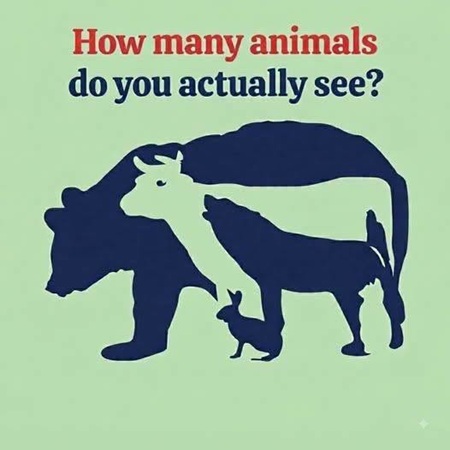
At first glance, the image seems simple enough. A few dark and light animal silhouettes are arranged against a pale background, and the largest shapes are easy to notice almost immediately. The bear on the left and the cow near the center naturally attract the eye because they are larger and more clearly defined than the other figures. That first impression makes the puzzle look easier than it really is. The challenge begins when you stop asking what the obvious animals are and start searching for smaller shapes hidden around, inside, or between them.
The cow in the center works as one of the strongest visual anchors in the image. Its body, legs, head, horns, and tail create a familiar outline that the brain can recognize very quickly. Once that recognition happens, the mind tends to group the surrounding lines together as part of the same figure. This can make smaller animals much easier to overlook. The viewer feels as though the central shape has already been fully understood. In reality, some of its outlines may also contribute to other figures.
The same effect happens with the bear on the left side. Its dark silhouette is large and immediately recognizable, which makes it difficult to look beyond the obvious shape. Once the brain decides that a certain region contains a bear, attention often moves elsewhere. Optical puzzles take advantage of that habit. A line that looks like part of the bear may also form part of another animal. The puzzle becomes harder because the brain has to reinterpret something it has already labeled.
That reinterpretation is one of the most important parts of solving the image. Instead of thinking that every line belongs to only one animal, it helps to treat the illustration as a collection of overlapping shapes. A curve can serve as the back of one animal while also forming the edge of another. A dark area may belong to a large silhouette while creating the outline of something smaller beside it. The same visual information can therefore support more than one recognizable form. That is what makes this type of puzzle so effective.
Negative space is also important. The lighter gaps between dark animals should not automatically be treated as empty background. In many optical illusions, those spaces are deliberately shaped to resemble another creature. A gap between legs might form a small body, while the area between two larger silhouettes could resemble a head or tail. Looking only at the dark regions means ignoring half of the visual information. A useful strategy is to actively search the pale areas as if they were shapes of their own.
One of the easiest ways to solve the puzzle is to examine the image in sections. Start on the left side and study the bear carefully. Trace the outline around the head, back, stomach, and legs instead of simply recognizing the whole figure at once. Then move slowly toward the center and do the same with the cow. After that, inspect the lower part and the right side. Breaking the image into smaller regions prevents the largest animals from dominating your attention.
According to the description accompanying the puzzle, a small mouse can be found near the lower center. Its size makes it much less noticeable than the larger animals. The human eye is naturally drawn toward bigger and higher-contrast objects first, so tiny figures can remain hidden even when they are clearly present. Looking near the lower portion of the image is therefore an important step. The mouse becomes much easier to notice once you stop concentrating on the central cow.
A small cat is also described on the right side beneath the larger silhouettes. Like the mouse, it can be missed because of its placement and scale. People often scan the center of an image before checking the corners or lower edges. This means a smaller animal positioned near the side can escape attention during the first few seconds. Once someone points out the general location, however, the shape often becomes obvious. That sudden change in perception is part of the fun.
The clearly identified animals in the source description include the bear, cow, mouse, and cat. These four figures provide a reliable starting point for the puzzle. There may also be additional overlapping forms depending on the exact original illustration. Without directly confirming the intended solution, it would be misleading to invent a precise total beyond what can actually be seen or verified. The best approach is to distinguish between clearly recognizable animals and shapes that may only resemble animals by coincidence.
This matters because optical illusions can sometimes produce more than one reasonable interpretation. Two people may look at the same curve and disagree about whether it forms a deliberate animal silhouette. One person may see a head while another sees only part of the larger figure. Neither reaction necessarily means one viewer is careless. Ambiguous images can naturally produce different answers. If the original creator provides an official solution, that can help clarify which shapes were intentionally included.
The puzzle also offers a simple example of how visual perception works. The brain does not process every line and shape with equal attention. Instead, it organizes information into familiar objects as quickly as possible. This ability is useful in everyday life because people need to recognize faces, cars, signs, animals, and surroundings without slowly analyzing every detail. Optical illusions deliberately take advantage of that efficiency. They create a situation where the first interpretation is useful but incomplete.
Once the brain identifies a cow, for example, it becomes less likely to search the same region for another creature. The same is true of the bear. That tendency can make hidden shapes surprisingly difficult to notice. The image itself has not concealed them physically. They are simply being filtered out by the way attention is organized. Looking again with a different goal can suddenly make them visible.
This is related to broader ideas studied in perception and attention research. People often fail to notice visible details when their attention is focused strongly on something else. The term inattentional blindness is often used in psychology to describe certain situations where an obvious object goes unnoticed because attention is directed elsewhere. A casual animal puzzle is not the same as a controlled psychological experiment, so it should not be treated as proof of any scientific condition. Still, the general idea helps explain why hidden figures can be missed.
Another useful concept comes from Gestalt psychology. Researchers in that tradition examined how people naturally organize visual elements into complete and meaningful forms. The brain prefers to see whole objects rather than disconnected lines. It also tends to separate a scene into a main figure and a background. In this puzzle, the cow and bear quickly become the main figures, while smaller shapes or pale areas may be treated as background. Solving the puzzle often requires reversing that relationship.
Changing viewing distance can sometimes help. Looking from farther away emphasizes the largest animals, while moving closer may reveal smaller shapes and shared outlines. Some people also find that briefly looking away and then returning helps reset their attention. Another method is to cover part of the image and focus on one region at a time. These techniques do not alter the illustration. They simply prevent the brain from relying too heavily on the first interpretation.
Mental rotation can also be useful with some optical puzzles. A shape that looks meaningless in one orientation may resemble an animal when imagined from another angle. This does not mean every hidden figure requires rotation, but changing perspective can interrupt the initial visual pattern. Even a slight shift in how the image is viewed can reveal something previously missed. The key is to avoid becoming locked into one interpretation.
One of the most satisfying moments in a hidden-animal puzzle happens when a figure suddenly becomes obvious. Before noticing it, a viewer may stare directly at the relevant lines without recognizing anything. After the animal is found, it can become almost impossible not to see it. The image has not changed at all. What changed is the way the brain grouped the visual information. That moment is what makes optical illusions feel surprising.
This also explains why people enjoy comparing answers. One person may immediately notice the mouse but completely miss the cat. Another may find the cat first and struggle with the bear. The same image produces different experiences depending on where attention goes first. Sharing the puzzle with others can therefore create several valid scanning strategies. The enjoyment comes from discovering what another person noticed that you did not.
These differences should not be treated as serious measurements of intelligence. A single visual puzzle cannot reliably determine how smart someone is. The speed at which an animal is noticed can depend on image quality, screen size, contrast, previous experience, and simple chance. Someone who finds six shapes faster than another person is not automatically more intelligent. It simply means their attention happened to organize the image differently at that moment.
The same caution applies to personality claims. Some online puzzles suggest that the first animal a person sees reveals hidden personality traits or emotional characteristics. Those claims are usually entertainment rather than established psychological science. There is no reason to assume that noticing the cow before the bear says something meaningful about a person’s character. The puzzle works perfectly well as a visual challenge without adding unsupported conclusions. Keeping the interpretation modest makes the content more accurate.
Image quality can also affect the result. On a small phone screen, subtle outlines may become difficult to distinguish. Enlarging the picture can help reveal smaller animals, but zooming in too far may remove the overall context needed to recognize larger forms. Moving between a full view and a closer view is often useful. A viewer should therefore consider technical factors before assuming a hidden figure was simply too difficult to notice.
Lighting and screen contrast matter too. Dark silhouettes may blend together if the display is too dim, while pale negative-space shapes may disappear if the contrast is weak. The same puzzle can look slightly different on different devices. This is another reason casual visual challenges should not be treated as formal tests. The viewing conditions themselves can change how easy the image is to interpret.
Another helpful method is to temporarily ignore the animals you have already identified. Once the bear and cow are obvious, stop thinking about them as complete creatures. Look only at the individual lines that make up their edges. Follow each curve and ask whether it connects to a smaller shape. This forces the brain to process the image in a less automatic way. Hidden animals often appear once the familiar labels are removed.
The same method works with the negative spaces. Instead of calling the pale areas “background,” treat them as possible silhouettes. Look at the gaps near the legs, heads, and tails of the larger animals. Some optical illusions are specifically designed so that the background becomes a second figure. The more deliberately you alternate between dark and light areas, the more likely you are to notice layered shapes.
Pattern recognition is extremely powerful, but it can also create false positives. People are very good at seeing familiar objects in ambiguous shapes. This tendency is sometimes described as pareidolia. It is the reason people can see faces in clouds, rocks, or shadows. In an optical puzzle, that ability helps find intended animals, but it can also cause viewers to imagine additional creatures that were never deliberately drawn.
That is why restraint is important. A shape should not automatically be counted as an animal just because part of it vaguely resembles a head or body. Look for a reasonably complete and intentional outline. If the shape requires too much imagination, it may simply be a coincidence. Comparing your observations with an official solution, if one exists, can help separate deliberate figures from accidental patterns.
The order in which you search also influences what you notice. A viewer who begins on the left may discover a different sequence of animals than someone who starts in the center. Once several creatures have been identified, the brain becomes more actively tuned to search for additional animal shapes. This can make later discoveries easier. It can also make overinterpretation more likely, which is why careful checking matters.
The puzzle is most enjoyable when it is approached slowly. Racing against a clock can be entertaining, but it encourages the brain to rely on fast first impressions. Taking more time allows attention to move toward the edges, lower areas, and negative spaces. The challenge rewards patience more than speed. There is no need to treat it as a competition.
If you are sharing the image with friends or family, it can be fun to ask what they see before giving any clues. Avoid revealing the total too quickly. If someone is stuck, a general hint such as “look near the bottom” can preserve the challenge. The moment of discovery is usually more satisfying when the person finds the animal themselves. Comparing the order in which different people notice each figure can be part of the experience.
The larger lesson behind the puzzle is simple. First impressions are useful, but they are not always complete. The bear and cow may be immediately correct interpretations, yet they do not necessarily reveal everything in the image. Looking again allows smaller or less obvious information to emerge. The first answer does not have to be wrong for a second look to be valuable.
This idea can be applied without turning the puzzle into something overly serious. The image is primarily entertainment. It does not need to become a lesson about intelligence, personality, or mental health. Its value comes from showing how quickly attention can settle on one interpretation. A second glance can reveal details that were always present.
The cow remains a cow even after the mouse is discovered. The bear does not disappear when the cat becomes visible. Multiple figures can coexist because the illustration was designed to layer them together. This is what makes overlapping silhouette puzzles different from simple hidden-object games. The same line can contribute to more than one recognizable form. That shared structure is where much of the difficulty comes from.
Scale plays an especially important role. Larger animals dominate attention because they occupy more visual space. Smaller animals require more concentrated searching. The mouse and cat mentioned in the source are good examples of this effect. They are not necessarily hidden behind something; they are simply less visually dominant. Once the viewer deliberately looks for small shapes, they become easier to identify.
Contrast has a similar effect. Dark objects against a pale background attract attention first. Pale shapes created by negative space may be ignored even when their outlines are clear. Switching attention between light and dark areas can therefore reveal different parts of the image. This figure-ground reversal is a classic feature of many optical illusions.
A practical solving routine can make the puzzle easier. First, identify the animals that are immediately obvious. Second, scan the outer edges and lower regions. Third, inspect the negative spaces. Fourth, trace shared outlines. Finally, change viewing distance and look again after a brief pause. This systematic approach reduces the chance of missing an animal simply because attention stayed in one place.
Once you have a total, compare it with the source or official answer if one is available. If your number is lower, look for the figure you missed. If your number is higher, check whether one of your extra shapes is actually intentional. Differences in interpretation are part of the appeal. They show how much perception depends on attention and expectation.
The clearly described bear, cow, mouse, and cat already demonstrate the central visual trick. Two larger animals attract attention first, while two smaller ones require closer inspection. Any additional figures would extend that same principle through overlap, shared boundaries, or negative space. The illustration becomes more complicated only because the brain keeps reorganizing the same information. Nothing new is being added.
That is the heart of the illusion. The picture remains completely static. The viewer’s interpretation changes. A line first belongs only to the cow, then becomes part of something else. A gap that seemed empty suddenly looks like a recognizable creature. This shift from one interpretation to another is what makes hidden-animal puzzles satisfying.
The challenge also shows why online discussions about the “correct” number can become surprisingly lively. Some viewers insist that a certain outline clearly represents an animal, while others cannot see it at all. If the illustration is genuinely ambiguous, both reactions can be understandable. The most responsible way to present the answer is to separate confirmed figures from uncertain interpretations. That avoids turning a fun puzzle into a misleading claim.
There is no need to make the challenge more dramatic than it is. It is not a medical test, an IQ test, or a scientific personality assessment. It is a visual puzzle that rewards careful observation. That is already enough to make it engaging. People enjoy discovering things they initially overlooked.
If the puzzle teaches anything useful, it is the value of checking again before assuming that an initial view is complete. A second look may reveal something important that the first glance missed. In this case, that hidden detail might simply be a tiny mouse or cat. The lesson remains lighthearted, but the habit of careful observation can still be worthwhile.
Ultimately, the best way to enjoy the image is to approach it with curiosity rather than pressure. Start with the obvious animals, then slow down. Look near the edges, beneath the larger silhouettes, and inside the pale spaces. Trace lines carefully and avoid forcing random shapes into animals just to increase your count. If an official solution exists, use it to compare your interpretation after you finish.
Whether you find every intended animal immediately or need several attempts does not say anything definitive about your intelligence or personality. It only reflects how your attention handled the image at that moment. The bear, cow, mouse, and cat may be the first confirmed figures you notice, while other shapes could require a different perspective. The important part is the process of looking again. The picture does not change, but the way you see it can.

