
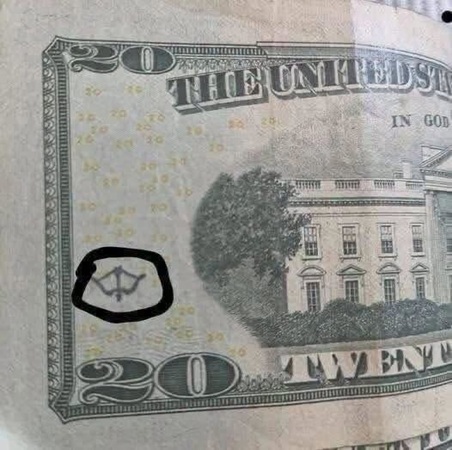
Finding an unfamiliar stamp on a U.S. dollar bill can raise an obvious question: why would someone deliberately mark genuine currency? Small ink symbols, initials, characters, geometric designs, and other markings are sometimes found on U.S. notes that have circulated through currency-exchange networks. Collectors and currency enthusiasts commonly refer to many of these markings as “chop marks.” They are generally private marks rather than official features added by the U.S. government.
In some cases, currency dealers or money changers have used stamps after examining notes they accepted. However, a mark by itself cannot reliably reveal every place a bill has traveled or prove exactly who handled it. The first important distinction is between these private markings and the official features printed on U.S. currency. Genuine Federal Reserve notes contain numerous design and security elements created as part of the official production process.
Depending on the denomination and series, these can include security threads, watermarks, color-shifting ink, microprinting, raised printing, serial numbers, Federal Reserve indicators, and other features. A random ink stamp added after a bill entered circulation is not one of those official security elements. Therefore, people should not assume that an unfamiliar symbol was secretly placed there by the U.S. Treasury, Federal Reserve, or Bureau of Engraving and Printing. The term “chop” has a much longer history than modern U.S. paper money.
Historically, chop marks are especially well known to numismatists through marks applied by merchants and money handlers to silver coins circulating in international trade, particularly in parts of Asia. Foreign silver coins moved through commercial networks where recipients wanted reassurance about the metal they were accepting. Merchants sometimes punched or stamped their own marks into coins they considered acceptable. Over time, a single coin could accumulate numerous marks as it passed between different handlers. These historical coin chops are well documented, although they should not be treated as identical in every respect to modern ink stamps found on paper currency.
The underlying idea is relatively easy to understand. Before accepting valuable currency, a merchant or exchange operator may inspect it. If that person regularly handles large quantities of cash, a private mark can indicate that a particular note or coin has already passed through that person’s process. With modern paper money, some currency dealers and exchange businesses have similarly used small stamps or markings. Such practices are not universal, standardized, or required by the U.S. government. Different businesses can use different procedures, and many never mark currency at all. This is why two stamped bills may have completely unrelated histories despite both being described informally as having chop marks.
U.S. dollars circulate internationally on a substantial scale, which helps explain why American notes can acquire markings outside the United States. Dollars are held abroad for a variety of reasons, including commerce, travel, savings, and financial transactions. In some economies, U.S. banknotes may circulate alongside local currency or be used for particular types of transactions. Cash can therefore move between banks, exchange businesses, merchants, travelers, companies, and individuals before eventually returning to the United States. A note found in an American wallet today could theoretically have spent time abroad, although a stamp alone usually cannot prove its entire history.
Counterfeit detection is one reason businesses handling cash carefully inspect banknotes. Modern U.S. notes include security features specifically intended to make counterfeiting more difficult and to help people authenticate currency. Professional handlers may examine printing characteristics, paper, security threads, watermarks, color-shifting features, or other elements appropriate to the denomination and series. Equipment may also be used in some settings. A private stamp applied after inspection can represent a particular handler’s internal practice, but the stamp itself is not an official authentication certificate. Someone receiving the note later should still evaluate the currency normally rather than assuming that a previous person’s mark guarantees authenticity.
That qualification is important because descriptions of chop marks sometimes exaggerate what they can tell us. A stamp does not automatically establish that a banknote is genuine. Anyone with access to ink and a stamp could theoretically place a symbol on paper. Likewise, counterfeit currency could conceivably carry markings that resemble those found on genuine notes. Official security features and appropriate authentication procedures remain more meaningful than an unexplained private symbol. A chop mark can provide an interesting clue about a note’s possible circulation history, but it should not replace actual examination of the bill.
It is also difficult to identify the precise origin of many marks. Some may consist of initials, letters, numbers, characters, logos, stars, arrows, circles, or simple geometric designs. Without reliable documentation connecting a particular design to a known business or currency handler, assigning it to a specific country or city would be speculation. Similar-looking stamps can be independently used by unrelated people. Even a distinctive symbol such as a bow-and-arrow-like design does not automatically reveal where the bill traveled. The responsible approach is to describe what is visible while separating confirmed information from an attractive but unverified story.
This is particularly relevant when images of unusual bills circulate online. A photograph may show a $20, $50, or $100 note carrying a small symbol, followed by a confident explanation claiming that the mark came from a particular money changer in a particular foreign market. Unless evidence supports that attribution, the explanation should be treated cautiously. The mark may indeed have been added during international circulation, but its precise origin might remain unknown. An interesting mystery does not need an invented solution. Sometimes the most accurate answer is simply that the stamp is privately applied and its specific history cannot be reconstructed from the mark alone.
Not every mark on a banknote is necessarily a chop mark either. Currency can acquire writing, teller stamps, counting marks, accidental ink, business stamps, personal notes, or other alterations during circulation. A symbol’s appearance alone does not establish its purpose. Collectors may use “chop mark” as a convenient description for certain small stamps believed to be associated with currency handling, but individual examples still require context. A note can pass through countless hands during its usable life, giving it many opportunities to acquire markings unrelated to international exchange.
The historical connection with silver coins remains one of the most interesting parts of the subject. During periods when foreign silver coins circulated widely in Asian trade, merchants sometimes tested coins and added identifying punches or stamps. These marks could provide evidence that the piece had been examined or accepted by a particular handler. Repeated circulation sometimes left coins covered with numerous chops. Today, such coins form a specialized area of numismatic collecting because their markings can reflect patterns of historical trade. The practice illustrates how trust could be established through local commercial networks long before modern electronic payment systems.
Paper banknotes are different physical objects, so their markings are normally applied with ink rather than punched deeply into metal. Nevertheless, the broad concept of a private handler leaving a recognizable mark has similarities. A money changer who regularly processes currency may want a quick indication that a note has previously been examined. Other handlers familiar with a particular mark may recognize it, although there is no universal international system governing such stamps. The usefulness of any mark therefore depends on the practices and relationships of the people using it. Outside that context, the symbol may tell a later owner very little.
This also means that describing chop marks as a worldwide tracking system would be inaccurate. A privately stamped bill does not function like a digitally tracked transaction. There is generally no central database recording every chop, owner, exchange, or country through which the note has traveled. If several identifiable stamps appear on one bill, they may offer clues about previous handling, but they do not necessarily provide a complete route. Cash is valuable partly because ordinary transactions can occur without creating the detailed movement records associated with many electronic payments. A small ink stamp does not fundamentally change that characteristic.
The legal status of marked U.S. currency also deserves careful explanation. It is incorrect to say simply that any marking of money is either always legal or always illegal. U.S. federal law contains provisions dealing with mutilation and alteration of currency, and legality can depend on the nature and intent of the conduct. Separately, federal law addresses advertisements placed on government obligations. A small mark does not automatically cause a genuine note to lose all value, but that does not create a blanket legal exception authorizing every imaginable modification. Anyone needing legal guidance about a specific practice should rely on the relevant law and official authorities rather than a generalized internet claim.
For ordinary consumers, the more practical question is often whether a marked bill can still be spent or deposited. A genuine note with a small stamp, pen mark, or other minor alteration may continue circulating if enough of the note remains intact and its authenticity and denomination can be established. However, individual businesses, financial institutions, or automated machines may hesitate to accept notes that are heavily damaged, suspicious, or difficult to authenticate. A private mark does not magically invalidate genuine currency, but neither does it guarantee that every cashier or machine will accept the note without question.
Heavily damaged currency is a separate issue from ordinary chop marks. The U.S. Bureau of Engraving and Printing has procedures dealing with mutilated currency when notes are so badly damaged that their value cannot be handled through ordinary channels. Examples can involve fire, water, chemicals, decomposition, or other severe physical damage. A small ink symbol on an otherwise intact bill is obviously a very different situation. Confusing these categories can make explanations about marked currency unnecessarily alarming. The physical condition of the note matters far more than the mere existence of one tiny stamp.
For collectors, chop-marked paper money occupies an interesting position. Some collectors prefer clean notes without writing, stamps, folds, or other circulation marks because condition strongly influences numismatic value. Others may find unusual stamps interesting because they suggest a less ordinary circulation history. Whether a particular marked note has additional collectible value depends on many factors, including rarity, denomination, series, condition, provenance, and whether the mark itself can be meaningfully identified. A mysterious symbol does not automatically make an ordinary bill rare or valuable.
The bow-and-arrow-style mark sometimes discussed online provides a good example of why caution is necessary. A viewer may encounter a photograph of such a symbol on a U.S. bill and assume that every identical-looking mark has one documented origin. Without reliable supporting evidence, that conclusion goes too far. It may be a private currency-handling stamp, and it may have been applied outside the United States, but a symbol alone does not establish the exact person, company, or country responsible. Responsible descriptions should acknowledge that uncertainty instead of transforming a plausible explanation into a confirmed fact.
What can be said confidently is that U.S. banknotes have extensive international circulation. The dollar has a major role in global finance, and substantial quantities of physical U.S. currency are held outside the country. Higher-denomination notes can be particularly useful for storing or transferring value in cash because fewer physical notes are needed for a given amount. That international demand creates environments in which careful authentication is important. Businesses handling foreign currency have strong financial reasons to avoid accepting counterfeits, regardless of whether they use private stamps as part of their procedures.
Trust is fundamental to physical currency. When someone accepts a banknote, that person needs confidence that others will recognize its value later. Official security features help support that confidence by giving the public and professional handlers ways to examine notes. Formal banking systems add another layer through institutional processes and equipment. In some commercial networks, private practices may develop alongside those official systems. Chop marks can be understood within that broader context, but they should never be confused with official U.S. authentication features.
The official features of modern U.S. currency are far more important when deciding whether a note is genuine. Depending on the denomination and design series, people can look for characteristics such as watermarks, embedded security threads, color-shifting ink, fine-line printing, and microprinting. The Federal Reserve and U.S. Currency Education Program provide information explaining security features for different denominations. Because note designs have changed over time, the correct features depend on the series being examined. A private stamp cannot substitute for that information.
A marked bill can nevertheless encourage curiosity about how physical money moves. Unlike a digital payment that can travel electronically in moments, a banknote has to move physically from one holder to another. It may be withdrawn from a bank, used by a traveler, exchanged by a currency dealer, accepted by a merchant, deposited again, and eventually recirculated somewhere else. Over time, the paper can acquire folds, wear, writing, stamps, and other physical evidence of handling. Most of that history remains impossible to reconstruct, but the visible marks remind us that cash is a physical object with a circulation life.
That does not mean every marked note has completed a dramatic journey around the world. A bill could receive a private stamp and remain within a relatively limited area afterward. Another could cross international borders multiple times without ever receiving a mark. Because there is no universal chop-mark requirement, the presence or absence of a stamp cannot reliably measure how far a bill has traveled. The idea of a “passport for money” can be a useful metaphor, but it should not be mistaken for literal documentation of every destination.
The global popularity of U.S. currency also has several explanations beyond simple familiarity. The dollar plays a central role in international finance, trade, reserves, and financial markets. Physical dollars may also be held as savings or used in transactions in some places outside the United States. The specific role differs considerably from one country to another and can change over time. It would therefore be misleading to claim that all countries or foreign merchants treat U.S. cash in the same manner. International currency use is diverse, and chop marks represent only one small practice within that much larger system.
Counterfeiting concerns likewise vary between locations and institutions. Professional currency handlers can use different technologies and procedures to authenticate notes. Some rely on trained visual examination, while others use machines or specialized tools. Security practices also evolve as banknote designs and counterfeit techniques change. A private stamp is therefore best understood as evidence of one possible handling practice rather than a universal defense against counterfeit currency. The strongest authentication depends on examining the note itself and its official security characteristics.
For someone who unexpectedly receives a marked U.S. bill, there is usually no reason to invent a dramatic explanation. First examine whether the note appears genuine using the appropriate official security features. If there is uncertainty, a financial institution can provide assistance rather than relying on social-media speculation. If the bill is genuine and the mark is small, the stamp may simply be part of its circulation history. Identifying the exact origin may be possible in some cases, especially when a mark is well documented, but many examples will remain anonymous.
The mystery can actually make these notes more interesting. A small symbol may indicate that somebody, somewhere, considered the bill important enough to inspect and mark. The identity of that person may never be known. Perhaps the note passed through a currency exchange business, merchant, or other cash-handling operation. Perhaps the mark has a completely different explanation. Without documentation, the possibilities should remain possibilities rather than being rewritten as facts.
This distinction between evidence and speculation is particularly important when discussing money because inaccurate claims can spread quickly. A photograph of an unusual symbol can generate stories about secret government markings, criminal organizations, hidden messages, or guaranteed collectible value. None of those explanations should be accepted simply because they sound intriguing. Most small stamps have far more ordinary explanations. A private handling mark is considerably more plausible than an elaborate hidden code, but even that attribution should be made carefully when the specific symbol has not been documented.
Chop marks also demonstrate how official and informal systems can coexist around currency. The U.S. government designs and issues notes with standardized security features. Banks and financial institutions use formal procedures for processing cash. At the same time, individual businesses and currency handlers can develop their own habits for managing the notes they encounter. A stamp applied privately belongs to this informal layer rather than the official design of the dollar. Understanding that distinction resolves much of the mystery surrounding unusual symbols.
Historically, merchants have always needed methods for deciding whether the money offered to them could be trusted. The tools have changed dramatically over centuries, moving from weighing and testing metal coins to examining sophisticated security features on modern banknotes. Chop marks are one visible reminder of those older traditions of verification and acceptance. Their presence on some modern notes does not mean today’s banking system operates like historical silver markets. It simply shows that private practices can persist alongside newer technologies.
A stamped U.S. bill therefore sits at the intersection of several interesting subjects: numismatics, international commerce, currency security, and the physical circulation of money. Its mark may be tiny, but understanding it requires separating historical traditions from modern practices and confirmed facts from assumptions. Some marks can potentially be identified. Others cannot. Some may have been applied abroad by currency handlers, while others may have entirely different origins. There is no single explanation that can responsibly cover every stamped note.
The next time a strange symbol appears on a dollar bill, it is worth looking carefully before deciding what it means. Check whether it is part of the official printed design or something added afterward. Examine the denomination’s legitimate security features if authenticity is a concern. If the mark resembles a private stamp, remember that it may reflect previous handling but does not provide a complete travel record. A distinctive bow, arrow, star, letter, or geometric symbol can be interesting without having a sensational explanation.
Ultimately, so-called chop marks provide a small glimpse into the complicated life of physical currency. They remind us that U.S. banknotes do not necessarily remain near the place where they were first issued or received. Cash can pass through countless hands, businesses, institutions, and sometimes countries before appearing in another wallet. A private stamp may preserve one tiny trace of that movement, although much of the note’s history will remain unknowable. That uncertainty is part of what makes marked currency fascinating.
A dollar bill carrying an unfamiliar stamp is still first and foremost a piece of currency whose authenticity should be judged through legitimate security features rather than an unexplained symbol. But the mark can also invite a broader appreciation of how money circulates and how people establish trust when exchanging it. From historical merchant chops on silver coins to modern private stamps on paper notes, the underlying human concern is recognizable: people want confidence in what they accept as money. The small marks found on some U.S. bills are one intriguing reminder of that long history, even when the exact story behind an individual stamp remains unknown.

