
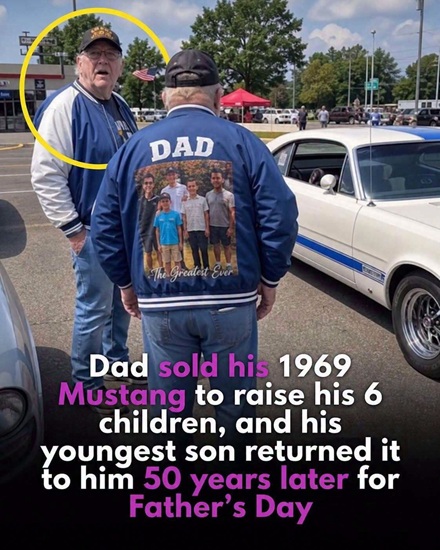
For Daniel Allen, the memory of a white 1969 Ford Mustang Mach 1 remained connected to an important chapter of his younger years. According to a published account of the family’s story, Daniel bought the Mustang new after returning home from multiple tours in Vietnam. The car had a four-speed manual transmission and became part of the period when he was building a life with his future wife, Diana. They spent time together in the Mustang during their dating years, giving the vehicle a significance that went far beyond transportation.
As decades passed, Daniel continued to remember the car and the experiences associated with it. Many years later, his youngest son, Shane Allen, found a remarkable way to bring some of those memories back. Daniel’s original Mustang was closely tied to the beginning of his relationship with Diana. One especially meaningful memory involved a ferry trip during which Daniel proposed to her.
The couple later married and eventually became parents to six sons. As their family grew, however, the realities of everyday transportation changed considerably. A two-door performance car that had suited an earlier stage of Daniel’s life was no longer the most practical choice for a large household. Eventually, he parted with the Mustang and moved on to transportation that better fit his family’s needs. Although the car was gone, Daniel never completely forgot what it had represented.
It is important to describe that part of the story carefully. Some versions circulating online may suggest that Daniel sold the Mustang specifically because he needed money for food, rent, or school clothing. The more detailed published account instead explains that his expanding family needed a vehicle that was more practical than the two-door Mach 1. That decision still involved giving up something Daniel valued, but there is no need to add financial circumstances that have not been clearly established. The documented version already explains why the Mustang became such a meaningful part of the family’s history. Daniel chose practicality as his responsibilities and family life changed.
Years later, Shane grew up hearing his father talk about the Mustang. Classic automobiles eventually became an interest that father and son could enjoy together. In 2018, they began attending Father’s Day car shows, turning the outings into a tradition. Shane owned a 1964 Ford Galaxie, and their conversations naturally included memories of vehicles from earlier decades. Daniel’s white 1969 Mach 1 remained particularly memorable because it was connected with his relationship with Diana and the beginning of their life together. Shane listened to those stories and understood that the car represented a period his father still remembered warmly.
For Shane, finding another Mach 1 eventually became more than a casual idea. He knew that locating Daniel’s exact former car would be extremely difficult and was not necessary to create a meaningful surprise. What mattered was finding a Mustang that closely resembled the one his father remembered. Eventually, Shane discovered a white 1969 Mustang Mach 1 that was remarkably similar to Daniel’s former vehicle. It was not reported to be the exact original Mustang Daniel had owned decades earlier, an important distinction when telling the story accurately. Instead, it offered Shane the opportunity to recreate something familiar for his father.
The discovery presented another challenge because acquiring a classic Mustang required a significant commitment. Shane owned a restored Mustang of his own, but he ultimately decided to trade his custom Mustang GT as part of making the gift possible. That decision added another layer of meaning to the story. Daniel had once parted with his Mustang when his family’s practical needs changed, and decades later Shane was willing to give up a Mustang he valued so his father could have a Mach 1 again. The circumstances were different, but the parallel was difficult to miss. Shane was determined to keep everything secret until the right moment.
Finding the car was only part of his plan. Shane wanted the Mach 1 to resemble Daniel’s remembered vehicle as closely as reasonably possible. He had work performed on the car, including reupholstering the seats, and he changed details of its appearance. The hood was painted black to make the Mustang more closely resemble his father’s original car. Shane was working toward a specific deadline because he wanted the surprise ready for Father’s Day. Each adjustment was intended to make the vehicle instantly familiar when Daniel finally encountered it. The goal was not to pretend it was the original car but to recreate the experience and appearance Daniel remembered.
The setting for the reveal also carried personal significance. Father and son had developed a tradition of attending car shows together around Father’s Day, so Shane arranged for the Mach 1 to appear at one of those events. Daniel arrived expecting to spend time looking at classic automobiles, just as they had done before. He did not know that one of the cars waiting there had been purchased specifically for him. Surrounded by vintage vehicles and other enthusiasts, Daniel approached the white Mustang without initially understanding why it was there. Shane had managed to keep the surprise intact.
A small detail inside the Mustang offered Daniel his first clue. Shane had placed his father’s name in the vehicle, hanging it from the rearview mirror. Even then, Daniel reportedly did not immediately understand what was happening. He initially regarded the detail as a coincidence while examining a car that already looked remarkably familiar. From his perspective, he was looking at another classic Mach 1 displayed at the event. Shane, however, knew that the moment his father realized the truth was approaching. The car Daniel was admiring was not simply another participant’s Mustang.
The meaning of the surprise became clear when Shane handed Daniel the keys. Suddenly, the familiar-looking Mach 1 was no longer something his father could only admire from the outside. Daniel was able to climb into the driver’s seat and experience a vehicle closely resembling the Mustang associated with his younger years. He started the engine, and a Father’s Day visit to a car show became a deeply personal family moment. Shane had spent considerable effort arranging something his father had not expected. Decades after Daniel had parted with his own Mach 1, he once again had a white 1969 Mustang of the same celebrated model.
Daniel’s reaction became even more emotional after he learned what Shane had done to obtain it. Shane explained that he had traded his own restored Mustang to help make the gift possible. According to Shane’s account of the moment, Daniel became emotional and embraced his son. For Daniel, the gesture was about far more than receiving a valuable classic car. His son had remembered stories that had been shared over many years and understood why one particular automobile still mattered. Shane had then been willing to give up something of his own to create an experience centered entirely on his father.
The Mustang also carried memories involving Diana, making the surprise relevant to more than Daniel’s interest in classic cars. The original Mach 1 had been present during the couple’s dating years and was connected to the ferry trip associated with Daniel’s proposal. By the time this Father’s Day surprise was reported, Daniel and Diana had spent more than half a century together. Seeing another white 1969 Mach 1 therefore connected the present with a period near the beginning of their relationship. No replacement vehicle could literally restore those earlier years, but familiar details could bring long-held memories closer again.
That distinction is part of what makes the story meaningful without requiring exaggeration. Shane did not need to locate the exact original Mustang to give his father something significant. The replacement was valuable because of what it represented rather than because of a direct ownership connection to the past. Its year, model, color, styling, and carefully adjusted details reminded Daniel of the automobile he once drove. The experiences associated with the original Mustang remained part of his personal history. Shane simply found a thoughtful way to give those memories a physical connection in the present.
Stories involving classic cars often have this emotional dimension. A vehicle can become associated with a first job, a relationship, a family milestone, a memorable journey, or another significant period of someone’s life. Years later, seeing the same model can bring back details that have little to do with the mechanical specifications of the car itself. Daniel’s attachment to the Mach 1 was connected with experiences involving his future wife and the life they were beginning together. That context explains why Shane’s Father’s Day gift carried a significance that cannot be measured only by the Mustang’s monetary value.
The story also provides an example of why factual details should remain separate from assumptions when personal accounts are shared online. It would be easy to make the narrative more dramatic by claiming that Shane spent years tracking the exact original car until he finally recovered it. Available reporting does not establish that. The vehicle Shane purchased was described as a nearly identical white 1969 Mach 1 rather than Daniel’s original Mustang. Similarly, there is no need to add unsupported claims about exactly how financially difficult Daniel’s circumstances were when he gave up his car. The verified elements already provide a compelling family story.
Daniel’s decision decades earlier reflected a transition that many families experience in different ways. A vehicle that works well for one stage of life may become impractical as circumstances change. When Daniel and Diana’s household grew, a two-door performance Mustang no longer provided the space they needed. Giving it up meant leaving behind a car associated with meaningful memories, but those memories were not lost when the vehicle disappeared. They survived through stories Daniel later shared with his children. Shane eventually transformed those stories into inspiration for one of the most memorable gifts he could have arranged.
There is also a notable symmetry between the choices made by Daniel and Shane. Daniel parted with a Mustang when the responsibilities of raising a growing family made another type of vehicle more practical. Many years later, Shane traded a Mustang of his own so that Daniel could have a Mach 1 resembling the one he remembered. The reasons were not identical, and the two situations should not be treated as exact equivalents. Even so, both decisions involved being willing to let go of a valued automobile because another priority mattered more. That connection added emotional depth to the exchange of the keys.
For Shane, the surprise was also a way to recognize the experiences his father had shared with him over the years. Children often learn about their parents’ younger lives through photographs, stories, keepsakes, and familiar objects. In Shane’s case, the Mustang had become one of those recurring pieces of family history. He knew what model his father had owned, understood its appearance, and knew why Daniel remembered it. Instead of allowing those stories to remain only conversations about the past, Shane created an opportunity for his father to experience something closely connected to them again.
The car show made the reveal especially appropriate because classic automobiles had already become something father and son enjoyed together. The location was not simply chosen to provide a dramatic background. It connected the gift with an activity that Daniel and Shane had been sharing for years. Daniel could arrive expecting an ordinary Father’s Day outing and encounter the Mustang naturally among other vehicles. That familiarity helped preserve the surprise until Shane was ready to reveal the truth. The result was a personal moment created within an existing father-and-son tradition.
The details Shane changed on the car demonstrate how carefully he approached the project. Reupholstering the seats and adjusting the appearance of the hood were intended to make the Mach 1 resemble Daniel’s memories more closely. These were not attempts to falsely present the car as Daniel’s original vehicle. They were part of recreating the look and feeling of something that had disappeared from his life decades earlier. The distinction matters because the emotional significance comes from the resemblance and effort involved. Shane knew he could not literally bring back the past, but he could recreate one recognizable part of it.
When Daniel finally sat behind the wheel, the experience connected several different periods of his life. There was the younger Daniel who had purchased a new Mustang after returning from Vietnam. There were the years when he and Diana were dating and beginning their future together. There was the father whose growing household eventually required more practical transportation. And finally there was the older Daniel sitting in another 1969 Mach 1 while his youngest son revealed what he had done. A single type of automobile had unexpectedly connected all of those stages.
For the family, the gift created a new memory rather than simply reproducing an old one. The replacement Mustang could never become the exact car Daniel had driven decades earlier, and it did not need to. From that Father’s Day forward, it carried its own story involving Shane’s planning, his decision to trade his Mustang, and Daniel’s reaction when he received the keys. The vehicle therefore represented both past and present. It reminded Daniel of his younger years while simultaneously becoming evidence of the relationship he had built with his son.
The story is ultimately less about owning a rare automobile than about remembering what matters to another person. Shane paid attention to something his father had talked about for years and understood the memories behind it. When an opportunity appeared, he invested considerable effort in turning that knowledge into a meaningful surprise. Daniel’s reaction reflected the significance of that effort as much as the car itself. A Mustang was the object at the center of the story, but family history and gratitude were what gave the moment its emotional weight.
There is no need to present the event as something it was not. The original 1969 Mustang did not literally return after being missing for decades, according to the published account. Instead, Shane found another white Mach 1 that closely matched it and carefully prepared that vehicle for his father. Daniel had not forgotten the original, and Shane had not forgotten hearing about it. That combination of memory and effort allowed a car from another era to become part of their family story once again.
In the end, Daniel received more than a set of keys on Father’s Day. He received a tangible reminder of a period that included his early relationship with Diana, a car he had once loved, and choices made as his family grew. Shane, meanwhile, was able to express his appreciation through something uniquely meaningful to his father. By finding a closely matching 1969 Mustang Mach 1, preparing it to resemble Daniel’s former car, and sacrificing a Mustang of his own to make the purchase possible, he created a surprise built around genuine family memories.
The white Mach 1 standing at that car show was not a machine capable of turning back time. It could not reproduce Daniel’s youth or replace the exact automobile he once owned. What it could do was reconnect him with memories that had remained important for decades while creating an entirely new memory with his son. That is what gives the story its lasting appeal. A car Daniel once had to leave behind remained part of the family’s history, and many years later, Shane found a thoughtful way to place a familiar Mustang back in his father’s hands.

