
Rebecca had spent months putting money aside for a gift she hoped her grandmother Rose would remember for the rest of her life. Rose was 86 and had spent decades caring for family, working, and postponing many of her own wishes. One dream had always remained near the top of her list: seeing the ocean in person. Rebecca decided that instead of buying another ordinary present, she would take her grandmother to Florida and finally let her experience something she had talked about for years.
When Rose opened the envelope containing the tickets, she became emotional and immediately understood how much thought had gone into the surprise. For Rose, the trip represented far more than a vacation. She had seen beaches in photographs and on television, but she had never stood beside the water herself. She wanted to hear the waves, feel the breeze, and see the horizon without a screen separating her from it. Rebecca knew that traveling at Rose’s age required extra planning, so she made sure everything was prepared carefully.
Medication, identification, comfortable clothing, and enough time at the airport were all part of the plan. The first real problem appeared when they checked their boarding passes and realized their seats were not together. Rebecca had hoped to remain beside her grandmother throughout the flight because Rose sometimes needed help moving around. Arthritis made sudden twisting and awkward positions uncomfortable for her. With the aircraft nearly full, however, there were very few options for changing seats. Rebecca therefore escorted Rose to her assigned row before heading several rows back to her own seat.
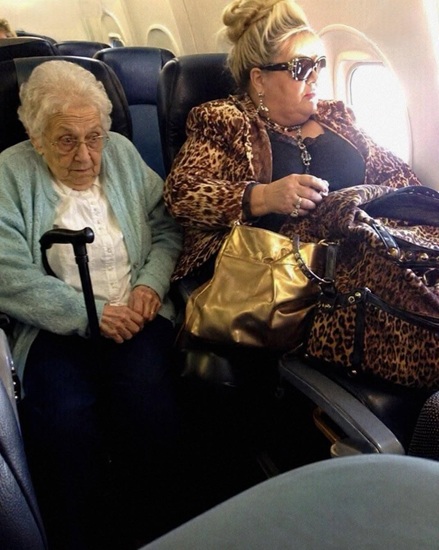
When they reached the row, Rebecca noticed that another passenger was occupying more than her assigned space. The woman, named Tiffany in this fictional story, had lifted the armrest and was sitting partly across the boundary between the seats. Rose was physically small, but that did not mean she could comfortably squeeze into whatever space remained. Rebecca politely asked Tiffany if she could move enough for Rose to sit properly.
Tiffany reacted defensively. She said she had paid for her seat and did not think she should have to change anything. Rebecca calmly explained that nobody was asking her to give up her seat. She only wanted her grandmother to be able to sit in the place assigned to her without being forced sideways for the entire flight.
A flight attendant named Cheryl noticed the disagreement and came over to assist. She looked around for another available seat, but the plane was close to full. There was no simple solution. Cheryl reminded the passengers that everyone should remain within their assigned space as much as possible and encouraged them to cooperate.
Instead of allowing the issue to end there, Tiffany became even more irritated. She made a dismissive comment about Rose’s age and suggested that someone so old should perhaps not be traveling. Rebecca immediately felt her patience disappear. The entire trip had been planned because Rose had spent most of her life delaying her own dreams, and hearing a stranger imply that she no longer had the right to enjoy new experiences felt cruel.
Rebecca was ready to respond, but Rose quietly reached for her hand. She told her granddaughter that they had waited too long for this vacation to let one rude person ruin it. Rose had lived enough life to understand that some arguments were not worth the emotional cost.
Rebecca reluctantly returned to her own seat. She remained concerned as the cabin doors closed and the plane pushed away from the gate. Rose adjusted herself as comfortably as she could. The passenger sitting on the aisle tried to create a little extra room, but there was nowhere else for him to go.
Once the plane began moving toward the runway, Rose focused on the excitement of flying. Even the uncomfortable seating arrangement could not completely erase her anticipation. She looked through the window and smiled as the aircraft accelerated and lifted into the air.
Several rows behind, Rebecca continued glancing forward. She knew Rose had a habit of tolerating discomfort rather than creating a scene. That made Rebecca worry even more because her grandmother might remain silent even if the position became painful.
After the aircraft reached cruising altitude and the seatbelt sign was switched off, passengers began moving around. Some opened laptops, others reached for bags, and a few stood to use the restroom. Tiffany remained focused on her phone and seemed determined to ignore Rose.
Then Rose noticed something unusual.
At first, she hesitated to say anything. Their earlier interaction had been unpleasant, and she did not want another confrontation. Still, Rose believed that allowing someone to walk through the cabin without realizing they had a clothing problem would be needlessly embarrassing.
She leaned slightly toward Tiffany and politely tried to get her attention.
Tiffany ignored her.
Rose waited a few seconds and tried again. She quietly explained that Tiffany might want to check something before standing up.
The response was immediate irritation. Tiffany told Rose to stop bothering her and returned her attention to her phone.
The aisle passenger noticed what was happening. Rose did not appear angry or sarcastic. She looked genuinely concerned.
He suggested that Tiffany might want to listen.
Tiffany dismissed him as well.
By then, a few nearby passengers had noticed the exchange. Rose clearly wanted to keep the matter private, but Tiffany’s increasingly loud responses were drawing more attention than Rose ever intended.
Rose tried one final time. She quietly explained that part of Tiffany’s clothing had become caught awkwardly and that she should probably adjust it before walking around the cabin.
Tiffany finally checked.
Her expression changed instantly.
She realized Rose had been trying to help her.
Part of her clothing had shifted without her noticing, creating an embarrassing situation that could have become much more obvious if she had walked down the aisle.
For several seconds, Tiffany looked stunned.
Then she carefully stood, corrected the problem as best she could, and made her way toward the restroom.
A few people reacted to the awkward moment, but Rose did not laugh.
That detail mattered.
Rose had every reason to feel hurt by Tiffany’s earlier comments. She had been insulted and treated as though her age made her less important.
Yet she still tried to protect Tiffany from embarrassment.
When Tiffany returned, she sat differently and remained within her own space.
The cabin became noticeably quieter.
There was no dramatic argument and no public confrontation.
Rose simply returned her attention to the flight.
Later, when Rebecca came forward to check on her grandmother, Rose assured her that everything was fine.
Only after some time did Rebecca learn what had happened.
She was surprised that Rose had made such an effort to help someone who had been rude to her.
Rose’s explanation was simple.
Another person behaving badly did not require her to do the same.
That idea became more memorable than the awkward moment itself.
The situation also highlighted why air travel often requires extra patience. Commercial aircraft place strangers in close quarters for hours at a time. Passengers have different body types, ages, health conditions, mobility needs, and comfort requirements.
Seat disagreements can therefore become tense very quickly.
The best response is usually to involve cabin crew instead of escalating the situation.
Flight attendants can explain policies, look for alternatives, and help passengers find the safest possible solution.
Passengers can also make a major difference simply by speaking respectfully.
Someone who needs extra time to sit down should not be mocked.
Someone with limited mobility should not be treated as an inconvenience.
An older traveler has exactly the same right to dignity and courtesy as anyone else.
Age does not erase awareness.
It does not erase intelligence.
It does not erase a person’s right to enjoy new experiences.
In Rose’s case, age had given her decades of practice handling difficult people.
Tiffany had interpreted quietness as weakness.
Rose’s behavior showed the opposite.
She had enough confidence not to fight every battle.
She also had enough compassion to warn someone who had just insulted her.
That did not make Tiffany’s behavior acceptable.
Rose simply refused to allow someone else’s rudeness to dictate her own values.
When the flight finally landed in Florida, Rebecca helped Rose collect her belongings and leave the aircraft.
Both women were ready to move on.
They had not traveled all that way to spend the vacation discussing an unpleasant passenger.
Their real destination was waiting.
Later, after reaching the coast, Rose finally saw the ocean.
For several seconds, she simply stood still.
The sound of the waves was louder than she expected.
The horizon seemed impossibly wide.
The breeze carried the smell of salt water, and the sand shifted beneath her shoes.
Rebecca watched her grandmother take in the scene.
The months of saving suddenly felt worth every sacrifice.
Rose eventually walked close enough for the water to reach her feet.
When the first small wave touched her, she laughed.
That was the memory Rebecca had hoped to create.
The uncomfortable flight suddenly felt much smaller.
The rude comments no longer mattered.
Rose was standing beside the ocean for the first time at 86.
The fictional story also offers a broader reminder about assumptions people make based on age.
Society sometimes treats older adults as though they are automatically helpless, unaware, or unable to make meaningful choices.
Real life is far more complex.
An older person may need help walking while still possessing excellent judgment.
A younger person may be physically independent while still lacking patience and perspective.
Wisdom does not belong to a particular age group.
It develops through experience and through the ability to reflect on mistakes.
The same lesson applies to public behavior.
Embarrassment should not become entertainment.
If another passenger experiences an accidental clothing problem or another private mishap, recording or mocking the person only makes the situation worse.
Rose did the opposite.
She tried to solve the problem quietly.
The fact that Tiffany had been rude did not make humiliation an appropriate response.
That distinction separates accountability from revenge.
Tiffany deserved to be reminded to respect another passenger’s seat.
She did not deserve to have an embarrassing mistake turned into public entertainment.
Rose understood both ideas at once.
Her response therefore showed more maturity than any dramatic comeback could have achieved.
She did not need to defeat Tiffany.
She only needed to remain herself.
By the end of the trip, Rebecca and Rose had two very different stories to remember.
One involved an uncomfortable encounter on an airplane.
The other involved an 86-year-old woman standing beside the ocean for the first time.
The second story mattered far more.
That may be the most important lesson in the entire fictional account.
People cannot always control who sits beside them.
They cannot control every rude comment.
They cannot control how strangers choose to behave.
They can control how much emotional power those moments receive.
Rose refused to give one unpleasant interaction more importance than a dream she had waited decades to experience.
She also refused to let someone else’s arrogance change the kind of person she wanted to be.
Respect remained valuable even when it was not returned.
Kindness remained meaningful even when the recipient had not earned affection.
And dignity remained important regardless of whether someone was young, middle-aged, or elderly.
The airplane incident eventually became a small part of a much larger memory.
Rose had finally made it to Florida.
She had finally seen the water she had imagined for decades.
She had finally stood at the edge of the ocean and watched wave after wave arrive on the shore.
That experience could not be taken away by a rude stranger.
Rebecca had hoped the vacation would become a celebration of her grandmother’s life.
In the end, it became exactly that.
The flight had simply added another lesson along the way.
Age does not make a person invisible.
Courtesy is usually more powerful than arrogance.
And sometimes the person who is underestimated most is the one demonstrating the greatest strength in the room.

