
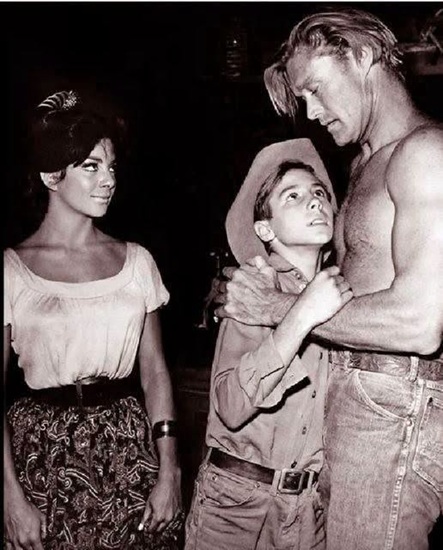
More than six decades after The Rifleman first reached television screens, the series remains one of the most recognizable Westerns of its era. Chuck Connors’ portrayal of rancher Lucas McCain, Johnny Crawford’s performance as his son Mark and the distinctive rapid-fire rifle created images that generations of viewers remember. Yet revisiting the program today also reveals something interesting: the fictional world of North Fork was never as historically perfect as it appeared.
That should not necessarily be considered a criticism. The Rifleman was a weekly television drama rather than a documentary about life in the 1880s. Producers needed entertaining stories, recognizable characters and visually exciting action while working under television schedules and budgets. Historical accuracy mattered, but it frequently had to compete with the practical demands of making a successful series.
The program premiered on ABC on September 30, 1958. It eventually ran for five seasons and produced 168 episodes before concluding in 1963. Its stories were centered around North Fork, a fictional community in New Mexico Territory, with the action generally taking place during the 1880s.
Television audiences at the time had plenty of Westerns to choose from. The genre dominated schedules, with cowboys, sheriffs, ranchers and gunfighters appearing across numerous programs. The Rifleman therefore needed an identity that separated it from the competition.
Part of that identity came from Lucas McCain’s unusual circumstances. Lucas was a widower raising his son while attempting to establish a life as a rancher. Rather than focusing exclusively on a wandering hero moving from confrontation to confrontation, the series gave Lucas responsibilities that followed him home.
Mark was central to that approach. His relationship with Lucas allowed stories to examine the consequences of the violence surrounding them. Lucas might be capable of defeating a dangerous opponent, but he also had to explain his choices to a boy who was learning how to understand adulthood.
That emotional element became one of the show’s most enduring qualities. Johnny Crawford later spoke positively about working with Connors and remembered how naturally their professional relationship developed. According to Crawford, they connected quickly and were helped enormously by scripts designed to make the father-son bond believable.
Connors also brought an unusual physical presence to the role. Standing approximately 6 feet 5 inches tall, he looked convincing as a formidable Western hero. Before establishing himself as an actor, Connors had competed professionally in sports, including Major League Baseball and professional basketball.
Yet neither his height nor athletic background became the most famous element of Lucas McCain.
That distinction belonged to the rifle.
The opening sequence immediately established the weapon as the character’s signature. Lucas walks down the street while rapidly firing his customized lever-action rifle. It was a memorable introduction, and the weapon became so closely associated with Connors that separating the character from the rifle is almost impossible.
Historically, however, the firearm creates one of the show’s clearest problems.
Lucas’ famous weapon was based on a Winchester Model 1892 chambered in .44-40. The problem is contained directly in its name: the Model 1892 was introduced after the early-1880s period in which much of the series was supposed to occur.
Lucas was therefore carrying a rifle from the future.
For television purposes, that did not matter very much. The Winchester was selected and modified because it could perform the distinctive action the producers wanted. An oversized loop lever allowed Connors to operate the weapon dramatically and helped create the rapid-fire style audiences associated with Lucas.
The rifle was further modified for filming. A screw could be positioned to interact with the trigger while the lever was being cycled, contributing to the illusion that Lucas could fire with extraordinary speed. Connors’ ability to handle the weapon completed the effect.
Multiple firearms were used during production rather than relying on one irreplaceable prop. Modified Winchester Model 1892 rifles were available for normal filming and close-up work. A Spanish-made El Tigre lever-action rifle could be substituted during scenes in which a weapon might be thrown, dropped or damaged.
These practical decisions reveal how much engineering went into something audiences were supposed to accept as effortless. Lucas’ legendary speed was not simply the result of an actor picking up an ordinary rifle. It involved customized props, carefully rehearsed handling, blank ammunition, camera work and enhanced sound.
The sound itself was part of the illusion. Gunshots heard in television Westerns were designed to produce dramatic impact rather than recreate every acoustic detail of a real historical gunfight. The combination of image and sound made Lucas’ rifle feel almost like another character.
Yet the Model 1892 was far from the only object in North Fork that did not belong in the fictional period.
Clothing provides several examples. Sharp-eyed viewers have noticed that Lucas sometimes wears jeans displaying the recognizable Wrangler “W” stitching on the rear pockets. Wrangler’s history belongs to the 20th century, making such jeans inappropriate for a story supposedly occurring in the 1880s.
The mistake was much easier to overlook when The Rifleman originally aired. Viewers were watching on comparatively small television screens, often with significantly lower picture quality than modern audiences enjoy. A tiny piece of stitching on the back of a pair of jeans was unlikely to become the focus of attention.
Modern viewing has completely changed that situation.
Episodes can now be paused, replayed and examined frame by frame. High-resolution screens make costume details far more visible. A background object that appeared for only a second in 1959 can become the subject of online discussion decades later.
Hairstyles provide another reminder of when the program was actually produced. Although the characters inhabit the late 19th century, some haircuts naturally reflect fashions familiar to audiences in the late 1950s and early 1960s.
This was hardly unique to The Rifleman. Historical television programs frequently allowed contemporary aesthetics to influence their interpretation of the past. Actors still needed to look attractive and familiar to the audience watching when the series was new.
Certain shirts and other costume details have similarly been questioned for reflecting later fashions. The overall appearance creates a convincing television version of the Old West, but it is not a perfectly reconstructed historical environment.
Geography and chronology occasionally create problems as well.
References involving Enid, Oklahoma, do not fit neatly with the show’s early-1880s setting. Enid’s major development is associated with the Cherokee Outlet opening of 1893, while Oklahoma Territory itself belongs to a later period than some of the chronology implied by the series.
Again, the writers were creating drama rather than preparing an academic reconstruction of Western settlement. A familiar or useful place name could serve the story even if historians might object to the exact date.
Continuity mistakes also appear throughout individual episodes.
A prop can be positioned differently after the camera angle changes. A character’s clothing can shift between shots. Something attached to a horse can disappear and then return moments later.
These mistakes usually have very ordinary explanations. Television scenes are rarely filmed continuously from beginning to end exactly as audiences see them. Different angles may be recorded separately, sometimes hours or days apart, before editors combine the footage.
If a prop is moved between takes and nobody notices, the final episode can contain a continuity error.
Today, viewers can freeze the two shots and compare them instantly. Original audiences generally could not.
Behind the cameras, the series also experienced creative changes, although some modern retellings exaggerate these into secret feuds.
One genuinely important figure in the early development of The Rifleman was Sam Peckinpah. Long before becoming famous for directing films such as The Wild Bunch, Peckinpah wrote for television Westerns and contributed significantly to the early identity of The Rifleman.
Peckinpah favored a more psychologically complicated vision of the frontier. He wanted Mark’s experiences to expose the boy to difficult realities while Lucas attempted to guide him through them. This approach gave early stories a degree of seriousness beyond straightforward weekly action.
His vision did not ultimately determine the show’s entire direction. Peckinpah left after the first season, while the series continued developing around the warmer relationship between Lucas and Mark.
That difference in creative direction is real.
Claims that a hidden battle nearly destroyed the program, however, go beyond what the documented history supports. Writers, producers and networks regularly disagree about tone and direction. Television shows evolve as audiences respond to characters and producers determine which elements are working.
The relationship between Connors and Crawford has also attracted exaggerated stories over the years.
The available comments from Crawford do not support the idea that the two actors secretly despised each other while pretending to be a loving father and son. Crawford repeatedly recalled Connors with affection and respect.
He said they “hit it off” early in their work together and described Connors as enjoyable to work with. Crawford also remembered that Connors treated him seriously as an actor despite their age difference.
That does not mean Connors behaved exactly like Lucas McCain when the cameras stopped.
Crawford described him as a practical joker and a larger-than-life personality who could enjoy intimidating people. The real actor had qualities that were naturally different from the carefully written television father audiences watched each week.
But different does not mean hostile.
Their ability to create a believable relationship remains one of the strongest reasons the show continues to be remembered. Lucas could be stern, protective or frustrated, but viewers generally understood that his decisions were shaped by responsibility toward Mark.
This gave gunfights more emotional context than they might otherwise have possessed.
Lucas’ weapon made him extraordinarily capable in dangerous situations, yet the program often returned to questions about judgment. Being able to shoot faster than an opponent did not automatically answer what a father should teach his son about using violence.
That tension helped separate The Rifleman from a purely action-driven Western.
Ironically, the historically inaccurate Winchester Model 1892 became the perfect visual symbol for the show. It did not belong in the fictional year, but it belonged completely to Lucas McCain.
Had producers insisted on using only a historically perfect firearm, the program might have lost the distinctive oversized lever and rapid-fire action that made its opening instantly recognizable.
The Wrangler jeans demonstrate the same conflict on a smaller scale. They are wrong for the period but made perfect sense as practical wardrobe for a television production being filmed in the late 1950s and early 1960s.
These details reveal an important truth about historical entertainment. Filmmakers rarely reproduce the past exactly. They construct a version of history that must also communicate effectively with contemporary audiences.
Western movies and television shows have been particularly influential in creating popular images of the American frontier. Clothing, dialogue, guns, town layouts and character types became familiar partly because audiences repeatedly saw them on screen.
Some of those images were historically grounded. Others were inventions or simplifications.
The Rifleman participated fully in that tradition.
North Fork looked convincing because the production assembled enough recognizable Western elements to make audiences accept the setting. Wooden buildings, horses, wagons, ranches and period-inspired costumes created an atmosphere that felt historically coherent even when individual details were incorrect.
The errors become obvious mainly when viewers stop watching the story and start investigating the construction of the illusion.
Doing so can actually make the series more interesting.
Discovering that Lucas’ rifle came from 1892 does not erase Connors’ performance. Spotting modern jeans does not destroy the emotional effectiveness of a scene between Lucas and Mark.
Instead, those discoveries reveal the practical decisions behind classic television.
The production team had to create an episode on schedule. Actors needed costumes they could repeatedly wear. Stunt scenes required equipment that could survive demanding use. Writers needed stories that audiences could understand without stopping for historical explanations.
Perfection was never realistic.
That is why continuity errors and anachronisms appear in almost every long-running television series, including expensive modern productions. The difference is that today’s audiences have tools that make finding them much easier.
There is also an important distinction between discovering a real production error and attaching an unsupported story to it.
If a viewer notices a Wrangler logo, the detail can be checked against the history of the brand. If someone identifies a Model 1892, the production date can be compared with the show’s fictional chronology.
But a claim that a mysterious unedited scene “proves what everyone suspected” needs actual evidence before being repeated as fact.
Without a clearly identified scene and reliable information explaining its significance, such wording is simply speculation.
The documented history is already fascinating enough.
The Rifleman produced 168 episodes during five seasons. It helped make Chuck Connors an enduring television Western star. Johnny Crawford received significant recognition as a young performer and remained closely associated with Mark McCain throughout his life.
Sam Peckinpah contributed to the show’s early creative development before following a very different path in film.
And the customized Winchester became one of television’s most famous Western props despite being historically impossible for part of the period portrayed.
Those facts provide a much richer story than an invented scandal.
The imperfections also offer modern audiences a new way to enjoy old episodes. Instead of simply watching the plot, fans can examine costumes, props and locations while learning about both Western history and mid-century television production.
One episode can therefore operate on two levels.
There is the fictional world, where Lucas McCain protects his ranch, raises Mark and confronts danger in North Fork.
Then there is the production world behind it, where actors stand on sets, prop specialists prepare modified rifles and editors combine footage into a finished episode.
Occasionally, those two worlds collide.
A modern pair of jeans slips into the 1880s. A prop changes position between shots. A firearm appears decades before it should exist.
Those moments do not expose some dark secret. They simply allow viewers to see the machinery behind the storytelling.
And perhaps that is why they remain so enjoyable to discover.
Classic television often feels polished by nostalgia. Decades of reruns can make a program seem almost untouchable, as though every frame arrived exactly as its creators intended.
Looking closely reminds us that it was produced by people.
Mistakes happened. Creative disagreements occurred. Historical compromises were made. Actors brought personalities to the set that differed from the characters they portrayed.
Yet the final product still worked.
Audiences believed in Lucas and Mark because Connors and Crawford made their relationship convincing. They believed in North Fork because the stories and production design created a recognizable Western environment.
And they believed in Lucas’ extraordinary rifle because television transformed an anachronistic Winchester into an unforgettable symbol.
That may be the most interesting truth hiding in plain sight throughout The Rifleman.
Its world was never historically flawless, but it did not need to be.
The show’s enduring appeal came from characters, storytelling and the emotional relationship at its center. The mistakes simply remind viewers that the frontier they remember was created on a television set rather than preserved from the 1880s.
More than 60 years later, audiences can appreciate both realities at once. They can enjoy the fictional adventures of Lucas and Mark while recognizing the costumes, props and production techniques that built their world.
So when a strange detail appears in an old scene, there may indeed be something worth noticing. But the most reliable explanation is usually not a hidden scandal.
Sometimes it is simply a Winchester built nine years too late, a pair of jeans manufactured many decades too early for the story, or a prop that moved when nobody on the set realized the cameras would preserve the mistake forever.
Those small imperfections do not diminish The Rifleman. They reveal how one of television’s classic Westerns was made — and why, despite all the details that slipped through, audiences are still looking closely at it generations later.

