
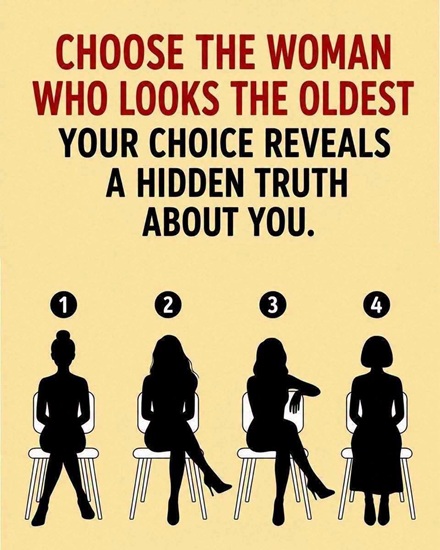
Imagine looking at an illustration of four women and being asked a seemingly easy question: which one appears to be the oldest? Most people will probably make a choice within seconds, and some may feel surprisingly certain about their answer. Yet if the picture provides no verified ages or other objective information, there is no reliable way to determine which woman is actually older. The exercise is therefore best treated as a light visual puzzle and an opportunity to examine perception rather than as a scientific personality test.
Our brains constantly interpret visual information. Posture, clothing, hairstyle, facial expression and body language can influence the conclusions we reach about another person. Much of this processing happens rapidly, sometimes before we consciously recognize which detail influenced us. That ability helps people navigate everyday situations efficiently, but it can also create strong impressions from surprisingly limited evidence.
Age is an especially good example. Two people of the same age can look very different, while people separated by several years may appear remarkably similar. Genetics, lifestyle, clothing, hair, facial expression and many other characteristics can influence perceived age. When the people are stylized drawings rather than photographs, even more useful information disappears.
Cultural background can shape these impressions as well. A hairstyle that one person associates with an older generation may be fashionable among young adults somewhere else. Formal clothing may suggest maturity to one viewer but simply professionalism to another. Upright posture can be interpreted as experience, confidence or youth depending on who is looking.
That ambiguity explains why different viewers can choose different women while each remains convinced that their answer makes sense. The interesting part is not proving that one person is correct. Instead, the exercise can reveal which visual details each person noticed first.
Woman Number One
If Woman Number One immediately appeared oldest to you, perhaps her posture, clothing or overall presentation communicated seriousness and composure. Informal personality quizzes often connect this type of choice with organization, discipline and responsibility. The interpretation is entertaining, but it should not be mistaken for a psychological conclusion.
People who identify with these characteristics may enjoy having plans and knowing what needs to happen next. They might prefer gathering information before making important decisions rather than reacting impulsively. When circumstances become stressful, they may try to create order so the problem feels more manageable.
That tendency can make someone dependable. Friends, relatives or colleagues may seek them out when a situation requires calm thinking and practical action. Following through on promises and respecting responsibilities can become important parts of how they approach relationships.
However, a strong preference for structure can occasionally become impatience with people who operate differently. Someone may interpret a disorganized approach as carelessness without knowing what circumstances produced it. Plans can also change for reasons no one anticipated.
The useful takeaway is therefore not that selecting Woman One proves you are disciplined. Instead, consider whether you value predictability and how you respond when reality refuses to follow the plan. Flexibility does not eliminate organization; it can make organization more effective.
Woman Number Two
Woman Number Two may stand out to viewers who notice a softer, more relaxed or expressive appearance. In a casual personality interpretation, choosing her might be associated with empathy, creativity and emotional awareness.
People who relate to those qualities may pay close attention to the feelings of others. They may notice subtle changes in someone’s mood or recognize when a friend needs support before that person directly asks for it. Meaningful conversations and emotional honesty can be especially important to them.
Creativity may also play a role. Creative thinking does not necessarily mean being an artist or musician. It can involve approaching ordinary problems from unexpected angles, imagining alternatives and remaining comfortable when there is more than one possible solution.
Sensitivity can nevertheless become tiring when someone begins carrying other people’s worries. A person who notices emotional tension easily may continue thinking about it long after everyone else has moved on. They may also spend considerable energy imagining problems that never actually occur.
Healthy boundaries allow compassion to remain useful without becoming overwhelming. Supporting another person does not require solving every problem for them. If the description feels familiar, that reflection may be more valuable than the original choice in the picture.
Woman Number Three
Some viewers may immediately select Woman Number Three because her posture appears especially confident or independent. She might seem decisive, energetic or self-assured. Lighthearted personality quizzes often associate those impressions with leadership and willingness to take initiative.
People who see themselves in that description may be comfortable making decisions. They might enjoy challenges and new experiences rather than waiting for someone else to take the first step. Expressing an opinion openly may also come naturally to them.
Confidence can be extremely useful when uncertainty causes everyone else to hesitate. A person willing to accept responsibility can help a group move forward. Independence can also make it easier to pursue goals without needing constant approval.
Yet certainty and accuracy are not identical. Confident people can occasionally reach conclusions before hearing quieter perspectives. Someone who speaks less frequently may still possess information that changes the entire situation.
The playful interpretation therefore offers a useful reminder about listening. Leadership can become stronger when confidence is combined with curiosity. Allowing room for disagreement does not necessarily weaken a decision; sometimes it produces a better one.
Woman Number Four
If Woman Number Four seemed oldest, perhaps something about her appearance suggested stability, tradition or experience. An informal interpretation might associate this choice with patience, loyalty and appreciation for familiar routines.
People who value stability often prefer relationships that deepen over time. They may not need constant excitement to feel satisfied and might appreciate predictable routines that make everyday life comfortable. Dependability can matter more than novelty.
Practical thinking may also influence their decisions. Rather than pursuing every new possibility immediately, they may prefer evaluating whether a change is actually necessary. This can prevent impulsive decisions and provide a strong sense of continuity.
The potential disadvantage is becoming overly cautious about unfamiliar situations. A comfortable routine can sometimes turn into resistance to change simply because something new feels uncertain.
Trying a different experience does not require abandoning everything familiar. Small changes can coexist with stability. For someone who recognizes this tendency, occasional experimentation may reveal that adaptability and security can exist together.
Why Personality Results Can Feel So Accurate
Many people read descriptions from informal personality quizzes and are surprised by how accurate they seem. There is a psychological reason this can happen.
The Barnum effect, also called the Forer effect, describes people’s tendency to accept broad personality statements as highly specific to themselves. Descriptions are especially persuasive when they combine flattering qualities with believable weaknesses.
Consider a statement such as, “You care deeply about people, but sometimes you worry too much.” That could accurately describe an enormous number of people. Yet when someone believes the sentence was generated from their personal quiz result, it may feel uniquely revealing.
The same principle applies to these four choices. Most people are responsible in some situations, emotional in others, confident at certain times and cautious under different circumstances. Human personality is far more complicated than a single selection in an illustration.
That does not make the puzzle useless. It simply changes what the puzzle is useful for.
What the Image May Actually Tell You
Rather than revealing a hidden personality type, your answer may reveal something about which visual information caught your attention. Perhaps you focused on hairstyle while someone else noticed posture. Maybe clothing influenced your judgment without you consciously realizing it.
Try comparing your answer with another person’s. Instead of simply asking which woman they selected, ask why. The explanations can be much more interesting than the choices themselves.
One person may associate short hair with older age. Another may believe formal clothing makes someone appear older. A third might focus almost entirely on the way each woman stands.
None of those features reliably determines someone’s age in real life.
Older women have an enormous range of hairstyles, clothing preferences, physical abilities and personalities. Some follow current fashion closely, while others prefer traditional styles. Some are highly athletic, and others have limited mobility. There is no single appearance that defines an older woman.
The exercise can therefore reveal assumptions about aging that people may not realize they carry. Recognizing those assumptions is not a reason for embarrassment. Human beings naturally use previous experiences to interpret new information.
The important question is what happens after the first impression. Do we treat it as a possibility, or immediately turn it into a fact?
First Impressions Are Not Complete Information
The principle extends beyond age. People constantly form opinions about strangers based on clothing, expression, posture and other visible characteristics. Sometimes these impressions can provide useful clues, but they are never substitutes for actually knowing someone.
A person who appears serious may simply be concentrating. Someone who looks tired may have had a difficult day rather than possessing a particular personality. A confident posture does not automatically mean a person feels confident internally.
Ambiguous pictures make this process easier to notice because viewers receive so little information. The brain dislikes gaps and naturally attempts to fill them.
Within moments, a viewer can create an entire explanation for why one illustrated woman must be older than another. Yet none of the women has an objectively stated age.
That contrast between limited evidence and strong confidence is arguably the most interesting part of the puzzle.
Not a Scientific Assessment
Choosing Woman One, Two, Three or Four cannot scientifically determine someone’s personality. A validated psychological assessment requires carefully designed questions, standardized procedures, research and evidence showing that the results measure what they claim to measure.
A four-image internet puzzle does not meet those standards.
It cannot diagnose personality traits, psychological conditions or emotional health. It should never be used to make serious decisions about yourself or another person.
What it can do is provide entertainment and a starting point for reflection. If a description happens to remind you of a genuine tendency, you can think about that tendency independently of the quiz.
Perhaps you realize you become uncomfortable when plans change. Maybe you recognize that you absorb other people’s worries too easily. You might notice that you sometimes speak before listening or avoid unfamiliar experiences because routine feels safer.
Those reflections can be worthwhile even though the image did not scientifically discover them.
The Most Interesting Answer May Be “Why?”
Ultimately, there may be no objectively correct answer to which illustrated woman is oldest unless the creator provides actual ages. The figures offer only visual clues, and viewers interpret those clues differently.
That is precisely what makes the exercise interesting.
If you chose Woman One, ask yourself what feature influenced you. Do the same if you selected Two, Three or Four. Then imagine changing one detail — the hairstyle, clothing or posture. Would your answer suddenly change?
If it would, that demonstrates how strongly one visual cue can influence an apparently confident judgment.
The puzzle therefore becomes more meaningful when it is treated not as a verdict about personality but as a small experiment in perception. It shows how quickly people can turn an impression into a conclusion.
There is nothing wrong with enjoying the playful personality descriptions attached to each choice. Woman One can represent organization, Woman Two empathy, Woman Three confidence and Woman Four stability as long as those descriptions remain clearly framed as entertainment.
But none of those results defines the viewer.
The more useful lesson is that people are complicated while images are incomplete. A hairstyle cannot reveal someone’s age with certainty. Posture cannot explain an entire personality. Clothing cannot tell us everything about a stranger’s life.
So after making your selection, there is one question worth asking before reading any personality result: What exactly made that woman look older to you?
Your explanation may reveal something more interesting than the answer itself. It can show which details your attention prioritized, which associations your experience supplied and how quickly your brain constructed certainty from limited evidence.
Used in that way, the four-woman puzzle becomes an enjoyable exercise in self-awareness. There is no need to treat the result as scientific or predictive. The real value lies in noticing the journey from seeing an ambiguous image to becoming convinced that one answer simply had to be right.

