
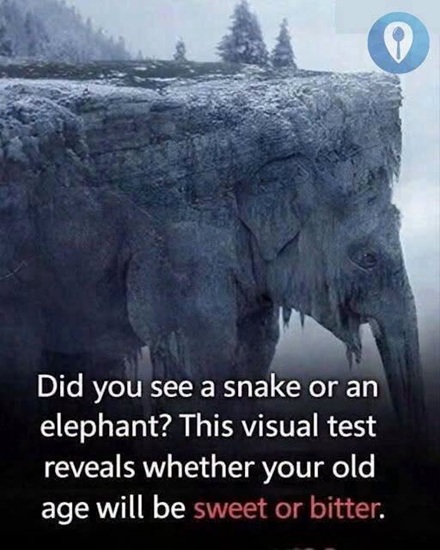
Take a quick look at an ambiguous picture containing the shapes of a snake and an elephant. Some people may immediately notice the curved outline of the snake, while others may first recognize the larger shape of the elephant. A third group might identify both animals almost immediately. The experience can feel surprisingly revealing because people looking at exactly the same picture may confidently describe different things. However, the scientifically interesting part is not that the first animal exposes a hidden personality trait.
It is that human visual perception can organize ambiguous information in more than one reasonable way. Headlines surrounding these images often promise something much more dramatic. They may claim that the first animal you notice reveals how you think, exposes your greatest strength, or uncovers a hidden part of your personality. Those claims are entertaining, but they should not be confused with validated psychological assessment.
There is no established scientific rule showing that noticing a snake first makes someone analytical or suspicious, or that recognizing an elephant first proves someone is compassionate or emotionally intelligent. What these images can demonstrate is a genuine phenomenon involving visual perception. Scientists have long studied ambiguous or reversible images that allow more than one interpretation. Famous examples include the Necker cube and pictures that can appear to contain different objects depending on how they are viewed. In such cases, the physical picture can remain completely unchanged while a person’s conscious perception switches from one interpretation to another.
That distinction is fascinating because we often imagine vision as something similar to a camera. Light reaches our eyes, and it can seem as though the brain simply produces a perfect internal copy of whatever is outside. Human perception is considerably more active than that simple description suggests. Visual information must be organized into recognizable objects, boundaries, backgrounds, shapes, and meaningful patterns before we experience a coherent scene.
Most of the time, this process works so efficiently that we barely notice it happening. You can enter a room and immediately recognize chairs, tables, windows, people, and countless other objects without consciously analyzing every individual line or patch of color. Your visual system rapidly processes available information and organizes it into forms that make sense.
Ambiguous images take advantage of that remarkable ability.
Instead of giving the visual system one obvious interpretation, they are deliberately designed so that the same lines can support two possibilities. A curve belonging to one animal might simultaneously form part of another animal. What initially appears to be background detail may suddenly become an important feature after the alternative interpretation is discovered.
Imagine that you immediately see the snake.
Its long curved form may dominate your perception so strongly that the elephant seems impossible to find. Someone sitting beside you could insist that an elephant is clearly visible, leaving you wondering how they could possibly reach that conclusion.
Then they point toward a particular section of the picture.
Suddenly, you notice the elephant.
The drawing itself has not moved.
No lines have been added.
Nothing has disappeared.
What changed was your interpretation.
The same process can occur in reverse for someone who notices the elephant first. The larger outline may immediately organize the picture into an elephant, while the features forming the snake appear to be meaningless background information. Once the snake is pointed out, those same curves suddenly become organized into another recognizable animal.
This ability for perception to alternate between interpretations is often discussed in research on bistable perception. A bistable image supports two relatively stable perceptual possibilities. A viewer may experience one interpretation for several seconds before spontaneously switching to another, even though the sensory stimulus remains constant.
That phenomenon gives researchers an interesting opportunity.
Normally, if scientists want to change what someone sees, they have to change what appears on a screen. With an ambiguous figure, however, subjective visual experience can sometimes change while the external stimulus remains identical.
That makes reversible images useful for studying aspects of perception and visual awareness.
Attention also plays an important role.
When you first examine a complicated image, you do not necessarily give equal attention to every part. Certain contours, shapes, contrasts, or familiar patterns may attract your eyes more quickly than others.
Where attention goes can influence which interpretation becomes dominant.
That provides one possible reason two people can initially experience the same picture differently without needing fundamentally different personalities.
Suppose one viewer’s attention is immediately captured by the narrow curved portion forming the snake.
Recognition may happen rapidly.
Another viewer might first focus on the larger arrangement of shapes forming the elephant’s head and body.
Their perception could therefore organize the image differently.
Neither response needs to be treated as evidence of superior intelligence or deeper insight.
It is simply a difference in how the ambiguous picture was initially processed.
Context can influence perception too.
If someone tells you, “There is a snake hidden in this picture,” you are likely to search for snake-like features. If someone instead asks you to find an elephant, your attention may be guided toward features supporting that interpretation.
This is why the wording surrounding an online optical illusion can affect the experience itself.
Reading the answer before looking at the image can make a supposedly spontaneous test much less spontaneous.
Previous experience can also influence recognition.
Someone who has recently been looking at photographs of snakes may notice a familiar curved shape particularly quickly. Another person who has been thinking about elephants may recognize elephant-like features sooner.
That does not mean either person’s character has been revealed.
It simply demonstrates that perception occurs within a broader context rather than in complete isolation.
This is where many viral personality quizzes make an unsupported leap.
A typical post might say that people who see the snake first are observant, strategic, independent, cautious, or intuitive. It might then describe elephant-first viewers as loyal, patient, compassionate, responsible, or emotionally sensitive.
Those descriptions can feel remarkably accurate.
But feeling accurate is not the same as being scientifically demonstrated.
Many personality descriptions used in entertainment quizzes contain broad qualities that large numbers of people can recognize in themselves.
A person can be cautious in some situations and adventurous in others.
Someone can be independent while also caring deeply about family and friends.
A reader may therefore find several flattering or relatable descriptions convincing regardless of which animal they selected.
A scientifically validated personality assessment requires considerably more evidence than one ambiguous picture.
Researchers interested in measuring psychological traits generally examine whether an assessment produces reliable and meaningful results. They investigate whether it actually measures the trait it claims to measure and whether findings can be reproduced.
A casual online optical illusion normally does not meet those standards.
That does not mean people should stop enjoying these puzzles.
They can be entertaining precisely because perception is so interesting.
The key is being clear about what the experience can and cannot demonstrate.
If you see the snake first, the most defensible conclusion is simply that the snake became your first conscious interpretation of this particular image.
Perhaps its contours attracted your attention.
Perhaps the shape was particularly recognizable to you.
Perhaps your eyes happened to land on the section that made the snake easiest to identify.
Those are plausible perceptual explanations.
What cannot responsibly be concluded from that observation alone is that you have a specific personality type.
Seeing a snake does not establish that you are suspicious.
It does not prove that you are unusually analytical.
It does not reveal whether you are introverted or extroverted.
And it certainly cannot predict your future decisions.
The same caution applies if you see the elephant first.
Recognizing the elephant does not prove that you are wiser, kinder, more patient, or more loyal than someone who noticed the snake.
Those qualities require far more information to evaluate.
The image tells us about an immediate visual experience, not the complete character of the person looking at it.
There is nevertheless something genuinely surprising about the illusion.
Once you have seen one interpretation, it can sometimes become difficult to understand how you missed the other.
The elephant might suddenly seem enormous and obvious.
You may look back at the snake and wonder why it dominated your perception only seconds earlier.
Or the reverse may happen.
This illustrates how strongly perception can organize ambiguous visual information.
At one moment, one interpretation seems unquestionably correct.
A moment later, another becomes equally convincing.
That does not mean your brain was malfunctioning during the first interpretation.
The ambiguity was deliberately built into the picture.
Both possibilities may be supported by the same visual features.
Some people can even deliberately switch between them.
Try focusing on the features forming the snake.
Hold that interpretation for several seconds.
Then shift your attention toward the contours forming the elephant.
You may experience a noticeable perceptual change despite knowing intellectually that the picture itself has remained constant.
For some viewers, switching is easy.
For others, one interpretation remains more dominant.
Again, those differences should not automatically be translated into personality labels.
Many factors can affect how an ambiguous image is perceived, including the design itself, visual attention, previous exposure, expectations, and the conditions under which the picture is viewed.
Even screen size can matter.
An image viewed on a small smartphone may emphasize different features than the same illustration displayed on a large monitor.
Contrast and image quality can affect which outlines are easiest to recognize.
Viewing distance can change the relative prominence of small details.
Someone seeing a compressed social-media version may therefore have a different experience from someone examining a high-resolution image.
This creates another problem for claims that these pictures are precise psychological tests.
Online viewers do not encounter them under controlled conditions.
One person studies the picture for twenty seconds.
Another glances at it for less than a second.
One has already read comments revealing both animals.
Another has never seen the illustration before.
Some people may even have encountered the same puzzle months earlier without consciously remembering it.
Those conditions make sweeping personality conclusions even less appropriate.
The more useful question is not, “Which animal reveals who I really am?”
A better question is, “Why could the same picture produce two convincing interpretations?”
That question leads directly into the science of perception.
Our visual system constantly has to decide which features belong together.
Lines are grouped.
Edges become boundaries.
Shapes become objects.
Some visual information becomes the figure we consciously notice, while other information functions as background.
These processes happen extremely rapidly.
Ambiguous illustrations cleverly arrange their features so that more than one grouping remains plausible.
When the snake dominates, some elephant-related features may effectively become background.
When the elephant dominates, the visual hierarchy changes.
That is one reason the second animal can seem to appear suddenly.
It was physically present in the picture all along.
What changed was the organization of the information.
This distinction is more scientifically interesting than claiming that the snake exposes a secret fear or that the elephant reveals someone’s emotional nature.
The picture demonstrates that perception is active.
The visual system interprets.
It organizes.
It prioritizes.
And when information is intentionally ambiguous, different interpretations can compete.
Another fascinating feature is how confident people can feel about their initial perception.
A viewer might say, “There is obviously a snake. I don’t understand how anyone sees an elephant.”
Another person may respond with exactly the opposite reaction.
Both can feel completely certain.
Then each may discover the alternative and realize that the other person’s description was reasonable after all.
This provides a useful reminder about ambiguous information.
Confidence and perception are related, but confidence alone does not transform one interpretation into the only possible interpretation.
In this specific visual puzzle, the designer may have intentionally created multiple valid ways of organizing the same shapes.
However, that lesson should not be stretched too far.
An optical illusion does not prove that every disagreement in everyday life is merely a matter of perspective.
Many real-world questions have objectively verifiable answers.
The puzzle demonstrates something specific about ambiguous visual information, not a universal rule that all interpretations of reality are equally correct.
Keeping that distinction prevents a simple illusion from being turned into an exaggerated philosophical claim.
The same care should be taken with intelligence.
Some posts claim that finding both animals quickly demonstrates exceptional intelligence or an unusually high IQ.
A single ambiguous animal image cannot establish that.
Formal cognitive assessment is much more complex.
Recognizing the hidden animal quickly may simply mean that the relevant visual features were particularly noticeable to you.
Likewise, taking longer does not demonstrate low intelligence.
The same applies to creativity.
Finding an alternative interpretation can certainly feel creative, and scientists have investigated relationships between perception and different cognitive processes.
But one picture is insufficient to declare someone highly creative.
A meaningful claim about creativity would require an appropriate assessment and supporting evidence.
There is no need to exaggerate the result to make the puzzle enjoyable.
In fact, the genuine science is arguably more interesting.
Think about what your brain accomplishes whenever you open your eyes.
A vast amount of visual information becomes available.
Yet you normally experience an organized world rather than disconnected patches of brightness and color.
Objects appear stable.
Faces become recognizable.
Depth is perceived.
Boundaries are organized.
Relevant information can attract attention.
Most of this occurs without deliberate conscious effort.
Optical illusions expose small situations where those normally efficient processes produce unexpected results.
That is why researchers and educators often find visual illusions useful.
They provide accessible demonstrations showing that perception involves processing and interpretation.
A viewer does not need specialized scientific training to experience the effect.
Simply discovering the second animal can make the principle immediately understandable.
There is also a difference between knowing and seeing.
Once someone tells you that an elephant exists in the image, you intellectually know it is there.
Yet you might still struggle to visually experience the elephant because the snake remains dominant.
Then, without the image changing, the elephant suddenly becomes obvious.
That transition can feel almost physical.
Your knowledge was present before your perception changed.
This difference is one reason ambiguous figures remain interesting to researchers studying conscious visual experience.
They allow scientists to ask what changes when subjective perception switches even though external visual input remains stable.
For ordinary viewers, however, no laboratory equipment is necessary to appreciate the basic phenomenon.
Simply notice what happens when your interpretation changes.
Pay attention to which contours suddenly become meaningful.
Notice which previously important lines fade into the background.
Then try switching back.
The exercise can turn a viral puzzle into a small informal demonstration of perception.
There is another reason these quizzes spread so easily online.
People enjoy comparing themselves with others.
If two friends see different animals, the difference creates an immediate conversation.
“How can you not see the snake?”
“Where is the snake? That’s clearly an elephant.”
A few seconds later, both may be laughing because they finally understand the alternative interpretation.
Adding personality descriptions makes that interaction even more shareable.
People compare results and decide whether the descriptions resemble them.
There is nothing inherently wrong with doing that for entertainment.
Problems arise only when playful descriptions are presented as established psychological facts.
Clear labeling solves much of that problem.
A responsible version might say, “For fun, snake-first viewers are sometimes described as cautious or observant.”
It should not say, “Psychology proves that seeing the snake means you are cautious.”
Those sentences make fundamentally different claims.
One is entertainment.
The other invokes scientific authority.
Evidence is necessary for the second.
The same principle applies to sensational phrases such as “shocking truth.”
The genuinely supported truth is less dramatic but more accurate.
An ambiguous image can reveal which interpretation became visually dominant first.
It can demonstrate that perception may change while the physical stimulus stays the same.
It can show how attention and context influence what becomes noticeable.
Those observations are interesting without pretending they expose someone’s deepest secrets.
So if the snake appeared first for you, enjoy that result.
Look again and search for the elephant.
Notice whether it suddenly becomes obvious.
If the elephant appeared first, try finding the snake.
Pay attention to how the same lines acquire a different meaning once the second interpretation becomes available.
If you immediately saw both animals, that is interesting too.
But none of these outcomes should become a label attached to your identity.
You remain far more complicated than one second of visual perception.
Your personality reflects countless experiences, tendencies, relationships, choices, and behaviors.
No single optical illusion can summarize all of that.
What the picture can offer is a moment of curiosity.
It can remind us that seeing is not always as simple as it feels.
Our brains continuously organize sensory information so efficiently that we normally never notice the process.
An ambiguous picture briefly makes that process visible.
The snake and elephant are therefore not secret personality codes.
They are competing interpretations built into a visual puzzle.
One may reach awareness before the other.
Attention may then shift.
The second form may suddenly emerge.
And the viewer may experience the remarkable sensation of seeing an unchanged picture in an entirely different way.
That is the real reason the illusion deserves another look.
Not because it can diagnose your personality.
Not because one animal makes you smarter than another viewer.
And not because the image predicts anything about your future.
It is interesting because it demonstrates something genuine about human perception.
The physical picture can stay exactly the same while our conscious experience of it changes.
So take one more look.
Snake?
Elephant?
Perhaps both?
Whatever appeared first, enjoy the puzzle for what it genuinely demonstrates: the remarkable ability of the human visual system to find meaningful patterns in ambiguous information—and to reorganize those patterns when another interpretation becomes available.

