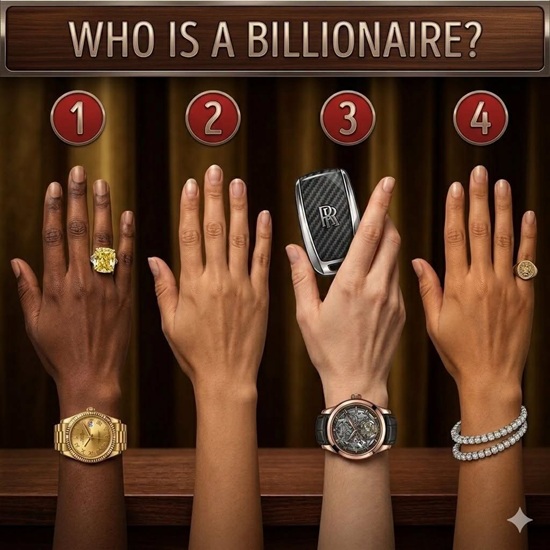
At first glance, identifying the billionaire in a visual puzzle might seem easy. Several characters may be surrounded by obvious signs of luxury, including expensive-looking clothes, jewelry, large houses, sports cars or piles of money. The natural reaction is to select whichever person appears richest. Yet that is usually exactly what these puzzles are designed to make viewers do. The real challenge is to ignore appearances long enough to examine the numbers and ownership clues hidden throughout the illustration.
Being surrounded by luxury and actually possessing a net worth of at least one billion are two very different things. The word billionaire generally refers to someone whose net worth reaches at least one billion units of the currency being discussed. Net worth is not simply the amount of money someone earns each year, nor does it necessarily represent cash sitting in a bank account. In simplified terms, it is the value of someone’s assets minus relevant liabilities.
A person can therefore own extremely valuable property and still have a substantially lower net worth if significant debts are attached to those assets. Understanding this distinction provides the foundation for solving the puzzle correctly. Start by looking carefully at what each character is actually shown to own. A person standing beside a luxury car may immediately appear wealthy, but the illustration might never establish ownership of that vehicle. The car could be rented, borrowed or financed.
The same applies to a mansion, expensive watch or private aircraft. Unless the puzzle provides enough information to associate the asset and its value with a particular character, appearances alone cannot establish that person’s wealth. A second character might look surprisingly ordinary.
Perhaps this person wears inexpensive-looking clothes and has none of the obvious luxury symbols surrounding the others. Somewhere nearby, however, there may be a small document showing ownership of a valuable company, property portfolio or investment. That seemingly insignificant clue can completely change the answer. A billion-dollar business interest matters considerably more to the calculation than a designer outfit whose actual value is never stated.
The numbers themselves deserve close attention.
One of the easiest mistakes is confusing millions with billions. Both represent enormous amounts of money in everyday life, but the mathematical difference between them is substantial. One billion equals one thousand million. A character shown with $20 million, for example, may be exceptionally wealthy without coming remotely close to billionaire status.
Even several large amounts expressed in millions may remain insufficient.
Imagine that one character has three assets valued at $250 million each. Together, they would total $750 million. That fortune would place the person among an extremely wealthy group, but it would still remain $250 million below the one-billion threshold. Another character with confirmed assets of $1.05 billion would qualify under the simplified rules of the puzzle even if that person appeared much less extravagant.
This is why addition should replace visual guessing.
Write down the amounts shown for each character and calculate them separately. Do not allow a large pile of money to seem more important simply because it occupies more space in the illustration. A small label displaying a larger numerical value can outweigh an entire collection of visually impressive objects.
Debts and liabilities can make the challenge more interesting.
Suppose a character owns property, investments and businesses worth a combined $1.4 billion. At first, that person appears to satisfy the billionaire requirement comfortably. But imagine the puzzle also shows that the character owes $600 million.
Under a simplified net-worth calculation, those figures would leave approximately $800 million.
The person would still be extraordinarily wealthy.
They simply would not meet the one-billion threshold based on those numbers.
This demonstrates why total asset value and net worth should not be treated as interchangeable concepts.
Debt can exist alongside wealth.
A valuable house can have a mortgage.
A company can carry significant liabilities.
An expensive vehicle can be financed.
The puzzle may deliberately place debt information in small print because viewers are expected to become distracted by the larger asset figure.
Income can create another misleading impression.
Imagine a character whose sign says, “Earns $4 million per month.”
That is extraordinary income.
However, monthly earnings alone do not tell viewers the person’s current net worth.
Someone earning $4 million every month might eventually accumulate enormous wealth, but the puzzle cannot assume that every dollar earned has been saved. The person could have expenses, taxes, investments, debts or other financial obligations.
Conversely, someone with relatively little salary could already possess assets worth billions.
A company founder may own a valuable business while receiving a comparatively modest salary.
An investor may derive wealth primarily from ownership rather than wages.
A property owner could have enormous net assets without displaying a large monthly paycheck.
For that reason, income should not automatically be counted as net worth unless the puzzle explicitly provides enough information to make that connection.
Ownership percentages can provide another hidden mathematical challenge.
Suppose a character owns 20 percent of a company valued at $4 billion.
It would be incorrect to assign the entire $4 billion value to that individual.
In the simplified mathematics of a visual puzzle, a 20 percent share would correspond to approximately $800 million.
That alone would not make the character a billionaire.
Now consider another person who owns 60 percent of a company valued at $2 billion.
Sixty percent of $2 billion equals approximately $1.2 billion.
Assuming no relevant liabilities are shown, that character would cross the threshold.
The smaller company could therefore make its owner wealthier than the person holding a small percentage of the larger company.
Currency is another detail that should not be overlooked.
A puzzle may use dollar signs, euros, pounds or other currency symbols. One billion units of different currencies do not necessarily represent identical values. Real exchange rates fluctuate continuously, so a puzzle comparing currencies needs to provide sufficient context if conversion is required.
If every amount uses the same currency, the calculation becomes much simpler.
If the illustration uses different currencies without supplying an exchange rate, viewers should be cautious about inventing a conversion that the puzzle may never have intended.
The puzzle may instead use fictional currencies simply to test arithmetic.
Another useful question is whether an expensive object actually belongs to the person standing beside it.
Visual puzzles often exploit proximity.
A character may be pictured next to a mansion.
That does not necessarily mean the mansion belongs to them.
Another person may be standing beside an expensive automobile while holding a rental agreement.
A third could be wearing jewelry that was borrowed for an event.
Small ownership clues can completely reverse the first impression.
This is why unsupported assumptions should be removed from the calculation.
If an illustration says a house is worth $10 million but never establishes who owns it, that value should not automatically be assigned to the closest character.
Likewise, viewers should not invent values for objects.
An expensive-looking watch might be worth thousands, hundreds or considerably less than it appears.
Unless the puzzle states a value or provides an unmistakable clue, guessing adds information that was never supplied.
A reliable puzzle should contain enough evidence to identify the intended solution without requiring viewers to invent financial facts.
The best strategy is therefore surprisingly systematic.
Begin with Character A.
Record only the assets clearly shown as belonging to that person.
Write down their stated values.
Calculate any ownership percentages.
Then identify debts or other liabilities explicitly provided by the puzzle.
Subtract those amounts.
Repeat the process for Character B, Character C and every other figure.
Finally, compare the resulting totals.
Whichever character has confirmed net assets of at least one billion satisfies the puzzle’s billionaire condition.
This process may sound overly analytical for a simple visual challenge, but that is exactly why such puzzles are entertaining.
They take advantage of how quickly people judge status from appearance.
Designer clothing communicates wealth.
Luxury cars communicate wealth.
Large houses communicate wealth.
Gold watches and jewelry communicate wealth.
But none of those things, individually, proves that someone possesses a billion-dollar net worth.
Someone can spend heavily without having enormous net assets.
Someone else can own valuable investments while living relatively modestly.
That contrast is frequently the central trick.
Puzzle designers know that viewers will initially look toward the person surrounded by the most obvious symbols of money.
The correct answer can therefore be deliberately positioned somewhere less dramatic.
Perhaps the billionaire is the person wearing ordinary clothes while holding a certificate showing a controlling interest in a valuable company.
Maybe another character has an enormous pile of cash but also an equally enormous debt.
Perhaps the sports car belongs to a dealership rather than the person posing beside it.
The smallest clue can overturn the entire visual narrative.
Understanding the scale of a billion also helps.
One million is 1,000,000.
One billion is 1,000,000,000.
In the commonly used short-scale numbering system, one billion equals one thousand millions.
That difference explains why someone possessing several million dollars is still far from billionaire status.
For example, $50 million represents only five percent of $1 billion.
Even $500 million is only halfway there.
A person with $900 million is exceptionally wealthy but remains $100 million below the threshold.
Meanwhile, someone with $1.01 billion has technically crossed it.
That is why precise numbers matter more than the emotional impression created by large figures.
The puzzle also illustrates an important difference between liquidity and wealth.
A billionaire does not necessarily have one billion dollars available as cash.
Much of a wealthy person’s net worth can exist in businesses, shares, real estate and other assets.
Likewise, someone visibly holding a great deal of cash is not automatically wealthier than someone whose fortune exists primarily through ownership.
Real-world billionaire rankings demonstrate this distinction clearly.
Fortunes associated with company ownership can change as asset values rise and fall.
For the purposes of a puzzle, however, calculations are normally much simpler.
Use the values shown in the illustration.
There is no need to speculate about taxes, future market changes, transaction costs or complicated corporate structures unless the puzzle explicitly introduces them.
The objective is observation rather than professional financial valuation.
Before choosing an answer, viewers can perform a final checklist.
Does the person actually own the assets shown?
Are the numbers in millions or billions?
Are there debts that need to be subtracted?
Is the figure describing income rather than accumulated wealth?
Does the person own the entire company or only a percentage?
Are all values expressed in the same currency?
Did an impressive-looking object influence the answer even though its value was never provided?
Answering those questions can expose most of the puzzle’s traps.
The broader lesson is simple but useful.
Looking rich and being wealthy are not the same thing.
Appearance tells observers very little about someone’s complete financial circumstances.
An expensive car does not reveal debt.
A modest outfit does not reveal investments.
A high salary does not reveal spending.
A mansion does not reveal whether it is owned outright, financed or even belongs to the person standing outside it.
In real life, someone’s finances are private and far more complicated than an illustration can show.
The puzzle simplifies those concepts for entertainment, but it still demonstrates why assumptions based on appearance can be unreliable.
That is what makes the challenge more interesting than simply counting luxury objects.
The viewer must replace instinct with evidence.
Look beyond the sports car.
Ignore the designer clothing unless its value matters.
Read the tiny labels.
Check every zero.
Separate millions from billions.
Distinguish earnings from assets.
Subtract stated debts.
Calculate ownership shares correctly.
Then make the comparison.
The character with the flashiest lifestyle may not be the answer.
The character holding the largest pile of visible cash may not be the answer either.
The billionaire is the person whose demonstrated net worth reaches or exceeds one billion according to the information actually supplied by the puzzle.
Everything else is decoration until the numbers prove otherwise.
And that is the real challenge hidden inside the image: not simply identifying who looks wealthy, but recognizing which details provide evidence of genuine billionaire-level net worth.
