
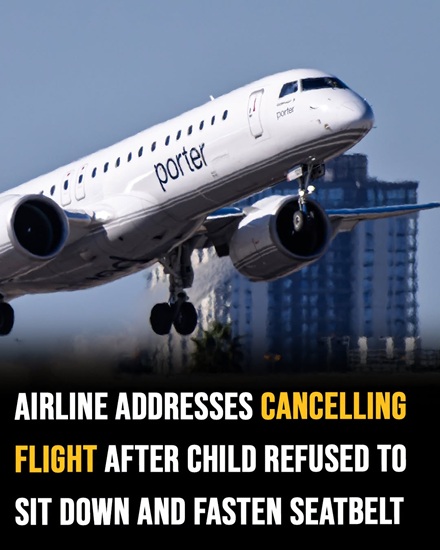
A late-night Porter Airlines flight from Victoria to Toronto turned into an unexpected overnight disruption after a young child could not remain seated with a seatbelt fastened before takeoff. The incident occurred on August 6 after the aircraft had already pushed away from the terminal at Victoria International Airport and was taxiing for its scheduled journey to Toronto Pearson International Airport. According to Porter Airlines, the child was standing on the seat and would not remain secured despite attempts by the accompanying parent and crew members to resolve the situation.
Because passengers who are required to be seated must be properly secured for takeoff, the crew determined that the aircraft could not safely depart. What initially appeared likely to be a relatively short delay ultimately affected everyone aboard. The pilots returned the aircraft to the terminal so the situation could be addressed. That decision was based on a straightforward safety requirement rather than on whether the child’s behavior was intentional.
Regardless of why a passenger is unable to remain safely secured, an aircraft cannot simply begin takeoff while that requirement remains unmet. The circumstances became more complicated because this was a late-night flight operating close to a scheduled airfield closure. Passenger Hillary Hertzberg later described the lengthy wait inside the aircraft. According to her account, the child and accompanying parent eventually left at approximately 11:30 p.m., by which point passengers had already been waiting for close to an hour.
What happened during that period was frustrating for travelers because they still did not know whether the flight would be able to continue to Toronto that night. Returning to a gate and removing passengers can involve more than simply allowing them to walk off the aircraft. Their baggage may need to be identified and removed, while airline employees must complete necessary operational and administrative procedures. Those requirements consumed additional time. The longer the process continued, the more difficult it became for the flight to depart within Victoria’s available operating window.
Porter spokesperson Brad Cicero explained that removing the parent and child, dealing with their baggage and completing required paperwork meant there was insufficient time to depart before Victoria’s scheduled 12:30 a.m. airfield closure. The flight therefore could not continue to Toronto that night. Passengers were required to disembark, transforming an unusual cabin issue into an overnight travel disruption.
Porter subsequently apologized to passengers for the inconvenience and said they were able to travel on another flight the following day. For travelers who had planned their schedules around an overnight arrival in Toronto, however, the consequences could extend beyond simply waiting for another aircraft. A cancellation can interfere with work, appointments, connecting travel and other commitments, making the frustration expressed by passengers understandable.
The incident quickly attracted attention for another reason: descriptions of the young child differed considerably.
Some accounts and online comments referred to the youngster as an “unruly toddler,” language that suggests intentional misbehavior or a conventional tantrum. However, passenger Aryeh Kozuch offered a substantially different description after witnessing the incident. Kozuch told The Canadian Press that he had initially assumed announcements about a disruptive passenger referred to an adult rather than a young child.
From his perspective, what he eventually observed did not look like a child deliberately causing trouble.
Kozuch said the youngster repeatedly attempted to hide underneath the seat. When efforts were made to secure the child, the youngster would reportedly slide underneath rather than remain buckled. Based on what he could observe, Kozuch interpreted the behavior as fear.
He described the child as apparently terrified by the environment.
That eyewitness account does not establish precisely what the child was experiencing. It would be inappropriate to diagnose a young passenger based solely on another traveler’s observations. However, it does demonstrate why labeling the youngster simply “unruly” can present an incomplete picture of the incident.
A child refusing to remain seated can be an observable fact.
Why the child is refusing is a different question.
Young children can become distressed in unfamiliar environments for many different reasons. Aircraft contain unusual sounds, restricted spaces, unfamiliar people and routines that children may never have experienced before. Late-night travel can also occur when a young child would normally be sleeping. These are general observations rather than confirmed explanations for this particular child’s behavior.
Kozuch acknowledged that other passengers were frustrated.
That frustration is easy to understand. Travelers had paid for a flight from British Columbia to Toronto and instead found themselves sitting inside an aircraft that eventually returned to the terminal. After waiting, they then learned that the flight could no longer depart that night.
Recognizing that frustration does not require assuming that the child intentionally caused the disruption.
The child could have been genuinely distressed while passengers were simultaneously experiencing a significant inconvenience. Both things can be true.
Much of the discussion following the cancellation shifted away from the child and toward the accompanying parent. Some online commenters argued that airplane seatbelt rules are among the situations in which a parent cannot allow a young child to decide whether to cooperate. In their view, physically ensuring that the child remained safely buckled should have been the parent’s responsibility.
Other commenters focused on the amount of time involved.
They argued that once it became apparent the child could not remain secured, the parent should have voluntarily left the aircraft much sooner. From that perspective, leaving after 10 or 15 minutes might have allowed the flight to depart before the scheduled airport closure and prevented the disruption experienced by everyone else.
Those reactions represent opinions from people discussing the incident.
They do not establish what the parent was actually doing throughout the delay.
The publicly available account does not provide a complete transcript of conversations among the parent, child and crew. It would therefore be speculative to state that the parent deliberately refused to cooperate or knowingly allowed the situation to continue for an hour without trying to resolve it.
Kozuch also challenged the idea that physically forcing the child into the seat would necessarily have provided a simple answer. Based on what he observed, the youngster appeared extremely frightened. He questioned how realistic it would be to force a distressed child into position while an entire cabin watched.
Regardless of differing opinions about parenting, one fact remained non-negotiable.
The child had to be appropriately secured before the aircraft could take off.
Airplane seatbelts are not merely an optional comfort measure. During taxi, takeoff, landing and unexpected aircraft movement, an unsecured passenger can be injured. A young child’s smaller body does not eliminate that risk.
Flight crews therefore could not simply overlook the problem in order to avoid delaying everyone else.
When attempts to secure the child were unsuccessful, returning to the terminal became necessary.
The timing of that decision ultimately proved critical.
Had the same event occurred significantly earlier, there might have been enough time to return to the terminal, remove the affected passengers, complete the required procedures and resume the journey. On this particular night, however, the scheduled airfield closure created a deadline that the flight could no longer meet.
This means the cancellation resulted from a sequence of events, rather than from a child single-handedly “grounding” an aircraft in one moment.
First, the child could not remain safely seated and secured.
Attempts to resolve the issue were unsuccessful.
The aircraft returned to the terminal.
The parent and child had to disembark.
Their baggage and necessary paperwork had to be handled.
By the time that process was completed, the available departure window had closed.
Understanding that sequence provides a more accurate picture than a headline suggesting that a toddler simply refused to sit down and immediately caused a flight cancellation.
The crew’s role should also be understood within the context of aviation safety.
Flight attendants are responsible for ensuring that cabin conditions meet safety requirements before departure. They cannot simply make exceptions because passengers are frustrated or because an airport deadline is approaching. If a required passenger cannot remain secured, the aircraft cannot proceed normally toward takeoff.
This principle applies regardless of whether the passenger is frightened, upset, uncooperative or experiencing another difficulty.
Safety requirements concern the physical situation, not a judgment about someone’s character.
The incident also illustrates how quickly operational problems can multiply during late-night aviation. A relatively small delay early in the process can create much larger consequences when an airport has limited operating hours or another fixed restriction. Baggage handling, documentation and gate procedures all require time.
For passengers, however, those operational explanations do not erase the inconvenience.
People aboard had legitimate reasons to be disappointed and frustrated. Some may have lost sleep, missed plans or faced additional travel complications. Porter acknowledged that disruption and apologized.
What deserves greater caution is turning that frustration into personal attacks against a young child.
The youngster has not been publicly identified in responsible reporting, nor is there a meaningful reason for the public to know the child’s identity. The relevant facts concern the safety problem aboard the flight and the resulting cancellation, not the identity of a minor who may have been frightened.
The same applies to speculation about developmental or medical issues.
Nothing in the established reporting justifies diagnosing the child or claiming that a particular condition explains the behavior. An eyewitness believing the youngster looked frightened is different from possessing medical knowledge about why the child reacted that way.
Accurate reporting should preserve that distinction.
Similarly, criticism of the parent should distinguish between opinion and documented conduct. People are free to believe that they would have handled the situation differently. Some parents may say they would have physically secured their child, while others might decide that leaving the aircraft would be the safer option if the child could not calm down.
What outsiders cannot responsibly claim without additional evidence is that they know every effort the accompanying parent made during the delay.
Another question raised by the cancellation concerns passenger compensation.
Porter apologized and arranged for passengers to travel the following day, but public reporting surrounding the incident did not establish a universal compensation outcome for every traveler. Passenger-rights obligations can depend on the reason for a cancellation, the degree of airline control over the circumstances and other applicable rules.
Travelers affected by a particular cancellation should therefore obtain information directly from the airline and relevant official passenger-protection resources rather than assuming that every cancellation creates identical compensation rights.
Beyond those legal and operational questions, the incident became an example of how quickly social-media framing can shape perceptions.
Calling someone an “unruly toddler” immediately creates one image.
Describing a young child repeatedly hiding beneath an airplane seat while appearing frightened creates another.
The observable facts can remain the same while the emotional interpretation changes dramatically.
The airline’s statement offers the clearest neutral foundation.
The child was standing in the seat and would not remain secured.
The parent and crew attempted to address the situation.
Those efforts were unsuccessful.
The aircraft could not safely take off under those conditions.
It returned to the terminal.
The additional time required meant the flight missed the available operating window before the scheduled airfield closure.
Those facts explain the cancellation without requiring assumptions about the child’s personality or the parent’s motives.
For passengers, it was undoubtedly an unpleasant night.
For the child, based on Kozuch’s observations, it may also have been an extremely difficult experience.
Those realities do not cancel each other out.
A plane full of travelers can be legitimately frustrated while a young child can simultaneously be genuinely overwhelmed.
The crew still has to enforce the same safety requirement in either situation.
That is ultimately the most important part of understanding what happened aboard the Porter Airlines flight. The aircraft was not returned to the terminal as punishment for bad behavior. It returned because a passenger could not remain safely secured for takeoff.
Once the situation could not be resolved quickly enough, operational restrictions transformed the delay into a cancellation.
The passengers eventually departed the following day.
The public debate, however, continued much longer.
Some people focused on parental responsibility.
Others emphasized compassion for a frightened child.
Both discussions can take place without exaggerating the confirmed facts.
There is no need to portray the youngster as intentionally ruining everyone’s trip, just as acknowledging the child’s possible distress does not mean dismissing the inconvenience experienced by other passengers.
The most accurate conclusion remains straightforward.
A young passenger aboard an August 6 Porter Airlines flight from Victoria to Toronto could not remain seated with the required seatbelt secured. The accompanying parent and crew attempted to resolve the issue but were unsuccessful. The aircraft returned to the terminal, and the resulting delay extended beyond the airport’s available departure window.
That sequence forced passengers to spend an unexpected night in Victoria before traveling the following day.
Whether the child should be described as “unruly” is much less certain.
At least one passenger who witnessed the incident believed the opposite: that the youngster appeared frightened and was trying to hide.
Without stronger evidence about the child’s state of mind, that uncertainty should remain part of the story.
What does not remain uncertain is the aviation requirement.
The plane could not take off until every passenger who needed to be seated and secured was safely positioned.
In the end, the incident was therefore both an operational disruption and a difficult human situation. The passengers experienced a real inconvenience, the crew faced a safety problem that could not simply be ignored, and a young child may have been overwhelmed by an environment they could not comfortably tolerate.
Understanding all three perspectives provides a more complete account than assigning blame based on a few minutes of behavior.
Sometimes an unexpected travel disruption does not have a simple villain.
In this case, the confirmed facts point instead to a chain of circumstances: a child unable to remain safely secured, unsuccessful efforts to resolve the situation, a necessary return to the terminal and an airport operating deadline that ultimately made departure impossible that night.

