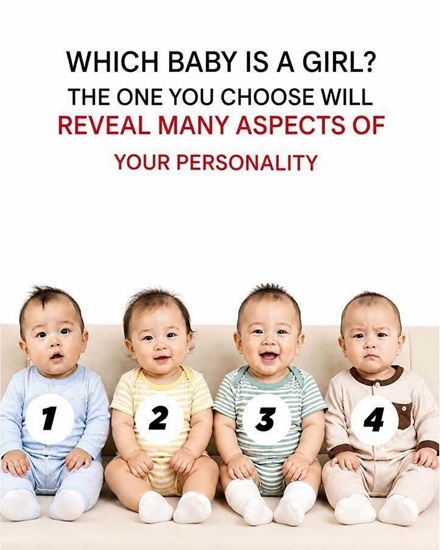
“Which baby is a girl?” is the kind of visual question that can make people stop scrolling and look twice. Several baby photographs may appear side by side, and viewers are invited to decide which one they believe shows a girl. Some versions of this online challenge go further by claiming that the answer can reveal important characteristics about a person’s personality. Although the activity can certainly be entertaining, there is an important limitation to understand.
A person’s selection from several baby photographs is not a scientifically validated method for measuring personality, intelligence, emotional characteristics, or psychological health. The challenge becomes interesting because people naturally try to make sense of visual information, even when only a few clues are available. When looking at photographs of babies, viewers may unconsciously focus on details such as hairstyle, facial expression, clothing, face shape, or accessories.
A particular feature might lead someone to believe that one baby is a girl, while another viewer could examine exactly the same photographs and reach a completely different conclusion. Neither reaction necessarily reveals a hidden personality trait. It more accurately demonstrates how individual expectations and previous experiences can influence perception.
Determining whether a baby is a girl or boy based solely on facial appearance can be unreliable, particularly when obvious contextual clues are absent. Clothing, names, hairstyles, blankets, accessories, and colors often provide information that people use when making assumptions about children. When those details are removed, people may rely on facial characteristics they personally associate with femininity or masculinity. Those associations are not necessarily dependable indicators of a baby’s sex. This explains why different people can feel equally confident while choosing different answers.
Imagine four babies photographed against similar backgrounds and dressed in neutral clothing. One is smiling broadly, another has a serious expression, a third has slightly longer hair, and the fourth has noticeably round cheeks. Some viewers may associate the longer hair with a girl, while others might focus on facial structure or expression. Another person may simply have an immediate intuition without being able to identify a specific reason. These differences make the puzzle entertaining, but they do not transform it into a scientific personality assessment.
Human beings frequently form impressions quickly because the brain is constantly organizing large amounts of information. Instead of analyzing every situation from the beginning, people often use familiar patterns and previous experiences to interpret what they see. These mental shortcuts can be useful in everyday life, but they are not always accurate. When visual information is ambiguous, expectations can influence the conclusions people reach. A simple image challenge can provide an accessible example of this process.
Gender-related assumptions can be especially influenced by social and cultural expectations. Certain hairstyles, colors, clothing styles, toys, and accessories have been associated with girls or boys in different societies. However, these conventions are neither universal nor fixed throughout history. They can vary between communities, countries, families, and generations. Consequently, using these cultural signals as though they were reliable biological evidence can easily produce incorrect conclusions.
Facial expressions introduce another layer of interpretation. People sometimes describe a smiling face as warm or gentle and a serious expression as strong, determined, or reserved. Yet a photograph records only a brief moment. A baby photographed with a serious expression may have been laughing immediately before or after the picture was taken. The expression captured by the camera cannot reliably establish the child’s long-term temperament or personality.
The same limitation applies when someone tries to determine the viewer’s personality from the answer. Some online quizzes might say that selecting the first baby means you are analytical, while choosing another supposedly demonstrates creativity, independence, sensitivity, or confidence. These descriptions may sound appealing and can be fun to compare with friends. However, unless such a test has been properly developed and scientifically validated, there is no reliable basis for treating those interpretations as established psychological findings.
Scientific personality assessment involves much more than selecting a picture. Researchers who develop psychological measures generally examine whether those tools produce reliable and meaningful results. Tests can be studied across many participants, evaluated repeatedly, and compared with other relevant evidence. Researchers also investigate whether a measure actually assesses the characteristic it claims to measure. A single selection from a visual puzzle does not provide this level of evidence.
This distinction does not make the challenge pointless. Instead, the puzzle can be understood as an entertaining exercise involving perception and first impressions. After choosing a photograph, participants can ask themselves what influenced their decision. Perhaps hairstyle was the strongest clue. Maybe facial expression seemed important. Someone else may have focused on the baby’s eyes, clothing, posture, or face shape. Comparing these observations can reveal how differently people interpret the same limited information.
The activity can also encourage people to think about stereotypes. Individuals learn associations from many sources, including family experiences, advertising, entertainment, social environments, and cultural traditions. Some of these associations can operate without conscious awareness. When a puzzle deliberately removes obvious contextual information, viewers may discover that they relied on assumptions they had rarely considered before. Recognizing that process can be more meaningful than receiving a predetermined personality label.
Children provide a particularly clear example of why appearance-based assumptions have limits. A baby’s photograph cannot reveal what profession that child will eventually choose, how intelligent the child will become, what interests will develop, or what personality characteristics will emerge later in life. Human development is complex and takes place over many years. A single photograph contains nowhere near enough information to make such predictions responsibly.
For the same reason, the viewer’s choice cannot establish that the viewer is automatically introverted, adventurous, compassionate, logical, stubborn, romantic, or unusually intuitive. Someone might recognize themselves in a personality description attached to their answer, but that feeling alone does not prove the test is accurate. Broad descriptions can often contain characteristics that apply to many different people, making them feel personally meaningful even when they were not derived from a validated assessment.
A better way to enjoy the challenge is to separate the game from scientific claims. Choose whichever baby you believe is the girl, but then think about the reasoning behind the selection. Did you decide almost immediately? Did you carefully compare all the photographs? Which visual feature attracted your attention first? Did another participant notice something completely different? These questions make the exercise interesting without suggesting that one selection can diagnose or define someone’s personality.
Even the speed of someone’s decision should not be overinterpreted. A participant who studies every photograph carefully is not automatically more analytical than someone who answers immediately. The first person may simply find the images difficult to distinguish. Likewise, a quick answer does not prove impulsiveness or exceptional intuition. Meaningful personality characteristics are generally reflected through broader patterns of behavior rather than one isolated decision during an online puzzle.
Parents may already recognize how unreliable assumptions about babies can be. People sometimes incorrectly guess whether a child is a girl or boy after relying on clothing, hair, accessories, or other visual cues. When these clues are neutral or absent, making a confident determination becomes even more difficult. That uncertainty highlights the importance of context and demonstrates why appearance alone can provide incomplete information.
Photographs themselves also have important limitations. Every image represents one moment captured from one angle, under particular lighting, and with a particular facial expression. A photograph cannot show the complete personality, history, feelings, or behavior of the person pictured. This applies not only to babies but to people generally. A first impression created by an image can feel convincing while still leaving most of the relevant information unknown.
The popularity of online visual quizzes is understandable. They are quick, interactive, and easy to share. A question asking viewers to choose between several images creates immediate curiosity, while the promise of discovering something about themselves provides another reason to participate. Such content can remain enjoyable without being presented as scientific evidence. The key is making the distinction between entertainment and validated psychological information clear to readers.
This distinction is particularly important when content involves pregnancy, maternity, parenting, children, or psychology. Readers should be able to tell whether they are looking at an entertaining puzzle, general educational information, or professional guidance. A visual game should not be presented as a medical or psychological diagnostic tool. Likewise, parents should not be encouraged to draw important conclusions about a child’s development or future from appearance alone.
Instead of asking what a selection supposedly proves about personality, the more interesting question may be why different people see different things in the same images. One viewer may concentrate on details, while another notices the overall appearance first. Previous experiences may influence which characteristics attract attention. Cultural expectations can affect interpretation as well. These influences make human perception complex, but a single visual choice cannot reliably separate or measure them.
There is also a useful lesson about certainty. People can sometimes feel extremely confident about conclusions reached from incomplete information. Confidence, however, does not guarantee accuracy. Discovering that an initial assumption was incorrect can be a simple reminder to gather additional information before reaching important conclusions. A harmless picture puzzle provides an easy way to observe this tendency without attaching serious consequences to being right or wrong.
The lesson can extend beyond online entertainment. Everyday interactions frequently involve incomplete information about other people. Someone’s expression, clothing, or brief behavior may create an immediate impression, but additional context can completely change the interpretation. Taking time to understand circumstances before making strong judgments can lead to more accurate conclusions. The visual challenge offers a small illustration of that broader principle.
For publishers and social-media pages, describing the activity accurately is equally important. A headline can invite readers to participate, but the article should not turn an entertainment exercise into an unsupported scientific claim. Explaining that the quiz is recreational and that its personality interpretations are not scientifically validated provides readers with necessary context. It also allows the content to remain engaging without misleading people about psychology or child development.
The responsible conclusion is therefore quite simple. Choosing one baby from a collection of photographs may tell you which visual clues attracted your attention at that particular moment, but it cannot scientifically reveal multiple hidden aspects of your personality. It cannot diagnose psychological characteristics, determine intelligence, or predict future behavior. Any personality descriptions attached to such a selection should be treated as entertainment rather than professional assessment.
You can still enjoy the challenge. Look at the available photographs, make your selection, and compare your reasoning with that of other participants. Instead of worrying about whether your answer is correct, pay attention to the clues that influenced you. You may discover that your first impression depended on something as small as hairstyle, expression, clothing, or another contextual feature.
Ultimately, “Which baby is a girl?” works best as a light visual exercise about perception rather than a test that claims to uncover someone’s true personality. Human beings naturally search for patterns and make quick interpretations when information is limited. Sometimes those interpretations are correct, and sometimes additional information proves them wrong. Understanding that difference is far more useful than attaching a fixed personality label to a single answer.
The larger takeaway is that appearances provide only part of a story. Whether looking at a baby photograph or interacting with someone in everyday life, first impressions can be influenced by expectations that we may not immediately recognize. Taking another look, considering additional context, and being willing to revise an assumption can lead to better understanding. The puzzle may begin with a simple question, but its most reasonable lesson is equally simple: enjoy the challenge, remain curious about how you reached your answer, and do not mistake an entertaining visual choice for a scientifically proven description of who you are.
