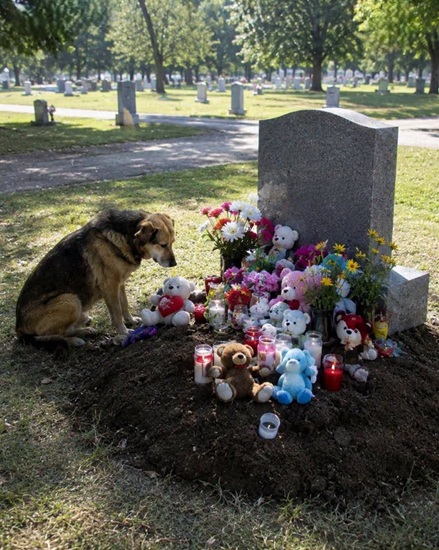
Some stories immediately capture attention because they combine grief with an unexpected moment of hope. The idea of an unfamiliar dog repeatedly appearing beside a young man’s grave and later arriving at his family’s home carrying a toy is one of those stories. However, without reliable documentation confirming that these specific events happened, the account should not be presented as verified news. It is more responsibly understood as an illustrative story exploring grief, companionship, assumptions, and the powerful meanings people sometimes attach to unexpected experiences.
Imagine a parent regularly visiting the cemetery where a beloved son has been laid to rest. Over time, almost every detail of the surroundings becomes familiar: the path between the graves, the nearby trees, the flowers placed by other families, and the changing landscape throughout the seasons. Visiting the grave becomes a deeply personal routine. Then, during one of those visits, something unusual happens. An unfamiliar dog appears nearby and quietly sits close to the grave.
At first, there would be little reason to assume anything extraordinary. Dogs explore places for countless ordinary reasons. They follow interesting scents, recognize familiar routes, investigate other animals, and sometimes return to locations where they previously had positive experiences. The dog could belong to someone living nearby or to another cemetery visitor. Without identifying the animal or its owner, there would be no reliable way to know why it had appeared.
But imagine that the dog returned again. Then it appeared during another visit, and eventually its presence became familiar. A grieving parent could understandably begin wondering whether there was a reason the animal seemed drawn to that particular area. Perhaps it knew someone connected with the cemetery. Maybe it had encountered the son before his death. Or perhaps the repeated visits were simply the result of an ordinary routine that the family did not yet understand.
Those possibilities demonstrate an important difference between emotional meaning and factual evidence. An encounter can feel deeply significant without proving a particular explanation. A grieving parent might find comfort in seeing the dog sitting peacefully nearby, even if the animal’s motivation remains unknown. The emotional effect of the moment is real for the person experiencing it, while the reason behind the animal’s behavior can remain uncertain.
Grief often changes how people experience familiar places and ordinary events. After losing someone important, photographs, songs, objects, locations, and even unexpected encounters can become strongly associated with memories. A particular flower might remind someone of a loved one. A familiar song heard unexpectedly might bring back an entire period of life. A friendly animal appearing during a difficult cemetery visit could similarly become connected with feelings of comfort and remembrance.
There is nothing unusual about finding personal meaning in these experiences. The important point is not to turn an emotional interpretation into an unsupported factual claim. Seeing a dog beside a grave does not establish that the animal understands the loss in the same way a human does. Nor does it prove that the dog had a previous relationship with the deceased. Those possibilities would require additional evidence before they could responsibly be presented as facts.
Suppose the visits continued for months. Eventually, the parent might begin looking for the dog whenever arriving at the cemetery. Its presence could become part of the routine, something familiar during an otherwise painful experience. Perhaps the dog would sit several feet away without demanding attention. Maybe it would occasionally approach before wandering elsewhere. Even without understanding its behavior, the parent could begin associating the animal with a place already filled with memories.
Then imagine that the pattern suddenly changed. Instead of appearing at the cemetery, the dog unexpectedly arrived outside the family’s home carrying a toy. Such an event would naturally create questions, particularly if the house were located some distance from the cemetery. The first reaction might be emotional, but the next step should be practical: determine whether the dog has identification and try to locate its owner.
A collar, identification tag, microchip, neighborhood group, animal shelter, veterinarian, or appropriate local service could potentially help establish where the dog belongs. This information might reveal a completely ordinary explanation. Perhaps the animal lived nearby and had wandered away. Maybe its regular route happened to pass both locations. Or perhaps additional information would reveal a genuine connection that nobody in the family previously knew about.
Until that information became available, however, every explanation would remain a possibility rather than an established fact. This distinction matters because people naturally create stories when information is incomplete. The human mind searches for patterns and explanations, particularly when circumstances are emotionally powerful. Sometimes those interpretations prove accurate. At other times, additional context reveals that the situation was very different from what initially seemed obvious.
The same process occurs frequently in relationships. People observe another person’s behavior and make assumptions about the motivation behind it. A missed telephone call may be interpreted as avoidance. A delayed response might feel disrespectful. Someone who becomes unusually quiet may be assumed to be angry. Yet there could be explanations that are completely unrelated to the observer’s first interpretation.
Communication becomes particularly important in these moments. Asking a direct question can prevent an assumption from developing into a larger conflict. Unfortunately, people sometimes do the opposite. They react before checking the facts, and the other person responds defensively. Soon the disagreement is no longer about the original event but about everything that has been said afterward.
Old frustrations can make the situation even more complicated. A misunderstanding from the present may revive unresolved disagreements from the past. People begin defending themselves rather than listening to each other. Words are interpreted in the least generous possible way, and emotions start replacing evidence. Something that might have been resolved through a calm conversation can become increasingly difficult to repair.
This is why new information can sometimes completely change how an event is understood. A detail that was missing from the original story may explain behavior that previously seemed confusing or selfish. It does not necessarily erase the pain caused by what happened, and it does not automatically make every decision acceptable. But context can change the meaning people assign to actions.
Discovering additional information also requires humility. Once someone has strongly defended a particular interpretation, admitting that it was incomplete can be uncomfortable. People naturally want to believe their original judgment was correct. Yet changing an opinion when better evidence becomes available is not weakness. It is an important part of making fair and informed decisions.
Understanding someone’s motivation should also be distinguished from excusing harmful behavior. A person may have understandable reasons for making a poor decision while still needing to take responsibility for its consequences. Both things can be true simultaneously. Context helps explain behavior, while accountability addresses its effects.
The imagined dog in this story provides a useful symbol for that uncertainty. Dogs are highly social animals capable of forming strong relationships and learning familiar routines. They can recognize people, locations, smells, and patterns associated with previous experiences. They may also respond behaviorally when familiar people or animals disappear from their environment. Researchers continue studying the complexity of these behaviors.
However, people should be cautious about assigning specifically human thoughts to an animal without evidence. If a dog repeatedly visits a cemetery, several explanations may be possible. Familiar scent, learned routine, previous positive experiences, another visitor, or simple exploration could all influence its behavior. Observing the animal alone cannot reveal precisely what it is thinking.
That uncertainty does not diminish the comfort someone might receive from the encounter. If seeing the dog makes a grieving parent feel less alone during a cemetery visit, that emotional response remains meaningful regardless of the scientific explanation for the animal’s behavior. Personal meaning and objective explanation are different questions, and one does not necessarily invalidate the other.
The toy carried by the dog can be understood similarly. An ordinary toy may become emotionally powerful when encountered in a meaningful context. If it resembles something associated with the deceased son, the parent might immediately connect it with a memory. That association can be genuine and moving without proving that the dog deliberately selected the object because of that connection.
This distinction becomes especially important when emotional stories spread online. Social-media posts are frequently copied, shortened, rewritten, or separated from their original sources. A fictional story can eventually be reposted as though it were documented news. A photograph from one event can be attached to an unrelated narrative. Details can also become more dramatic as different versions circulate.
For that reason, publishers and readers benefit from distinguishing verified reporting from fictional or illustrative storytelling. A factual news article should be supported by reliable sources. A personal story should be clearly attributed to the person telling it when independent verification is unavailable. An illustrative narrative should not be presented as a documented real event merely because doing so would make the headline more dramatic.
Emotional storytelling does not need misinformation to be effective. Themes such as grief, love, companionship, misunderstanding, forgiveness, and hope are powerful because people recognize them from real life. A fictional or illustrative scenario can explore those emotions openly as long as readers understand what they are reading.
The central lesson of this story is therefore broader than the mysterious appearance of a dog. It concerns how quickly people form conclusions when they have only part of the information. First impressions can be useful, but they are not always complete. Asking questions and gathering additional context can reveal possibilities that were invisible at the beginning.
Patience can prevent unnecessary conflict for the same reason. When emotions are intense, reacting immediately can feel natural. Yet waiting long enough to gather more information may completely change the appropriate response. A brief pause can create an opportunity to ask whether there might be another reasonable explanation.
This does not mean ignoring genuine problems or warning signs. There are situations where immediate action is necessary, particularly when someone’s safety is at risk. The lesson is simply that certainty should match the available evidence. When important information is missing, acknowledging uncertainty is more responsible than filling the gap with assumptions.
Grief makes these principles particularly important because people experience bereavement differently. There is no universal timetable for mourning and no single correct way to remember someone. One person may visit a grave frequently, while another may rarely do so. Some people talk openly about their loss, while others prefer privacy. Different responses do not determine how deeply someone cared about the person who died.
Unexpected sources of comfort can also become meaningful during bereavement. For one person, it might be a pet. For another, it could be a photograph, garden, song, familiar place, or conversation with someone who knew the deceased. These experiences cannot remove the loss, but they may provide moments of connection during a difficult period.
If the dog in this illustrative story eventually led the family to discover previously unknown information, that revelation could understandably change how the earlier visits were interpreted. Perhaps there really was a connection. Perhaps there was not. Either outcome could still carry emotional significance because the parent’s experience during those visits was genuine.
The more important transformation would involve learning not to confuse the first explanation with the final truth. People often know only one part of a situation when they begin judging it. Another person’s perspective may contain information that changes everything. Sometimes simply listening long enough to hear that perspective prevents years of misunderstanding.
Trust can be damaged quickly when assumptions replace communication. Rebuilding it usually takes considerably longer. Honest explanations, sincere apologies, accountability, and consistent behavior can sometimes create a path forward, although reconciliation is not guaranteed in every situation. What matters is that future decisions are based on accurate information rather than an incomplete version of events.
In the end, the image of a stranger’s dog quietly sitting beside a grave remains powerful because it combines sadness with unexpected companionship. It represents the possibility that comfort can appear from places nobody anticipated. At the same time, responsible storytelling requires acknowledging that the specific scenario should not be described as verified fact without reliable evidence supporting it.
The larger message does not depend on whether every dramatic detail literally happened. People frequently misunderstand situations because they react before learning the full story. Grief can make unexpected experiences especially meaningful, and compassion can sometimes emerge in surprising forms. Listening before judging and checking facts before reaching conclusions are valuable habits in almost any relationship.
Sometimes the truth confirms what people suspected from the beginning. Sometimes it reveals an explanation nobody considered. And sometimes uncertainty remains even after every reasonable question has been asked. In each case, patience and honesty offer a stronger foundation than speculation.
A mysterious dog, an unexpected toy, and a grieving family therefore become more than elements of an emotional narrative. Together, they illustrate a simple idea: we rarely understand another person—or an unusual situation—from a single moment. The first impression may begin the story, but understanding usually requires looking beyond it.
