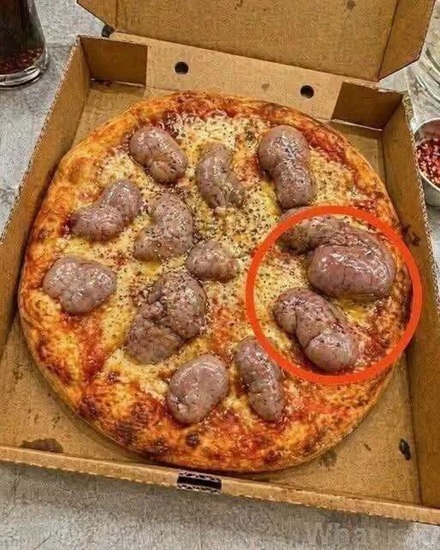
It had been a long evening, and cooking was the last thing I wanted to do. In this fictional scenario, rain was falling outside while I sat alone in my apartment looking for something quick to eat. I opened a food-delivery app, ordered a pizza, and waited for what I expected to be an entirely ordinary meal. When the delivery arrived, everything initially appeared normal. The cardboard box was warm, the order looked correct, and there was no obvious reason to think anything was wrong.
I carried the pizza into the kitchen and opened the box beneath the overhead light. At first, I noticed the familiar golden crust, melted cheese, and tomato sauce. Then something unusual caught my attention. Several raised bubbles were scattered across the surface of the cheese. Some were small, while others looked like hollow pockets pushing upward from underneath. Because I did not immediately understand what had caused them, I began looking at the pizza much more carefully.
The longer I stared, the stranger the bubbles seemed. Instead of considering an ordinary cooking explanation, my imagination began moving in a completely different direction. I wondered whether something had happened during preparation or delivery. Could the pizza have been contaminated? Was something unusual trapped underneath the cheese? Had the ingredients reacted strangely to something in the kitchen?
None of those possibilities was supported by actual evidence, but uncertainty made them feel more plausible than they really were. The pizza smelled normal, the packaging appeared intact, and nothing else about the food looked suspicious. Still, I found myself focusing almost entirely on those unfamiliar bubbles.
I stood there for several minutes without taking a slice. The refrigerator hummed behind me while rain continued tapping against the window. Meanwhile, the pizza slowly cooled on the counter. Nothing in the room had actually become more dangerous, but my interpretation of the situation had changed dramatically.
Eventually, I realized that I was allowing uncertainty to become evidence of danger. I had noticed something I did not recognize and immediately started searching mentally for the worst possible explanation. Instead of continuing to speculate, I decided to find out whether there was a straightforward reason melted cheese could develop raised pockets during baking.
The explanation turned out to be considerably less dramatic than anything I had imagined. Pizza is cooked at high temperatures, and both its dough and toppings contain moisture and gases. As the pizza heats, moisture can turn into steam while gases trapped inside the dough expand. Those changes can create pockets underneath the surface.
Cheese can also trap steam or air beneath it as it melts. When that happens, pressure can temporarily push sections of melted cheese upward, producing rounded bubbles or blisters. Depending on the cheese, oven temperature, moisture content, dough structure, and arrangement of the toppings, some bubbles may become surprisingly large.
Mozzarella is particularly relevant because it contains moisture. When heated, the cheese melts while water within the food is also being heated. Some moisture evaporates, and the resulting steam may become temporarily trapped before finding a way to escape.
The dough underneath can contribute as well. Pizza dough contains gas created during fermentation. When the dough enters a hot oven, those existing gas pockets expand. If one develops beneath a section covered with cheese, the entire surface can rise temporarily and produce an unusual-looking dome.
High-temperature pizza ovens make these changes happen rapidly. The crust expands, cheese melts, moisture evaporates, and the surface begins browning within a relatively short period. The finished pizza can therefore contain bubbles, charred spots, blisters, and uneven textures without any of those features automatically indicating a safety problem.
Once I understood that, the pizza looked completely different to me. Nothing about the food itself had changed. The same bubbles were still there, and the same slice was sitting in exactly the same position. What had changed was the explanation I attached to what I was seeing.
Instead of interpreting every bubble as something suspicious, I could now recognize it as a possible result of ordinary baking. The pizza smelled like garlic, cheese, herbs, and baked dough. The crust looked properly cooked, and the box had arrived without any obvious signs of interference.
That did not mean appearance should never matter when deciding whether food is safe. Genuine warning signs should always be taken seriously. Food that has an unusual spoiled odor, visible mold where it should not be present, foreign objects, damaged packaging, or evidence of contamination should not simply be eaten because someone assumes everything is fine.
Temperature and storage also matter. Perishable foods should not remain at unsafe temperatures for extended periods. If someone genuinely suspects that a delivered meal has been contaminated or mishandled, contacting the restaurant or delivery service is more sensible than eating it merely to avoid wasting money.
But bubbles in melted pizza cheese, by themselves, are not evidence of deliberate tampering. Their presence can have a straightforward physical explanation involving heat, moisture, gas, and the structure of the food.
I looked at the pizza again with that distinction in mind. There was no strange odor. Nothing unexpected was hidden beneath the cheese. The food had arrived warm and appeared otherwise completely ordinary.
Finally, I picked up a slice. Melted cheese stretched from the remaining pizza as I lifted it from the box. The raised area partially collapsed as the slice moved, which made the explanation about trapped air or steam seem even more obvious.
I took a bite.
It tasted completely normal.
The crust was crisp near the edge and softer toward the center. The cheese was warm and salty, and the tomato sauce carried the familiar flavors I had expected when placing the order. Nothing dramatic happened because there had never been a dramatic problem to begin with.
I started laughing at how quickly my imagination had transformed an ordinary dinner into a mystery. Only a few minutes earlier, I had been considering explanations that had no supporting evidence. Now I was simply eating pizza while learning something new about how it behaves in an oven.
The experience highlighted an important difference between caution and catastrophizing. Caution means noticing something unusual, gathering information, checking for legitimate warning signs, and making a reasonable decision. Catastrophizing means jumping from uncertainty directly to the most frightening interpretation without enough evidence to support it.
Those two reactions can initially feel very similar. Both begin with the thought that something might be wrong. The difference comes in what happens next.
A cautious response asks questions. What exactly am I seeing? Is there a normal explanation? Are there additional signs suggesting an actual problem? Can reliable information help me understand it?
A fearful response can skip those steps entirely. Something looks unfamiliar, therefore it must be dangerous. Once that assumption takes hold, every additional detail can seem to confirm it.
That evening reminded me how easily stress can influence perception. I was already tired after a difficult day. Had I opened the same pizza during a relaxed afternoon with friends, I might have laughed at the bubbles or ignored them entirely.
Late at night, alone and exhausted, the same visual detail seemed far more significant. The environment had not changed the pizza, but it had influenced how I reacted to it.
Food preparation contains countless examples of ordinary processes that can initially look strange. Bread develops large holes because gases expand inside dough. Cheese can blister and brown. Sauces separate or thicken as water evaporates. Meat changes color and texture during heating, while vegetables soften as their cellular structures respond to heat.
Someone unfamiliar with those processes could interpret an unusual appearance as evidence that something has gone wrong. Often, however, it is simply chemistry and physics taking place during cooking.
Pizza is particularly interesting because several processes occur at the same time. Dough expands, sauce heats, cheese melts, fats separate, water becomes vapor, and the exterior is exposed to intense heat. The final appearance therefore does not have to be perfectly smooth or uniform.
In some styles of pizza, blistering is actually expected. Small charred bubbles along the crust can be associated with high-temperature baking, and uneven browning may contribute flavor and texture. A perfectly flat surface is not necessarily an indicator of higher quality or greater safety.
Different cheeses can also behave differently. Their moisture and fat contents vary, and those differences affect how they melt, stretch, brown, and blister. Even two pizzas made in the same restaurant may emerge from the oven looking slightly different.
The distribution of toppings matters too. A section with more cheese may retain heat and moisture differently from a thinner area. Sauce underneath the cheese contributes additional moisture, while toppings can trap steam or alter the way heat reaches the surface.
Understanding these details made the original mystery seem almost amusing. The bubbles had never been communicating anything sinister. They were simply visible evidence that food had been exposed to heat.
There was another useful lesson hidden in the experience. Reliable information can sometimes change an emotional reaction surprisingly quickly. Before finding an explanation, I had uncertainty. Uncertainty created speculation, and speculation created fear.
Once I had enough information to understand what I was looking at, the speculation lost its power. The pizza had not changed; my interpretation had.
This does not mean every fear can be solved with an internet search. Health, safety, and other serious concerns sometimes require professional advice rather than online reassurance. It is also important to use reliable sources because inaccurate information can make uncertainty worse rather than better.
But for ordinary questions, learning how something works can prevent imagination from filling every unanswered space with the worst possible scenario.
That principle extends beyond food. A strange sound from an appliance might have a simple mechanical explanation. An unfamiliar mark on an object might be a normal manufacturing feature. A confusing message from another person might have several interpretations rather than only the most negative one.
Uncertainty is uncomfortable because the mind naturally wants an answer. The first explanation that appears, however, is not necessarily the correct one.
Sometimes the healthiest response is simply to slow the process down. Notice the concern, identify what is actually known, and separate observable facts from assumptions.
In my fictional pizza situation, the observable facts were straightforward. The food had arrived warm. The box appeared normal. The pizza smelled normal. Several bubbles were visible beneath or within the melted cheese.
Everything beyond that initially came from imagination.
Once that distinction became clear, there was no need for a dramatic explanation. Heat and trapped moisture provided a much more plausible one.
By the time I finished eating, the rain was still falling outside and the kitchen looked exactly as it had before. Yet the room felt completely different because the sense of danger had disappeared.
The refrigerator was no longer an ominous background sound. It was simply an appliance humming in a quiet apartment. The pizza box was no longer something I was afraid to touch. It was dinner.
The entire experience had begun with one unfamiliar visual detail and ended with a basic lesson about cooking.
But it also offered a broader reminder about fear.
Feeling frightened does not automatically mean danger is present. An emotional response can be completely genuine even when the interpretation causing it turns out to be incorrect.
At the same time, dismissing every concern would be equally unwise. The goal is not to ignore uncertainty but to investigate it proportionately.
If food genuinely shows signs of spoilage or contamination, caution is appropriate. If the only unusual feature is a common result of cooking, understanding that process can prevent unnecessary alarm.
By the end of that rainy evening, the mystery had disappeared entirely. There was no hidden substance beneath the cheese, no unexplained threat, and no evidence of anyone tampering with the order.
There were simply bubbles formed during baking.
And sometimes that is the difference a little reliable information can make. Something that appears frightening when it is unexplained can become completely ordinary once we understand how it happened.
The pizza never changed.
Only the story I had created around it did.
